Ford Edge Review (2016-2020)
Ford Edge cars for sale
4.0
Expert review
Pros
Comfortable for long-distance driving
Very spacious cabin and boot
Lots of kit as standard
Cons
Not as sharp to drive as most Fords
Earlier engines are less efficient than later units
Some reliability issues with dual-mass flywheels

The CarGurus verdict
On first acquaintance, the Edge may seem like a bit of a bull-in-a-china-shop but once you get used to it, it is actually a very easy car to live with. It may not be the finest driving car Ford has ever produced and it is certainly no ball of fire, but it is a very refined long-distance cruiser and you’ll be pleasantly surprised by just how many miles you’ll get to a tankful.
It’s also big on equipment and safety systems, while its commanding driving position and exceptionally spacious cabin provide abundant accommodation for all the family. As for boot space; if you need more, then we suggest you start looking in the direction of Ford’s commercial vehicle line-up.
Providing you’re savvy and buy an Edge at the right price-point while recognising it will not retain its value as well as German rivals, then the Edge has the all the makings of an excellent family car.

What is the Ford Edge?
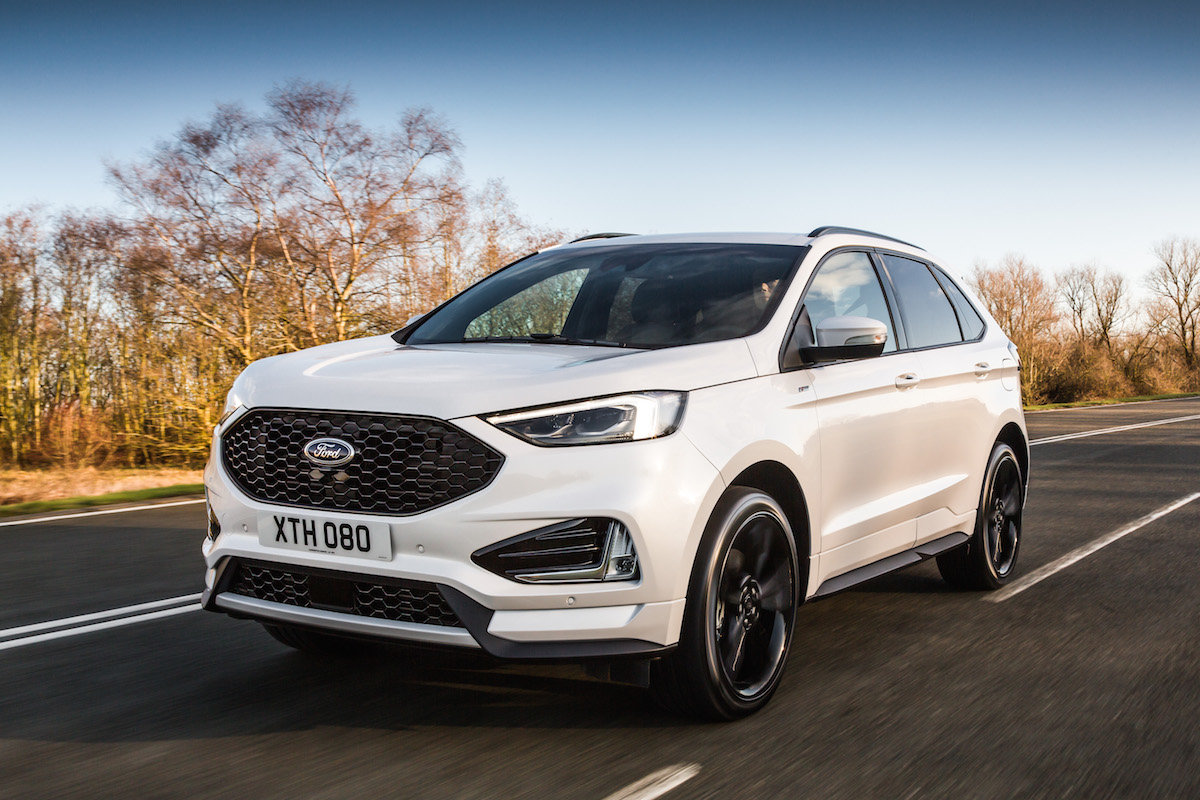
The Edge is Ford’s flagship SUV and although was priced roughly in line with the Volvo XC60 and Audi Q5, it is bigger in every direction than those cars. Originally intended for the North American market, the Blue Oval decided to bring the car to Europe in an attempt to cash in on the ongoing SUV boom.
Overall, the Ford is a big, well-equipped and comfortable family SUV, that gives you more car for your cash than almost any other rival. It can’t match upmarket, premium badged rivals for kerb appeal or car park kudos, but if badge snobbery isn’t your thing and you just want an easy-going and spacious family off-roader, the Edge has a lot going for it.
Originally introduced to the UK in 2016, the Ford struggled for sales success, which even a small facelift in 2018 failed to fix, despite new headlamps, a revised grille and revamped trim line-up. Ultimately, the firm pulled the plug on the Edge at the end of 2019, although it was still possible to buy new examples in 2020.

How practical is it?
There’s no two ways about it, the Edge is a big car and is an imposing presence on the road. On the plus side, the vast exterior does translate into an equally cavernous interior. In fact, there is more space inside than you can shake several large sticks at. Along with loads of leg and headroom front and back, there’s also an exceptional amount of shoulder room, making it easy for three folks to fit across the rear bench without getting too pally.
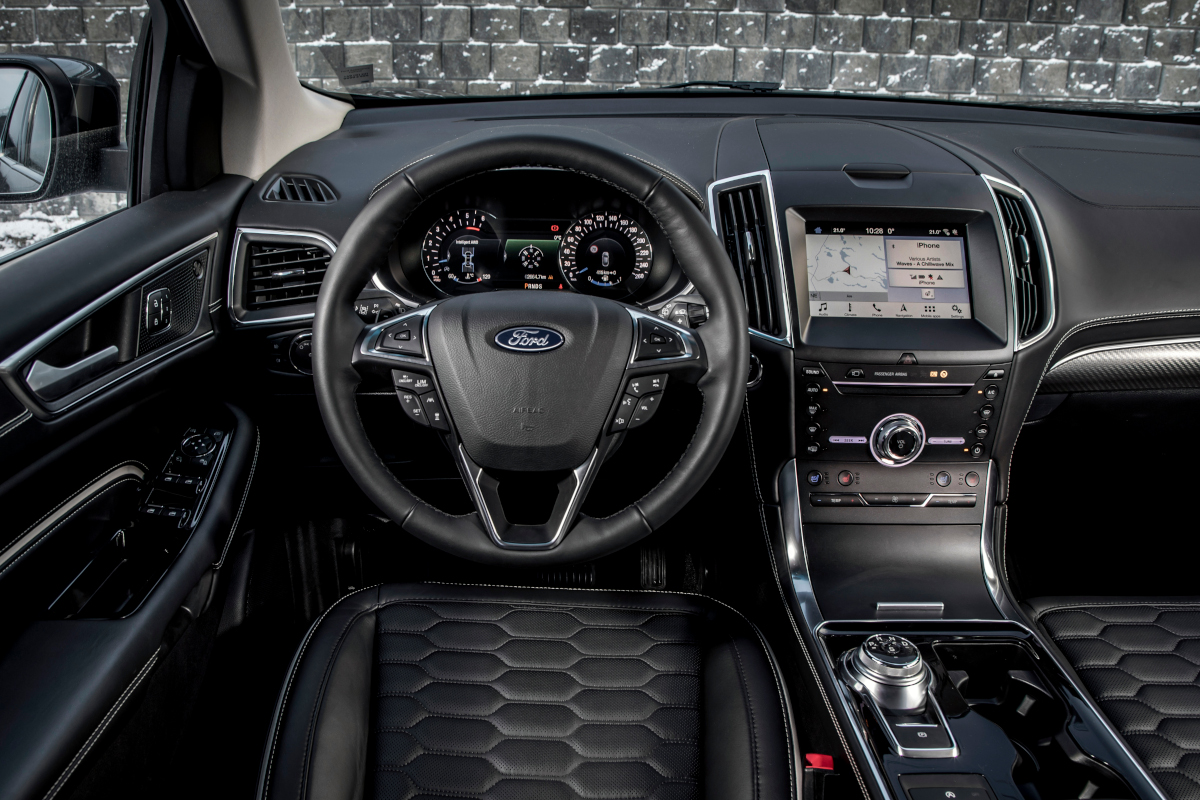
As well as looking very snazzy, the Edge’s seats are particularly comfortable and supportive, while the padded rear seat belts are a thoughtful touch and will help protect little uns’ from chafed necks. As you’d expect, there’s loads of useful storage space, with the usual large door bins, a big glovebox and, showing its American roots, plenty of cupholders. There’s also a very deep compartment between the front seats, a shallow lidded tray on top of the dashboard and a large area ahead of the gear selector for smartphone storage.
At 602 litres, with all the seats in place, no one will ever complain about the Edge’s load-carrying capacity. The boot is well-shaped as well, with no load lip and minimal intrusions, while there’s a shallow storage area hidden below the boot floor. Levers in the load area make it easy to fold the 60/40 split/fold rear seat, and when you do there’s a very healthy 1,688 litres of space to play with.
One touch that many will appreciate are the door bottoms that effectively cover the sills, meaning they don’t get covered in mud and grime and so can’t smear it onto your clothes when you climb aboard.
What's it like to drive?
From the outset the Edge was only available with diesel power, and all the various versions were essentially based on the same 2.0-litre four-cylinder unit. Given the car’s overall mass, we’re talking well over two-tonnes here, it’s not surprising that even with the stronger of the engines motivating matters, the Edge never feels particularly sprightly.
At least the engines are reasonably smooth, only producing harsher vibrations higher up the rev band, and to their credit, they are extremely hushed, thanks in part to synthetically enhanced tones piped into the cabin to help mask combustion rattle. They’re aided by gearboxes that are on the whole smooth and responsive. Early cars were available with a precise six-speed manual or six-speed twin clutch automatic, but it's the eight-speed torque converter auto introduced with the 2018 facelift that best suits the car’s character.
The Edge can feel a mite firm at lower speeds and is undoubtedly at its best when bumbling up and down motorways, where its smooth, comfortable ride and low levels of wind and road noise really come into their own. When it comes to gobbling up the miles in a smooth and stress-free manner, the big Ford is a fine choice.
It’s not particularly unruly on twistier routes either, thanks to plenty of grip and little discernible roll in bends but that substantial mass means there is quite a delay between steering inputs and changes in direction and the brakes need a good old shove to slow the Edge’s progress. Entry-level models were front-wheel drive, while the flagship models benefitted from all-wheel drive - although this set-up delivers all-weather on-road security rather than any real mud-plugging off-road ability. Either way, those expecting to find the sort of driving dynamism found in Ford’s smaller SUVs, such as the Kuga Puma, will be disappointed.
Technology, equipment & infotainment
When it was first launched, the Edge was available in fairly familiar Ford trim lines of Zetec and Titanium, plus the less familiar Sport. All versions came with lots of standard equipment. Alloy wheels, dual-zone climate control, electrically-operated and heated folding door mirrors, remote-central-locking, a 10-inch infotainment touchscreen display, keyless entry and automatic high-beam activation are all standard as is an electrically heated Quickclear windscreen, front and rear parking sensors, a rearview camera.
Titanium added some luxury touches, such as leather trim and heated seats, while the Sport had a racy exterior bodykit, some unique interior trim and slightly stiffer suspension set-up
Following the 2018 facelift, Zetec and Titanium remained, but Sport was replaced by ST-Line, while there was also a luxurious Vignale range-topper. Essentially equipment levels stayed largely the same, but the ST-Line trim added larger 20-inch alloys and lots of body styling enhancements, sports suspension, powered and heated front seats, trimmed in part leather and a kicking B&O stereo.
For the Vignale there were some lavish touches, including a unique front grille on the outside and quilted leather trim inside, plus tech upgrades including matrix LED headlights and adaptive cruise control, Although some of the trim materials are not as convincing as those Swedish or German rivals, the main touch-points, including all the buttons and switches look and feel solid enough. All versions also got the SYNC3 infotainment system that features an eight-inch touchscreen and various features, including Bluetooth, USB connectivity, sat-nav and voice recognition. From 2018, Apple CarPlay and Android Auto were added.
Ford Edge running costs
If you buy one at the right age and price point, the Edge can seem like an incredible bargain. Relatively low mileage cars can easily be sourced for around half their original list price, making them exceedingly good value for money, when you consider the enormous amount of car and equipment you get for your outlay.
Of course, you need to temper any unbridled enthusiasm with the knowledge that the Edge sheds value at a rapid rate of knots. The fact that the car went off sale in the UK in 2019 hasn’t helped matters, either. While most models will cost £150 to tax, do bear in mind that any car that tipped over the £40,000 price point when new, including options, will incur the more punitive rate of £475 a year.
In terms of fuel economy, despite their varying power outputs, there’s absolutely nothing between the most up-to-date engines. Although the less powerful front-wheel-drive car is a smidgeon better, returning up to 42.4mpg, according to the official figures, if you can afford the premium to buy one in the first place, the stronger twin-turbo cars returns are only 4mpg worse. Earlier engines were slightly less fuel-efficient, most noticeably in stop-start traffic conditions, but when driven in relaxed fashion on the motorway there’s very little real-world difference.
Servicing your Edge should be a relatively affordable undertaking, as labour and parts prices are amongst the lowest of any major dealer network and services should be carried out every twelve months.
Along with the usual fluid and filter changes, a responsible Ford dealer will also carry out 30-point health check to identify any work that may need undertaking in the near future. They’ll also send a video to your phone showing any areas that required immediate remedial work and once your Edge passes its third birthday it will qualify for Ford's Motorcraft pricing scheme, which offers service and repair costs at a fixed, discounted price.
Ford Edge reliability
As well as being cracking value for money it’s also reassuring to know that an Edge will be cheap to maintain, and if anything should go wrong, labour rates and the price of replacement parts won’t break the bank. Not that you should encounter too many problems, in the first place.
Most reliability surveys, including the Warranty Direct Reliability Index and the JD Power Vehicle Dependability Survey, place Ford firmly in the top half of their performance tables and given parts sharing is common practice throughout the Ford empire, this bodes well for the Edge. The Warranty Direct study reports that if something does go wrong it is most likely going to be an electrical problem, so before parting with your hard-earned, double-check that all the various switches and components are alive and well. Apart from this, the usual caveats apply. In addition to a thorough visual inspection to check every bit of trim and body panel fits the way it ought, make sure the service book has all the correct and check each date to make sure maintenance was carried out in timely fashion.
Some Edge owners have reported problems with the power steering, caused by dodgy sensors, which can make the steering go excessively light or conversely excessively heavy, but if you are buying from a reputable dealer we would expect issues like this to have been identified and remedied.
One of the more expensive failings, which blights many modern diesel engines, is the dual-mass flywheel, which is part of the clutch assembly. It’s most prevalent in cars that spend their lives trapped in stop-start traffic and this is one of the reasons why high mileage cars can make more sense than low mileage town tools.
– The Ford Edge is assembled in Canada and it was originally designed with the endless straightaways of North America in mind. Fortunately, before coming to the UK, the steering and suspension were recalibrated in order to cope with our rather ‘unique’ tarmac conditions. There are a couple of Edge subtleties you should be aware of. Most notably, Sport trim comes with sports suspension and adaptive steering and it is certainly worth looking out for this, as the steering is more accurate, and a lot less aggressive when returning to centre, making for a more pleasurable driving experience. – The tail end of 2018 ushered in a fairly significant wash-and-brush-up, and a new entry-level Titanium model, featuring a 150hp powertrain with front-wheel drive rather than the all-wheel-drive setup. More notably, manual gearboxes were abandoned and the six-speed twin-clutch Powershift gearbox was switched out for an all-new eight-speed automatic. The range originally kicked off with a 180hp four-cylinder Duratorq TDCi engine using a single-turbocharger and a twin-turbo version of the same engine producing 210hp. Post-facelifted engines are more efficient and re-designated EcoBlue, with power outputs of 150hp and 240hp. – The Edge comes with a five-star EuroNCAP crash test rating, and an impressive suite of safety measures, including a plethora of airbags, Isofix seat fixing points and a collision mitigation system that warns of an impending low-speed impact and slows or stops the car if the driver takes no action. Additionally, a lane-departure system helps keep the car in lane, while warning lights located in the mirrors are triggered when other motors are approaching or sitting in your blind-spot.
- If you’re looking for maximum value for money: If you’re considering an Edge because you want a solid workhorse, masses of space and the traction benefits of all-wheel drive, then providing you don’t mind shifting your own gears, an early, lower-powered Zetec car will do the trick. Even though this was the entry model, Ford realised if it was to stand any chance of competing with more premium badge, rivals it would have to throw the kitchen sink at the specification roster. Consequently, the Zetec comes with many niceties that would normally be costly options on many rivals. If you are a wee bit concerned about motivating such a large car via a relatively modest power output and manual gearbox, you shouldn’t be. With loads of mid-range torque, the engine is plenty strong enough and being a Ford, the manual gearbox shifts are as sweet, if not sweeter, than any you’re likely to come across.
- If you’re looking for the best driving Edge: If you’ve ever seen any bawdy orange models kicking about – you wouldn’t forget them if you had – then there’s a good chance it is one of the original Sport models. The colour was only available for 12-month but the driving experience continued long after. Despite its lowered suspension, the Sport’s ride is far from brittle and the connected steering helps the Edge feel less prodigious than it actually is.
- If you’re looking for the ultimate show pony: The Vignale model is the most expensive Edge: something that’s blatantly obvious from the moment you first clap eyes on it. Dripping with chrome and rolling on 20-inch mirror-finish alloys, it comes stuffed to the gunwales with kit, is powered by the strongest twin-turbo engine and lays its power to the road via a slick-shifting eight-speed automatic transmission and on-demand four-wheel-drive.
