BMW 5 Series (2003-2009) review | A flawed but fabulous executive saloon
Pros and cons
What we like
Packed with tech for a car of this era
Very enjoyable to drive
Wide choice of powerful and efficient engines
What to consider
Bold looks don't appeal to everyone
Plenty of known faults that can be costly to put right
Stiff ride on run-flat tyres
The CarGurus verdict
BMW built and sold more than 1.4 million E60s during an eight-year lifespan. There are plenty of used examples to choose from as a result, meaning second-hand buyers can afford to be picky. Just keep in mind that you’ll need to do your research and inspect any candidates very closely indeed, because there are plenty of known faults that can ultimately land you with very sizeable bills.
And given values have now fallen to bargain basement levels, you’ll have to sift through a lot of poorly-maintained chaff to find the well cared-for cars with documented histories and relevant recall work carried out that are worth taking home with you. Buy badly, and you’ll end up subsidising your BMW specialist’s next summer holiday. Buy well, however, and you’ll own a striking-looking saloon or estate car that steers and handles better than any of its contemporary rivals, for a bargain price.
out of 5 expert review
What is the BMW 5 Series?
After the simple and elegant E39 5 Series, the E60 came as something of a shock. Its arrival in 2003 coincided with an all-new era for BMW, one that would be built upon new technologies and clever new functions, such as the now-ubiquitous iDrive infotainment system, and various active driver assistance systems that have since become commonplace across the automotive industry.
In BMW’s judgement, its mid-sized saloon and estate car (the latter called the 5 Series Touring) needed an up-to-date look with which to hail the arrival of this new era of technology. Whereas most mainstream BMWs that came before the 5 Series E60 were characterised by timeless designs that clearly owed a great deal to the company’s cars of the '70s and '80s, the 5 Series that arrived soon after the turn of century resolutely and intentionally did not.
Its styling was overseen by BMW’s former design director, Chris Bangle, who at the time was busily reimagining the company’s entire design philosophy. No more looking backwards – with sharp creases, angular headlights, complex surfacing across their flanks and minimalist interiors, Bangle-era BMWs would turn to face the future instead, a philosophy that continues to this day.
Practicality
How practical is it?
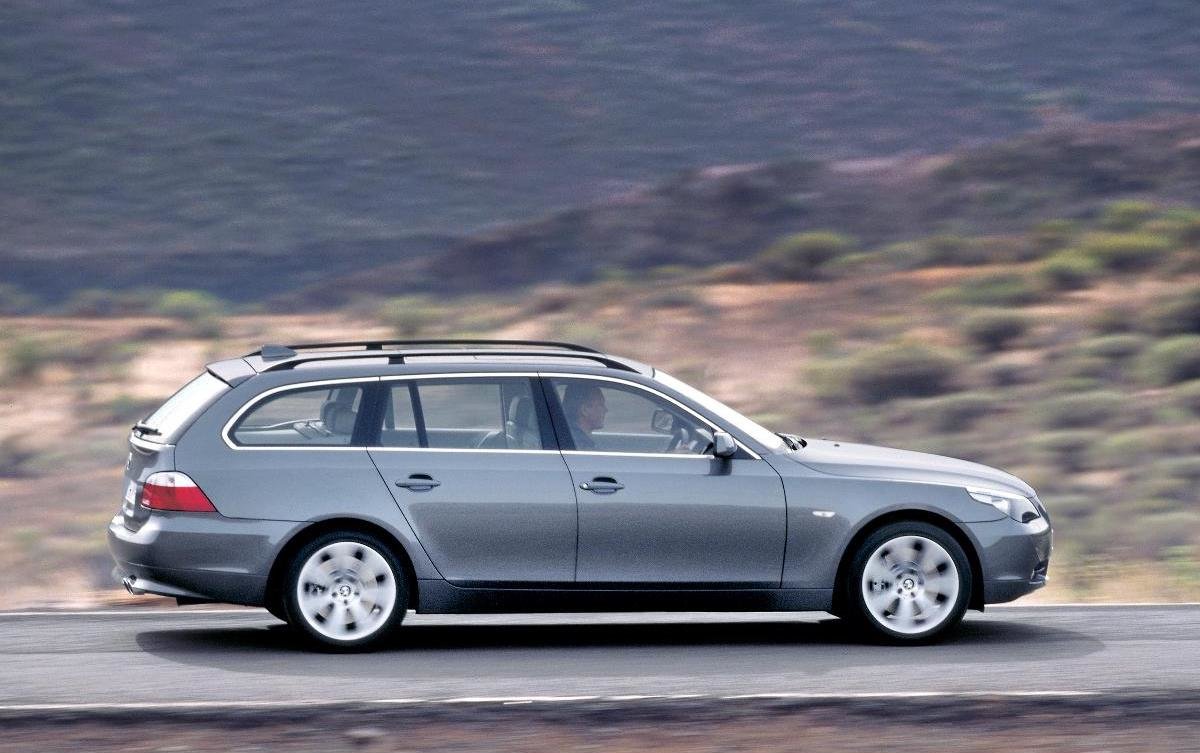
You could take your pick of either the four-door saloon or five-door estate body styles when ordering your E60 5 Series.
The saloon is pretty roomy, with space for four adults to sit comfortably. The boot, meanwhile, can swallow 520 litres, which isn’t as much as some of its contemporary rivals, but still plenty enough to mean you can fit two suitcases and two cabin bags – enough for a week-long family holiday, in other words.
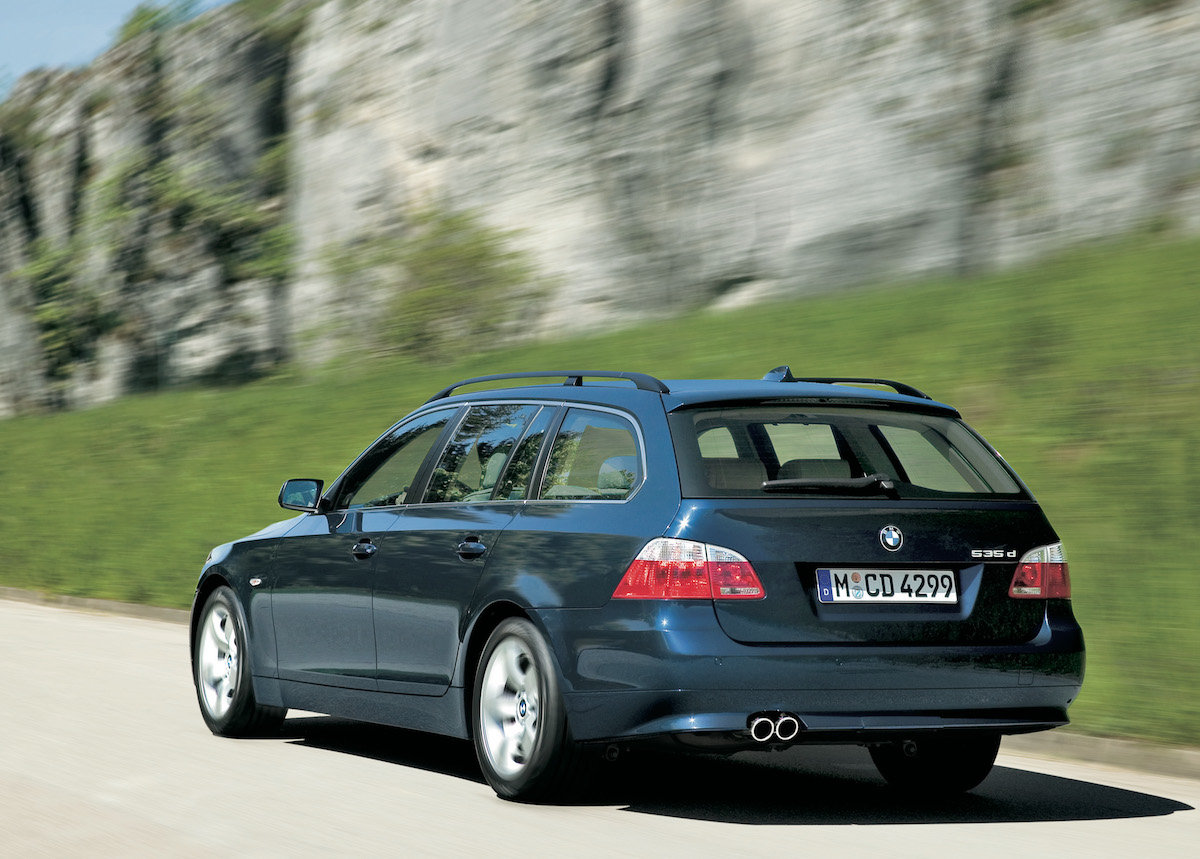
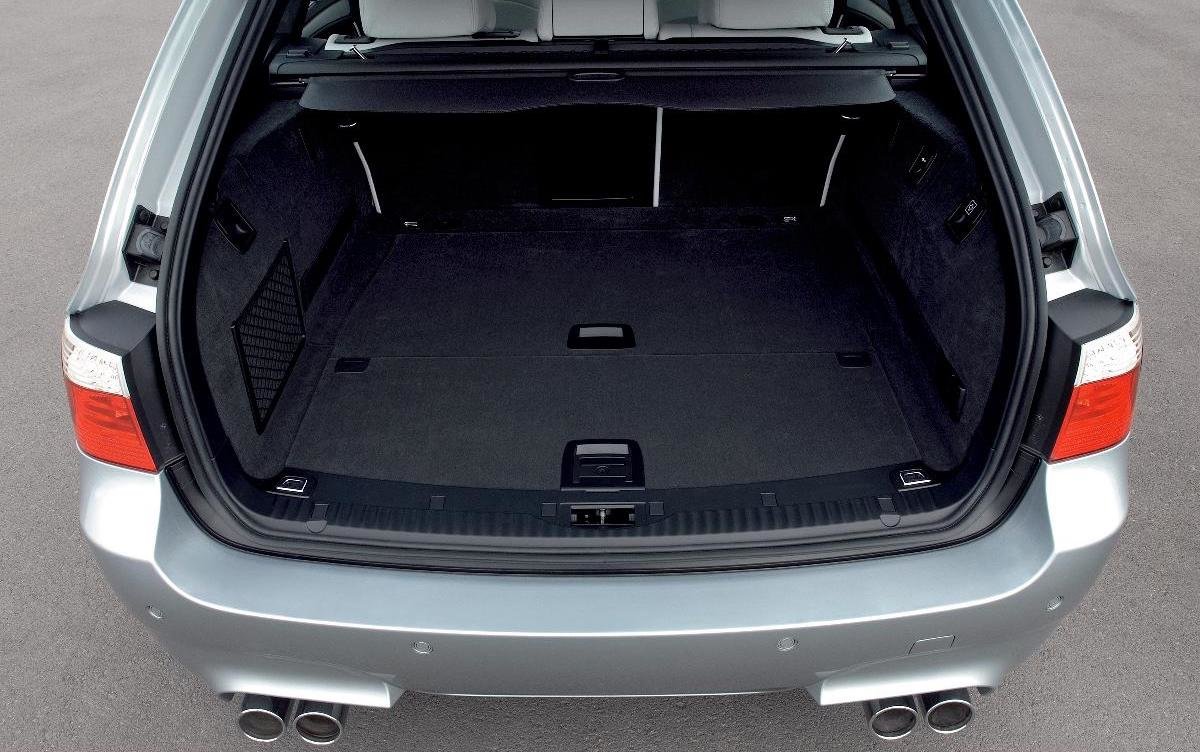
While you might expect the estate to be even more spacious, the 5 Series Touring actually offers less in terms of actual capacity with its rear seats in place than the saloon model – strange, but true. Officially, you get just 500 litres.
That said, we can’t find any good reason why. It could be nothing more than the result of a difference in measurements; that volume, for example, may not include the area beneath the Touring’s false boot floor, which is useful additional carrying space. It could, on the other hand, reflect the use of larger wheel arches and extra control modules required for the self-levelling air suspension that’s fitted as standard to the rear of the Touring models.
Either way, what’s beyond doubt is that with the rear seats up, the Touring’s boot isn’t as big as those of rival models such as the Audi A6, Volvo V70 and Mercedes E-Class. The same is true of estate cars without the premium badge, such as the Volkswagen Passat and Skoda Super, which both boast vastly roomier load areas.
You do at least get a wide-opening hatchback door in the Touring, through which to access the boot, which means it’s more versatile, and of course, when the seats are folded down, the yawning space on offer makes it much easier to load the contents of your trolley when you’ve been to the local flat-pack furniture emporium.
What’s more, the higher rear roofline of the estate helps with headroom in the back seats; this isn’t really a huge issue in the saloon, but taller rear passengers will certainly be happier in the Touring.
Up front, both Touring and saloon models share a cockpit that’s well endowed with additional storage space for odds and ends.
Mind you, it’s worth noting that build quality took a dive compared to the previous E39-generation 5 Series, and you might find that the plastics on a well-worn example look a little tattier than those of the equivalent E-Class or V70. For all that, though, the E60 still feels plush enough to qualify as a high-end executive car.
Driving
What’s it like to drive?
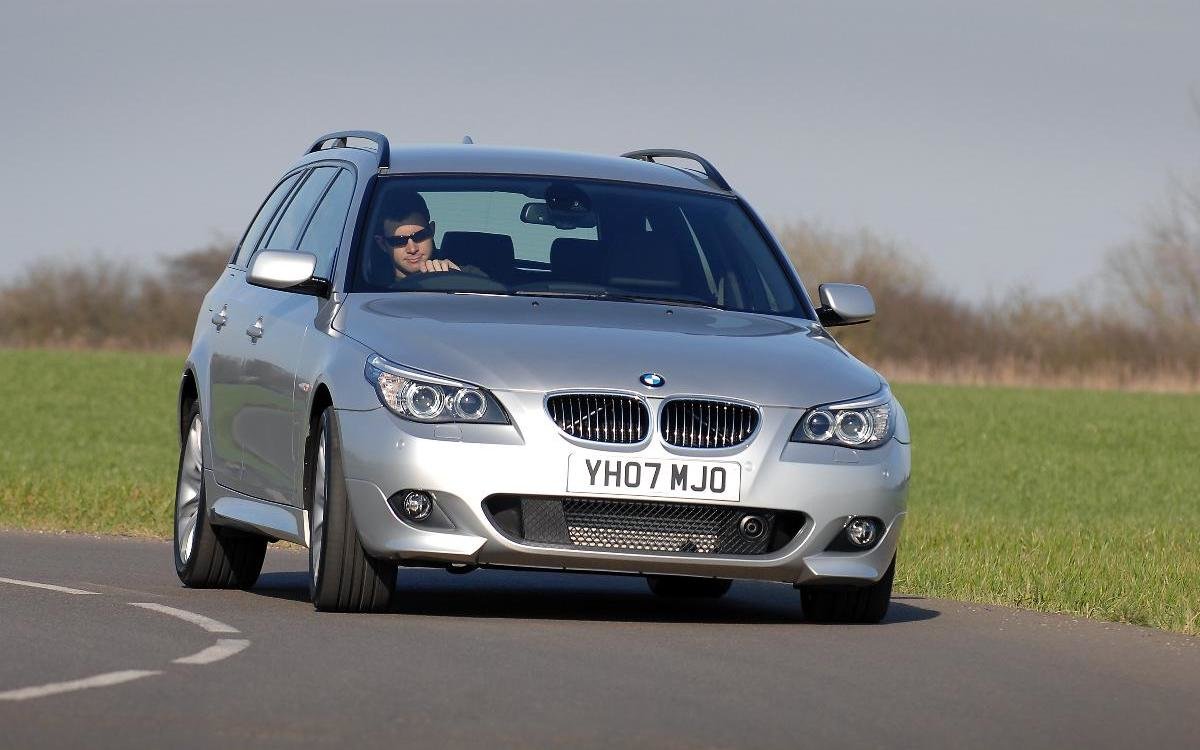
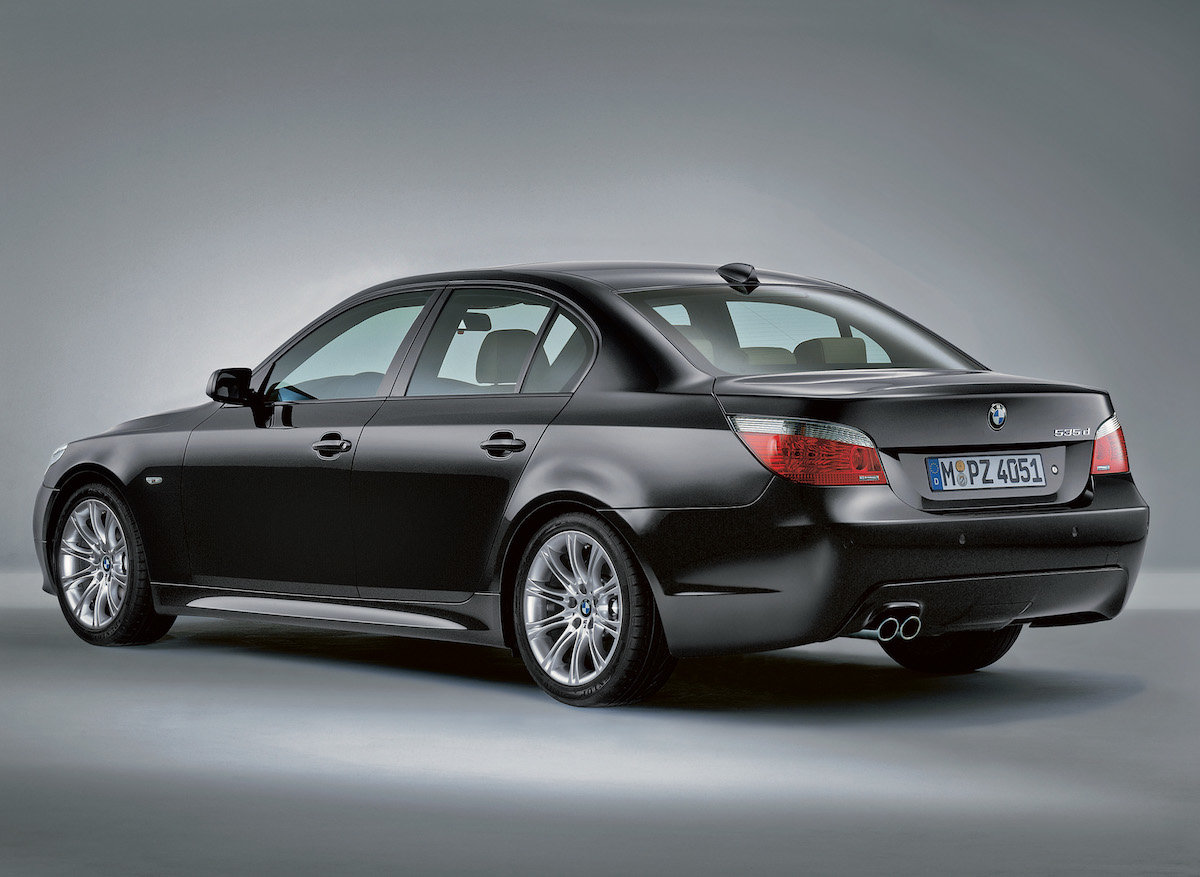
Many thought the BMW 5 Series E60 was ugly when it was first unveiled. BMW had in fact been very shrewd (and perhaps a little underhand) in deliberately making higher-spec models with their purposeful M Sport bodykits far more desirable. These versions were more profitable after all, and it’d be no bad thing if buyers felt compelled to upgrade to them.
Over time, the shock of the E60’s styling has long since faded away and today the fifth-generation 5 Series looks a handsome machine, particularly with bigger alloy wheels and that M Sport styling kit.
Those variants did have a downside, however. With stiff suspension and minimal tyre sidewalls, they were hardly the last word in ride comfort, a fact not helped by the stiffness of the ‘run-flat’ puncture resistant tyres BMW fitted from the factory.
The trade-off was that these M-Sport models steered and handled very well indeed – though much the same was true of the SE models, which did without the sporty bits, as well. That’s why we’d tend to recommend seeking out one of these instead; an SE with plump tyres and small wheels will ride much better – if you can live with the dumpier styling.
The engine range was similarly geared towards driver enjoyment. At launch, it was fairly simple; the petrol range stretched from a 168bhp 2.2-litre six-cylinder engine in the 520i right up to a 328bhp 4.4-litre V8, badged 545i, with two six-cylinder diesels, the 525d and 530d, kicking out 175 and 215bhp respectively.
As time went on, the range filled out, with a 161bhp four-cylinder 2.0-litre diesel, the 520d, taking up station at the bottom of the line-up, and additional six-cylinder petrol and diesel models filling out the mid-range. The 545i was eventually replaced by two V8s – the 302bhp 540i and 362bhp 550i – while a 268bhp version of the 3.0-litre diesel engine, the 535d, became the pick of the bunch.
And as if that little lot wasn’t enough, the line-up was topped off with the M5, a V10-engined technological tour de force that kicked out 500bhp and allowed you to set it up to be as docile or as lairy as you might like it to be, and one that has since become an iconic drivers’ car. Mind you, all that technology has proven thumpingly expensive to maintain, so buy one now only if you’ve very deep pockets.
Keep in mind that BMW continuously tweaked the E60 5 Series throughout its life, so power outputs (and fuel economy figures) received regular upgrades as engine technology improved. As a rule, then, the later the example you buy, the greater is power output is likely to be.
Tech and equipment
Technology, equipment & infotainment
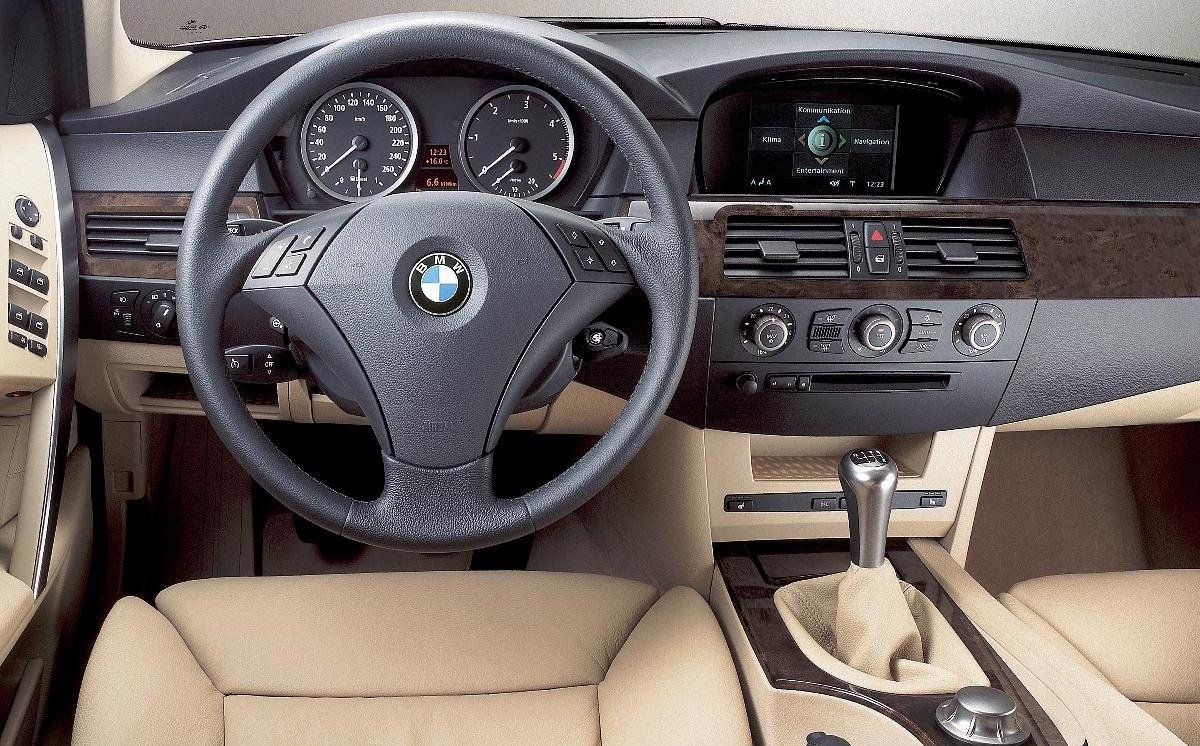
BMW introduced its iDrive infotainment interface two years before the arrival of the 5 Series, with the E65 7 Series. It found its way into the E60 with all its quirks and foibles very much intact.
While iDrive – which uses a scroll wheel on the transmission tunnel to control a digital display in the dashboard – has evolved over the years to be one of the most intuitive systems of its type, those earlier iterations could be somewhat bewildering.
Take a little time to learn how to navigate the menus and switch between the various functions, and it becomes easier to use – but the fact remains that this is a very early iteration of the sort of central infotainment screen that’s now become a familiar sight in modern cars, and its idiosyncrasies mean it can be distracting to use.
The 5 Series model range was incredibly simple. There were just two models, the SE and M Sport – but both were fairly sparsely equipped, with the M Sport’s only notable additional items of equipment being its leather upholstery, larger wheels and sportier looks.
The idea was that you would choose the base car, which would come with air conditioning, a CD player, and satellite navigation, but not much else – and then add specification to it by way of the extensive options list, which included such safety and convenience technologies as adaptive headlights, heated seats, cruise control, variable ratio steering, Bluetooth, voice control and even a head-up display, which projected key information onto the windscreen.
All of which means that if you’re searching for a 5 Series with particular items of equipment fitted today, you’re faced with the task of poring through the classified ads to try and identify an example that’s so-equipped, rather than settling on a version with all the toys as standard. That can make finding an example with the specification you want quite tricky.
Running costs
BMW 5 Series running costs
With such a wide selection of engines on offer, fuel efficiency ranges from positively parsimonious to utterly horrendous. The 520d should return an average of around 40mpg in mixed driving and more than that on the motorway, while the 5.0-litre V10 in the BMW M5 might not manage much more than 15mpg if used to its full potential. As a rule of thumb, diesel engines will be more fuel efficient than petrols, and that applies even to the more powerful diesels like the 535d with its twin turbochargers.
You shouldn’t expect any more than 25mpg from the petrol V8s, while petrol straight-sixes should achieve closer to 30mpg. BMW introduced its Efficient Dynamics technologies along with the 2007 facelift. These included functions like stop-start and regenerative braking, meaning later cars will be slightly more fuel efficient than earlier ones. Efficient Dynamics models will also be cleaner in terms of CO2 emissions as well.
As these cars grow older and older, there is increasingly less reason to have them serviced at main dealers. In fact, if you find a good local specialist your car will be maintained to the same high standards, but you’ll fork out a good deal less money. Accordingly, you shouldn’t be put off by a car that doesn’t have a full BMW service history, as long as it's been looked after by a reputable specialist. Do make sure there’s plenty of evidence of careful maintenance, though.
Insurance costs can vary significantly between models – lower-powered variants sit in group 31 while the exotic M5 is in group 50, the highest there is. The same goes for tyres, because while a 520d won’t need especially expensive rubber, the M5 absolutely will. Expect to pay £300 for a full set on the former model and at least double that on the M5.
The 5 Series comes from an era when a car’s tax rate was determined by its CO2 emissions output. That means the more fuel the car burns, the more CO2 it emits, and the more it’s taxed. In other words, diesel versions will actually be quite reasonable to tax, especially the later EfficientDynamics models.
By contrast, most of the higher-end models are now getting quite pricey as far as VED is concerned; the V8 and V10 versions especially will fall into the highest car tax brackets, and require you to pay upwards of £700 to the Exchequer each year to keep them on the road.
BMW 5 Series reliability
With so many electrical systems that were right at the vanguard of automotive technology when the E60 was new, there is unfortunately plenty that can go wrong. iDrive systems are known to be temperamental and can sometimes freeze altogether, leaving you unable to access the car’s entertainment and satnav functions. It’s therefore worth having a really good play with the system to make sure it operates the way it should. Early cars are more commonly affected by iDrive problems.
Otherwise, you’ll want to know that the driver assistance systems, where fitted, all work properly, that the air conditioning blows cold air, the remote central locking works, the seat heaters function as they should and the Bluetooth system connects with your phone. Over the years there have been various recalls for the E60, ranging from airbags faults to fuel pump issues, as well as clutch, stability control system and engine troubles. It’s worth checking that all of these recalls have been carried out.
Many owners choose to fit conventional rather than run-flat tyres to their cars, in part to save money but also to improve the ride quality. BMW doesn’t recommend this (and you should always carry an air compressor and a can of expanding foam in case you pick up a puncture), but countless owners have favoured conventional tyres for many years without reporting any issues.
During your test-drive, listen out for unusual knocks and creaks from the suspension, which can indicate worn bushes that’ll want to be replaced. Also check that the steering is straight and true – if not, the wheel alignment will need to be corrected.
There are common faults that relate to particular engines and you’ll want to be mindful of those. For instance, 525i and 530i petrol engines can suffer excessive fuel consumption and damaged cylinder linings as a result of faulty fuel injectors. This issue can ultimately prove terminal, the only fix being a replacement engine.
Meanwhile, diesel motors can suffer issues with their swirl flaps. These were fitted to improve emissions on start-up, but over time they can degrade and sometimes fail completely, often leading to engine failure. Many owners simply choose to remove the swirl flaps altogether.
Perhaps the most infamous of all E60 faults relates to the four-cylinder 2.0-litre diesels, which are prone to snapping their timing chains or shattering the tensioners, both faults that can crop up with relatively little warning and require an expensive engine rebuild – or more likely, given current values, write off the car completely.

What owners say
"The BMW 5 Series consistently impresses owners with its fantastic driving experience, reliability, and value for money across various model years. Many appreciate the great fuel economy and the range of features offered. However, some drivers feel that it can be a bit pricey compared to competitors, which can be a downside for some buyers."
Great car with all the features you'd expect from a 5 series. Fantastic to drive and amazing on mpg (comfortably doing 52mpg in town)
31 August 2025Lovely car great to drive would definitely have another. A nice all round car
15 October 2025Know this model well. Owned several. Looks good but would prefer lower mlge.
11 April 2025What owners say
Great car with all the features you'd expect from a 5 series. Fantastic to drive and amazing on mpg (comfortably doing 52mpg in town)
31 August 2025Lovely car great to drive would definitely have another. A nice all round car
15 October 2025Know this model well. Owned several. Looks good but would prefer lower mlge.
11 April 2025Fantastic car for the money. You can’t go wrong with a BMW 5 Series
21 February 2021Excellent. The car is absolutely good value for money.
23 July 2022Excellent value for money, excellent build quality and up to 70mpg! cant go wrong at all! Perfect choice! with many various features for all your needs! Highly recommended!
28 September 2021Great car, super smooth acceleration and drive. 520d lacks poke go for 525, 530 or 535d if u can stretch to it.
20 December 2020wonderful car and very reliable and good on fuel if you have a 2.0d even if its an auto
20 January 2021Good condition very good value for money very reliable car
25 September 2024Compared with Mercedes and Jaguar, the BMW is top!
15 February 2021Three things to know
- The E60 came with a four-star Euro NCAP crash-test score, which was about what you’d expect from a car like this at the time. That said, it wasn’t the safest car of its type; that honour fell to the Volvo S80 and V70, which achieved the maximum five stars. So if you’re after the safest cheap executive car around, that’s where you’ll need to look.
- As very early examples edge towards their 25th birthdays, the entry-point into E60 ownership falls lower and lower. That in turn means owners are naturally less inclined to spend vast sums on maintenance – and that can mean the proliferation of poorly looked-after examples that could turn out to be money pits. Choose wisely, though, and you’ll have yourself a very desirable saloon or estate car with many years of faithful service left in it.
- The E60 was facelifted in September 2007. BMW refers to its facelifts with the term ‘Life Cycle Impulse’ and vendors will often use the acronym LCI to denote an updated model. There were subtle styling tweaks to lights and bumpers, while cabins were upgraded with a much more intuitive iDrive system that featured programmable ‘favourite’ buttons to make navigating its various functions much more straightforward. The engines and transmissions were updated as well. BMW offered a six-speed manual gearbox or a six-speed automatic transmission on the 5 Series, apart from the M5 which has a seven-speed automatic.
Which one to buy
- If you want the big-selling all-rounder: Beloved of company car drivers, the BMW 520d remains the most common variant today. Its 2.0-litre diesel produced 161bhp before the 2007 facelift and 174bhp after it. With plenty of torque, the 520d is quick enough for most people and it’ll return around 40mpg, too. Just keep in mind its engine has proven to be troublesome.
- If you want something fast but frugal: The BMW 535d was and remains a highly sought-after model. Its 3.0-litre, six-cylinder engine featured twin-turbos, which meant it produced close to 280bhp later in life and more than 400lb-ft of torque. Despite all that straight-line speed, the 535d can comfortably return 35mpg.
- If you want the performance sweet spot: BMW offered various petrol V8s in the E60, but for the best balance of speed and efficiency, the six-cylinder 530i is the one to look out for. There were three different versions over the years, their power outputs ranging from 228bhp to 268bhp. They deliver brisk performance without the hefty fuel bills that come with a thirsty eight-cylinder.
- If you value speed above all else: With more than 500bhp and motorsport-derived hardware through the drivetrain and chassis, the BMW M5 is a fearsome saloon/estate. Sadly, running costs and reliability have proven to be equally fearsome over the years and you’ll want to make sure you’re covered by a good warranty before taking the plunge. Find a good one and you'll have a car that has to be electronically limited to a 155mph top speed, unless it has the optional M Drivers Package, in which case you'll be able to hit 190mph. On private land, obviously.


More on the E60 BMW 5 Series (2003 - 2009)
Compare 2007 BMW 5 Series Trims
The 2007 BMW 5 Series offers a blend of luxury and performance, with trims ranging from budget-friendly to sport-oriented options.
- Starting at £1,650
- Most Popular: 520d M Sport 4dr Auto
Trim Overview
Prices updated weekly from CarGurus listings.
| 520d Se 4dr Auto | 520d Se 5dr Auto | 520d M Sport 4dr Auto (Most Popular) | 520d M Sport 4dr Step Auto | 520d M Sport 5dr Auto | 530i M Sport 4dr Auto | 530d M Sport 4dr Auto | 530d M Sport 4dr Step Auto | |
|---|---|---|---|---|---|---|---|---|
| Starting MSRP | £26,955 | £28,955 | £30,065 | £30,805 | £32,065 | £36,555 | £37,090 | £39,540 |
| Avg. Market Price | £1,650 | £1,702 | £1,702 | £2,495 | £1,702 | £1,702 | £1,702 | £1,702 |
| Positioning | Best value | Standard | Standard | Standard | Standard | Standard | Standard | Fully loaded |
| Standout Features | Bluetooth, Navigation System | Bluetooth, Backup Camera | Bluetooth, M Sport Package | Bluetooth, M Sport Package | Bluetooth, Navigation System | Bluetooth, Navigation System | Navigation System, Heated Seats | Navigation System, Heated Seats |
| Drivetrain | RWD | RWD | RWD | RWD | RWD | RWD | RWD | RWD |
| Listings Available | 29 | 16 | 63 | 16 | 35 | 14 | 13 | 15 |
Quick Compare Table
Listing prices sourced from CarGurus — updated weekly. OEM specs from manufacturer data.
| 520d Se 4dr Auto | 520d Se 5dr Auto | 520d M Sport 4dr Auto | 520d M Sport 4dr Step Auto | 520d M Sport 5dr Auto | 530i M Sport 4dr Auto | 530d M Sport 4dr Auto | 530d M Sport 4dr Step Auto | |
|---|---|---|---|---|---|---|---|---|
| AI Summary | Best value option for budget-conscious buyers | Solid choice with added practicality | Popular for sporty features and style | Sporty performance with auto transmission | Well-equipped with luxury features | Powerful engine with sporty appeal | Efficient with luxury features | Fully loaded with advanced tech |
| Avg. Market Price | £1,650 | £1,702 | £1,702 | £2,495 | £1,702 | £1,702 | £1,702 | £1,702 |
| MSRP | £26,955 | £28,955 | £30,065 | £30,805 | £32,065 | £36,555 | £37,090 | £39,540 |
| Engine | 1995.0cc 163 hp I4 | 1995.0cc 163 hp I4 | 1995.0cc 163 hp I4 | 1995.0cc 163 hp I4 | 1995.0cc 163 hp I4 | 2996.0cc 258 hp I6 | 2993.0cc 231 hp I6 | 2993.0cc 235 hp I6 |
| Drivetrain | RWD | RWD | RWD | RWD | RWD | RWD | RWD | RWD |
| MPG/MPGe (City/Hwy) | 30.4/51.4 | 29.4/50.4 | 30.4/51.4 | 30.4/51.4 | 29.4/50.4 | 20.8/41.5 | 27.4/47.9 | 31.0/54.3 |
| Bluetooth | ✓ | ✓ | ✓ | ✓ | ✓ | ✓ | ✓ | ✓ |
| isofix | ✓ | ✓ | ✓ | ✓ | ✓ | ✓ | — | ✓ |
| AUX/USB connectivity | ✓ | ✓ | ✓ | ✓ | ✓ | ✓ | ✓ | ✓ |
| Air Conditioning | ✓ | ✓ | ✓ | ✓ | ✓ | ✓ | ✓ | ✓ |
| Navigation System | ✓ | ✓ | ✓ | — | ✓ | ✓ | ✓ | ✓ |
| Parking Assist | ✓ | ✓ | ✓ | ✓ | ✓ | ✓ | ✓ | — |
| Cruise Control | ✓ | ✓ | ✓ | ✓ | ✓ | ✓ | ✓ | ✓ |
| Alarm/Immobiliser | ✓ | ✓ | ✓ | ✓ | ✓ | — | — | — |
| DAB Radio | ✓ | ✓ | ✓ | — | ✓ | ✓ | ✓ | ✓ |
| DVD Entertainment System | ✓ | ✓ | — | — | — | ✓ | — | — |
| Heated Seats | ✓ | — | — | — | — | — | ✓ | ✓ |
| Backup Camera | — | ✓ | — | — | — | — | — | — |
| Leather Seats | — | — | — | — | — | — | ✓ | — |
| Keyless Entry/Start system | — | — | — | — | — | — | — | ✓ |
| Active Listings | 29 | 16 | 63 | 16 | 35 | 14 | 13 | 15 |
Missing data displayed as "—".
Trim Deep Dives
520d Se 4dr Auto — "Who It's For"
The 520d Se 4dr Auto is the pick for shoppers who want a budget-friendly luxury sedan without sacrificing essential features.
- Avg. market price: £1,650 (updated weekly)
- MPG/MPGe: 30.4 city / 51.4 hwy
- Inventory: 29 listings — lower availability; may limit negotiating room
- View 520d Se 4dr Auto listings
520d Se 5dr Auto — "Who It's For"
The 520d Se 5dr Auto is ideal for those seeking a practical luxury sedan with additional space and features without a hefty price tag.
- Avg. market price: £1,702 (updated weekly)
- MPG/MPGe: 29.4 city / 50.4 hwy
- Inventory: 16 listings — lower availability; may limit negotiating room
- View 520d Se 5dr Auto listings
520d M Sport 4dr Auto — "Who It's For"
The 520d M Sport 4dr Auto is perfect for buyers who want sporty aesthetics and features without stepping up to a higher price point.
- Avg. market price: £1,702 (updated weekly)
- MPG/MPGe: 30.4 city / 51.4 hwy
- Inventory: 63 listings — lower availability; may limit negotiating room
- View 520d M Sport 4dr Auto listings
520d M Sport 4dr Step Auto — "Who It's For"
The 520d M Sport 4dr Step Auto is suited for those who desire a sporty driving experience with the convenience of an automatic transmission.
- Avg. market price: £2,495 (updated weekly)
- MPG/MPGe: 30.4 city / 51.4 hwy
- Inventory: 16 listings — lower availability; may limit negotiating room
- View 520d M Sport 4dr Step Auto listings
520d M Sport 5dr Auto — "Who It's For"
The 520d M Sport 5dr Auto is for buyers looking for a blend of sporty features and practicality in a luxury sedan.
- Avg. market price: £1,702 (updated weekly)
- MPG/MPGe: 29.4 city / 50.4 hwy
- Inventory: 35 listings — lower availability; may limit negotiating room
- View 520d M Sport 5dr Auto listings
530i M Sport 4dr Auto — "Who It's For"
The 530i M Sport 4dr Auto is ideal for those who want a powerful engine and sporty features in a luxury sedan.
- Avg. market price: £1,702 (updated weekly)
- MPG/MPGe: 20.8 city / 41.5 hwy
- Inventory: 14 listings — lower availability; may limit negotiating room
- View 530i M Sport 4dr Auto listings
530d M Sport 4dr Auto — "Who It's For"
The 530d M Sport 4dr Auto is for buyers seeking a balance of performance and luxury with advanced features.
- Avg. market price: £1,702 (updated weekly)
- MPG/MPGe: 27.4 city / 47.9 hwy
- Inventory: 13 listings — lower availability; may limit negotiating room
- View 530d M Sport 4dr Auto listings
530d M Sport 4dr Step Auto — "Who It's For"
The 530d M Sport 4dr Step Auto is perfect for those who want a fully loaded luxury sedan with advanced technology and performance.
- Avg. market price: £1,702 (updated weekly)
- MPG/MPGe: 31.0 city / 54.3 hwy
- Inventory: 15 listings — lower availability; may limit negotiating room
- View 530d M Sport 4dr Step Auto listings
Trim Recommendations
Most Popular — 520d M Sport 4dr Auto
With 63 active listings, the 520d M Sport 4dr Auto is the clear volume leader in the lineup.
Browse 520d M Sport 4dr Auto listings
Best Budget Option — 520d Se 4dr Auto
At £1,650 avg market price — below the lineup median of £1,702 — it's the most accessible entry point.
Browse 520d Se 4dr Auto listings
These recommendations are based on CarGurus' proprietary market data from October 22, 2026, CarGurus experts' opinions, and generative AI.

