Hyundai Kona Review (2017-present)
Hyundai Kona cars for sale
3.0
Expert review
Pros
Choice of petrol, electric or hybrid power
Quirky and attractive looks
Strong reliability record
Cons
Rear seats are rather cramped
Not as good to drive as a Ford Puma
Cabin looks a little cheap in places
The CarGurus verdict
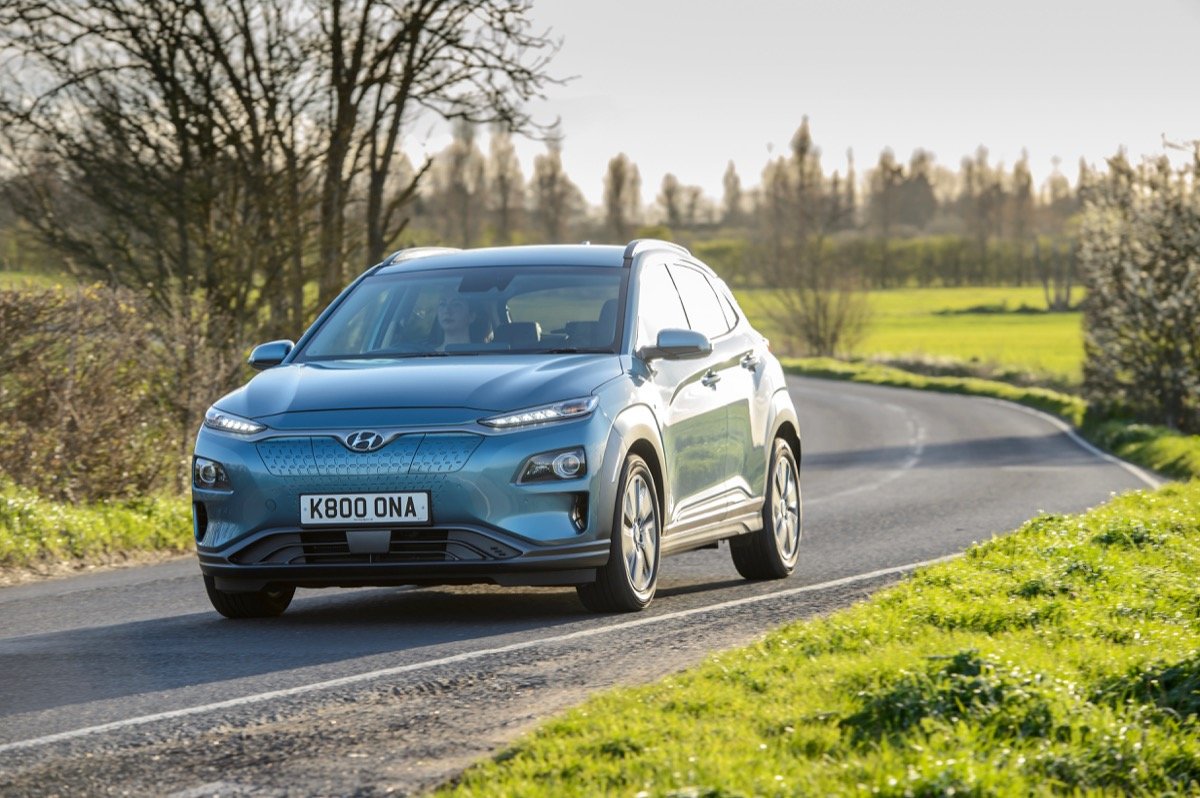
Few cars are quite as unusual to look at as the Kona; you’ll make your own mind up as to whether that’s a good thing or not. What’s undeniable is that it isn’t without its flaws; its best rivals beat it on practicality, and it isn’t quite as much fun to drive as it could be, although the sharp-handling Kona N is definitely the exception there.
Having said all that, what it does offer is a very impressive reliability record, backed up by a five-year warranty, and a range of powertrains that’s unmatched by its rivals. The hybrid version is particularly economical, and every model is well equipped.
So if you don’t need the most spacious compact SUV on the market, and you can live with one that isn’t quite as sharp to drive as the best, the Kona is a strong contender, and it proves that choosing a sensible, dependable small SUV doesn’t mean you have to buy a boring one.
What is the Hyundai Kona?
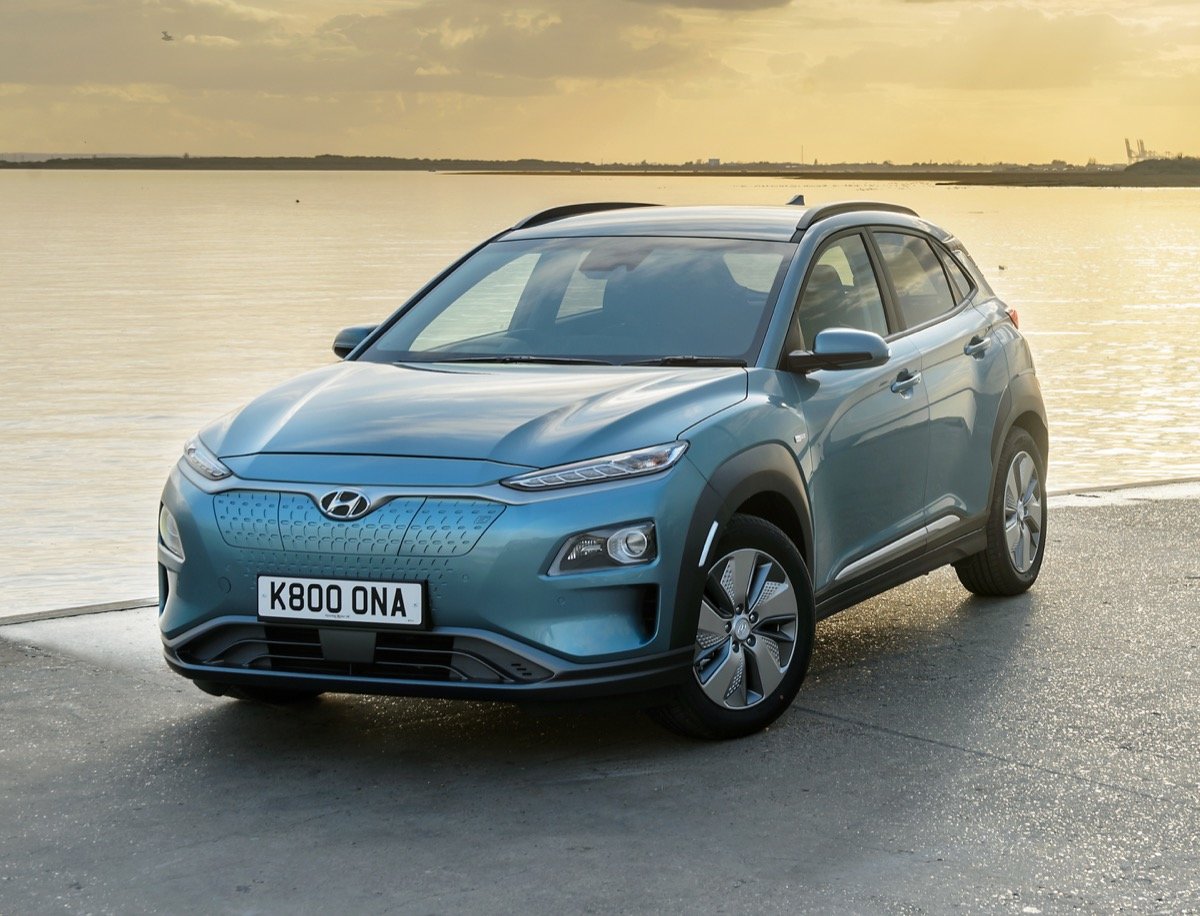
If you’ve brushed up on your geography, then the Kona name tells you everything Hyundai wants you to think about its compact SUV model. That moniker refers to the Kona Coast, one of Hawaii’s most beautiful tourist hotspots, widely associated with surfing, chilling, and generally being cool.
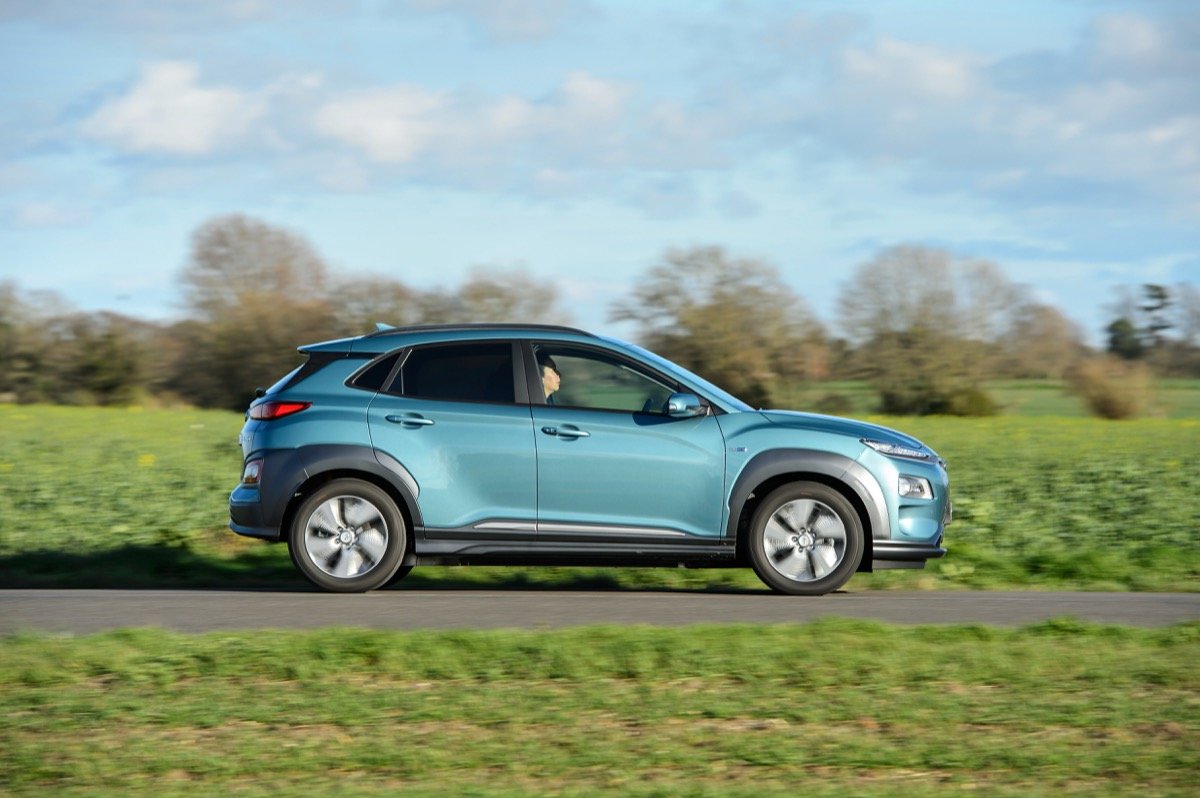
It’s that youthful audience that Hyundai’s targeting here, hence the looks. The Kona borrows from the Nissan Juke playbook, with quirky design cues that make it stand out from the (very large) crowd of more me-too crossover rivals (those including the Seat Arona, Volkswagen T-Cross, Toyota Yaris Cross, Mazda CX-30 and Kia Niro.
The Kona also differs from these rivals in offering a wide range of electrified powertrains, including a ‘self-charging’ hybrid and an all-electric version called, erm, the Kona Electric. And for those more concerned with burning fossil fuels than reducing their use, then there’s also the Kona N, a 276bhp alternative to a regular hot hatch and a rival for the VW T-Roc R, Audi SQ2 and Ford Puma ST.
The Kona made its debut in 2017, initially in petrol and diesel guises, before the EV joined the line-up in 2019. In 2021 a facelifted model was revealed, which had even quirkier looks, improved equipment levels and revised engines. An all-new Kona arrived to replace this model in late 2023.
How practical is it?
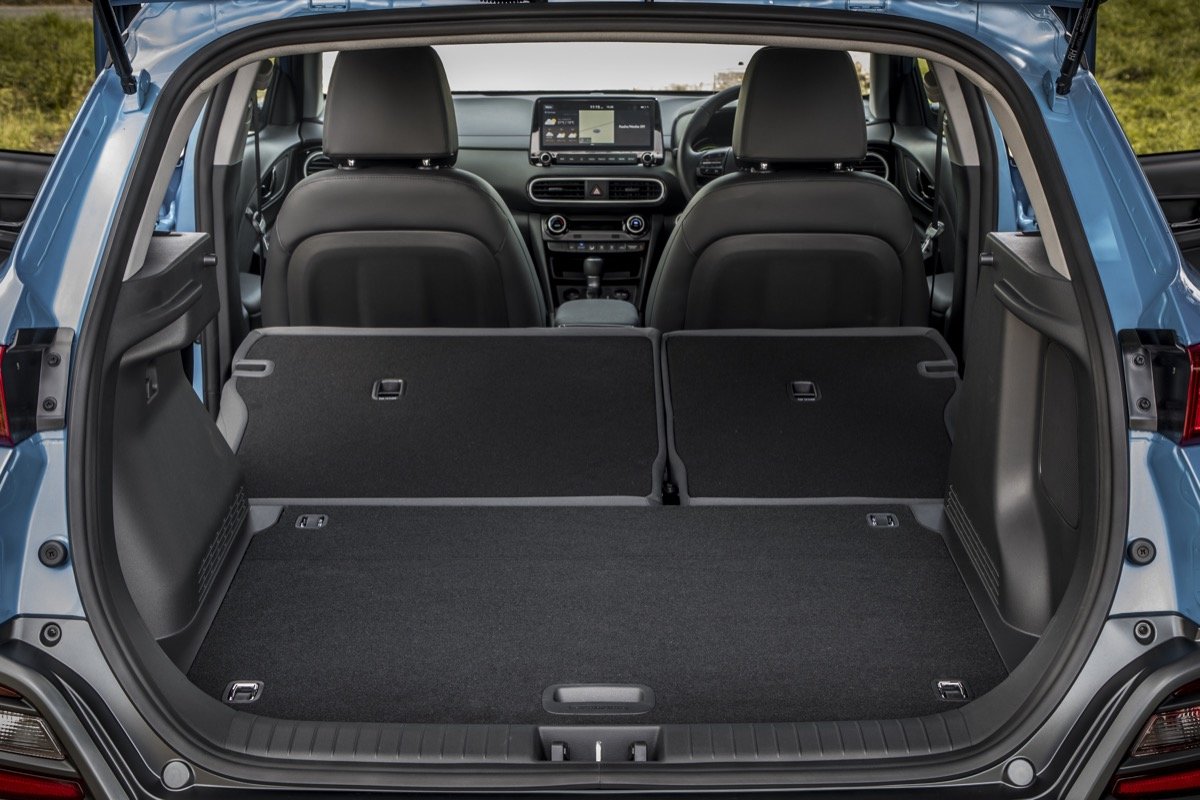
Whichever Kona you choose, you get the same amount of boot space, although at 374-litres the overall capacity isn’t actually all that big. If you need lots of luggage space you’d do better with a Seat Arona or a Volkswagen T-Cross. That said, fold the 60/40 split/fold rear bench flat and you’ll liberate a very useful 1,156-litres of capacity. Bear in mind, however, that if you tick the box for a space saver spare wheel, the need to raise the boot floor to accommodate it reduces these figures to 334-litres and 1,116-litres respectively.
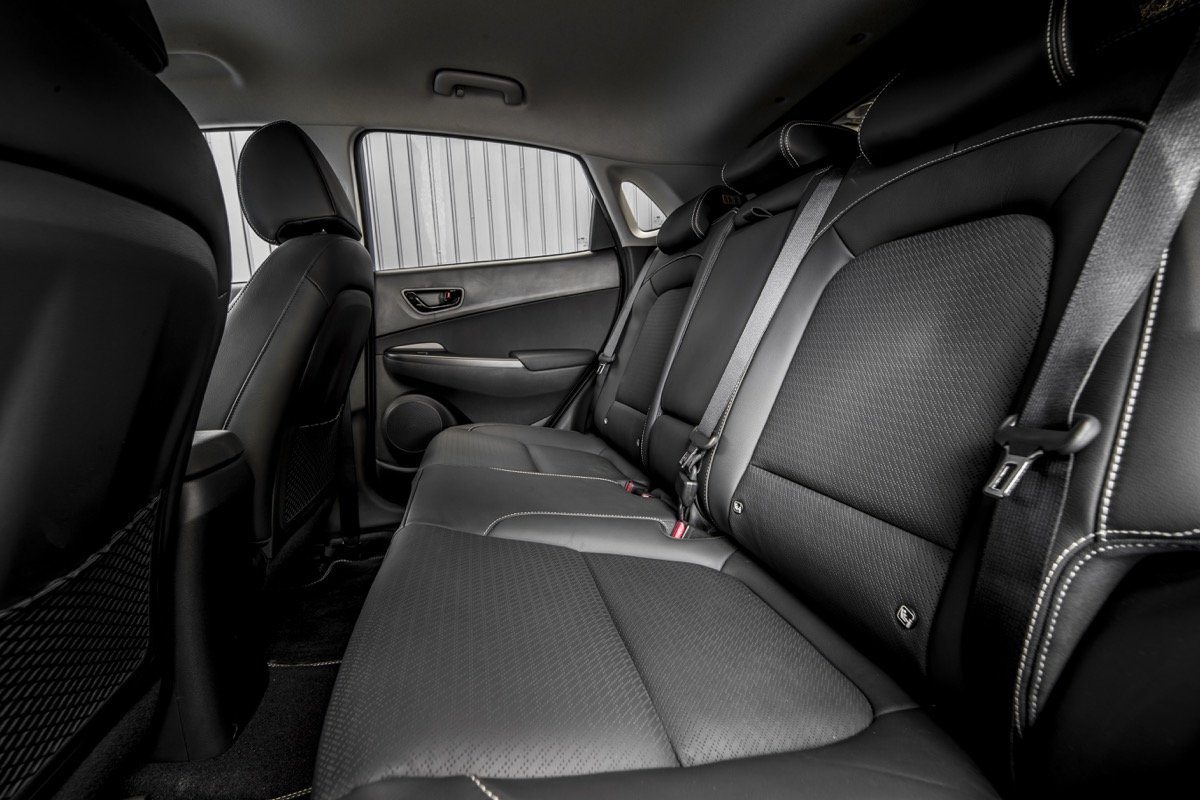
The rear seats are rather cramped, too, so it's not the best family car of its type. Taller adults in the rear seats will feel cramped and they certainly won’t thank you after a long journey. Again, you'll get more room in the Seat Arona or a Citroen C3 Aircross.
At least the front seats are roomy enough, and there’s plenty of wheel and seat adjustment, so sorting a comfortable driving position won’t be an issue. There are also plenty of little nooks and crannies in which to store smaller items. Not only do you get door bins front and rear, there’s a decent-sized glovebox and useful phone storage tray with a USB socket ahead of the gearlever. Even rear seat passengers get something similar, which is set into the back of the lidded armrest cubby that sits between the front seats.
What's it like to drive?
Hyundai’s decision to offer three types of powerplant – petrol, electric and hybrid – is just as unconventional as the car's styling. In fact, technically, all petrol Konas are hybrids now; since the car’s 2021 facelift, petrol models gained a small electric boost from a 48-volt mild hybrid system, giving buyers the choice between a mild hybrid, a full hybrid, or fully electric power.
All three powertrains give the Kona slightly different personalities. The mild hybrid engines are punchy, responsive, and the most affordable of all to buy, but their electric boost is marginal at best, so think of these as lightly breathed-on petrol models in terms of their fuel efficiency.
The full hybrid option gets a more substantial battery and a proper electric motor, and is therefore more expensive. But, it’s also more efficient, which will help you recoup some of that extra cost. In the same vein, electric models are the priciest of all, though also the cheapest to run, and the most futuristic-feeling to drive, thanks to the ethereal whirr with which they accelerate away seamlessly.
Still, don’t discount the earlier petrols without the mild-hybrid assistance, as the 118bhp turbocharged 1.0-litre unit is punchy, smooth and frugal performers. Much rarer is the 175bhp 1.6-litre, which came as standard with four-wheel drive and seven-speed twin-clutch gearbox. It’s not quite as much fun to drive as its exotic specification would have you believe, but it’s a swift and surefooted choice.
If you want a diesel-powered Kona, then a pair of 1.6-litre diesel engines were offered when the car was first launched, but taken off sale again shortly afterwards when it became clear that public appetite for diesel had dwindled. One had 113bhp, the other 134bhp. They’re worth keeping an eye out for if you do longer journeys thanks to their superior fuel economy, with an official figure of up to 67.3mpg.
Out on the road, the Kona handles tidily, and would actually be good fun to drive were it not for the fact its steering - while precise - feels very remote, leaving you with little idea of what’s actually going on at the front wheels.
The fast-and-fun 276bhp Kona N has much more alive-feeling steering, and its electronic limited-slip differential helps it get its power down to the road despite the fact that it’s still front-wheel drive, just like the rest of the Kona range. It’s not as fun as a Ford Puma ST, but it’s very quick, with bags of grip and cast iron body control. The trade-off for this is a very firm ride, even with the adaptive damper in their softest setting.
In fact, ride comfort isn’t the best across the range, especially at low speed. Matters improve as you go faster, however, and the Kona cruises stably and securely on the motorway, with relatively little in the way of wind, road or engine noise (in the case of the latter, none at all if you go for the Kona Electric). Even so, the standard Ford Puma bests it for both comfort and handling.
Technology, equipment & infotainment
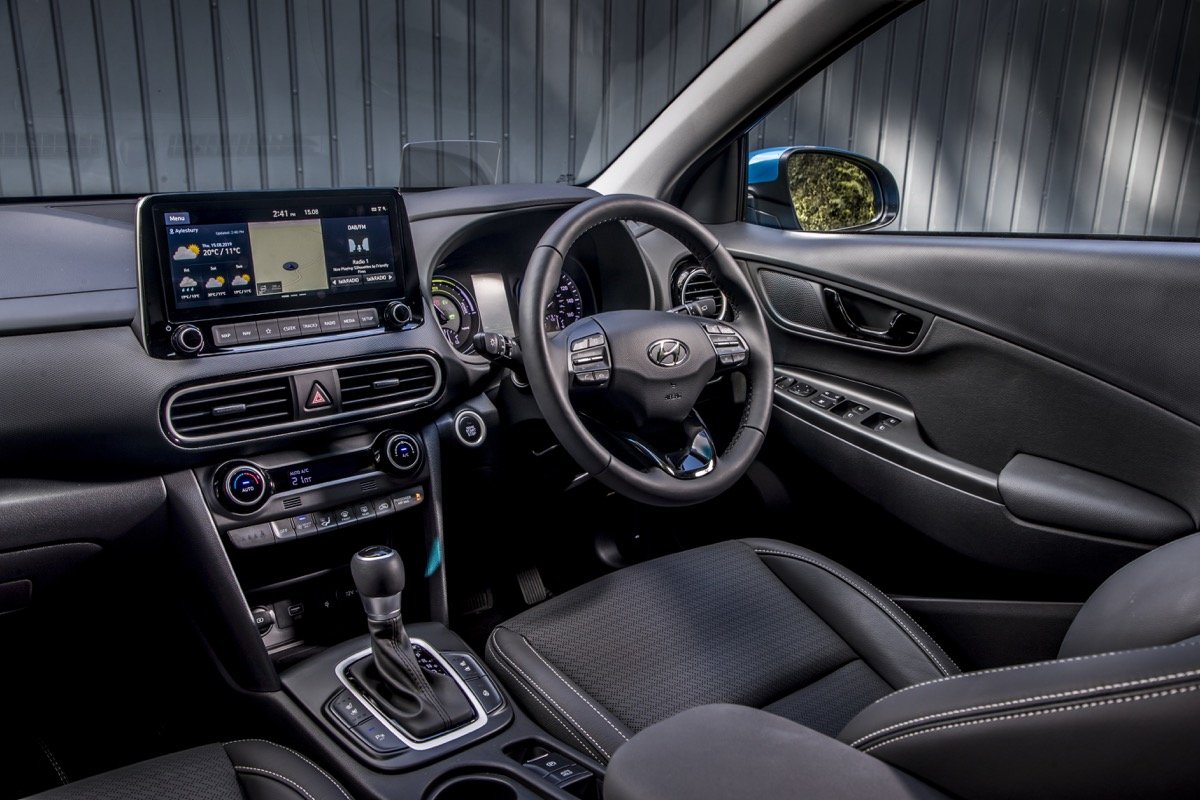
The dashboard feels a little cheap in places, so you'll never be fooled into thinking that you're sitting in an Audi or BMW, but it's well laid out, and the touchscreen infotainment system is clear and easy to use, with sharp graphics and intuitive menus. It gets Apple CarPlay and Android Auto connectivity as standard, too.
Even the most basic SE Connect gets 17-inch alloy wheels, air-conditioning, cruise control, and both a rear-view camera and rear parking sensors. N Line adds sportier styling, 18-inch wheels, automatic headlights and climate control, while Premium gets heated front seats, a heated steering wheel and front parking sensors. At the top of the line-up, meanwhile, the Ultimate comes with LED headlights, ventilated front seats, and a head-up display.
The Kona earned itself a five-star EuroNCAP rating when it was tested in 2017, which was largely down to its list of standard driver aids. Lane departure warning, lane keep assist and a driver fatigue monitor are all included, while the Ultimate added blind spot monitoring. However, it was only with the 2021 facelift that autonomous emergency braking was fitted as standard across the range - it had previously been an option only on top spec models.
Hyundai Kona running costs
Choose a Kona Electric, and you’ll have one of the most efficient electric vehicles (EVs) out there. The 64kWh car should achieve between 3.5 and 4 miles per kilowatt hour (mpkWh) on average, while the 39kWh will manage fractionally more, and both models should outdo most of their rivals.
If it’s a petrol-fuelled Kona you’re after, then it’ll come as no surprise to learn that the full Hyundai Kona hybrid is the more efficient of the two. You can expect to see fuel economy of around 50 mpg on average, though you might get more than that if you use it around town more, because the battery gets more of a chance to charge up as you speed up and slow down.
The mild hybrid model is still pretty economical, though, and uses a clever electronically-actuated clutch that can disengage when you’re coasting to save fuel. As a result, you should see 40-45 mpg out of it in everyday use, depending on how gently you drive.
You are much less likely to get that sort of fuel economy if you go for the high-performance Kona N. Officially, Hyundai says it should achieve 33.2mpg, but in reality you’ll struggle to get better than around 30mpg: it’s just too tempting to hit that accelerator pedal and enjoy the car’s turbocharged punch...
Hyundai’s servicing costs are pretty reasonable, and you can choose to pay via a service plan to avoid future price increases, which involves paying either for several services up front, or spreading the cost and paying monthly with a fixed premium. The electric version is even more affordable to service, meanwhile, as it has far fewer moving parts.
Maintenance costs are further held down by the fact that none of the Kona’s engines have a rubber timing belt, which would need replacing periodically. Instead, they use a metal timing chain, which is designed to last the life of the engine.
Hyundai Kona reliability
Reliability data for the Kona is split between the EV and non-EV versions. And it's the latter that are developing the better reputation, finishing 3rd of out the 22 cars in the small SUV class of the 2023 What Car? Reliability Survey. The Kona Electric meanwhile achieved an 11th place finish out of the 20 cars in the electric car class in the same survey, and Hyundai as a brand came 7th out of 32 manufacturers that were included.
Potential buyers should be reassured that Hyundai offers a very good five-year, unlimited-mileage warranty, which is ahead of most of the competition. Only the seven-year warranty on the Kia Stonic can beat it.
We haven‘t heard of many common problems with the Kona. Some owners have reported a rattle when the car was started, which has been solved by replacement timing chains covered under warranty.
At the time of writing there had been no recalls for the Kona. Dealers should notify current owners if any remedial work needs carrying out, but it’s worth checking to see if a car you’re considering has been affected and, if so, that the issue has been fixed.
- Unlike many of its SUV-inspired rivals, the Kona was actually available with four-wheel drive. Only available as an option on top spec cars with the 175bhp turbocharged 1.6-litre petrol, it delivers more of an all-weather security blanket than true off-road ability. Even so, there is an electronic locking centre differential that fixes the torque split between the front and rear wheels at 50/50, which is helpful in snow or when escaping one of those grass car parks that’s turned into a rain-lashed quagmire.
- Meanwhile, the Hyundai Kona Electric is almost a range unto itself. You can choose between SE Connect, Premium and Ultimate trim levels, though the specifications differ slightly – all get 17-inch wheels, for example. There are two battery sizes to choose from: a 39kWh with a maximum range of 189 miles, and a 64kWh with a potential 300-mile maximum range. The 64kWh battery comes with a more powerful motor, too, kicking out 201bhp; by contrast, the smaller battery comes with a 134bhp motor. Don’t let that put you off, though; it still provides peppy performance, and if you’ve no need of the extra range that comes with the bigger battery, it should be more than enough.
- Alongside the 2021 facelifted car, Hyundai also revealed a new performance version of the Kona: the Kona N. With a whopping 276bhp on offer from its 2.0-litre turbo engine and an electronically activated limited-slip differential, it’s capable of 0-62mph in just 5.5 seconds. This makes the Kona N one of the fastest performance SUVs you can buy, at least without spending tens of thousands more on something like a BMW X3 M.
- For most buyers, the car that will make the most sense is the Kona Hybrid Premium. Yes, it costs almost £3,000 more than the mild hybrid model, but you get a slick automatic gearbox thrown in, and besides, it’ll only take you around 5,000 miles to recoup the difference in cost compared with the mild hybrid version through the savings you’ll make thanks to its lower fuel consumption (perhaps even less if your driving’s mostly around town). The Premium model looks good value given the lengthy kit list.
- If you have access to a charging point, or park somewhere you can get one installed, then the Kona Electric is very much worth a look. It’s one of the better electric cars on the market, especially in long-range 64kWh form. However, like all EVs it now no longer qualifies for the Government’s Plug-in Car Grant, which makes it look very pricey compared to its petrol-engined brothers.
- Buying on a budget? If so, you’ll be glad to hear the entry-level Kona available is no stripped-down special. The 1.0 T-GDi 48V SE Connect comes with a decent complement of equipment, while its little engine is boosted by both a turbo and that electric boost, making it feel much stronger than its capacity suggests. It’s also reasonably economical. That said, if you can stretch your budget a little bit, you might be better off choosing the Hybrid instead, as once again the price difference will be cancelled out by the fuel savings.
- Want a genuinely sporty Kona? The N model is the one to go for. It’s actually cheaper than the long-range versions of the Kona Electric, and more than £5,000 cheaper than a VW T-Roc R. Okay, it’s not quite as fast as the T-Roc and it doesn’t get four-wheel drive, but its limited-slip differential and snappy eight-speed dual-clutch automatic gearbox make it quite an effective cross-country tool.


