Ford Focus review (2018-2025) | The go-to family hatchback
Ford Focus cars for sale
4.0
Expert review
Pros
Enjoyable to drive
Ample room for tall passengers
Excellent Ecoboost petrol engines
Cons
Some rivals have bigger boots
Ford's new car warranty is short compared with those offered by Hyundai and Kia
Entry-level cars with torsion beam suspension aren't as good to drive
The CarGurus verdict
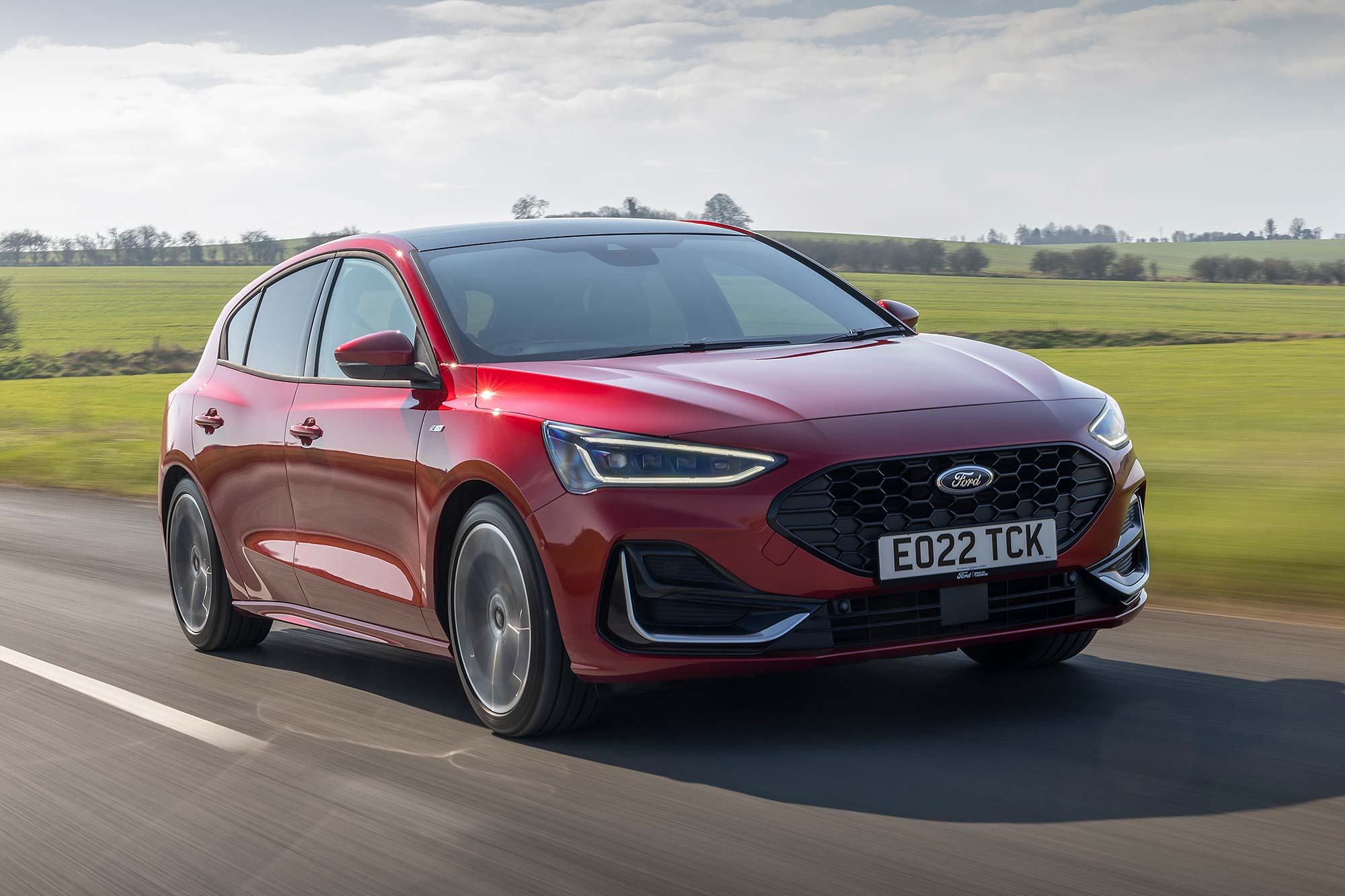
There are more striking family cars out there, others that have flashier interiors, and others that are more reliable. The Ford Focus offers a good range of commendable petrol and diesel engines, though, and in terms of safety and roadholding, it is right up there with the very best, perhaps even a step ahead.
Don’t be put off by the small displacement three-cylinder engines. They’re all turbocharged, which means they punch well above their weight. They’re also more charismatic than many conventional four-cylinder motors, with a distinct three-cylinder thrum. Pick the right one from the extensive line up for your particular needs (take a few versions for a test-drive before you buy, if possible) and you’ll enjoy a good blend of performance, refinement and fuel efficiency.
Meanwhile, the sporty Focus ST is a very good all-rounder without being truly exceptional in any one area. Whereas other hot hatchbacks compromise on day-to-day comfort to deliver a more thrilling driving experience, the Ford delivers consistently across the board. It’s effortless to use everyday and fun to drive on a great road.
What is the Ford Focus Mk4?
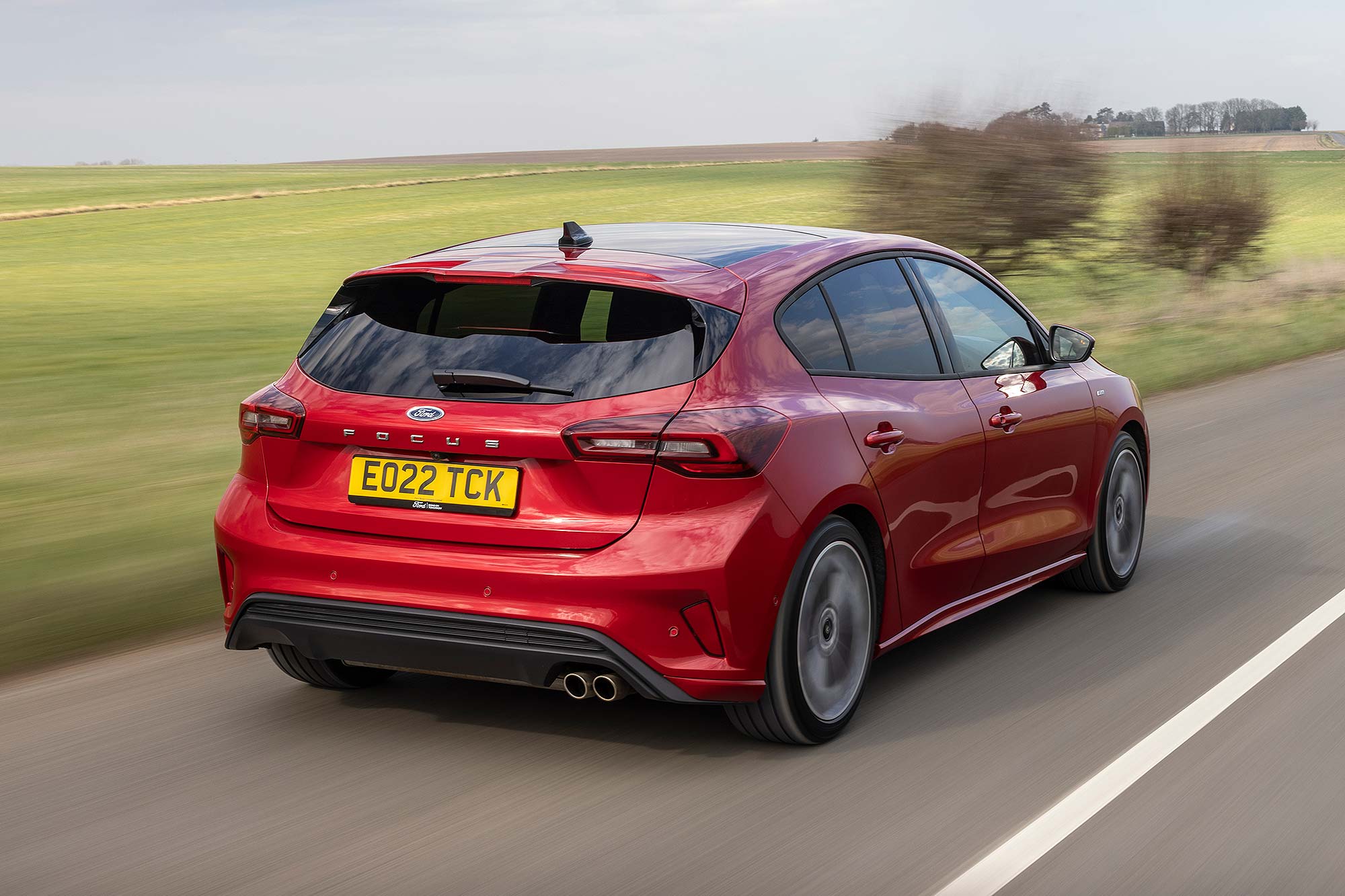
The original Ford Focus rewrote the family hatchback rulebook when it arrived in 1998. Since then, the Focus has consistently been among the best cars in its class, and was a permanent fixture in the top-five bestsellers in the UK. Throughout its time on sale, the Mk4 Focus stayed true to the attributes that made the first car stand out, notably class-leading handling and steering response, combined with a practical and well-finished interior.
Over the years, the Focus grew in size and weight, but even in its final form, known by Ford as the ‘C519’, it trumped the competition for those who enjoy driving (rivals steadily closed the gap, though, with cars such as the Volkswagen Golf and Seat Leon becoming almost as agile and responsive in later years). Other hatchbacks like the Honda Civic offer more distinctive styling, while the Golf’s very crisp and modern interior made the Ford’s cabin look rather plain. As an overall package, though, you could argue the Focus was still the strongest of the bunch.
Unveiled at Ford’s UK headquarters in Essex in 2018, the fourth-generation Focus was given a refresh in 2021, just a year before Ford made its call to retire the Focus nameplate for the foreseeable future.
How practical is it?
The basics of the Focus interior, such as materials and build quality, along with the driver’s seating position and passenger space, are all fine. There simply isn’t much design flair on show in either the pre- or post-facelift cars. More pragmatic buyers won’t mind that – anyone who’s dealt with the touch-sensitive slider controls or haptic buttons in a Mk8 Golf will know that being traditional and a bit basic isn’t always a bad thing – and they’ll love the comprehensive range of petrol and diesel engines. Essentially, there is a used Ford Focus to suit all needs.
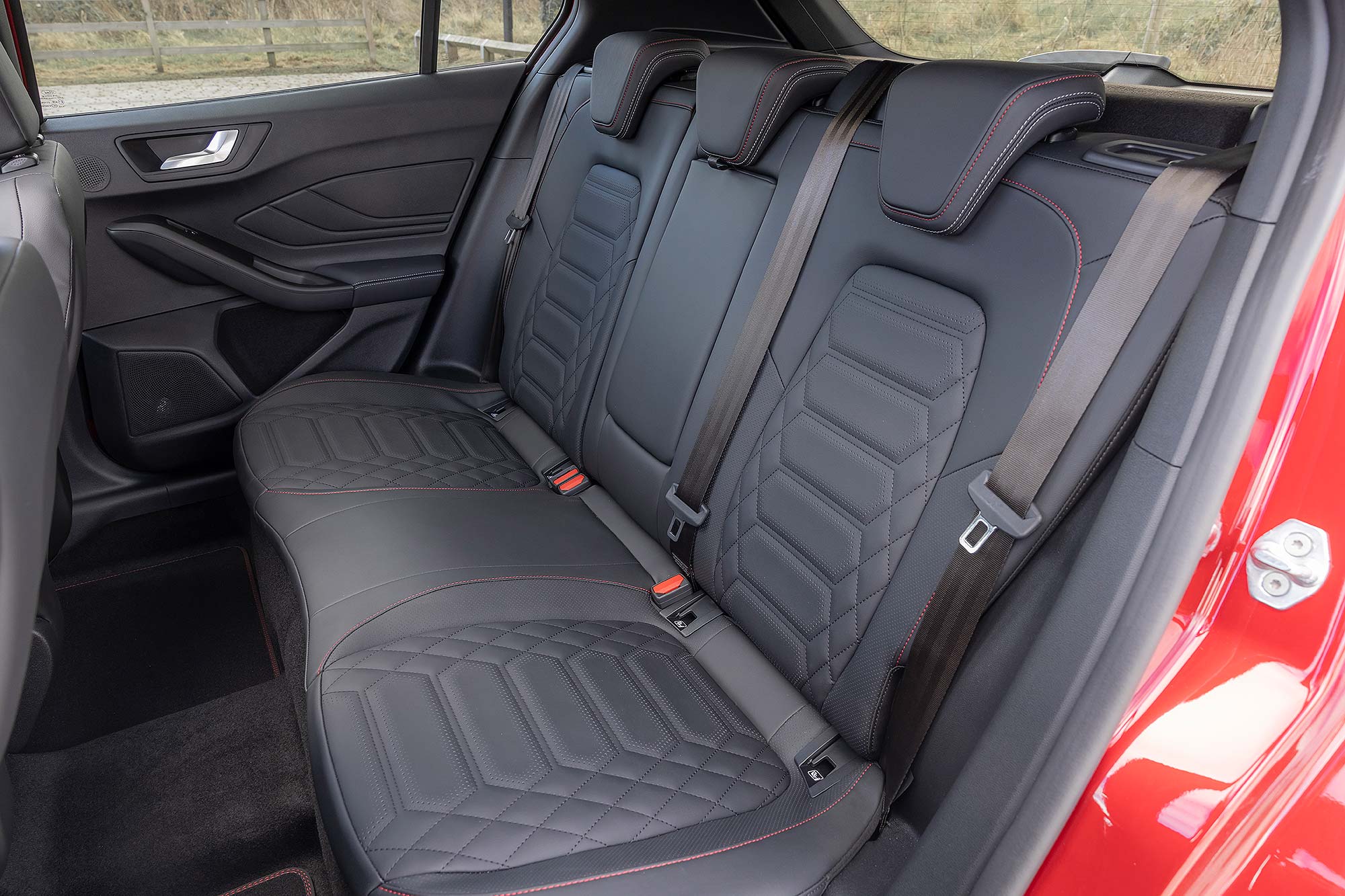
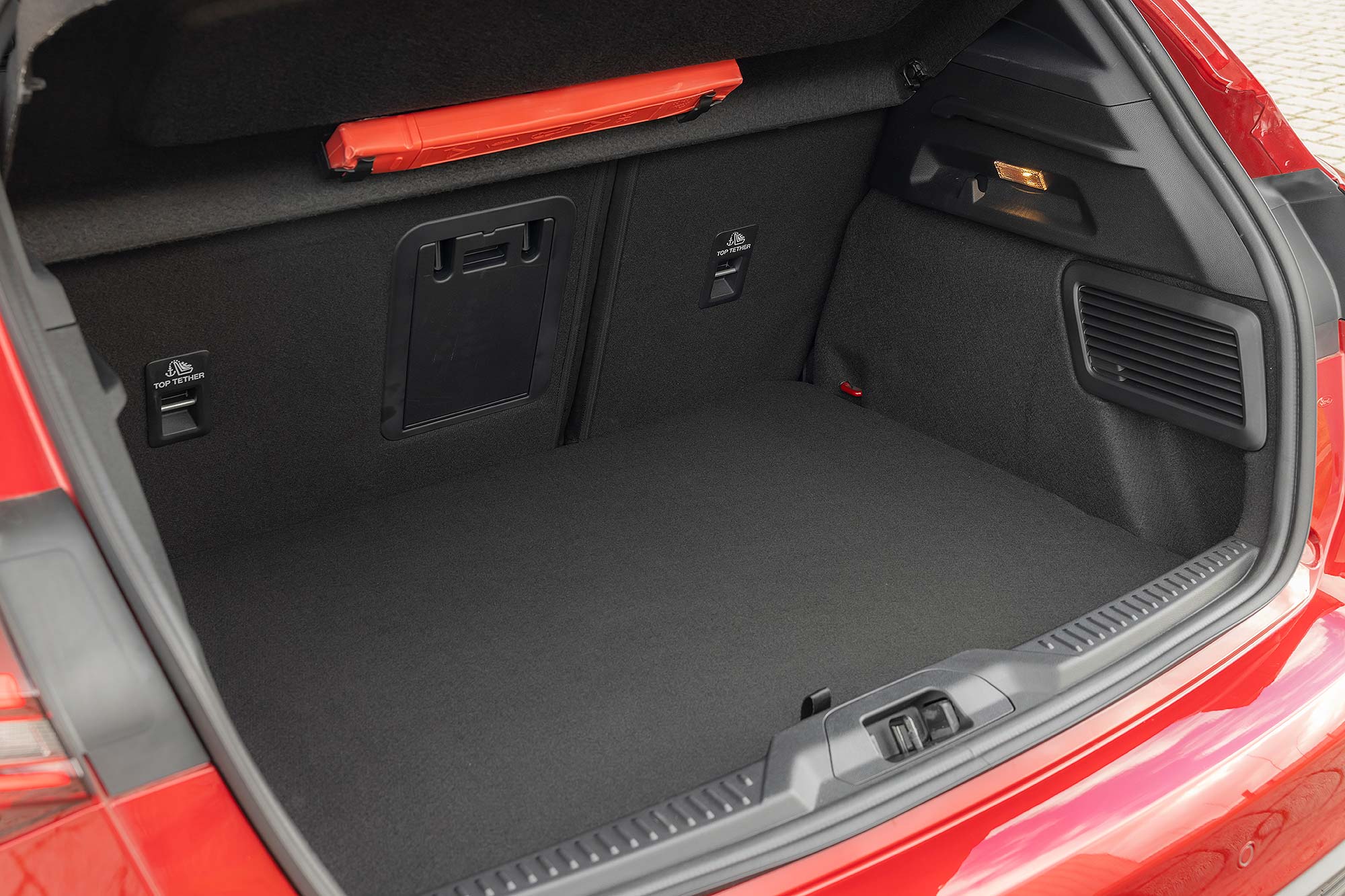
Equally, after years of offering a Focus that was slightly smaller than the opposition, Ford finally got back on track when it came to interior space, extending the Mk4’s wheelbase by more than 50mm compared to its predecessor. Inside, you’ll find ample room in the rear seats for tall passengers, plus Isofix child car seat mounting points at both outer edges of the rear bench. The hatchback's 375-litre boot is pretty much a match for the equivalent Golf, while the estate had a 635-litre luggage capacity.
Those figures remained the same for pre- and post-facelift cars, as did the numbers for when the rear seats were folded flat. Specifically, these were 1,354 litres for the hatchback and 1,653 litres for the Focus estate. Both had a 60:40 split rear bench, so you don’t have to fold all of the seats down at once. However, carrying capacity isn’t a match for the Skoda Octavia, nor the Vauxhall Astra that was launched in 2021. One final point of note when it comes to practicality and boot space: the rugged-looking Focus Active actually had a marginally smaller luggage compartment, measuring 341 litres with the rear seats up.
Beyond the cabin itself, the Focus was available with numerous practicality-enhancing accessories, such as rubber boot liners, mud flaps, roof boxes, tow bars, bike racks and more.
What's it like to drive?
At launch, the Focus was available with quite a wide range of engines, although this was slimmed down as time went on, then changed significantly with the debut of the facelifted model. Let’s cover the earlier cars first.
Pre-facelift models were, at one point or another, available with 1.0- and 1.5-litre three-cylinder turbocharged EcoBoost engines, with power figures ranging from 83bhp to 179bhp. On the diesel side of the equation, Ford offered 1.5- and 2.0-litre four-cylinder turbo units, with outputs between 93bhp and 148bhp.
The sporty Focus ST was a different kettle of fish, with a 276bhp 2.3-litre petrol engine or a 187bhp 2.0 diesel, with the latter delivering long-distance economy and torque-dominated performance. Few car manufacturers built performance diesels outside of the Volkswagen Group (think of the Golf GTI and GTD, Skoda Octavia vRS, Seat Leon Cupra and FR), which is perhaps why diesel versions of the Focus ST proved so popular. None aside from the Golf could get close to the Ford’s driving dynamics.
Post-facelift, the 1.5-litre petrol was dropped as 48V mild-hybrid technology arrived in the Focus for the first time. At the cheaper end of the spectrum was a 1.0-litre EcoBoost petrol with 98bhp, while mild hybrid versions served up 123bhp or 153bhp. The diesel engines never got the hybrid treatment, and their power figures remained the same, but they did get cleaner. Post-facelift ST engines and gearboxes remained unchanged.
Depending on the engine and model year, the Focus either had a six-speed manual gearbox, or a seven-speed automatic (an eight-speed auto was available only on post-facelift EcoBoost mild hybrid models.
Without delving deeper and deeper into the depths of Ford Focus specifications past, then relaying a long list of possible engine and gearbox combinations, performance stats, CO2 figures and economy details, simply understand that the Focus had a wide range of engines available throughout its life.
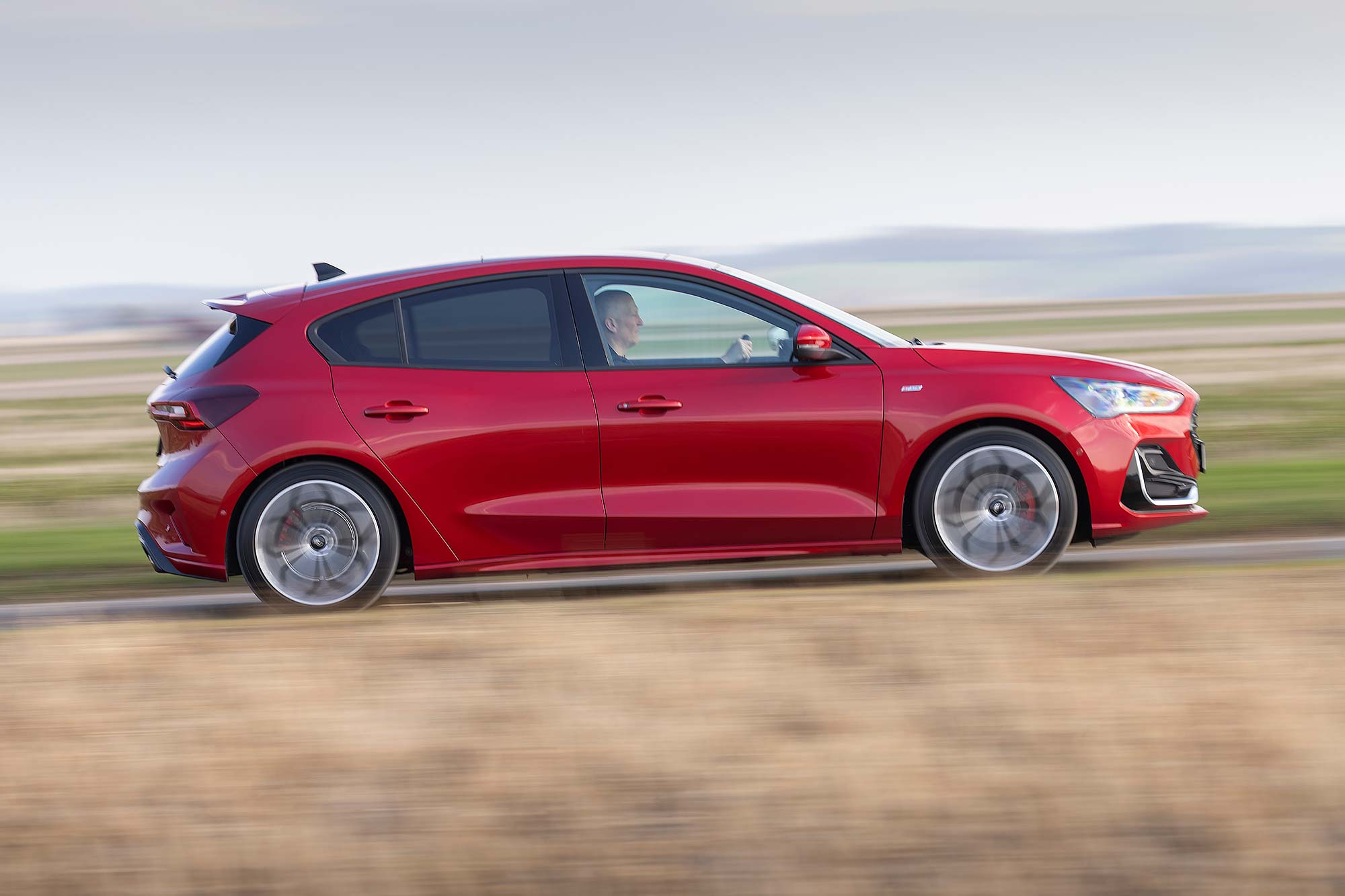
As for the car’s ride and handling, it was always class-leading. It might look like a fairly ordinary family hatchback, but the fourth-generation Focus always offered a superb blend of comfort and control. Along with accurate and well-weighted steering, this makes every model a joy to drive. The Focus ST was on another level, able to tackle any road with a precision that few could match. Put it this way: a well-driven Focus ST would be very hard to keep up with on a British B-road, whatever car you happen to be following in.
Technology, equipment & infotainment
When the Mk4 Focus was launched, trim levels were wide-ranging, starting with the entry-level Zetec then climbing through Titanium, Titanium X, sporty ST-Line and ST-Line X, the raised Active, Active X and Active X Vignale, and finally the flagship Vignale.
Later on, Zetec was swapped for the more sparsely equipped Trend, while the Titanium X and ST-Line X were renamed Titanium Vignale and ST-Line Vignale. At the same time, the Focus Active range was rationalised to just Active and Active Vignale.
All Focus models were well-specified for their price point when new, with alloy wheels, a touchscreen infotainment system (including Apple CarPlay and Android Auto) and cruise control across the range. But you’ll be a smart used buyer by knowing that the facelifted model benefited from some serious technology upgrades, even beyond the addition of a mild-hybrid system.
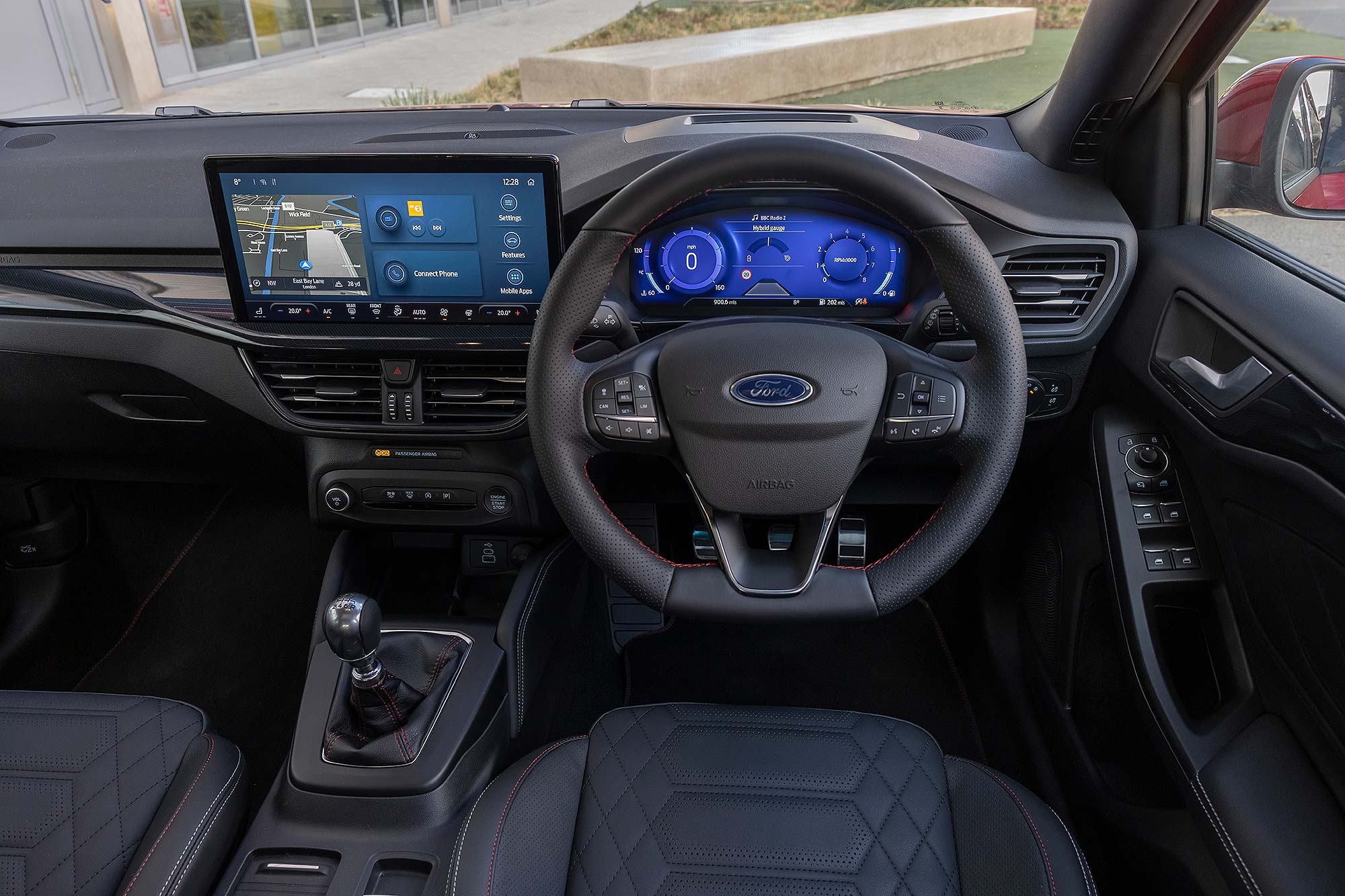
The early Focus had an 8.0-inch central touchscreen that utilised Ford’s SYNC3 software, plus a traditional set of driver dials combined with a small LCD display. The facelift saw SYNC3 replaced with SYNC4 and the screen swapped for one measuring 13.0 inches. The dials also went digital on some models, with a new 12.3-inch driver’s display.
SYNC4 was a big step for Ford. It used machine learning algorithms to study a driver’s behaviour and be more useful over time. It also included wireless Apple CarPlay and Android Auto connectivity, speech recognition, Ford Power-Up over-the-air updates, plus a connected navigation system that delivers real-time and predictive traffic information. This was delivered by TomTom, with Garmin supplying in-vehicle and in-cloud routing for the most efficient and quickest journeys.
The big negative with the introduction of SYNC4 was the death of physical climate controls. These were moved into the infotainment screen, which decluttered the interior a little, but not for the better.
Ford Focus Mk4 running costs
Whichever engine you choose, the Focus will return decent fuel economy for this type of car: not class-swot mpg, but certainly not in detention. If fuel efficiency is a driving factor in your decision-making, it’s important to look a little deeper than the official figures. For instance, if you do rather more miles than the average driver, particularly on the motorway, a diesel engine will prove most efficient. However, if you mainly drive in town and do fewer miles than most, a smaller petrol unit or a hybrid is the best bet.
Additionally, every version of the Mk4 Focus is ULEZ-compliant, including the diesels, as they all meet Euro6 emissions regulations.
As we’ve discussed, most engines are offered with either a six-speed manual gearbox or a seven-speed automatic. For the best fuel economy, choose the manual transmission and drive cautiously. Having said that, the mild-hybrids, which are likely to be more economical around town, have automatic transmissions only. Generally speaking, post-facelift cars are more efficient than their similarly powered pre-facelift counterparts. Even so, it’s worth studying the spec of any potential purchase.
Focus resale values and insurance costs are very competitive for the class (good news if you’re selling, less so if you’re buying), although servicing may cost a little more than some rivals. That said, Ford does allow you to spread the cost with its Ford Protect Service Plan and Ford Protect Wear and Tear plan (covering non-service items that are likely to wear down, such as brake discs and pads). Alternatively, the belt-and-braces Service Plan Plus is both of these plans combined.
Ford Focus Mk4 reliability
Ford has rarely excelled itself in the kind of owner reliability surveys that provide insight into how dependable certain makes and models are. Nor has it disgraced itself in those surveys, either. The brand tends to rank in the middle for reliability, with only a small percentage of owners reporting faults in the first year of ownership.
In the 2021 What Car? Reliability Survey, the Focus finished 19th out of 24 family cars, which doesn’t exactly cover it with glory. What’s more, it didn’t score highly enough in the Auto Express Driver Power Survey to finish within the top 75 cars, which are the only results that the magazine publishes. More recently, the 2025 What Car? Reliability Survey placed Ford joint 24th out of 30 brands overall, while this generation of Focus came home in 9th place out 18 runners in the diesel car reliability tables, scoring 89.7%. The petrol Focus, meanwhile, finished 15th out of 37 cars, with a score of 94.9%, ahead of both the Ford Puma and the Fiesta. It could be worse, then, but it could be much better.
The main thing, and we cannot stress this enough, is never to miss a service. If anything, get your Focus serviced more regularly than it needs to be. We say that because Ford EcoBoost and EcoBlue engines use wet belts: rubber, oil-lubricated alternatives to timing chains (or cambelts, if you prefer) that degrade over time, depositing chunks of rubber into the system before eventually failing. It’s become a well-known issue for engines across the entire Ford model range. If you’re buying used and your car is 10,000 miles away from its scheduled belt change, just get it done. The cost of the work will be much less than buying a whole new engine.
Every new Ford comes with a three-year, 60,000-mile warranty, which can be extended for an additional cost to four years and 36,000 miles, four years and 80,000 miles, or five years and 100,000 miles. Buying a later car may mean you get a car that’s still under warranty.
- As well as the hatchback and estate, Ford offered an Active body style on the Focus. Its ride height was raised by 30mm at the front and 34mm at the rear, the idea being it would cater for those who perhaps lived in the countryside and often faced scenarios where extra ground clearance would be useful. Active models are by no means proper off-roaders, though.
- Independent rear suspension was the original Focus’s big innovation. Subsequent models have used similar arrangements since, but on the latest cars, almost every Focus hatchback features a simpler and cheaper torsion beam setup. All estate models still get the more sophisticated independent suspension, however, as do ST-Line versions (which also have a 10mm lower ride height). Keen drivers will notice the difference.
- The fourth-generation Focus was never offered with an all-wheel-drive system. In fact, it was only ever the third-generation Focus in ultimate RS guise that benefitted from 4WD. Well, unless you count the WRC rally cars, but good luck buying one of those used…
- For saving at the pumps: The 118bhp EcoBlue diesel returns 67.3mpg in the official fuel economy test. Good though the mild-hybrid petrol cars from 2021 onwards were, you just can’t ignore the efficiency of a diesel. Just be aware you’ll struggle to match any claimed consumption figures unless you have a very light right foot.
- For driving in the city: Either of the 1.0-litre mild-hybrids is suitable if you’re going to be sitting in traffic on a regular basis. Quite apart from the fact they’re automatic-only, the battery system reduces the load on the oily bits when they’re at their least efficient. Whether it’s the 123bhp or 153bhp version, both will be as serene as can be.
- For all types of driving: It’s a tricky one, because they’re all good all-rounders. Post-facelift, we’d have to say the 153bhp 1.0-litre mild-hybrid, because it’s punchy, reasonably frugal and clean. Pre-facelift, we’d be on the lookout for a 148bhp 1.5-litre, the middle of the range for power, torque, economy and performance.
- For setting your pulse racing: With no RS version (a first for any generation of Focus), we’ll have to say a Focus ST. As the engines were the same pre- and post-facelift, with both petrol and diesel offerings, it’s a matter of finding out which one you prefer the looks of, or would rather spend more time in. Remember, there are no physical heater controls in the later cars, which could drive some people up the wall.


