Mercedes-Benz EQS 2026 review | The definitive electric luxury saloon

Pros and cons
What we like
A true long-range electric car
Comfortable ride
Luxurious interior
What to consider
Hugely expensive
A Porsche Taycan is more fun to drive
Looks the same as smaller EQE
The CarGurus verdict
If you want the most sporting luxury electric car, the Mercedes EQS is not for you. Certainly not unless you’re looking at the full-fat AMG version, which is a different prospect altogether. For now, the Tesla Model S, Audi e-tron GT and our driver’s EV of choice – the Porsche Taycan – offer more driver interaction and reward on a good road. But when it comes to luxury, technology, interior space, refinement and comfort? Well, the EQS is something else. After all, it’s easy to call a lot of EVs milestones, as manufacturers push the boundaries of what an electric powertrain can bring to personal transport, but the Mercedes EQS really does set the benchmark for range and sumptuousness.
Ironically, then, given the many decades of development that have seen the Mercedes S-Class sitting pretty as the chauffeur car of choice in the circa £100,000 price arena, it might well be Mercedes itself that finally ends the reign of the S-Class. Regardless, the EQS is sublime to drive, be driven in and live with. It’s our full-sized luxury EV of choice.
out of 5 expert review
What is the Mercedes-Benz EQS?
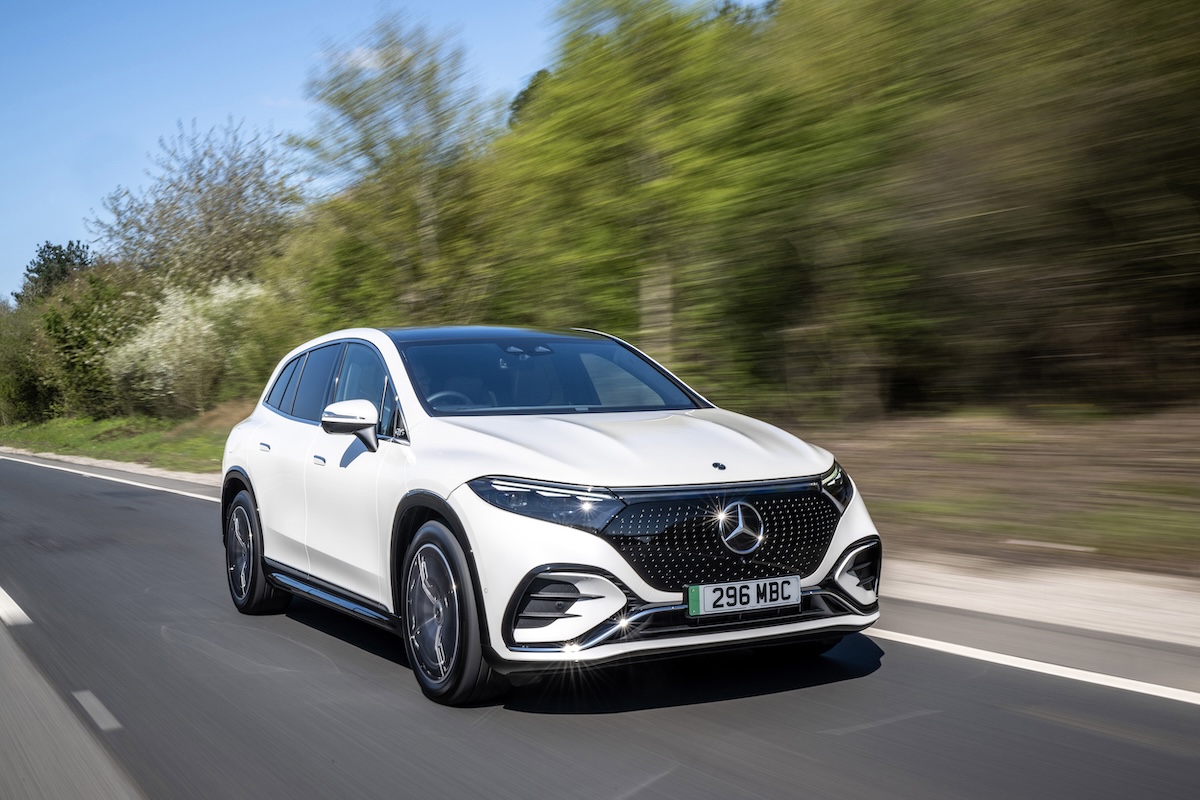
The Mercedes EQS is the halo model of the brand’s electric car range – effectively an S-Class in everything but name. It was the first Mercedes built on the company’s bespoke EVA2 platform, designed exclusively for electric vehicles, and that is obvious in its proportions. The wheels are pushed right out to the corners, the wheelbase is enormous, and the bonnet is much shorter than on any combustion-engined luxury saloon. Whether you find it elegant or slightly ungainly is a matter of taste, but there’s no denying it has presence.
In the UK, the standard EQS saloon has been offered in several forms. The range has included the EQS 350, EQS 450+ and all-wheel-drive EQS 450 4Matic, with power outputs and performance stepping up accordingly. All versions focus on long-distance comfort and efficiency rather than outright pace, pairing smooth electric performance with a very large battery and an emphasis on refinement.
Sitting above the regular models is the Mercedes-AMG EQS 53 4Matic+, which takes the same basic underpinnings and turns the dial firmly towards performance. With dual motors, all-wheel drive and dramatically increased power, it delivers supercar-rivalling acceleration wrapped in a luxury saloon body. It’s hugely expensive and far removed from the EQS’s original brief as a serene long-distance cruiser, but it underlines just how broad the EQS lineup has become.
Overall, the EQS isn’t trying to be a conventional executive saloon with an electric powertrain shoehorned in. It’s a ground-up rethink of what a luxury Mercedes-Benz looks like in the electric age. The EQS prioritises space, silence and efficiency, even if that means challenging traditional ideas of style and proportion.

Practicality
How practical is it?
That bespoke EV platform has paid off, not only in terms of the battery that the EQS can hold and the way it comports itself on the road, but also in the space that Mercedes has squeezed inside. Yes, the EQS is a similar size to a Mercedes-Benz S-Class, so you expect plenty of room, and it doesn’t disappoint, particularly following post-launch revisions that improved rear seat comfort. You can seat three people across the rear bench as standard, or there’s a Rear Luxury Lounge package that brings electrically adjustable seats with a massage setting, plus a central tablet to control all the media and comfort functions from the back seats. A panoramic sliding glass roof is standard across the range and makes things feel light and airy, too.
Rear-seat space and comfort is up there with the Mercedes S-Class, BMW 7 Series (not forgetting the electric BMW i7 and other traditional limos, but boot practicality is on another level. The Mercedes EQS has a big hatchback opening that reveals a huge 620-litre boot. This will easily take a couple of full-size suitcases, and it expands to 1,700 litres with the rear seats folded down. There’s cable storage beneath the boot floor, too, although there’s no ‘frunk’ or front boot, as some EV users might expect. In fact, the Mercedes’ clamshell bonnet is sealed shut for better aerodynamics courtesy of fewer panel gaps. Even the windscreen washer fluid is accessed via a ‘services’ hatch on the front passenger-side wing of the car. Regardless, the Mercedes EQS is perhaps an unlikely practicality champion, offering estate-like boot volume and access, along with limousine luxury for those in the back.
It’s also a fabulous experience to sit in the front of the EQS, with electrically adjustable seats offering top-notch comfort, exquisite material finishes and contrasts (particularly on cars with the yacht-style wood inserts), and decent visibility all-round. If we’re looking for quibbles, the trademark Mercedes turbine air vents could be better quality; the plastic feels a little lighter and cheaper than you’d expect.

Driving
What's it like to drive?
You’d expect a luxury saloon from Mercedes to be world-class when it comes to ride and refinement, and you won’t be disappointed here. Adaptive air suspension is standard and gives the EQS a pillowy ride. Go for standard 21-inch alloy wheels if you can; we’ve driven the EQS on both 21- and 22-inch wheels, and while both are comfortable, the smaller wheels make it even cushier around town and help eke out a little more range.
Refinement is also hard to fault. There’s barely a vibration through any controls, no electric motor whine, and wind noise is impressively suppressed by the EQS’s ultra-slippery, coupe-like shape. This is a formidable long-distance cruiser. Despite its size, it’s also easy to drive in town, especially on cars fitted with the now-standard four-wheel steering. Feedback through the wheel is light but precise, and the EQS feels remarkably wieldy despite stretching over 5.2 metres long.
On narrower country roads you’re more aware of the car’s width, and while its handling is tidy and responsive, the EQS isn’t trying to be a sports saloon. In other words, it’s no Porsche Taycan when it comes to driver engagement. It’s fun when you want it to be, and the augmented whirring and whooshing sounds in Sport mode are oddly entertaining. But the EQS always feels like a classy, long-legged limousine. By contrast, the Taycan feels like a sports GT first and foremost. Rivals such as the Audi e-tron GT, Tesla Model S and BMW iX strike something of a middle ground between the two approaches.
Performance in the regular EQS 450 models feels entirely appropriate rather than thrilling. Acceleration is strong and immediate, with plenty of mid-range punch for overtakes and exiting junctions, even if it doesn’t deliver the fireworks of some rivals. In context, though, it suits the EQS’s relaxed, refined character perfectly.
Overall, the EQS feels exactly as it should: serene and soothing most of the time, with enough feedback and polish to make it satisfying to drive when you’re behind the wheel yourself – rather than being chauffeured.

Tech and equipment
Technology, equipment & infotainment
It’s easier to list the things you don’t get as standard with the Mercedes EQS, because even early versions were lavishly equipped. Features such as four-wheel steering, adaptive air suspension, soft-closing doors, ‘digital’ LED headlights that flood the road with high-beam illumination without dazzling oncoming traffic, large alloy wheels, a Burmester sound system and an upgraded suite of semi-autonomous driver assistance systems are all part of the EQS experience.
Higher-spec versions add further luxury and technology, including a head-up display, automated parking, upgraded interior trims and climatised front seats with massage functions and luxury head restraints. Its specification has evolved over time, but regardless of the trim level chosen, the EQS never feels under-equipped.
Every Mercedes EQS comes with a large digital driver display featuring beautifully rendered graphics and multiple view options, alongside a huge central touchscreen offering all the features you’d expect. Wireless Apple CarPlay and Android Auto are standard, as is sat-nav with live services, online connectivity, music streaming, a wi-fi hotspot and one of the more accurate and natural voice-control systems on the market.
One of the standout features is the augmented reality navigation system, which overlays directional arrows onto a live camera feed of the road ahead, both on the central screen and in the windscreen’s head-up display. It sounds gimmicky, but it works exceptionally well in busy urban environments.
Controls are handled either via the touchscreen or the small touch-sensitive pads on the steering wheel. This setup could have been fiddly, but in practice it’s intuitive and quick to learn, helped by responsive software and clear menus.
The real technological showcase, however, is the now-standard MBUX Hyperscreen. This spans almost the entire width of the dashboard with a single glass panel housing the digital driver display, central infotainment screen and a dedicated passenger display. While the underlying interface is familiar, the presentation, graphics and sheer sense of futuristic theatre are genuinely impressive.
Crucially, it’s not just for show. The system is easy to use, and both the central and passenger screens can be dimmed or switched off entirely with a few taps, helping to reduce distraction when preferred.
Overall, this is an exceptional, class-leading interior – one that manages to feel genuinely advanced without being overwhelming.

Running costs
Mercedes-Benz EQS running costs
The Mercedes EQS is not cheap by any yardstick, but it’s priced in line with other luxury limousines and four-door GT cars, whether petrol, diesel or electric. Given the level of standard equipment, it compares closely with Mercedes’ own S-Class, and with long-range electric cars currently holding their value relatively well, it’s possible the EQS will avoid some of the worst depreciation traditionally suffered by large, luxury saloons.
Electricity is also still significantly cheaper than petrol or diesel when charging at home. The EQS can comfortably achieve around 3.0 miles per kWh in real-world use, which is usefully better than less aerodynamic rivals such as the BMW iX or large electric SUVs like the Audi E-tron. That efficiency is particularly impressive given the EQS’s substantial kerbweight of around 2.5 tonnes, and is largely down to its exceptionally aerodynamic shape.
At that level of efficiency, you’re looking at a cost of just over 9p per mile when charging at home. But even at 28p/kWh rather than a cheaper overnight tariff, that's still roughly half the cost of running a petrol car that does 40mpg. However, mileage covered using ultra-rapid public chargers at 50p/kWh or more will cost closer to petrol-car money, narrowing the gap considerably on long journeys.
All versions of the EQS sit in the highest insurance group, so cover is likely to be expensive. And with electric cars no longer exempt from VED, you’ll also need to budget for annual road tax.

Mercedes-Benz EQS reliability
The Mercedes EQS hasn’t appeared in major reliability surveys, but it does come with a three-year, unlimited-mileage warranty. The high-voltage battery is covered for eight years or 100,000 miles, which is standard for electric cars. Mercedes as a brand was rated a very disappointing 22nd out of 30 brands included in the 2025 What Car? Reliability Survey.
Mercedes also includes roadside assistance, which can be up to 30 years, when the car is serviced with a Mercedes-Benz retailer, subject to the scheme’s terms and conditions.


What owners say
Three things to know
- The Mercedes EQS charges up via a Type 2 and CCS socket, located where you’d expect the fuel filler to be on a petrol car. These are the European standard socket types, compatible with the vast majority of charging stations in the UK and Western Europe. Using a typical 7.4kW home wallbox, a full charge takes around 15 hours in the EQS 350, or up to 18.5 hours in EQS 450 models with the larger battery. The EQS also supports three-phase AC charging, meaning an 11kW home or workplace charger can complete a full charge in roughly 10 to 12 hours, depending on the model and battery size.
- For longer journeys, the EQS supports DC rapid charging at speeds of up to 200kW. Plugged into a suitably powerful ultra-rapid charger, Mercedes quotes a 10-80 percent charge in 31 minutes, making motorway trips entirely realistic with a bit of planning.
- Real-world driving range in the Mercedes EQS is very impressive. Even in cold conditions with a lot of motorway miles, we saw around 350 miles from a charge on a car fitted with 21-inch alloy wheels. Opting for larger 22-inch rims has a noticeable impact, reducing real-world range to more like 310 miles in similar conditions. The difference is reflected in the official WLTP testing figures, too. The entry-level EQS 350, with its 96kWh battery, is rated at between 377 and 412 miles, while the EQS 450+ stretches that to 444-485 miles thanks to a larger 118kWh battery. The all-wheel-drive EQS 450 4Matic uses the same battery as the 450+, but extra drivetrain hardware and the larger wheels reduce the official range to 429-471 miles.
Which one to buy
- If you want the best value: The Mercedes EQS is hardly a budget buy, but there is still a sweet spot in the range. The EQS 450+ in AMG Line Premium trim comes with everything you’re likely to want at a comparatively sensible price. It’s more powerful than the entry-level model, and the larger battery delivers an impressive official electric range of up to 485 miles, making it the most convincing all-rounder in the line-up.
- If you want the most luxurious: The Business Class model feels like flying… business class. The airliner-style cushions, the ‘Energising Comfort’ programmes that combine ambient lighting, music and massage, and the overall sense of calm make it feel closer to executive jet travel than a conventional saloon. Add the Rear Luxury Lounge Package and you get climatised back seats, an MBUX tablet, rear interior assist, an armrest and even a belt bag. It helps turn the EQS into a genuine chauffeur-e limousine.
- If you want the sportiest one: We haven’t driven it yet, but it would have to be the Mercedes-AMG EQS 53 4Matic+. That said, it’s worth pausing before you buy one. Rivals such as the Porsche Taycan and Audi E-tron GT are both cheaper than the AMG EQS and offer a far more involving drive. You could opt for something like a Taycan 4S for similar money once options are factored in, ending up with a genuinely tactile electric sports car that also works brilliantly as a long-distance GT. If driver involvement is your priority, even the AMG EQS is a harder sell than its badge and figures might suggest.