Toyota Corolla Review (2019-present)
Toyota Corolla cars for sale
4.0
Expert review
Pros
Very well equipped
The Touring Sport estate is roomy
Efficient and economical hybrid powertrains
Cons
The 2.0-litre is much pricier than the 1.8
Surprisingly cramped rear seats and boot in the hatchback
The Trek model has SUV looks, but no off-road ability

The CarGurus verdict
The Toyota Corolla Hybrid is a sweet middle-ground for anybody after an efficient family or small executive car, who’s keen to avoid diesel and plug-in motoring. It’s pleasant to drive, comfortable to sit in, and feels fresh and modern in a way that the Auris it replaces never did. It’s also efficient in the real world, and will better most non-electrified alternatives for about-town economy.
Just be aware that the hatchback is surprisingly poor for rear passenger room and boot space, and also don’t expect to return better economy on the motorway than you’d get with most diesel rivals. The excellent Touring Sports certainly solves the former issue, and for many buyers the refinement, tax and air quality benefits of hybrid over diesel more than makes up for the latter. If you’re one of them then the Corolla is a really great car. Finally, this is a Toyota hybrid that’s recommendable not just for being a solid financial case, but also for being a likeable and even enjoyable car to live with.

What is the Toyota Corolla?
The Toyota Corolla is the successor to the Toyota Auris, but Toyota has been selling its heartland family car as the Corolla in many countries for decades now. And with more than a little success, since the saloon version is officially the biggest selling car in the world, with no fewer than 1.2 million sold globally in 2019.
This latest example is a big improvement over the Auris that it replaces. It looks fresh, with its pronounced lines and scowling face, and it’s a really pleasant drive.
In 2023, the Corolla was given a facelift although you'd hardly know it from the outside because the changes amount to little more than a new pattern on the grille. Inside, the facelift cars receive digital dials and an improved infotainment system, while under the bonnet there are refinements to the car's hybrid powertrains.

How practical is it?
Overall, practicality in the Corolla hatchback and saloon is adequate, but there are more spacious alternatives. Two adults will be okay in the back but there’s less leg- and elbow room than in a VW Golf, Audi A3, Kia Ceed or Ford Focus, and the 361-litre boot in the hatchback is also smaller than in alternatives such as the usefully huge Skoda Octavia.
The Corolla Touring Sports estate is much better for space and practicality. It has more rear legroom – more even than the Octavia – and while the 596-litre boot (581 in the 2.0-litre estate) isn’t the biggest compact estate boot going, it’s still a generous size and a practical, squared-off shape. Ultimately, if you want a decent family car it’s well worth the premium that the estate commands, while the saloon and hatchback are better off for those who only need occasional use of the rear seats and boot.
The driving position is comfortable, and every Corolla gets electric lumbar adjustment, which is great for long journeys.

What's it like to drive?
The steering is light but precise and intuitive whether you’re winding through town or covering motorway miles, there’s plentiful grip from the front-wheel-drive chassis and the ride is supple without letting the body roll about too much. It’s all very nice: nothing thrilling, but good enough to satisfy on a decent road and reassure the rest of the time.
Much the same can be said of the powertrain, which may be familiar to those who have experienced the popular Toyota C-HR hybrid SUV. There are two hybrid engines to choose from, a 1.8 with 120bhp (or 138bhp after the 2023 facelift) or a 2.0-litre with 177bhp (193bhp post-facelift). These are both full hybrid, or what Toyota refers to as ‘self-charging hybrid.’ What this means is that you can’t plug the car in, but the small battery and electric motor give the car enough power to move about at very low speeds on electricity only, or it’ll switch into electric mode when coasting or under very light throttle at any speed.
Try and get continuous electric drive around town and you’ll have to maintain funereal pace, and even then you’ll only get a mile or so. However, the beauty of the powertrain is that it flicks cleanly into pure electric mode very regularly, albeit for short periods, delivering decent efficiency and refinement, and the battery is recharged by the petrol engine and the car’s regenerative braking system, hence there’s no need to plug it in.
Together with the standard CVT automatic gearbox, both engines work well, integrating the electric power well and remaining refined even when the petrol engine is running provided you don’t accelerate hard. Go for a hearty overtake or enthusiastic junction exit, and in the 1.8, the automatic ‘box lets the engine rev noisily without delivering the burst of acceleration you were after (this is less of a problem in the 2023 post-facelift cars). The 2.0-litre feels much stronger in general, and while it’ll rev noisily given a heavy right foot, it delivers much more satisfying performance.
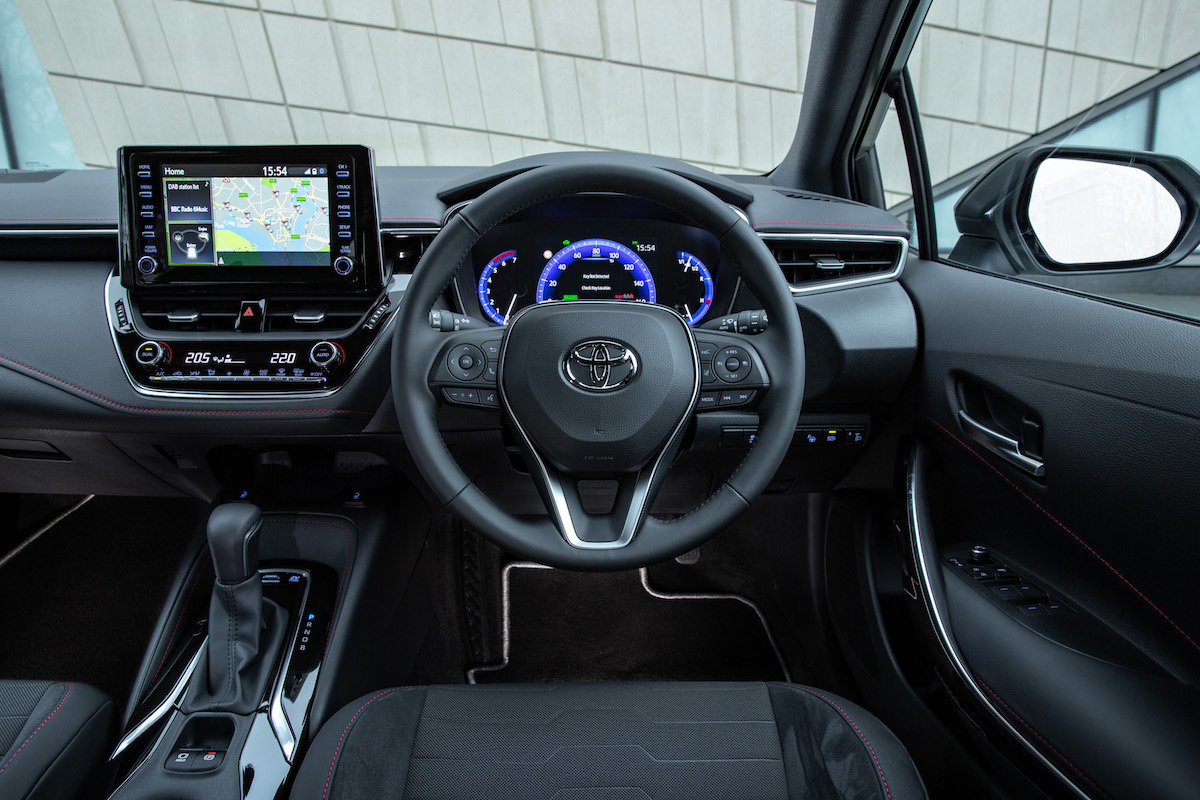
Technology, equipment and infotainment
Standard equipment across the range includes 16-inch alloy wheels, automatic LED headlights (excluding the saloon), dual-zone climate control, heated front seats, a reversing camera, adaptive cruise control, traffic sign recognition and autonomous emergency braking.
All pre-facelift Corollas also get an 8.0-inch touchscreen with DAB radio, USB charging, Apple CarPlay and Android Auto. The screen resolution and response is way off what you enjoy in a VW, Skoda or Kia, and the Toyota’s native interface isn’t always easy to navigate. However, Apple CarPlay and Android Auto make it easier to use, and with the screen set high up on the dashboard, it’s not a bad system to live with.
Opt for a post-2023 facelift model and the touchscreen grows to 10.5 inches with improved graphics and menu layouts to boot. It's a much better system than in earlier Corollas.

How much does the Toyota Corolla cost to run?
One of the chief appeals of the Toyota Corolla hybrid is that it’s priced well next to non-electrified alternatives, where pure electric and plug-in hybrid cars tend to be much more expensive to buy.
The Toyota Corolla’s official fuel economy varies between around 50mpg for the 2.0-litre hybrid and 55mpg for the 1.8, with wheel size and trim level causing small variations to that. In real-world use we found that both will return well over 45mpg regardless of how you drive them, while the 1.8-litre hybrid will get close to its claimed economy if you drive it gently. This latest generation of Toyota’s full hybrid system also spends a useful amount of time in pure electric mode, so you’ll see good economy even if you spend a lot of time around town. In fact, this might be where a hybrid makes most sense, as a diesel hatchback such as the VW Golf, Ford Focus or Kia Ceed will generally match - or even better - the economy you’ll get from a Corolla hybrid on the motorway.
Servicing will be every 12 months on the Corolla, but pricing is very competitive. Toyota offers fixed price plans, and also promises to match any service price you can find from an independent garage provided it’s using genuine Toyota parts.
Overall, the Corolla will be cheap to run, if no cheaper than an efficient diesel.

Is the Toyota Corolla reliable?
Toyota’s long-lived reputation as one of the most reliable car brands is well deserved. It routinely tops the customer service and used car reliability surveys.
All Toyotas come with a three-year mile warranty, but this can be topped up to 10 years and 100,000 miles provided you service the car every year at an official dealership. By any measure, that's a fantastic warranty offering.
While that warranty is good reason to service routinely, don’t worry about the battery life in Toyota’s hybrid cars. There are hybrid Toyotas out there with the same lithium-ion battery tech as you find in the Corolla, which have been to the moon and back distance-wise, and all without any noticeable loss of efficiency or reliability issues from the battery cells (or any other part of the car). To say that Toyota’s ‘self-charging’ hybrid powertrain has been tried, tested and proven durable is something of an understatement.
- If you’re keen to get decent boot space, be careful which engine you choose; the 2.0-litre loses some boot space as the bigger engine has forced Toyota to hide the 12V battery under the boot floor instead of under the bonnet. It’s not a huge difference but it’s enough to be annoying, especially in the hatchback, which has one of the smaller boots in the family hatchback class even in the 1.8. Both the estate and the saloon have usefully bigger boots, and more space for rear passengers as they sit on a longer wheelbase. The saloon is only offered with the 1.8-litre petrol engine, and manages a boot size of 471 litres.
- A Trek variant of the Corolla Touring Sports brings plastic wheel arches and raised ride height for SUV-esque looks, but no actual additional off-road ability. The driving position is only 20mm higher than in the standard car, so it doesn’t feel noticeably higher from the driver’s seat, either.
- Plenty of buyers will consider the Toyota Corolla hybrid instead of the ubiquitous Toyota Prius, and rightly so, given its similar efficiency. The Corolla’s CO2 emissions are as low as 101g/km on the hatch, 102g/km on the saloon and 103g/km on the estate. That’s usefully lower than any non-electrified petrol or diesel alternative, and while the Prius undercuts it with emissions from 94g/km, the Corolla is a little cheaper to buy so works out a very similar cost on company car tax or on PCP finance. Given that the Corolla is a smarter-looking car, and in saloon or estate form is similarly or usefully more practical than the Prius, we’d certainly recommend the Corolla hybrid over the Prius.
- In terms of body style, our pick for just about any buyer is the estate, or Toyota Corolla Touring Sports, to give it its full and rather clunky title. It’s vastly more practical than the hatch and saloon, looks great and is available with all the same trim levels and engines as the hatchback. It also offers virtually the same efficiency of between 50–55mpg depending on whether you go for the 2.0-litre or 1.8.
- In terms of those engine choices, most buyers will find the 1.8 perfectly satisfactory. It’s quiet and responsive enough from lower speeds, and feels within its comfort zone on the motorway even if it is far from fast by any standard. If you do value peppier performance, the 2.0-litre has much more vigour to it and will be more pleasant to drive – especially if you regularly travel with a lot of people and stuff on board – but it costs around £2,000 more than the 1.8 and is less efficient, so most will be more than happy to save that money and stick with the sedate 1.8 hybrid instead.
- Company car buyers should definitely stick to the 1.8 since its emissions put it in a lower tax band, and we’d recommend Icon Tech trim. This adds front- and rear parking sensors, factory-fit satnav to the touchscreen, and a 7.0-inch colour display for the driver, making it the best compromise between comfort and cost. We’d also suggest the saloon over the hatchback; it costs exactly the same on Benefit in Kind tax and list price, yet gets a much bigger boot and better rear passenger space (albeit the less practical saloon boot opening).
- For sportier looks, Toyota offers the Corolla in GR Sport trim, although the changes are actually only aesthetic - it drives just like any other Corolla.
- If you want to tow with your Corolla then the best bet is probably to buy something else. While you can add a tow pack to the Corolla hybrid, the maximum braked towing capacity is 750kg (450kg unbraked), so you’re limited to very light loads. For some context, most Volkswagen Golf models can tow up to 1,500kg.


