Abarth 500e 2026 review | An electric car that puts fun first

Pros and cons
What we like
Cute looks and undeniable charm
A hoot to drive
Smart interior
What to consider
Limited range
Not very practical
Not terribly affordable
The CarGurus verdict
The Abarth 500e is full of joy. It makes you smile just to look at it, and it’s peculiarly addictive to drive. Sure, the synthesised ‘engine noise’ has hints of sounding like you’re standing dangerously close to a power line, and rear-seat space is tight, but it’s hard not to warm to the fun and cheekiness it brings to everyday driving. And, provided you’re sat up front and don’t have much luggage to carry, it does a surprisingly good job of feeling comfortable and easygoing when you just want to get home.
We really like it, and if you can justify the costs and live with the limited range, it’s well worth serious consideration. It’s not the most sensible small electric car you can buy, but it is one of the most characterful. Few electric cars do a better job of ending the argument that EVs are boring.
out of 5 expert review
What is the Abarth 500e?
The Abarth 500e is a pure electric hot hatch that’s available as a two-door hatchback or 500e Convertible. It’s the angrier, more aggressive version of the Fiat 500e electric city car, although Abarth is now classed as its own standalone brand rather than simply an offshoot of Fiat. As you’d expect, there are plenty of visual nods to earlier Abarth 500s, from the pumped-up stance to the scorpion badges and extrovert colour choices.
Despite its familiar look, the Abarth 500e is very much an Abarth for a new generation. It’s only available as an electric car, using a 42kWh battery paired with a 152bhp electric motor driving the front wheels. Official WLTP-tested driving range stands at 164 miles for the hatchback and 156 miles for the Convertible – a small penalty for the feeling of wind in your hair. The short range underlines the 500e’s role as a city-focused performance car, rather than an all-round EV.
Under the skin, the Abarth sticks with the same basic suspension layout as the Fiat 500e – MacPherson struts up front and a torsion beam at the rear – but with revised spring rates and damper tuning. The wheelbase is 24mm longer, the tracks are a substantial 60mm wider, and bespoke Bridgestone tyres are fitted. It’s all in the name of sharper handling and a more purposeful stance.
The platform itself predates Stellantis’ formation in 2021, so it’s not shared with newer small electric cars like the Peugeot e-208 or Vauxhall Corsa Electric. In spirit, the Abarth 500e is closer to cars like the MINI Cooper Electric: compact, characterful and deliberately a bit compromised. With its bold styling, bright paint options and even a synthesised ‘Abarth Sound Generator’, it sets out to be one of the first electric hot hatches that puts fun ahead of outright range or practicality.
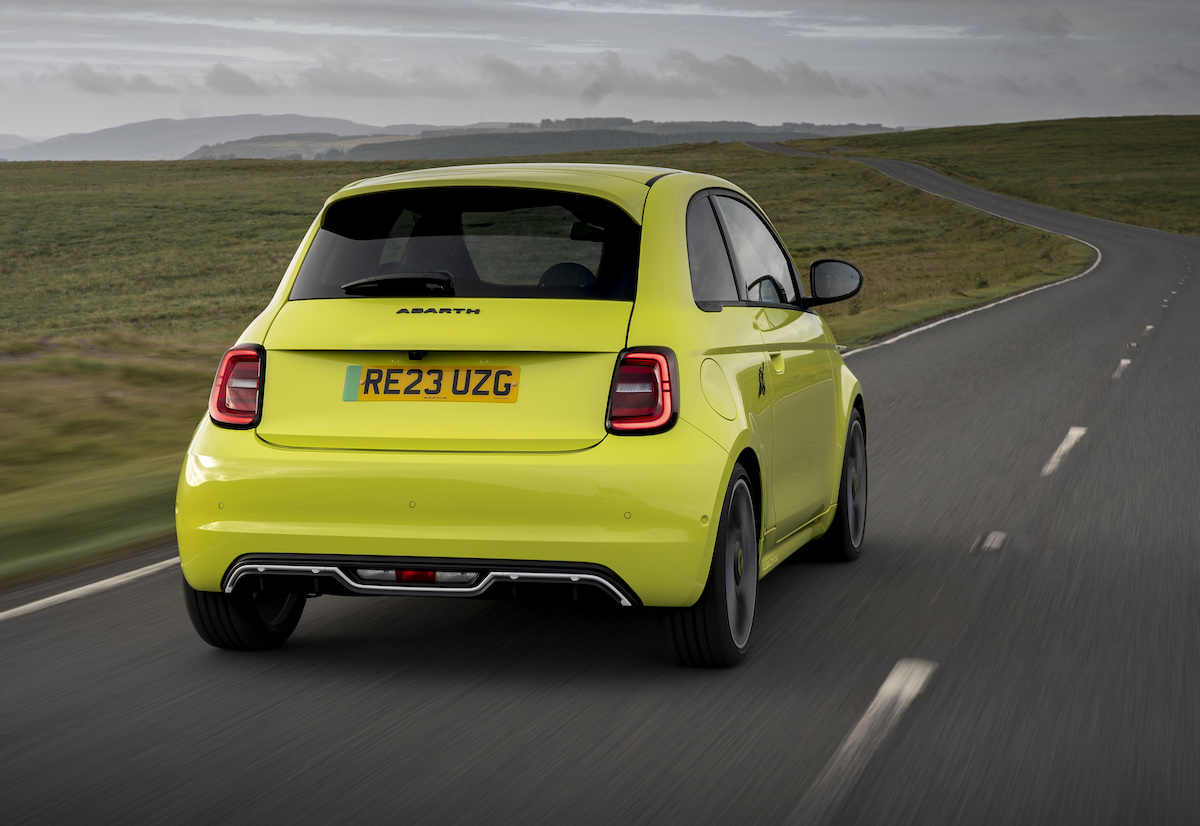
Practicality
How Practical is the Abarth 500e?
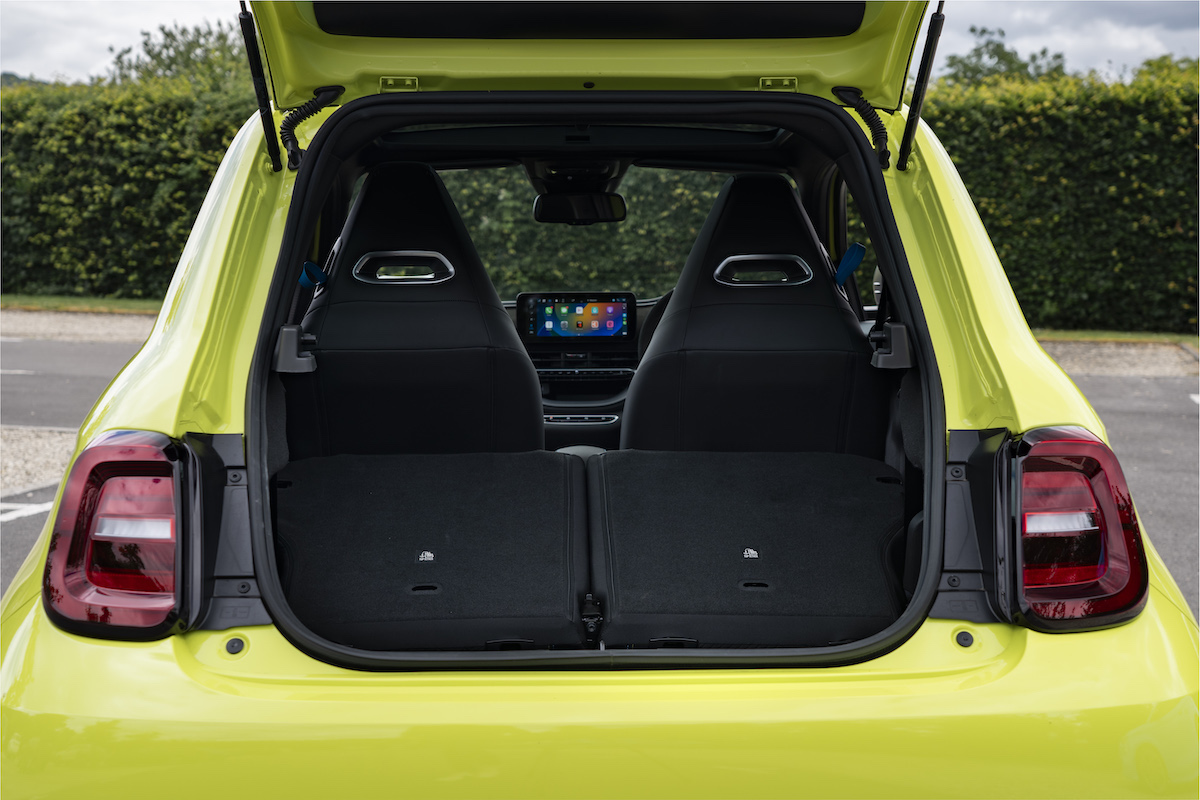
Not very, to be honest. Whether you choose the hatchback or the 500e Convertible, boot space is limited to 185 litres, or 550 litres with the rear seats folded. The Convertible is slightly more compromised, thanks to its smaller, top-hinged boot opening, which makes loading bulkier items more awkward.
There’s enough room for a couple of soft weekend bags, and the rear seats do at least fold in a 60:40 split. Space in the back seats is tight, though, particularly as the Abarth’s sportier front seats eat into rear legroom compared with the regular Fiat 500e. You can fit a pair of shorter adults back there for short trips, but access is fiddly and comfort is limited.
That said, the Abarth 500e is unlikely to be bought by anyone regularly carrying more than one passenger. For drivers using it mainly as a two-seat city car, the lack of rear space probably won’t matter too much. Up front, things are far better: the driving position is good, storage is reasonable for a small car, and manoeuvrability around town is helped by the short bonnet and compact dimensions.
Driving
What’s it like to drive?
The Abarth 500e isn’t flawless. That suspension makes things a touch bumpy at higher speeds, and some may want even more performance than the seven-second 0-62mph time signifies. Turismo drive mode – the most modest of the three modes, which comes with softer accelerator pedal response and a slight power reduction – can feel a little stodgy and mild for such an extrovert hot hatch. However, it’s a good option when you simply want to relax and get the best range from the car.
Selecting Scorpion Street mode causes everything to perk up, including the accelerator pedal response and the power output, which is boosted to the full 152bhp. You still get fairly heavy brake regeneration in this mode, but that’s easy to get used to and doesn’t detract from what’s a riotous little car to drive. You can always select Scorpion Track mode, which is the rortiest of the modes and also removes the ‘one pedal’ brake regen function that’s a feature of the less focussed settings.
The steering has a lovely weight to it, regardless of the drive mode chosen, and gives a good sense of what’s going on with the tyres and road surface. Even at very normal road speeds, there’s a real sense of connection with the Abarth, so you don’t need to rinse everything it’s got to find the Abarth bravado. Also, because it isn’t hugely powerful, the real joy is that you can use everything that the Abarth has without finding yourself fearing for your driving licence. In truth, on most roads in the UK, this sort of performance is about spot-on for having maximum fun at legal speeds.
Especially when you’ve got suspension that keeps the car tied down nicely in corners, a lovely, slim Alcantara-wrapped steering wheel (standard on the higher-spec Abarth 500e Turismo), and a car that feels lively in a cheerful, unintimidating way. It’s comfortable enough for daily life, too. Even on the 18-inch alloys of the hatchback that we drove (17s are the smallest available), it’s pliant and comfortable enough to make light work of any routine journey. The ride does get a touch sharper at higher speeds, but the Abarth still offers a nice balance of usability and playfulness.
That synthetic noise plays a big part, too. When you slide into the Abarth and hit the start button, it comes to life with a menacing rumble that burrs and vibrates from somewhere under the rear bumper, echoing into the cabin. Accelerate and the rumble increases in pitch. To say it was symphonic would be pushing it, but there is a peculiar, appealing resonance to the noise.
That said, it gets really tiresome on longer drives when a steady throttle makes it drone annoyingly. Thankfully, you can turn the sound off, although you have to be at a standstill, and you have to toggle through multiple menu settings on the driver’s readout. A simple ‘on/off’ button for the sound generator is definitely a job for the 500e facelift.
Regardless, the Abarth is a scrappy, fun little car that feels ideally suited to UK roads.

Tech and equipment
Technology, equipment & infotainment
There are two trim levels available on the Abarth 500e hatchback and Convertible. You can go for the standard car, or there’s the higher spec Abarth 500e Turismo. There was also a ‘Scorpionissima’ launch edition, but that sold out quickly and is one you might want to seek out on the used market.
The standard car is well enough equipped, with rear parking sensors, a seven-speaker JBL audio system, LED headlights, 17-inch alloys, contrasting white inserts in the bumper, tinted rear windows, lane-keep assist and autonomous emergency braking. The 500e Convertible also gets an electrically operated soft top as standard.
Turismo is the one to go for if you want the 500e to feel properly premium inside. Highlights include a black Alcantara and leather interior finish, a 360-degree parking camera, a fixed sunroof (on the hatchback), heated windscreen wipers and mirrors, heated front seats, wireless phone charging, keyless entry and blind-spot detection.
Every Abarth 500e gets a 7.0-inch colour TFT readout behind the steering wheel, plus a 10.25-inch ‘Uconnect’ touchscreen infotainment system with navigation, digital radio, Bluetooth and wireless Apple CarPlay and Android Auto connectivity. There’s also a phone app that allows remote control of the climate control, central locking and charging functions.

Running costs
Abarth 500e running costs
We initially criticised the Abarth 500e for being too expensive, but a couple of rounds of price cuts have made it more appealing. Since launch, Abarth has reduced prices significantly, bringing the 500e much closer to where it should have been. It’s still not cheap, though, especially when you can get far bigger, longer-range electric cars for that sort of cash, including the MG4, Peugeot e-208 and even the Cupra Born. None, however, offer the same sense of theatre or hot hatch bravado as the Abarth.
Monthly PCP and finance deals will be key to making the numbers stack up, as they are with most electric cars. If you can charge at home on a competitive tariff – especially an off-peak overnight rate – the Abarth can be very cheap to run, with energy costs dropping to just a few pence per mile. Relying on public charging is far more expensive, and depending on where and how you charge, running costs can end up similar to a petrol car that returns around 40mpg.
Electric cars are often more expensive to insure than petrol or diesel equivalents, but the Abarth 500e sits in relatively modest insurance groups for a performance-led vehicle, so premiums may be lower than you expect. It also benefits from very low Benefit-in-Kind (BiK) tax rates, making it an especially attractive option for company car drivers.
Abarth 500e reliability
Abarth didn’t feature in the 2025 What Car? Reliability Survey, but its parent brand Fiat didn’t fare particularly well, finishing near the bottom of the manufacturer rankings. The closely related Fiat 500e, however, performed more respectably, placing mid-table in the electric car reliability results, ahead of several more expensive, premium-branded EVs.
Like most electric cars, the Abarth 500e benefits from a relatively simple mechanical layout, which removes many of the components that can cause issues in petrol or diesel cars. It also shares much of its hardware with the Fiat 500e, and while the creation of Stellantis doesn’t guarantee reliability, it does mean wider parts availability and greater manufacturing scale than Abarth has ever had before.
An eight-year, 100,000-mile battery warranty is included as standard, while the car itself is covered by a three-year, 60,000-mile warranty. The likes of MG, Kia and Hyundai all offer longer warranties.


What owners say
Three things to know
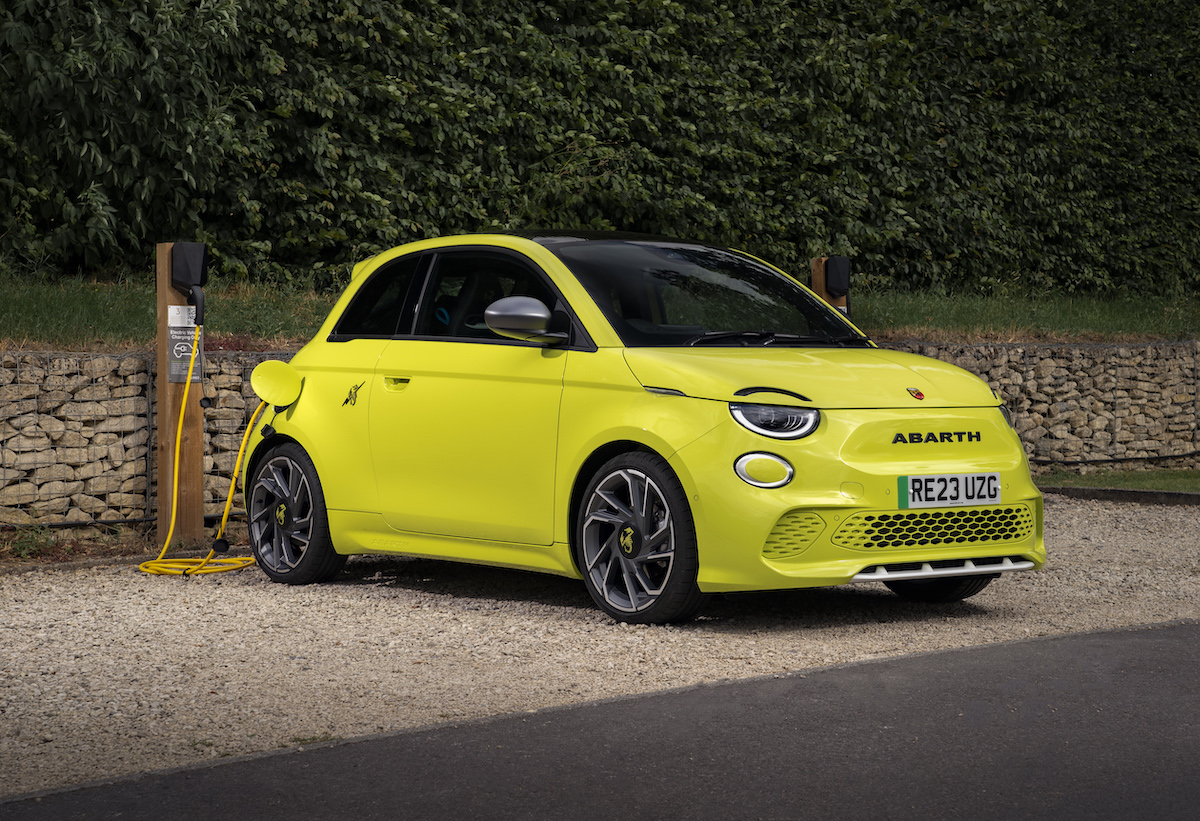
- The Abarth 500e gets an 85kW peak charging speed, which is less than you get in the Peugeot e-208. Expect to get a 10-80 percent top-up in 35 minutes, while a full charge from a 7kW home wallbox will take around seven hours.
- The WLTP-tested range for the Abarth 500e is up to 164 miles, but this drops to 157 miles if you go for the Turismo with 18-inch alloy wheels. Similarly, the range is 156 miles in the standard 500e Convertible, dropping to 151 miles in Turismo guise. Expect real-world range to be more like 100-130 miles in winter, or 120-150 miles in warmer weather. Longer range alternatives for a similar price include the Peugeot e-208, or you could consider the standard Fiat 500e, as it has a usefully longer range and still looks cool (even if it lacks the Abarth’s rebelliousness).
- The Abarth 500e Convertible doesn’t have a full convertible roof but, as with the standard Fiat 500e Convertible, has fixed roof arches that the fabric roof scrolls back on electrically. Rear visibility is atrocious with the fabric roof fully back in its ‘pram’ position, because the fabric is folded where your eyeline falls when you look in the rear-view mirror. However, it is great fun to have the roof down. You can also close or open the roof at fairly high speeds, which is useful.
Which one to buy
- If you want the best value: The standard 500e Abarth hatchback gets most of the important equipment as standard and is the cheapest to buy. That said, the step up to the Turismo brings a lot of desirable extras, and resale values are likely to be stronger. It’s a noticeable jump in price, but in the long run the Turismo may actually prove better value and nicer to live with.
- If you want the sportiest: The Abarth 500e Turismo hatchback in a bold colour is the one to have. Acid Green would be our pick if you want to stand out, while the discontinued Poison Blue is well worth seeking out on the used market.
- If you want the best urban commuter: Ride comfort is good enough even on the Turismo’s 18-inch alloy wheels, and the extra features – including keyless entry, heated seats, blind-spot warning, a 360-degree camera and that Alcantara steering wheel – all make day-to-day driving in town easier and more enjoyable.


