Audi R8 Review (2016-2024)
Audi R8 cars for sale
5.0
Expert review
Pros
Tremendous V10 engine delivers sound and fury
Choice of coupe and cabrio body styles
Thrilling to drive, yet easy to live with
Cons
Lacks the exotic appeal of a Ferrari or Lamborghini
No manual gearbox option
High running costs
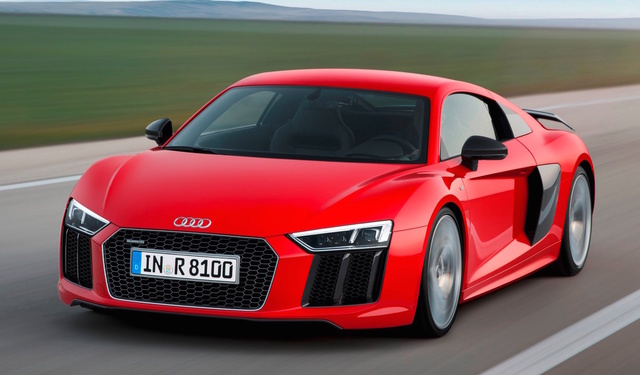
The CarGurus verdict
Judged by any measure, the R8 is a truly exceptional piece of engineering, regardless of whether you’re drawn to the slinky Coupe or sunseeker Spyder. Both offer a truly engaging driving experience, underpinned by staggering performance and heralded by one of the most evocative soundtracks in motoring.
The fact that the R8 is so flexible, so comfortable and so usable on a daily basis only adds to its overall appeal. Undoubtedly the R8 will be sorely missed when it is finally consigned to the annals of emissions-enforced history, so our advice would be to snap one up while you still can.

What is the Audi R8?
If you’re in the market for an awe-inspiring mid-engined supercar, then Audi isn’t necessarily going to be your first port of call. Cars such as the Porsche 911, numerous Ferraris or perhaps a Lamborghini Huracan are likely to come higher up the pecking order. And therein lies one of the very few problems with the R8, because in every other respect, it is an adrenalin junkie's paradise.
Still, while it might not carry the brand cachet of some of its rivals, with V8 or V10 power, an advanced spaceframe chassis and proper supercar styling cues, it cuts quite the dash.
How practical is it?
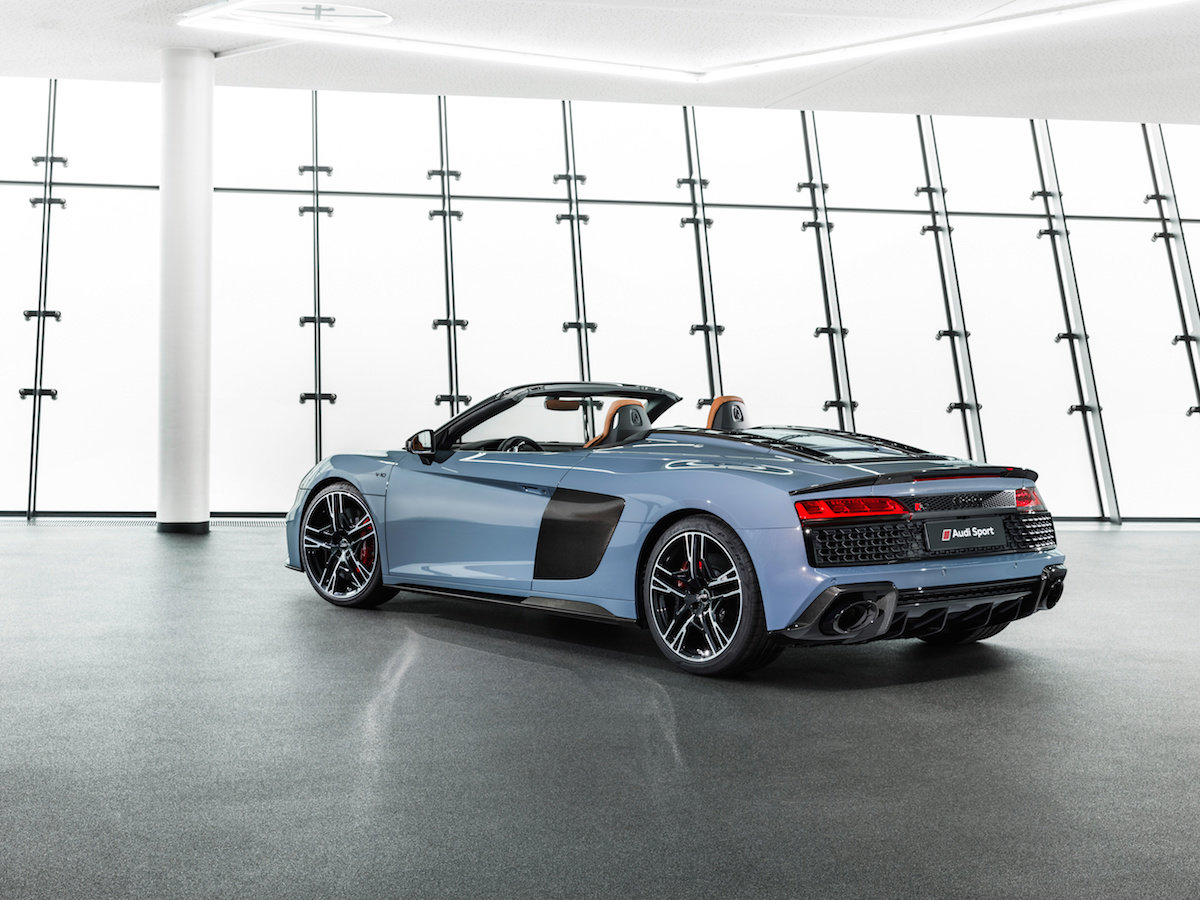
You’ll need to be a light packer because, as with any mid-engined car, there’s not a lot of luggage space (112 litres), and even less in Spyder form, as it needs to accommodate that folding roof. So if you plan to use your R8 for road trips on a regular basis, that might be a clincher for choosing the Coupe.
But while in the case of most supercars, we’d probably recommend the Coupe version over the soft-top for its additional torsional rigidity, the R8’s space frame does such a brilliant job of resisting flex and sacrifices so little in handling integrity that we’d be inclined to give the nod to the drop-top Audi R8 Spyder, assuming you can live with its diminished luggage capacity. There are two major reasons for that: firstly, who doesn’t love the sun on their face on a sweet summer’s evening? Secondly, with the roof dropped, the engine can be appreciated in all its glory as its incendiary exhaust note lays waste to the surrounding countryside.
What's it like to drive?
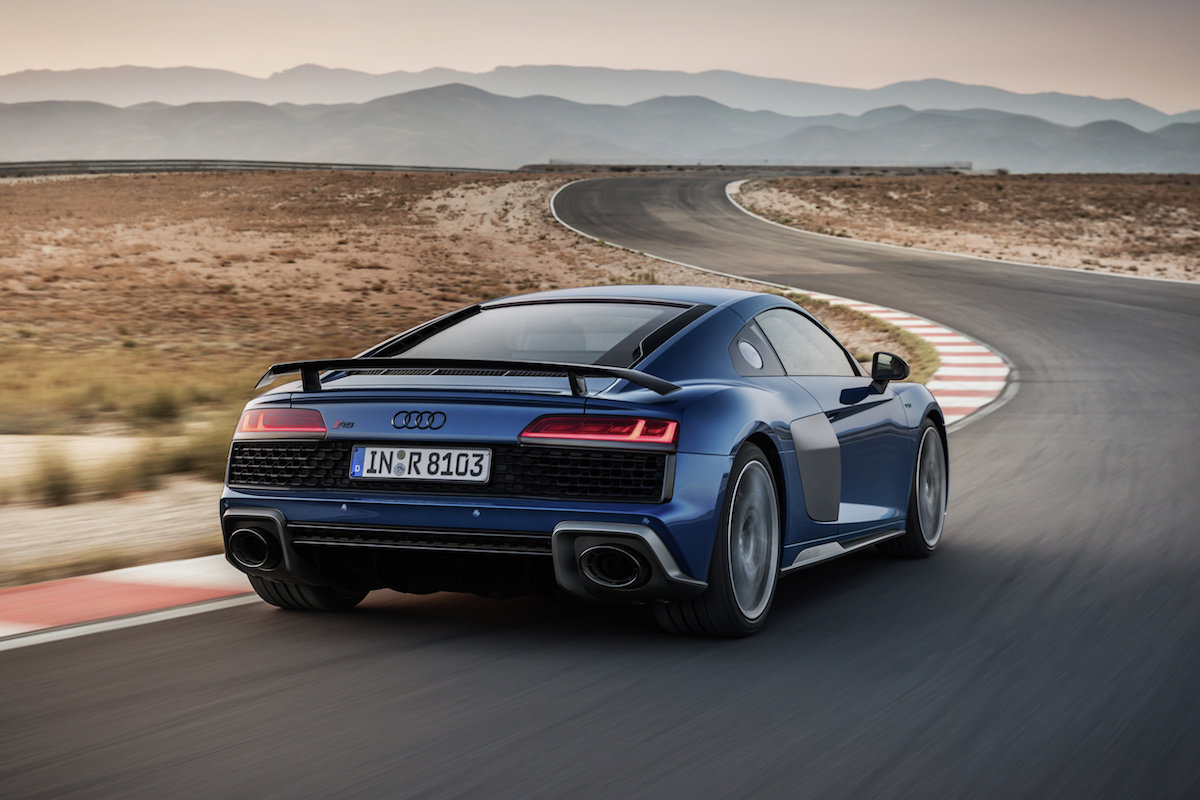
Powered by one of the greatest engines ever to put light to petrol, the mid-mounted 5.2-litre FSI V10 engine's explosive output is transferred to the road via a quick-fire double-clutch paddle-shift gearbox, and in most cases, Audi’s famed Quattro all-wheel-drive.
These days, almost every car engine relies on turbocharging to boost engine power and increase efficiency, but not the R8, which needs no such mechanical slave-driver to produce its phenomenal power outputs. Although the engine builds strong power just off idle, making it very tractable and a doddle to drive around city streets, it really comes alive above 5,000rpm, delivering a spine-tingling mechanical cacophony and eye-ball dilating performance all the way to the 8,500rpm limiter.
Despite its intense performance, the R8 is very composed on all but the roughest surfaces, so it’s a comfortable car to go touring in thanks to its supple, sophisticated suspension. You’ll also need to take quite a few breaks along the way as low twenties fuel consumption is the norm.
The R8 is no shrinking violet, and the tape measure suggests it’s pretty wide with it, but approach a series of bends and you’ll instantly dismiss any misgivings. The steering is well-weighted, responsive and direct, and the grip levels are simply epic. The four-wheel-drive system is rear-biased, but it’s so sure-footed you can stamp on the accelerator and the tyres will stick to their task with unshakeable determination.
When it comes to stopping, the R8’s brakes are no less impressive. With lots of feel from the pedal you can detect exactly how much force to apply, and only if the road surface becomes particularly gnarly will you trigger an ABS intervention.
Technology, equipment & infotainment
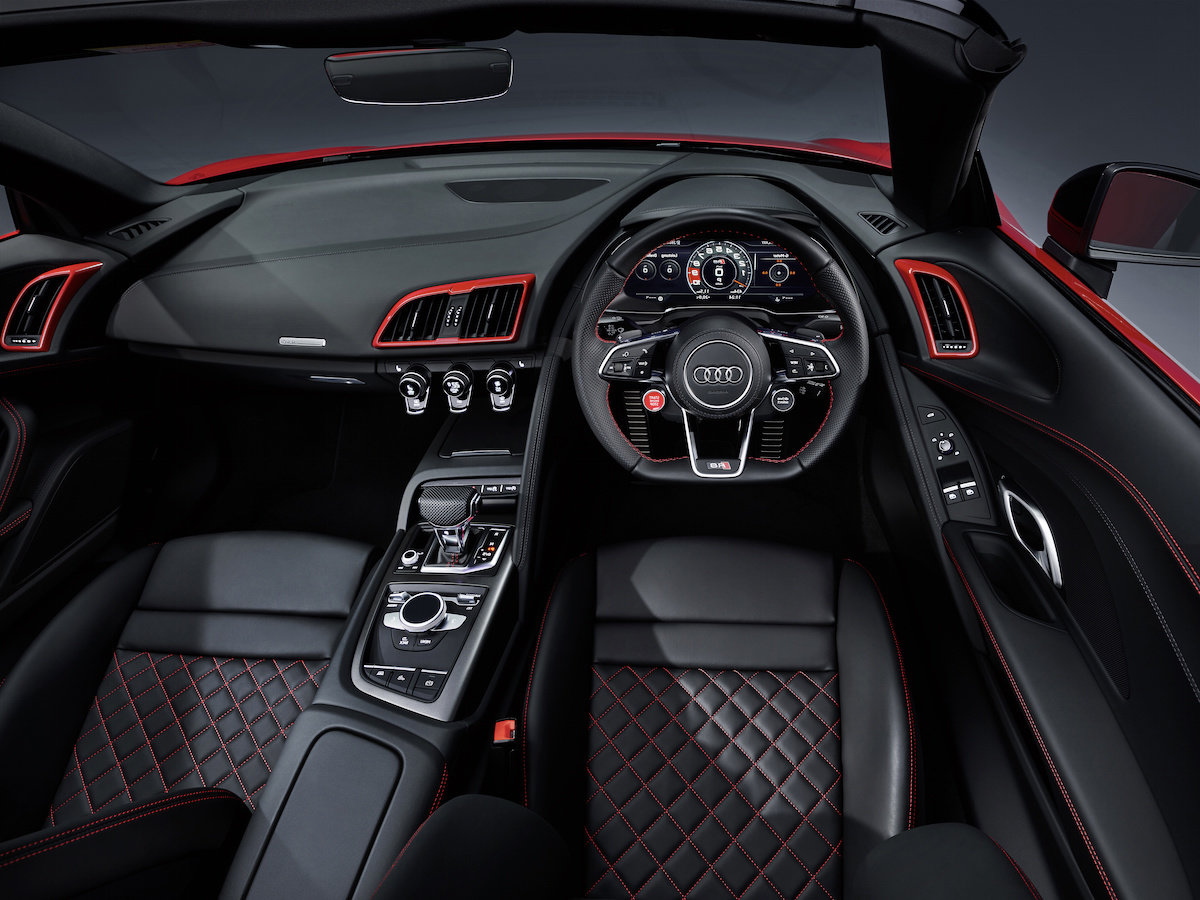
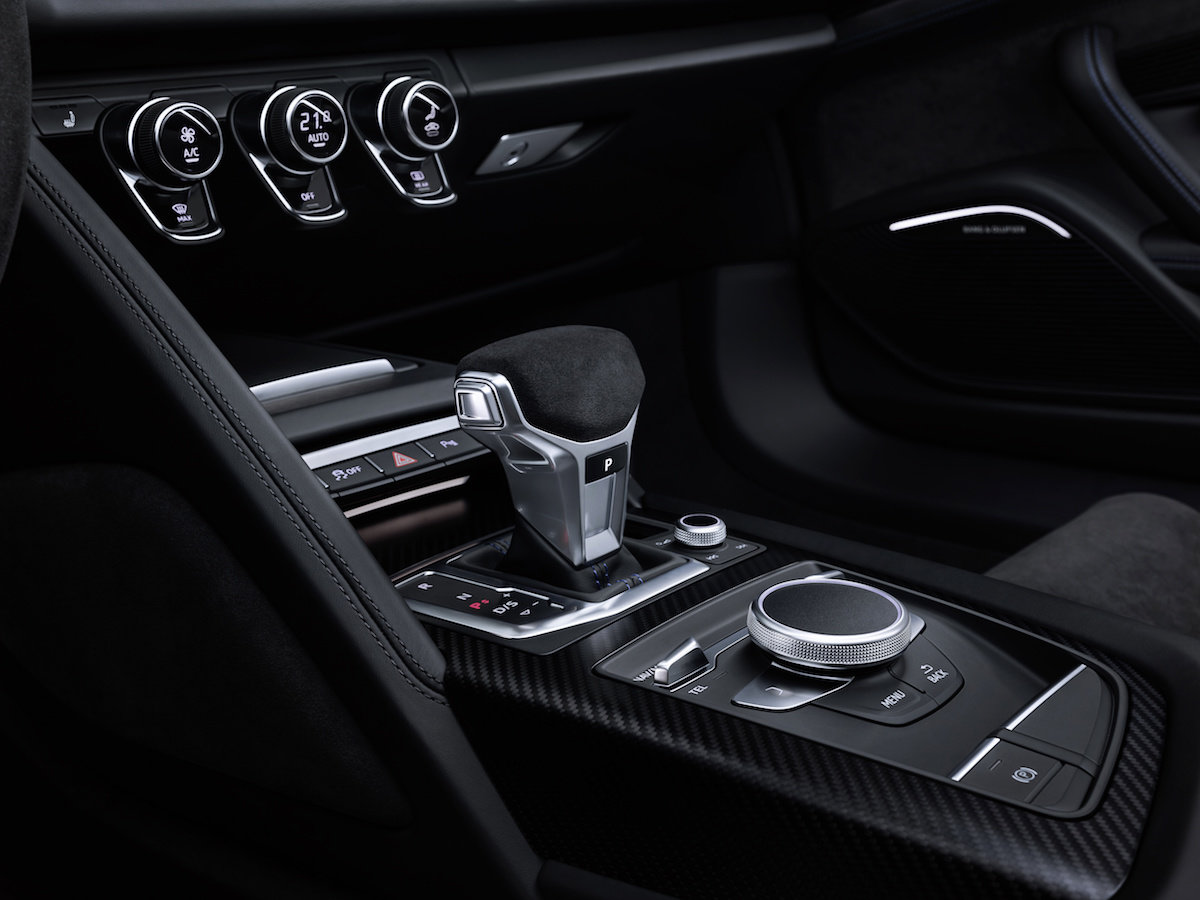
At first glance, there’s nothing startlingly flash about the R8’s interior, but it is pretty cool. A blood-red starter button and many of the car’s functions - including the various driving modes - are controlled via the flat bottomed steering wheel. Although there’s no central screen, you do get Audi’s virtual cockpit display which, shows a digital speedometer and rev-counter, and doubles as a configurable infotainment screen, including a 3D satnav display.
The entry-level cars come with pretty much everything you need, including leather trim, climate control and Audi's virtual cockpit, but if money is no object, you can up the ante with some pretty pricey extras. Adding sports bucket seats to the basic car costs an additional £3,000, while piano black highlights will set you back £1,300, making the Bang and Olufsen upgraded sound system look pretty reasonable at £1,900.
Audi R8 running costs
Just because the R8 is an Audi, don’t go thinking it’s going to be cheap to run and keep in rude health.
If you’re buying new, you’ll pay the first-year VED premium of £2175, and £475 in annual road tax thereafter. There’s also no prizes for guessing that the R8 falls into the top insurance grouping. Consequently, regardless of your age or how blemish-free your driving record is, your premium is going to be pretty hefty. Four figures will be more the norm than the exception for comprehensive cover, and if you’re in your early twenties, well, good luck.
The R8 is a high-performance car and that prodigious power output certainly takes its toll on fuel and tyres. If you drive it as God intended, your mpg will struggle to better the mid-teens. We certainly wouldn’t recommend using anything other than the premium tyre brands that Audi’s engineers signed off on, as anything less will undermine the car’s optimum grip, steering feel and braking performance levels. They won’t be cheap – you’ll be lucky to get much change out of £1000 – but it will be money well spent.
An initial service should be carried out at 10,000 miles or after one year has elapsed, and thereafter, every 20,000 miles or two years, whichever comes first. A short oil and inspection service, including a replacement pollen filter and a thorough check of all the R8’s componentry, should cost around £450, while a major service will up the ante to the painful end of £900, depending on what the technicians discover once the car is up on the ramp.
Other than that, Audi has more than a hundred dealerships in the UK, so you shouldn’t have to travel too far to have your R8 fettled. Aside from any specialist undertakings, prices for basic items such as an air-conditioning re-gas at an approved dealership shouldn’t be any more expensive than your local garage.
Audi R8 reliability
By the standards of complex modern supercars, the R8 has a pretty impressive reliability record. With the power of the Volkswagen Group behind it, it is not surprising it is relatively untroubled by the kind of electrical and infotainment gremlins that afflict some more bespoke offerings. Despite the prodigious strain placed on the V10 engine, it is known to be a very robust device, as is the twin-clutch gearbox, which is a beefed-up version of the basic S-Tronic transmission used right across the VW/Audi empire. If you use your R8 on a daily basis, you’ll also get through brake pads, and eventually, the disc rotors themselves. You can expect a set of pads to cost around £350 per axle, but if these are replaced at the same time as the rotors, there’ll be little change from £1200 per axle.
Aftermarket suspension units may also be a more cost-effective way to go if your variable dampers begin to weep, because replaced as a set, they really will make you weep. Other than that, suspension bushes will need attention as the car ages and these will need to be replaced completely with their aluminium suspension arms, rather than attempting to remove and replace the bushes alone. Along with the air-conditioning condenser, the R8 has three radiators located behind the front bumper grilles. These are vulnerable to stone damage and prone to gathering leaves and other small pieces of road debris. It’s good practice to have the vents cleaned out on a regular basis to ensure maximum airflow. Although the bumpers and grilles do protect the radiators to some extent, if one does get punctured it will cost around £300 for a replacement unit, plus labour and a fluid top-up.
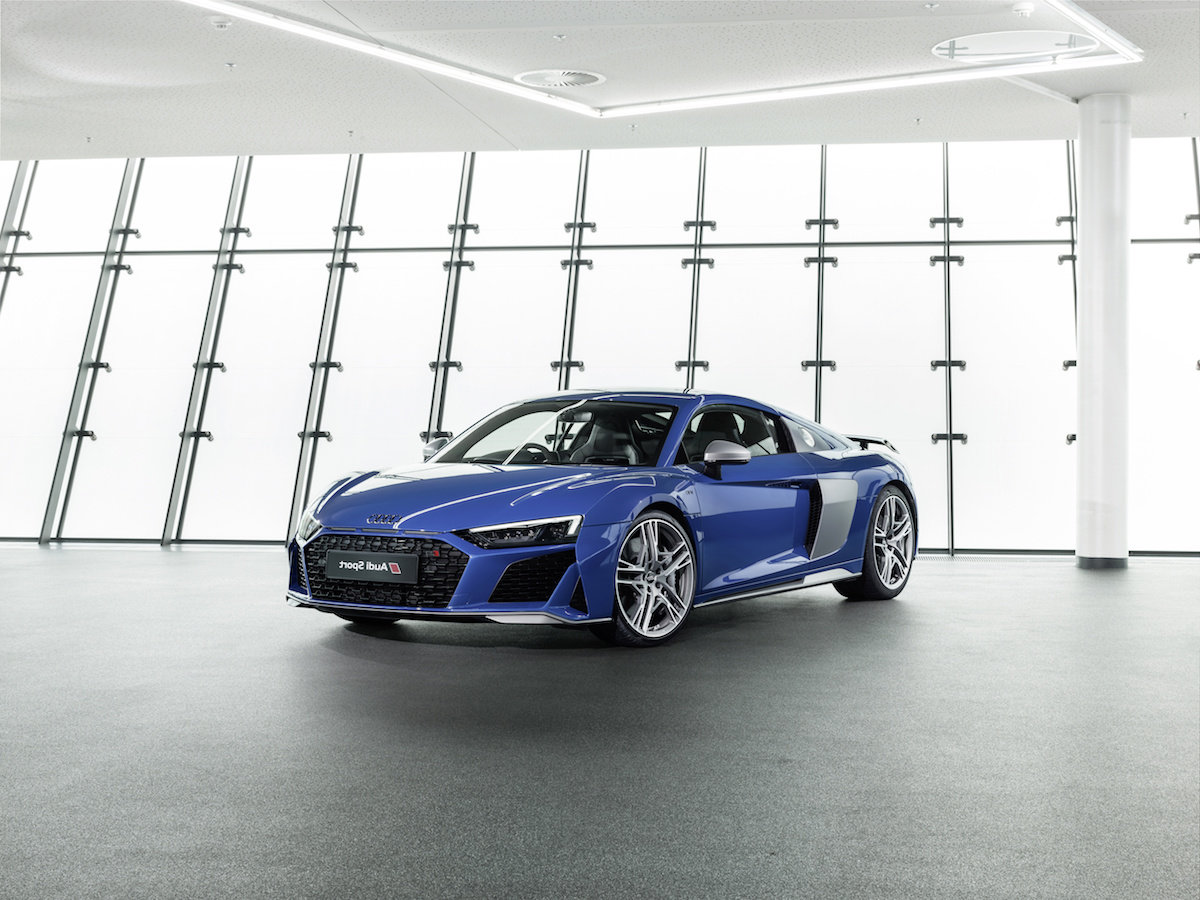
- It’s easy to identify the latest version of the R8 from its predecessor as it no longer has the distinctive carbon fibre mid-mounted aero blades and features far more angular lines than the droop-nosed original. Under the skin, the mechanical layout remains essentially unchanged with a labyrinth tubed space frame and a mid-mounted engine used to provide near-perfect weight distribution.
- Sadly, there’s no longer a more affordable smaller capacity V8 version or a manual gearbox option for those who prefer to change gears the old fashioned way. Thankfully, the old R-Tronic automatic gearbox has been binned. In truth, it was a pretty awful device, mainly because it wasn’t a true automatic. Relying on a series of robotised mechanisms to disengage a single clutch plate and punch home the gears, it was at best uncultured and frustratingly jerky at low-speeds. The seven-speed dual-clutch S-Tronic automatic in the latest models is infinitely better. In manual mode, when you’re taking control with the paddles, the shifts are lightning-fast, and even when left in its full autoselect mode, it is so much smoother than the previous encumbrance. In 2018, a mid-cycle facelift ushered in cosmetic styling enhancements, while 2019 saw subtle power and mechanical upgrades.
- The latest cars are available in three states of tune. A 533bhp version comes with rear-wheel-drive rather than the famed Quattro all-wheel-drive set up, followed by the 562bhp Quattro, which makes up the lion’s share of sales. If that isn’t enough lunacy for you then the eye-watering 600bhp produced by the V10 Plus and later Performance Quattro model should hit the spot.
- If you’re buying on a budget: R8s are primarily owned as second cars, so it’s easy to find plenty of low mileage examples. You can pick up a pristine, 30-40 thousand-mile privately-owned car for around £70,000. If you’re buying a lower mileage car with only one or two previous owners from a dealer, however, you can expect to pay closer to £90k. At that sort of money, a spanking new car begins to look quite attainable.
- If you want the most affordable new model: For just under £115,000, a rear-wheel-drive R8 can be sitting on your drive. This undercuts the Quattro version by about £15,000 and you shouldn’t let the marginal power deficit or the absence of all-wheel drive put you off, as many consider this is to be the sweetest driving R8 of all.
- If you want the full-on V10 experience: If you really want to tap into the full supercar involvement, then you should forget about bald power figures and concentrate on the R8 Spyder. In essence, you buy an R8 for the soundtrack as much as the performance and handling, and the best way to tap into this mechanical overture is to drop the roof and get the full aural assault from the V10 belting out its melodious bellow. Used prices are slightly punchier than the Coupe’s, but we’d consider this a premium worth paying.

