BMW M3 E46 Review (2000-2006)
BMW M3 Coupé cars for sale
5.0
Expert review
Pros
Wonderful straight-six engine
Hugely enjoyable to drive
Relatively roomy interior and decent boot space
Cons
Convertible doesn't drive as well as the coupe
The CSL model wasn't offered with a manual gearbox
The cost of upgrading a tired example could be crippling

The CarGurus verdict
The E46 M3 is one of those cars that was nigh-on perfect straight out of the box, and is still revered today for its brilliant blend of attributes. The combination of everyday tractability and almost supercar levels of performance is almost a BMW M trademark, and the fact that the M3 is also a very practical proposition is the icing on the cake.
The engine is a jewel; the way the needle flicks round the rev counter from 4,000 to its 8,000rpm redline is simply astonishing and the hard-edged straight-six howl is utterly addictive. The driving experience is just as memorable, with the direct steering enhancing the BMW E46’s already-impeccable handling, while the level of driver involvement and sheer excitement will ensure a place for the E46 M3 in the pantheon of BMW greats.

What is the BMW M3?
The E46 M3 was the third car in BMW’s M3 dynasty, following on from the race-bred E30 and the subtler and more rounded E36. It was introduced right at the end of 2000, with right-hand-drive production starting at the beginning of 2001, initially just as a two-door coupe. A cabriolet would join the line up later in 2001 but for this generation of M3 there would be no four-door model.
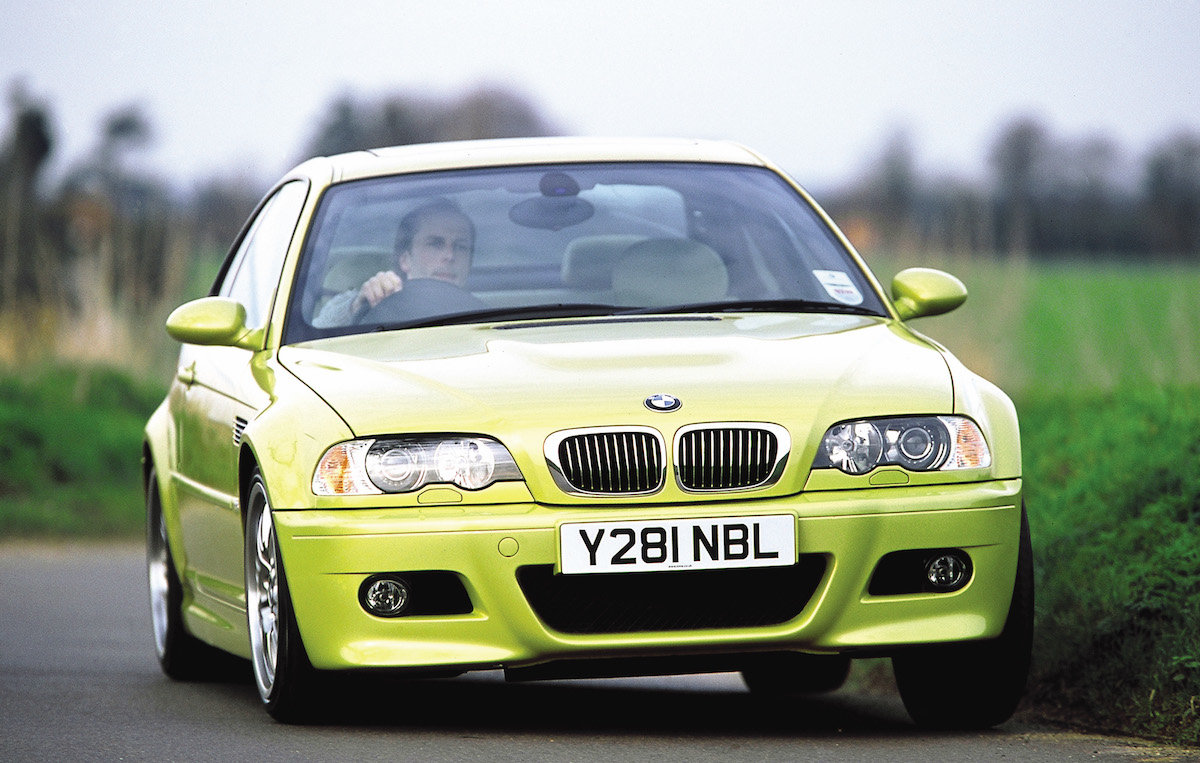
On the looks front, BMW decided to make the E46 M3 stand out from the crowd rather more than the subtle previous generation M3 and added extended wheel-arches, quad exhaust tailpipes, aerodynamic mirrors and an aluminium bonnet with a power dome. Side air vents and a more aggressive bumper design with large, sculpted intakes added to the look, finished off with a discreet rear boot spoiler. It looked right from the word go and there was no chance of mistaking it for anything less than the top dog in the 3 Series range.
The E46 M3 bowed out in 2006 and we had to wait until 2008 for its replacement, the controversially V8-engined E92 BMW M3.

How practical is it?
The E46 M3’s cabin drew on the already excellent cockpit of the regular BMW 3 Series, and added M-specific instruments with a clever illuminated band around the rev counter to let the driver know how warm the engine was and how many revs could be used. Elsewhere there were excellent sports seats and a pretty decent quota of standard equipment. As with many contemporary BMWs there was an extensive options list, too.
Remember that the M3 is practical for such a high performance vehicle, too. The rear seats will fit a couple of adults, and the boot, at a roomy 410 litres, is just as useful as it is on any other 3 Series.
What's it like to drive?
Prior to the E46 M3’s debut there had been plenty of speculation as to what engine would be under the bonnet. Previously, BMW’s M division had claimed that the E36 M3 Evo’s straight-six had already been taken as far as it could go, and there were plenty of rumours that the new E46 M3 would sport a V8 under its sculpted bonnet.
In the end, M did manage to extract extra capacity and additional power from the straight-six. The capacity was increased to 3,246cc and, unlike many of the E46 M3’s contemporaries, the S54 (as the new unit was codenamed) retained an iron block with an alloy head. There were plenty of refinements and revisions over the E36 M3’s engine, and these included reprofiled camshafts, a double Vanos continuously variable valve timing system that operated faster the higher the revs went, and electronic throttle butterflies controlled by a new engine management system. There were also redesigned rocker arms for reduced reciprocating mass and friction, a one-piece aluminium head casting for lighter weight and a scavenging oil pump to maintain pressure during heavy cornering. Peak power was an impressive 338bhp at a heady 7,900rpm, backed up by 269lb ft of torque at 4,900rpm. Power was transmitted via a six-speed manual gearbox, and reached the rear wheels via an M limited-slip differential.
Everywhere else on the car components were upgraded over the normal 3 Series models, with a wider track, stiffer and shorter coil springs and gas-filled dampers front and rear, with separate mounting of top spring and shock absorber anchor points. Anti-roll bars were thicker while there were bespoke forged aluminium suspension components with unique bushings and ball joints.
Larger cross-drilled brakes were fitted but BMW opted against four-piston callipers, which made the car’s brakes one of the few areas where it could be found lacking. For the first time on an M3 there was a traction control setup known was Dynamic Stability Control (DSC), which was developed specifically for the car. It could reduce power and/or brake each wheel individually, to help maintain traction and control oversteer.
Given the success of the previous generation M3 convertible it was a shoe-in that BMW would continue with the soft-top for the E46 M3, and the car made its production debut not long after the coupe in April 2001. Mechanically it was identical to its coupe counterpart but, inevitably, the additional weight of the body strengthening measures and the electric hood blunted the performance slightly – 0-62mph took 5.5 seconds, 0.3 seconds slower than the coupe.

Technology, equipment & infotainment
The E46 M3 was equipped as standard with 18-inch alloy wheels and, as an option, a set of 19-inch wheels were available. As is often the way with manufacturers, the larger set – which were a costly £895 option when new – are perhaps the more visually appealing design, and as a result many owners optioned these wheels when the car was new. However, the 18-inch wheels actually suit the car better in terms of ride comfort and handling. Ultimate grip levels might be slightly lower, but there’s better feedback through the steering and improved balance on the smaller 18-inch set up.
The Sequential M Gearbox in the E46 M3 was a far better option than the automatic that was fitted to the previous generation of M3, but most keen drivers will still opt for the traditional six-speed manual, as it adds another layer of interaction between the car and driver. However, some die-hard manual fans do end up buying a car with the SMG II transmission, and its whip-crack shift speeds do suit the nature of the car. Change quality can be harsh on its fastest setting but a momentary lift of the throttle smooths this out considerably. Cars with the SMG II gearbox do tend to be significantly cheaper than those with manual gearboxes.

BMW M3 running costs
On the face of it the E46 M3 looks to have just about the perfect blend of style, performance and practicality but there is a caveat. While the E46 M3 might be referred to as a relatively affordable performance car, it shouldn’t be viewed as bargain performance car – running costs can be high and returning a cheaper example back to its former glory could be financially crippling.
Fuel economy isn’t too bad, especially on a cruise, with owners reporting more than 30mpg on the motorway. Use the car’s considerable performance though, and that will quickly plummet to 15-20mpg. Annual VED is £330 a year, although some very late examples registered after March 2006 will attract the higher rate of £580 thanks to their high emissions.
Servicing is based on how the car is being driven and which service is due is shown on a service indicator, but we would advise having the oil changed on a yearly basis, especially for higher mileage examples. An oil service will cost between £150 and £200 at a BMW independent specialist while an interim Inspection I service will be in the region of £500, with the most major service, an Inspection II costing around £700. The valve clearances need to be checked and adjusted at every Inspection service.
Brakes tend to be used quite hard on an M3 so expect to change the brake discs on every second pad change – a new set of front pads and discs will be in the region of £500 at an independent specialist with the rears costing £350. A set of tyres will cost between £600 and £900 for a quality brand, and it’s vital to fit decent rubber to a car like this.

BMW M3 reliability
From launch, the E46 M3 earned itself a reputation for durability as well as driver involvement and that remains true today, provided the car has been well maintained and has a full service history. However, like just about any older vehicle there are a few problem points to be aware of.
When the M3 was new, its engine had a less-than-robust bottom end, but a series of recalls from BMW addressed these issues. Models from 2001 and 2002 were affected so it’s worth checking with BMW that these recalls were carried out. Bottom end shells can still wear (more so on machines that are driven for short distances without properly warming up) and will get noisy. It’s best to get them attended to as soon as it’s diagnosed, as failure to do so will result in further damage. It can be done without removing the engine so it’s not as ruinously expensive as you might think.
Other potential engine faults can be blown head gaskets – around £1,500 to replace at a specialist – while faulty coils and crank and camshaft sensors can lead to the engine running rough. There have also been some cases of Vanos variable valve timing failure, but the failure rate is not as high as internet folklore makes out. A new Vanos unit from BMW will cost in excess of £2,500 but there are several companies that will rebuild Vanos units from about £600 to £1,000 depending on the nature of the repair.
Perhaps the biggest concern on an E46 M3 is the tendency for the rear subframe to pull away from the body of the car, cracking the boot floor in the process. Not all cars are affected, but it does seem to be becoming an increasingly common problem. Prevention is better than cure so many owners are fitting reinforcement plates to the floor of their M3s – the cost could be up to £2,000, but it’s a very worthwhile investment to make and prevents the issue occurring in the first place.
When buying an E46 M3 it’s vitally important to have a specialist inspection carried out on a prospective purchase.
- Late in 2001 the E46 M3 was also offered with the second-generation Sequential M Gearbox (SMG II) as a £2,100 option. This uses the unaltered internal gears and ratios of the six-speed manual gearbox but with automatic operation of the clutch and engagement of each gear via an electrohydraulic system, operated by Drivelogic, the electronic gearbox software. There were 11 different modes that could be chosen by the driver; six ‘manual’ where the driver could change gear either with the stubby gear knob or via steering wheel-mounted paddles, and five ‘auto’ modes where the changes were computer controlled. The SMG gearbox also brought with it a launch control function.
- Ostensibly, the pinnacle of the E46 M3 range is the CSL, a stripped-out lightweight version of the coupe that was in production over an eight-month period in 2003. Creature comforts were dropped – no air-con, xenon headlights or even a radio (although all could be added as options) – and a carbon roof, aluminium doors and other lightweight components, such as a forged set of 19-inch wheels, ensured it weighed 110 kilos less than the normal M3. It had more power, now up to 355bhp, and a carbon fibre air box that endowed it with the best induction roar this side of an F1 car. The suspension, steering and brakes were all uprated and inside there were racing seats with carbon shells. The only transmission was the SMG II sequential gearbox and just 524 right-hand drive examples of the E46 M3 CSL were made. However, arguably the best all-round E46 M3 was its fourth and final incarnation of the CS, which was launched in the UK late in 2005. The M3’s swan song, it combines some of the best items from the CSL – including the brakes and, perhaps most importantly, the CSL’s quicker steering rack and 19-inch wheels – along with the comfortable bits of the standard car to produce what is arguably the best all-round E46 M3.
- While the production M3 was fitted with a straight-six engine there was a V8-powered version of the E46 M3, the motorsport M3 GTR. This was designed to win the American Le Mans Series in 2001 which it proceeded to do as well as winning the Nürburgring 24 Hour race twice in 2004 and 2005. In order for the car to meet homologation requirements a handful of road going versions were built making it the first V8-powered M3.
- If you want to use it every day: A standard E46 M3 is still highly useable as day-to-day transport, despite the oldest examples now touching 20 years old. For the best ride, choose a model with 18-inch wheels. Both manual and SMG II models would be suitable, although if a lot of town miles are involved then an SMG would be a better choice for its automatic mode.
- If you want to rustle your toupee: While the E46 M3 Convertible isn’t quite as rigid as the coupe – and hence not quite as satisfying to drive hard – it’s still a potent soft top that is an enjoyable steer. Thanks to a fully electric soft-top roof, lowering and raising the hood can be done from the comfort of the driver’s seat and finding a factory hardtop will make it a good prospect for the winter months. The hardtop is pretty bulky and heavy and is definitely a two-person job to fit and remove.
- If you want the ultimate thrill: The E46 M3 CSL is the ultimate model, although some drivers bemoan the lack of a manual option. However, the CSL offers the best handling, and grip is of the highest order in the dry thanks to the Michelin Cup tyres with which it should be equipped. The enhanced engine is absolutely wonderful and has an enthralling induction roar thanks to its carbon air box. One fly in the ointment could be the seats though – their fixed backs and a lack of lumbar support mean that some drivers struggle to get comfortable.
- If you want the best all-rounder: While it lacks the glorious engine note of the CSL, the M3 CS combines the best elements of the standard M3 and the CSL. With the subtle suspension changes and a faster steering rack, as well as bigger brakes, it handles better than the standard car, yet retains its creature comforts.