BMW M4 Coupe Review (2014-2020)
BMW M4 Coupé cars for sale
4.0
Expert review
Pros
Colossal performance and immense grip in the dry
Handling became more accessible towards the end of the car's life
Easy to use every day
Cons
Turbocharged engine lacks character
Tricky wet weather handling of early cars
Expect to chew through rear tyres if you use all of the M4's performance

The CarGurus verdict
BMW made significant improvements to the first-generation M4 throughout its years on sale. While in 2014, when it was brand new, the M4 could be a tricky and unforgiving machine (especially on challenging roads and even more so when those roads were wet), by the end of its life, it was a brilliantly-resolved and hugely enjoyable performance car. Even the most basic M4 you could buy during its twilight years was a far better thing than an equivalent early example.
Nonetheless, the F82/F83 M4 isn’t likely to be remembered as a cast-iron great, but with hugely varying opinions. Some will adore it; others think it a low point in the history of BMW M. But today and as long as you know what to expect, the M4 makes for a very tempting used buy. It’s a fast and very usable car that looks the part and will always set your heart racing – whether you want it to or not.

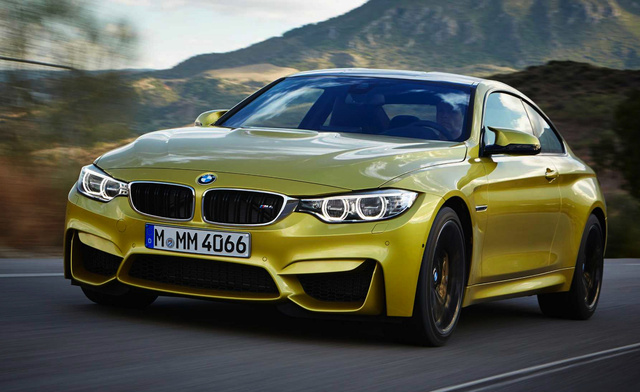
With the tough-looking M4 in 2014, BMW chewed up and spat out almost three decades of tradition. This was the first time the M4 nameplate had been used – until then, its M3 super saloon was badged as such whether it had two doors or four. But in 2014 the saloon and coupe variants went separate ways, the former sticking with the M3 designation that had been in use since 1986, while the latter adopted the new name.

How practical is it?
Within the cabin, BMW did a fair job of making the M4 feel like more than just a 4 Series with a bigger engine. All that was good about the mainstream car’s interior was carried over – general practicality, the low-slung seating position, two usable rear seats, the very good iDrive infotainment system, the general sense of build and material quality – but with heavily-bolstered seats and flashes of carbon fibre trim, the M4 felt much more special inside than your neighbour’s 420d.
It shared the same capacious boot as the everyday 4 Series, however, with a roomy 445 litres of available luggage capacity.

What's it like to drive?
But a debutant nameplate was just the start. BMW M-cars had become renowned as much for their high-revving, normally-aspirated engines as anything else, but the M4 used a blunter, less characterful 3.0-litre six-cylinder twin-turbo, known as the S55. That engine generated masses of power and torque (431hp and 406lb ft) and it was far more flexible in real-world use than the earlier M3’s peaky V8, but gone was that car’s howling soundtrack and intoxicating power delivery.
Based on the BMW 4 Series of the day, the F82/F83 M4 also had electrically-assisted power steering rather than the more talkative hydraulically-assisted type that most M-cars had favoured until then. And while buyers could specify a six-speed manual gearbox – once the only kind of transmission you’d ever want in a high-performance BMW – the vast majority opted instead for the seven-speed dual-clutch transmission.
Given all of that, perhaps it’s no surprise the first reviews of the M4 were hardly effusive in their praise. It didn’t help that the M4, certainly in its early days, was a tricky car to drive at speed. The slightly numb steering and very sudden torque delivery that could overwhelm the rear tyres with ease, plus gearshifts so immediate that you could break traction just by pulling the right-hand paddle for an upshift, all made for a wild ride. The most significant dynamic issue involved body control over undulations – rather than feeling really well tied down at the rear, the M4 was somewhat wayward.
Bring all of those things together on a damp road and you had a car that was tremendously fast and exceptionally handsome, but also potentially quite frightening to drive. With each passing year BMW made improvement behind the scenes and the M4’s body control improved drastically, as did the smoothness of its upshifts. The 2016 M4 Competition Package brought significant gains in both regards, as well as a 19hp uptick in power to 450hp, while the 460hp M4 CS that arrived a year later (with a near £90,000 asking price) all but eradicated the early car’s wayward tendencies.
On the plus side, the M4 coupe had bundles of dry-weather grip (the front axle in particular generated so much bite that understeer on the road simply wasn’t a factor), really good chassis balance and a reasonably compliant ride quality, plus good overall refinement levels. This wasn’t the sort of car that would beat you up in day-to-day driving.

Technology, equipment & infotainment
Like the 4 Series, the M4 was available either as a fixed-head coupe or a convertible with a folding hardtop. Really enthusiastic drivers should be aware that the M4 Convertible (codenamed F83) carried a weight penalty of almost 200kg (thanks in part to the roof mechanism, but also the additional body strengthening that BMW’s engineers felt obliged to chuck in), which really blunted the M4’s performance and handling response.
As you’d expect, BMW’s M Division uprated each and every component that might deliver some sort of performance gain – it didn’t simply sling a powerful engine beneath the car’s bonnet and hope for the best. Upgrades included an exposed carbon-fibre roof that, claimed BMW, saved weight, plus custom suspension with adaptive dampers and a gorgeous carbon-fibre strut brace beneath the bonnet that added torsional rigidity to the front of the car, plus a switchable sports exhaust.
Along with the seven-speed paddle shift DCT transmission, the other notable performance-related optional extra was the carbon ceramic brake upgrade, which cost more than £6,000. You can tell when an M4 has carbon ceramic brakes because it’ll have very flashy gold brake callipers. For track day use, the uprated brakes are desirable because they resist fade far more effectively than the standard cast iron brakes. In theory the discs should last the lifetime of the car, too. For road use, the standard brakes are more than adequate.

BMW M4 running costs
One advantage of downsizing from a high-revving, normally-aspirated V8 to a smaller six-cylinder with a pair of turbochargers was that fuel economy took a sharp uptick. BMW claimed the M4 would return up to 34mpg, whereas the M3 coupe it replaced managed less than 23mpg. Over the course of a year, that greater mpg would make a significant difference in terms of running costs.
Of course, these figures should only ever be used as a rough guide. In everyday driving the newer model will prove more fuel efficient, but use the full performance of each and they’ll burn just as much fuel as one another.
M4s can chew through tyres, rears in particular, at an alarming rate – expect to pay as much as £700 for a replacement set of four. Insurance group 42 (out of 50) for coupes and 44 for convertibles means you’ll pay a sizeable sum to insure an M4 each year, while road tax will cost between £305 and £475 every 12 months depending on the exact model.
Servicing shouldn’t be prohibitively expensive, although these cars do need significant attention at 36,000 miles or before the three-year mark. This can cost as much as £1,200 since it involves replacing the spark plugs.
BMW M4 reliability
For the most part, the M4 gets a clean bill of health with only a small number of issues that would-be buyers should research more fully – although as the years roll on, the number of commonly occurring faults may well increase.
The earliest cars (built before the end of 2015) could suffer the same engine issue that afflicted a number of other BMW units. A crank hub is a small component used to hold the crankshaft and timing gear together. These can spin out of position, potentially leading to significant engine damage. It was a very rare failure, but BMW still felt the need to redesign the engine’s bedplate for post-2016 cars to put the issue right.
That aside, the problems to be aware of are very minor ones. Tyre pressure monitoring systems have been known to fail and seatbelts might not retract fully. Irritating squeaks can emirate from door seals, seats, the glovebox lid and various other pieces of trim. Overall, though, the M4 is a tougher and more durable car than the M3 is superseded, which is gradually earning itself a reputation in some quarters for being fragile and expensive to maintain.
However, given how lively the M4’s handling can be, particularly in poor weather, it isn’t uncommon for them to thump into kerbs, walls and other pieces of roadside furniture. Looking out for accident damage should be the top priority when viewing an M4.
Warranty cover, be it an aftermarket product or an extended manufacturer warranty, is desirable to say the least. Items like the M differential will be expensive to replace in the (very unusual) event of failure. What’s more, BMW’s reliability record doesn’t necessarily tally with its premium-market positioning – owner satisfaction surveys often find that BMWs suffer reliability woes more often than cheaper cars from VW, Hyundai and others.
– All that power and torque made the rear-wheel drive M4 a very natural oversteering device, although you did have to be alert to catch a slide – the M4 tended to break away very suddenly under power rather than progressively the way its smaller sibling, the M2, would do. The M4 was no flyweight at around 1,600kg, but it could still sprint to 62mph in 4.1 seconds and run on to an electronically-limited top speed of 155mph. – BMW first overhauled the M4 in 2016 with a facelift, or 'Life Cycle Impulse' in BMW speak. The iDrive system was updated and some minor tweaks made to the cabin, while a year later LED rear lights were added. A second update in 2018 brought adaptive LED headlights with a sharper look, plus another iDrive update that introduced a touchscreen to complement the existing click-wheel interface. – The M4 reached its zenith when in 2016 BMW launched the M4 GTS, which was essentially a track day special. The GTS was the most hardcore model of the lot and, with 500hp, also the fastest – which you’d expect given it cost more than £120,000.
- On a budget: Though they were undoubtedly flawed, very early M4s were still really good performance coupes; they were just happiest on smooth, dry roads. Several years after they appeared in showrooms, an early standard M4 can now be picked up for £25,000. Expect such a car to have covered 80,000 miles or so.
- Stretch a little further: If your budget runs to £30,000, you’ll be able to afford a Competition Package M4. With better body control than earlier versions, these cars are easier to drive quickly and far more at home on uneven, wet roads. Reckon on something like 40,000 miles.
- The sweet spot: With better-resolved handling than lesser M4s but not the frightening list price of the low-volume M4 GTS, the M4 CS is arguably the sweet spot in the line-up, though it’s still costly at around £52,000 on the used market. Tauter suspension brought huge gains in terms of body control, while additional power and sticky track day tyres ramped up performance.
- Money no object: If you simply want the most hardcore M4 there is and will pay whatever it takes, hunt out an M4 GTS. With a stripped-out interior, bigger aero devices and motorsport-style suspension, the M4 GTS was BMW’s riposte to the sublime Porsche 911 GT3 (but it wasn’t quite as rewarding to drive). You’ll pay around £75,000 as a minimum for a used example.

