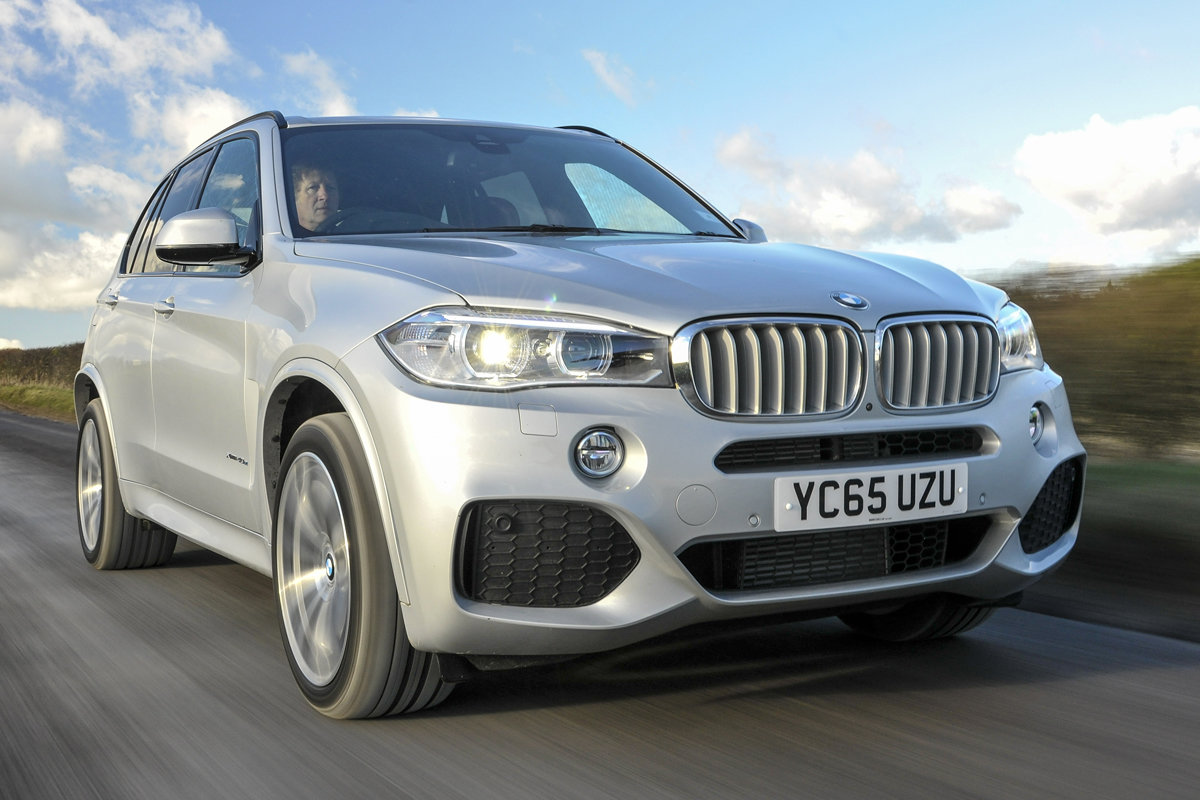
BMW X5 Review (2014-2018)
Pros and cons
What we like
Drives well on Tarmac for such a big and heavy car
The Professional Adaptive Suspension package improves the ride and handling even further
High-quality, roomy cabin
What to consider
Costly to run, especially if you choose a petrol
Not as able off road as a Land Rover Discovery
The aggressive styling is too brutish for some tastes
The CarGurus verdict
BMW’s X5 delivers a great array of equipment in conjunction with excellent BMW’s X5 delivers a great array of equipment in conjunction with excellent engines and decent on-road performance. Consequently, if you’re not going to engage in any serious off-roading, it’s a car worthy of shortlisting.
What’s worth bearing in mind, sheer size and potential running costs aside, is that other rivals can deliver a more luxurious and upmarket experience. The sleek Range Rover Velar, as a case in point, can often be had for similar money on the used market – and doesn’t look as brutish as the X5 – and there are plenty of Range Rover Sports, Porsche Macans and Cayennes on offer at a similar price point.
If badge appeal and appearance is key, those might prove preferential options. Otherwise, the BMW X5 delivers a suitably refined and impressive experience that won’t leave you wanting.
out of 5 expert review
What is the BMW X5?
Just because you’re buying a large and heavy SUV doesn’t mean that you have to abandon any hope of an engaging driving experience. The BMW X5, for example, has long demonstrated that you can get a more compelling driving experience in a taller and heavier vehicle, and the third generation, which was introduced in 2013, offered impressive handling for its class.
The third-generation X5 built upon the credentials of its predecessor with the introduction of new technologies, more efficient powertrains and sharper, more modern styling. It also marked the debut of new sDrive rear-wheel-drive models, which were less costly and more efficient than the heavier xDrive all-wheel-drive BMW X5s.

Practicality
How practical is it?
There’s no getting around the fact that the X5 is a big car, but that pays off once you get inside. It comes with a vast 650-litre boot, and five spacious seats, and you even get the option of third-row seating, which brings the number of seats up to seven, and can also prove useful.
If you’re looking specifically for a seven-seat SUV, mind you, you’d do well to consider the Audi Q7, too – it comes with seven seats as standard, and the rearmost row is roomier than the X5’s.

Driving
What's it like to drive?
In the first year on sale, the line-up consisted of the four-cylinder diesel sDrive25d and xDrive25d, the diesel six-cylinder xDrive30d, xDrive40d and M50d, and the V8 petrol xDrive50i. Engine outputs ranged from 215bhp to 442bhp and, in every instance, the X5 was fitted with an eight-speed automatic transmission.
The range wouldn’t change terrifically over the years, but a high-performance X5 M variant was introduced in late 2014. In early 2015, BMW also launched a more economical plug-in hybrid version called the X5 xDrive40e.
Despite its mass, the X5 serves up a more enjoyable and capable driving experience than rival offerings. The BMW is also comfortable and rides well but, if you want better handling still, you’ll need to opt for a conventional saloon or estate.
No version of the BMW could be called slow, with even the entry-level diesel sDrive25d accelerating from 0-62mph in 8.2 seconds, and if you bump up to a mid-range xDrive30d, that time falls to just 6.9 seconds. Such swift performance is in part thanks to the superb eight-speed automatic gearbox used in the BMW, as well as the impressive torque offered by even the base four-cylinder diesel engine.

Tech and equipment
Technology and equipment
Trim levels were straightforward, with the range kicking off with the SE variant. This was no bare-bones SUV, though, and came with features including cruise control, leather trim, parking sensors, xenon lights, a DAB tuner and the BMW Professional Multimedia system with satnav. M Sport models featured more distinctive exterior and interior trims, as well as features such as a Sport automatic transmission, while the flagship M50d came with a host of high-performance upgrades.
BMW offered an array of luxurious interior packs and modern technology options, too, including adaptive LED headlights, a head-up display and night vision. If you wanted to specify your X5 like a flagship luxury saloon, and you had the money, the extensive upgrades list would allow you to do just that with no compromises.
All in, the BMW X5 is a high-quality SUV that comes with lots of kit, good engines and an array of advanced options. There’s little to gripe about but, in some cases, buyers may find its appeal lacking when parked alongside alternatives such as a Mercedes-Benz GLE, Porsche Cayenne or Range Rover Sport. Otherwise, the only predictable downside is that it’s expensive and running costs can be high, especially for the more complex versions.

Running costs
How much does it cost to run?
The BMW X5 is an expensive SUV to run, which won’t come as a surprise given its class, size and price tag. Insurance, parts, tyres and servicing will all end up costing a fair whack and, as the X5 gets older, you can expect repair costs to start ratcheting up as well.
It’s not all bad news, though. The sDrive25d version, as a case in point, was initially claimed to average up to 50.4mpg and emits 149g/km of CO2. Annual road tax came in at £165 a year, as a result. An updated version was introduced in August 2015, however, which was more powerful and slightly cleaner, but tax initially remained unchanged.
That said, it’s important to note that post-31 March 2017 models are more expensive to tax, due to the changes in the VED system. An sDrive25d registered after that date will cost a significant £475 to tax (although that'll drop to £150 once the car reaches six years old). Versions such as the xDrive50i were also expensive to tax straight out of the gate, due to high emissions, and cost up to £565 a year depending on their registration date.
All of the petrol V8 versions are also thirsty, with the xDrive50i registering a best combined mpg of 27.2, while the X5 M nets a combined 25.4mpg. The V8 diesel, the M50d, is a little more reasonable, and driven gently, can average 42.2mpg.
In the real world, you’ll be doing well to get over 30mpg out of any of the diesels, and in the petrols, you can consider it a win if your average economy ticks over the 20mpg mark. Neither is a great result but they’re not terrible figures given the weight and performance of the X5.
BMW offers fixed-price service plans which can at least help you keep tabs on your expenditure. One sample 27-month plan for a used sDrive25d, for example, came in at just over £1,000. You can also add options to the servicing schedule, such as additional brake fluid changes and aircon refreshes, to keep your X5 in fine fettle.
Usefully, you can get quotes for the service plans online by simply entering the details of the vehicle you’re interested in, so there shouldn’t be any unexpected surprises down the line. You’ll have to factor in the cost of replacement tyres, though, which can easily cost upwards of £200 per corner for the larger wheel sizes.

Is it reliable?
Although it’s a premium and much-admired brand, BMW doesn’t have an outstanding reputation for reliability and owner satisfaction in the UK, but it does often fare better than some mainstream rivals.
This generation of X5, which is referred to by BMW boffins as the 'F15' generation, has also performed well in the reliability stakes, in part because much tried-and-tested hardware has been carried over from the previous generation. Regardless, given its complexity, it’s worth ensuring you’ve got a good warranty on any used purchase. One major failure could prove extremely expensive and sour your ownership experience completely, after all, so investing in a warranty is a sensible move.
A three-year, unlimited-mileage warranty was standard and BMW does offer extended warranties, so you may be able to get your hands on an X5 with an official warranty, and of course, there are always the aftermarket options.
Buying a used approved BMW X5 can be a good option, as every car offered will have gone through a comprehensive check and come with at least 12 months’ BMW warranty. You’ll get 12 months’ roadside assistance and MOT cover, too, further minimising the chance of stress and grief.
Few X5s will be used for anything resembling serious off-roading, but do have a look at the underside of any prospective purchase, just in case there’s any obvious damage. Similarly, check the wheels and panel work for any scratches or dents.
There have been several recalls on the X5 as well, so if you’re looking at a used example it’s worth taking the time to check the online government recall website. This will list the recalls that apply to your vehicle, allowing you to subsequently check with the dealer if the specified revision has been applied to the car in question.


What owners say
The car was very high spec but the colour and exterior were not to my taste
7 July 2026The car has everything I need and is great condition, and I feel value for the cost
28 April 2026I love it!! The space is amazing, the feeling of sitting higher and the roar of the 3 Litre engine is any car enthousiasts dream! Owning one of these beauties, has been a 20 year long dream and it’s finally come true and it’s better than I expected! 10 out of 10! Best car I’ve ever owned by far!!
23 February 2024What owners say
The car was very high spec but the colour and exterior were not to my taste
7 July 2026The car has everything I need and is great condition, and I feel value for the cost
28 April 2026I love it!! The space is amazing, the feeling of sitting higher and the roar of the 3 Litre engine is any car enthousiasts dream! Owning one of these beauties, has been a 20 year long dream and it’s finally come true and it’s better than I expected! 10 out of 10! Best car I’ve ever owned by far!!
23 February 2024Good value, excellent condition many extras, fantastic drive, very comfortable and very responsive
2 February 2023Reliable and well built Great engine easy to drive
16 August 2023Really nice car just on another level from the Mercedes GLE
27 February 2024It was discussed as black and it is blue. It was said to be 4x4 and its not. Also the whatcar review didnt depict it as a great choice.
20 March 2021I have the x3 automatic 2.5 petrol, much smoother gearbox but still have the same transfer case problems.
25 June 2021Three things to know
- BMW unveiled a plug-in hybrid version of the third-gen X5 at the start of 2015. The all-wheel-drive xDrive40e featured a 242bhp four-cylinder turbocharged petrol engine and a 112bhp electric motor, which was integrated into the transmission. The net result was a total system output of 309bhp, a 0-62mph time of just 6.8 seconds and a claimed average of 85.6mpg. More pertinently, its CO2 emissions were just 77g/km. BMW also claimed that the X5 xDrive40e could travel up to 19 miles on electric power alone, which could prove useful to those with short commutes.
- The BMW measures 2184mm across the mirrors and 4886mm long, which is slightly wider and longer than a Range Rover Sport. It’s not excessively large for its class but does often feel its size, and if you’re regularly driving down country lanes or through smaller towns or villages, its dimensions may become a bugbear. Standard-fit parking sensors, and an optional reversing assist camera and surround-view display, can make it easier to manage.
- An update to the iDrive interface was released in May 2016, and in October 2016, BMW also updated the Professional Media System to allow for the addition of Apple CarPlay. This wireless set-up allows for direct use of certain apps through the BMW’s media system, such as navigation and media playback, and is a much more elegant and upmarket solution than alternatives such as Bluetooth audio streaming. It was a cost option, however, so not every X5 will have it.
Which one to buy
- The best all-rounder: The four-cylinder diesel options aren’t bad but the X5 is at its best when equipped with six or more cylinders. Consequently, we’d aim for the xDrive30d variant as it offers a good balance of cost, refinement, output and efficiency. SE trim includes stacks of kit, but you might want to keep an eye out for models fitted with options such as the surround-view camera. The Cold Weather option pack can be desirable, as it adds heated front seats and a heated steering wheel, and look for X5s fitted with the Professional Adaptive Suspension package. This improves the ride and handling of the BMW and helps combat its hefty nature.
- For the eco-minded: If you want the most frugal X5, and you’re trying to keep the purchase price down, the standard sDrive25d is a good option. It’s the cleanest and most efficient of the standard X5 range, yet it still performs in a decent fashion. Otherwise, opt for the petrol-electric BMW X5 xDrive40e plug-in hybrid. It’s quick, it’s efficient and it can travel up to 19 miles on electric power when the battery is fully charged. Expect its real-world pure EV range to be less, though. You’ll also have to plug it in regularly to get the best out of it.
- For maximum performance: BMW unveiled the range-topping X5 M in 2014 and if you’re looking for large SUV with serious cornering prowess and pace, it’s a good option. Its twin-turbocharged 4.4-litre petrol V8 puts out a whopping 567bhp and flat out, the X5 M can sprint from 0-62mph in just 4.2 seconds. It’s remarkably quick but it’s also expensive; if you want a less costly alternative, and one with reduced running costs, you could consider the diesel M50d.


Pricing trends
Starting RRP
£39,300
Current avg. market price
£19,784
Trending down by 3.3% this month
April 2026 - October 2026
More on the F15 BMW X5 (2014 - 2018)

Compare 2018 BMW X5 Trims
The 2018 BMW X5 offers a range of trims from budget-friendly options to performance-oriented models, all featuring AWD and impressive fuel efficiency.
- Starting at £13,109
- Most Popular: Xdrive30d M Sport 5dr Auto
Trim Overview
Prices updated weekly from CarGurus listings.
| Xdrive30d Se 5dr Auto | Xdrive40d M Sport 5dr Auto | Xdrive40e M Sport 5dr Auto | Xdrive30d M Sport 5dr Auto (Most Popular) | Xdrive40d M Sport 5dr Auto [7 Seat] | Xdrive30d M Sport 5dr Auto [7 Seat] | Xdrive M50d 5dr Auto | Xdrive M50d 5dr Auto [7 Seat] | |
|---|---|---|---|---|---|---|---|---|
| Starting MSRP | £53,395 | £60,100 | £60,185 | £60,870 | £61,090 | £62,455 | £71,640 | £75,255 |
| Avg. Market Price | £13,109 | £23,818 | £17,470 | £25,330 | £24,664 | £24,160 | £30,180 | £25,677 |
| Positioning | Best value | Adventure-ready | Adventure-ready | Adventure-ready | Adventure-ready | Adventure-ready | Adventure-ready | Trail-ready |
| Standout Features | Navigation System, Heated Seats | Bluetooth, Navigation System | Navigation System, Bluetooth | Cruise Control, Parking Assist | Bluetooth, Navigation System | Bluetooth, Navigation System | Bluetooth, DAB Radio | Bluetooth, Panoramic Roof |
| Drivetrain | AWD | AWD | AWD | AWD | AWD | AWD | AWD | AWD |
| Listings Available | 21 | 50 | 22 | 162 | 71 | 49 | 53 | 28 |
Quick Compare Table
Listing prices sourced from CarGurus — updated weekly. OEM specs from manufacturer data.
| Xdrive30d Se 5dr Auto | Xdrive40d M Sport 5dr Auto | Xdrive40e M Sport 5dr Auto | Xdrive30d M Sport 5dr Auto | Xdrive40d M Sport 5dr Auto [7 Seat] | Xdrive30d M Sport 5dr Auto [7 Seat] | Xdrive M50d 5dr Auto | Xdrive M50d 5dr Auto [7 Seat] | |
|---|---|---|---|---|---|---|---|---|
| AI Summary | Best value option for budget-conscious buyers | Great for those seeking adventure and performance | Eco-friendly choice with hybrid capabilities | Popular choice with balanced features | Spacious option for families needing 7 seats | Family-friendly with sporty features | Powerful performance for enthusiasts | Luxurious with added seating and features |
| Avg. Market Price | £13,109 | £23,818 | £17,470 | £25,330 | £24,664 | £24,160 | £30,180 | £25,677 |
| MSRP | £53,395 | £60,100 | £60,185 | £60,870 | £61,090 | £62,455 | £71,640 | £75,255 |
| Engine | 2993.0cc 258 hp I6 | 2993.0cc 313 hp I6 | 1997.0cc 313 hp I4 | 2993.0cc 258 hp I6 | 2993.0cc 313 hp I6 | 2993.0cc 258 hp I6 | 2993.0cc 381 hp I6 | 2993.0cc 381 hp I6 |
| Drivetrain | AWD | AWD | AWD | AWD | AWD | AWD | AWD | AWD |
| MPG/MPGe (City/Hwy) | 28.2/54.3 | 35.7/44.1 | — | 28.2/54.3 | 35.7/44.1 | 28.2/54.3 | 32.5/38.6 | 32.5/38.6 |
| Navigation System | ✓ | ✓ | ✓ | — | ✓ | ✓ | — | ✓ |
| Parking Assist | ✓ | ✓ | ✓ | ✓ | ✓ | ✓ | ✓ | ✓ |
| Cruise Control | ✓ | ✓ | ✓ | ✓ | ✓ | ✓ | ✓ | ✓ |
| Bluetooth | ✓ | ✓ | ✓ | ✓ | ✓ | ✓ | ✓ | ✓ |
| Air Conditioning | ✓ | ✓ | ✓ | ✓ | ✓ | ✓ | ✓ | ✓ |
| DAB Radio | ✓ | ✓ | ✓ | ✓ | ✓ | ✓ | ✓ | ✓ |
| Heated Seats | ✓ | — | — | — | — | ✓ | — | — |
| isofix | ✓ | ✓ | — | ✓ | ✓ | ✓ | ✓ | ✓ |
| AUX/USB connectivity | ✓ | ✓ | ✓ | ✓ | ✓ | ✓ | ✓ | ✓ |
| Backup Camera | ✓ | ✓ | ✓ | — | ✓ | ✓ | — | — |
| Alarm/Immobiliser | ✓ | — | ✓ | ✓ | ✓ | ✓ | ✓ | ✓ |
| Active Listings | 21 | 50 | 22 | 162 | 71 | 49 | 53 | 28 |
Missing data displayed as "—".
Trim Deep Dives
Xdrive30d Se 5dr Auto — "Who It's For"
The Xdrive30d Se is the pick for shoppers who want a well-equipped SUV without paying for higher trims. It's the most budget-friendly option in the lineup.
- Avg. market price: £13,109 (updated weekly)
- MPG/MPGe: 28.2 city / 54.3 hwy
- Inventory: 21 listings — lower availability; may limit negotiating room
- View Xdrive30d Se listings
Xdrive40d M Sport 5dr Auto — "Who It's For"
The Xdrive40d M Sport is the pick for shoppers who want a sporty SUV with enhanced performance features without going for the top-tier models.
- Avg. market price: £23,818 (updated weekly)
- MPG/MPGe: 35.7 city / 44.1 hwy
- Inventory: 50 listings — lower availability; may limit negotiating room
- View Xdrive40d M Sport listings
Xdrive40e M Sport 5dr Auto — "Who It's For"
The Xdrive40e M Sport is the pick for shoppers who want a hybrid SUV that combines performance with eco-friendliness, though availability may be limited.
- Avg. market price: £17,470 (updated weekly)
- Inventory: 22 listings — lower availability; may limit negotiating room
- View Xdrive40e M Sport listings
Xdrive30d M Sport 5dr Auto — "Who It's For"
The Xdrive30d M Sport is the pick for shoppers who want a blend of luxury and performance without stepping up to the highest price point. It's the most popular trim in the lineup.
- Avg. market price: £25,330 (updated weekly)
- MPG/MPGe: 28.2 city / 54.3 hwy
- Inventory: 162 listings — lower availability; may limit negotiating room
- View Xdrive30d M Sport listings
Xdrive40d M Sport 5dr Auto [7 Seat] — "Who It's For"
The Xdrive40d M Sport [7 Seat] is the pick for shoppers who need extra seating capacity without sacrificing performance and luxury features.
- Avg. market price: £24,664 (updated weekly)
- MPG/MPGe: 35.7 city / 44.1 hwy
- Inventory: 71 listings — lower availability; may limit negotiating room
- View Xdrive40d M Sport [7 Seat] listings
Xdrive30d M Sport 5dr Auto [7 Seat] — "Who It's For"
The Xdrive30d M Sport [7 Seat] is the pick for shoppers who want a spacious SUV with sporty features, ideal for families needing extra room.
- Avg. market price: £24,160 (updated weekly)
- MPG/MPGe: 28.2 city / 54.3 hwy
- Inventory: 49 listings — lower availability; may limit negotiating room
- View Xdrive30d M Sport [7 Seat] listings
Xdrive M50d 5dr Auto — "Who It's For"
The Xdrive M50d is the pick for shoppers who want top-tier performance and luxury features in a powerful SUV, though it comes at a premium price.
- Avg. market price: £30,180 (updated weekly)
- MPG/MPGe: 32.5 city / 38.6 hwy
- Inventory: 53 listings — lower availability; may limit negotiating room
- View Xdrive M50d listings
Xdrive M50d 5dr Auto [7 Seat] — "Who It's For"
The Xdrive M50d [7 Seat] is the pick for shoppers who want a luxurious SUV with ample seating and advanced features, perfect for larger families.
- Avg. market price: £25,677 (updated weekly)
- MPG/MPGe: 32.5 city / 38.6 hwy
- Inventory: 28 listings — lower availability; may limit negotiating room
- View Xdrive M50d [7 Seat] listings
Trim Recommendations
Most Popular — Xdrive30d M Sport 5dr Auto
With 162 active listings, the Xdrive30d M Sport is the clear volume leader in the lineup.
Browse Xdrive30d M Sport listings
Best Budget Option — Xdrive30d Se 5dr Auto
At £13,109 avg market price — below the lineup median of £24,412 — it's the most accessible entry point.
These recommendations are based on CarGurus' proprietary market data from October 22, 2026, CarGurus experts' opinions, and generative AI.

