Ford Focus Mk1 Review (1998-2003)
Ford Focus cars for sale
4.0
Expert review
Pros
Fantastic to drive
Modern classic status looming
Cheap to run
Cons
Toyota Corolla is likely to be more reliable
Noisy diesel engines
Finding good ones is becoming more difficult

The CarGurus verdict
For the money, you can’t do much better than a used Ford Focus. Not only is it an icon and a surefire future classic but, at today’s prices, it makes an excellent bargain runaround. It’s a great family car with space and comfort aplenty, especially if you choose one of the more upmarket versions. Were that where it ended, the Focus would still be a good buy, but its magnificent chassis adds a sprinkling of magic that transforms it from a good car into a truly special one.
There is no shortage of dog-eared examples out there, so buy carefully, but a good one will give you miles of satisfying motoring.

Was there ever a car that came quite so out of the blue as the Mk1 Ford Focus? It replaced the final Ford Escort, a car so utterly below-par that Ford felt the need to completely rename its successor.
The Focus was a revelation. A new car from the ground up, and so different to its predecessor that it could have come from a different manufacturer. It was available as a hatchback, a saloon or an estate, just like all its family car rivals, but on the outside, its wild styling – called 'New Edge' by Ford – set it apart from anything else on the road, and it was just as radical inside.
More surprisingly given its stodgy predecessor, the Focus was fantastic to drive, with agile and engaging handling and a cushioned ride. It even has a line-up of decent engines, for a long time a Ford weak point.

Beneath that styling, the Focus was roomy and versatile, and so it remains today. 60/40 split fold rear seats aid practicality, while the hatchback’s 350-litre boot is almost as big as those of some modern-day family cars. The ungainly and relatively rare four-door saloon was even roomier, with 490 litres of carrying capacity.
The estate is even more practical, and with its upright tail and squared-off roof, its boot is particularly good at swallowing bulky items. With the rear seats in place it packed in a generous 520 litres of space, while lowering the back bench liberated an impressive 1,580 litres Passenger space is good, too, with plenty of head- and legroom, and lots of seat adjustment. However, bear in mind that access to the back bench in the sharp-looking three-door model is a bit of a squeeze, even with front seats that handily slide and tilt forward to create a bigger gap to climb through.
Elsewhere, the dashboard’s swoops and slashes conceal several deep storage spaces, two sizeable cupholders, a large glovebox and some chunky door bins.
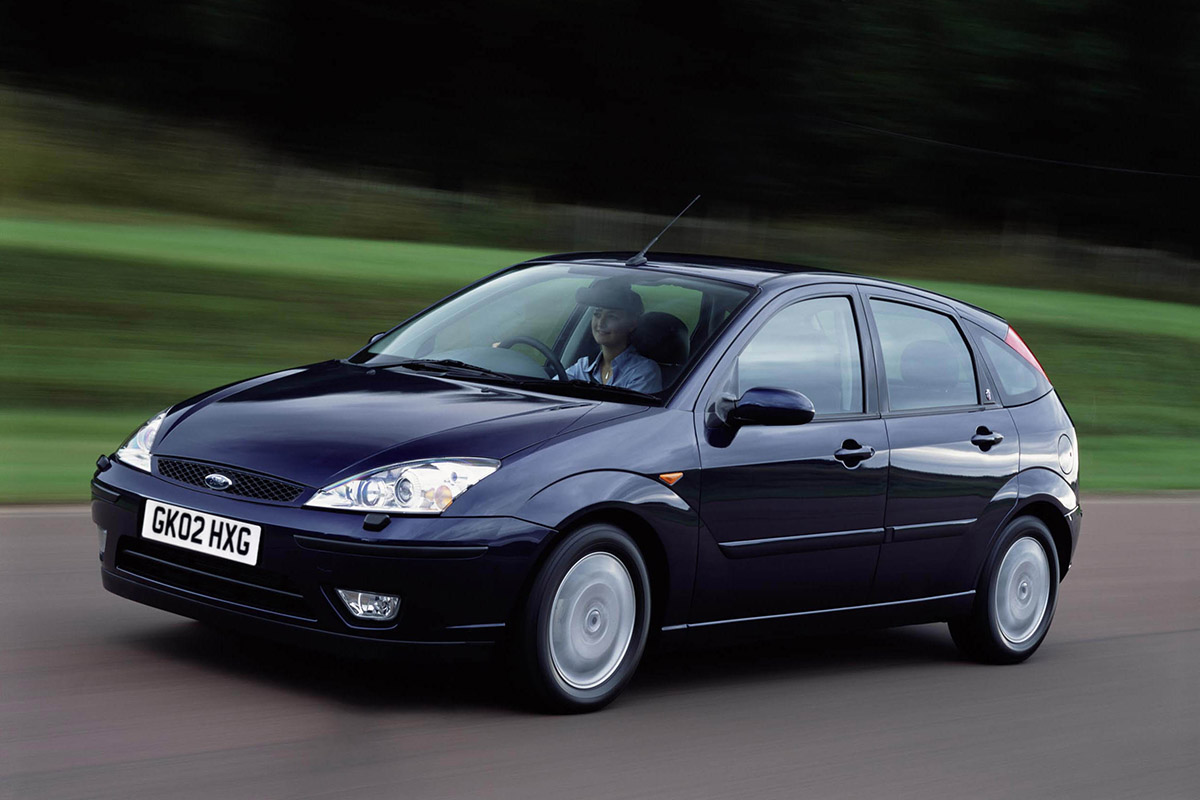
Quite simply, brilliant. Ford had proved it was capable of delivering ordinary family cars that were good to drive when it launched the first-generation Mondeo five years earlier, but the Focus represented arguably the firm’s finest effort to date. Featuring one of the most communicative, sharp and well-weighted steering set-ups ever fitted to a front-wheel-drive family hatchback, the Focus feels alert and responsive. The nose does whatever you ask of it, and the clever ‘Control Blade’ multi-link rear suspension means the tail of the car reacts every bit as deftly.
The result is that the Focus is great fun to drive quickly or slowly. Its sweet, direct steering and slick gearbox make it a delight to throw around a back road or just noodle around town. Although, be aware that the need to pack in as much boot space in as possible means the estate doesn’t get the same trick independent rear suspension as the hatchback models.
It’s also comfortable. The worst urban bumps can occasionally make their presence felt, but generally, and especially on the motorway, the Focus glosses over imperfections in the road with little fuss.

The entry-level CL model, available from launch, was pretty basic, with central locking, electric front windows, twin airbags and an immobiliser all as standard, but not much else. It even had fairly basic plastic wheel trims covering its steel rims.
The Zetec model was sportier. It added stiffer suspension, alloy wheels and front fog lamps, plus some natty grey-backed instruments and a leather steering wheel. LX trim added a sunroof on early models, remote central locking and an upgraded radio/cassette player with steering column-mounted fingertip controls. Crucially, it featured air-conditioning as standard.
At the top of the range was the Ghia, which was the plushest of all with a heated front windscreen, electronic height adjustment for the driver’s seat and some wood trim that had likely never seen a tree.
It's worth remembering that ABS and traction control were not standard on anything but the Ghia version with the 2.0-litre engine. That combination also added electric rear windows and a CD autochanger. However, it was available on all other models as part of a Reflex Pack that also included traction control and, on the LX and Ghia, electronic stability control.

The diesels might be noisy but they’re also efficient. The TDDi version should see around 50mpg in day-to-day use, and while the more powerful TDCi variant will probably get a little less than that, you can still expect to see around 45mpg.
Among the petrol-engined models, the 1.4- and 1.6-litre cars are the most frugal, with the latter returning around 35mpg on average, and the former a smidgen more. The 1.8-litre models should see around 32mpg, while the 2.0-litre models (including the ST170) will probably deliver around 30mpg, depending on how hard they’re driven.
These figures might sound disappointing by modern standards, but in its day, the Focus was one of the more frugal family hatchbacks, bettering rivals such as the Volkswagen Golf and the Vauxhall Astra.
The RS, meanwhile, won't achieve more than 25mpg if it’s driven gently, and you can expect that figure to plummet if it’s used to its full potential.
Any Focus registered before 1 March 2001 will be subject to the old-style tax rules, which are pretty simple: 1.4-litre models will pay a lower rate, while every other Focus will be subject to the higher rate.
Cars registered on or after 1 March 2001 are taxed using bands based on their CO2 outputs. Generally, speaking, the more frugal the engine, the less it costs to tax. The 2.0-litre models fall into the third-highest band, K, so they're more expensive, but 1.8-litre engines, in band I, are cheaper and 1.6-litre models, in band H, are more affordable still. Both diesel models fall into the same tax band, F, so they're the cheapest on tax.
The Focus has a rubber timing belt that needs changing regularly to avoid the risk of it degrading and breaking, which would cause costly engine damage. According to the manual, the recommended change interval is every 10 years or 100,000 miles, but we suggest changing the cambelt more regularly. Many 1990s cars with long intervals like this have since had those recommendations revised down, and getting the belt done sooner – say, every six or eight years – will be a safer bet. It shouldn't cost you more than about £300 at your local garage.

The Focus isn't quite up there with the Toyota Corolla for reliability, but its popularity works in its favour, because anyone with the ability to wield a spanner can work on one, rendering it cheap and easy to repair. Parts are widely available, too, which makes it one of the more affordable and hassle-free cars of its era to keep running.
The biggest problem facing owners today is corrosion, because a rust-free Mk1 Focus is a truly rare thing. They were poorly protected from new, and the vast majority will have experienced rust problems of some sort by now. If you plan to keep your Focus long-term, then budget to keep on top of its tendency to go crusty, and look hard at rust hotspots such as the rear wheel arches, the undersides of the doors, the boot lid and its hinges, and the metalwork where the mirrors meet the doors.
Other common problems include the instrument cluster, which often requires a costly full replacement, misfires due to dodgy coil packs, grumbly wheel bearings and the electrics, which can be affected by water ingress.
- The performance models are the most sought-after versions of the Focus, particularly the Ford Focus RS Mk1. With its 212 bhp 2.0-litre turbo engine, Brembo brakes, Sparco bucket seats and limited-slip differential, and finished only in Imperial Blue, the RS picked up where the legendary Escort Cosworth left off years earlier. It was rampantly quick, and devoured corners with an alacrity that put Ford back on the performance car map. These days, a good RS is an expensive thing, but they look set to hold their value, or go up further still. If your budget won’t quite stretch to one, the Focus ST170 is a cheaper alternative. Its relatively modest output means it feels a little underpowered, but it makes the best of the standard car's excellent chassis and looks classy. And for the ultimate blend of practicality and involvement, seek out the rare ST170 Estate, although, as with the other estates it doesn’t get the Control Blade rear suspension.
- You can’t go far wrong with the mid-range 1.6-litre, 1.8-litre and 2.0-litre petrol engines. However, you might want to avoid the 1.4-litre model, because its diminutive engine, pilfered from the Fiesta, struggles to haul the Focus around. It's also worth avoiding the 1.8-litre TDDi diesel engine, which can trace its roots back as far as 1986. It was outdated when the Focus was new, with its laggy power delivery and clattery soundtrack, so today it feels positively ancient. However, the later common-rail variants, - badged TDCi - were transformed, delivering superior refinement and punchier performance
- The only facelift came in 2001, and brought a sleeker look for the Focus. The indicators were moved from the bumpers into the headlights and both the front and rear were freshened up. Equipment levels were also improved, as (very rare) satellite navigation, climate control and Xenon headlamps became optional extras. However, with the exception of the introduction of the TDCi diesel engines, there were no substantive changes to the mechanicals. At the time, Ford's attitude was “if it ain’t broke, don’t fix it”.
- As an all-rounder, a Focus Zetec with the 1.6-litre engine is hard to beat. It offers up a winning blend of fuel economy and equipment, while the slightly stiffer version of the legendary chassis makes it even sharper to drive. Better still, most were fitted with the optional Climate Pack that added air-con, Quickclear heated windscreen and powered door mirrors.
- If, however, you want greater levels of equipment, your best bet is to seek out a Ghia model, preferably a post-facelift example with its slightly higher standard specification.
- An estate in any guise is a fine choice if you need more space. The 1.8-litre engine has a useful increase in grunt over the 1.6, but it isn't as thirsty as the 2.0-litre.
- If fuel economy is paramount, then the diesels are the most frugal Focus models. As we mentioned, the TDDi versions aren’t that great to drive, so seek out the far smoother and more muscular TDCi that arrived in 2001.
- An ST170 is a really smart choice if you’re after a bargain hot hatch. Prices for good ones are starting to drift upwards, though, so get in quick.
- If you want the fastest Focus of all, expect to pay significantly more for a Focus RS. Rare and highly prized, prices have been on the rise for years, so expect to pay at least ten times more than you would for a good, standard Mk1 Focus, if not even more.

