Ford Focus Mk3 Review (2011-2018)
Ford Focus cars for sale
4.0
Expert review
Pros
Great to drive and comfortable to travel in
The ST and RS hot hatches are lots of fun
Affordable running costs for most models
Cons
Troublesome early Powershift gearboxes
Be wary of cars that have not had their timing belt changed on time
Small boot
The CarGurus verdict
With any car that sells in extremely high volumes, it is almost inevitable that some customers will experience problems somewhere down the line. So it has transpired to some extent with the third-generation Ford Focus, particularly in regard to earlier iterations of the Powershift gearbox.
However, allowing for this and the coolant hose issue on earlier 1.0-litre models, a properly maintained Focus should be a perfectly dependable car, not to mention one that’s well-liked by owners. Combined with there being a plentiful supply across a wide range of budgets, it’s easy to see why it is such a dominant force in the used car market.
For the best part of a quarter of a century, the Focus has been a mainstay of the Ford line-up. The original version of the compact family hatchback was a revelation when it debuted in 1998, proving to be as sharp to drive as it looked. It was an instant hit, becoming a more or less permanent fixture in the sales chart top 10.
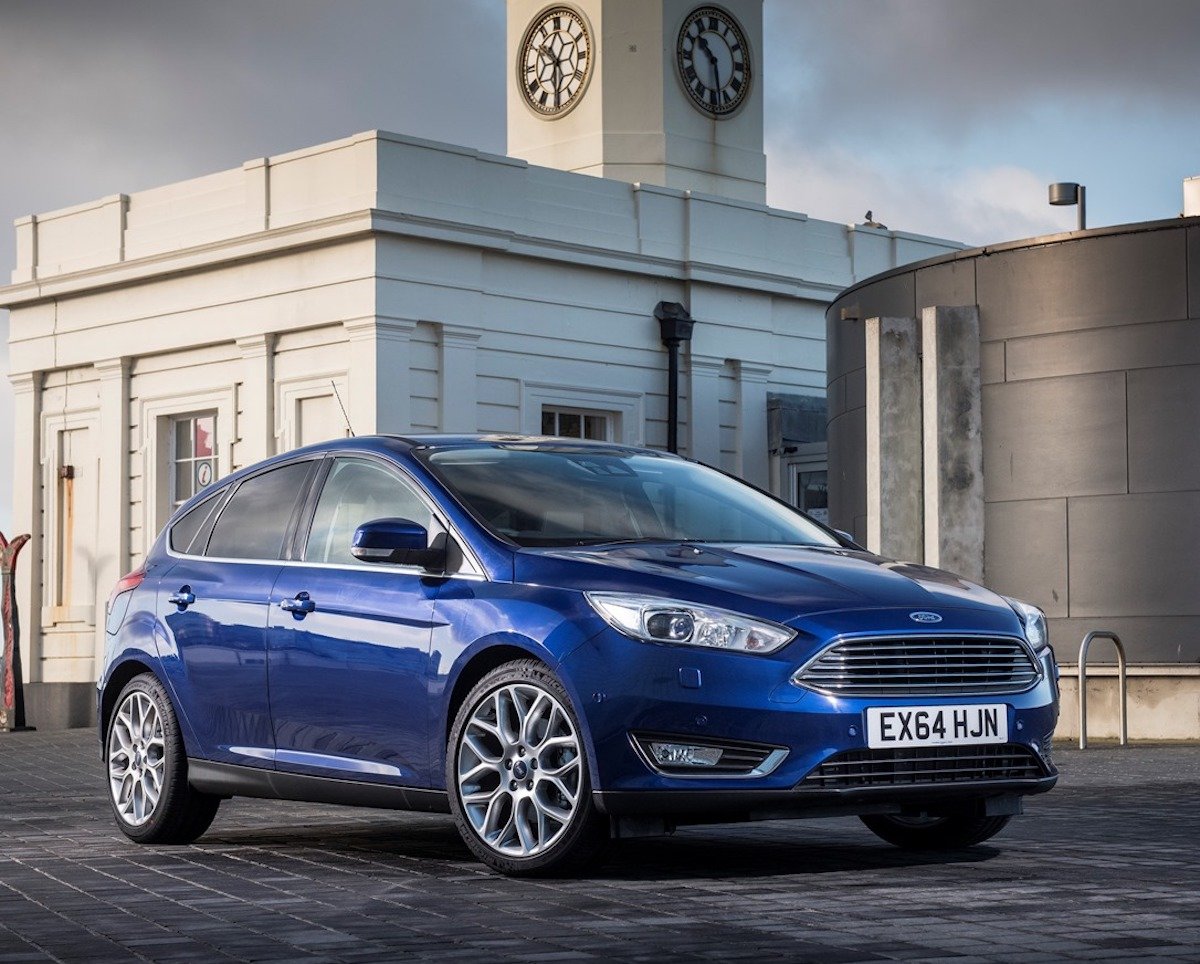
The third generation of Ford Focus, which was sold between 2011 and 2018 (it received a major update in 2014), continued the trend. More upmarket than its predecessors, it also rediscovered some of the rakish design magic that was missing from the rather dowdy second generation machine. Better still, the MK3 Focus can make for a great used buy. Prices are competitive, running costs are low, and there’s a broad range of models that spans a wide price range.
There’s everything from thrifty diesels through to fire-breathing RS models, while the body styles ran to a five-door hatchback and a versatile estate. More importantly, it retained the sparkling driving dynamics that made the original such a brilliant buy - few family cars are as satisfying for keen drivers.

If maximum space per pound is at the top of your shopping list, then the Focus probably won’t be for you. It’s not that the Ford isn’t family-friendly, it’s just that it’s at the lower end of the hatchback pecking order when it comes to packing stuff in.
In fairness, there’s decent room for you and your passengers, with just enough leg and headroom in the rear that even taller occupants are unlikely to complain. You can even squeeze three adults onto the rear bench, although they won’t thank you if the journey’s anything longer than a short hop. The driving position is excellent too, with enough wheel and seat adjustment that drivers of all shapes and sizes will be able to get comfortable.
You won’t struggle for handy storage either, with the Focus clearly designed to cope with the numerous odds and ends that tend to accumulate with life on the road. There are cupholders in the cupholders in the centre console, large door bins in the front that’ll hold one-litre bottles of water and a deep lidded box between the front seats that doubles up as an armrest.
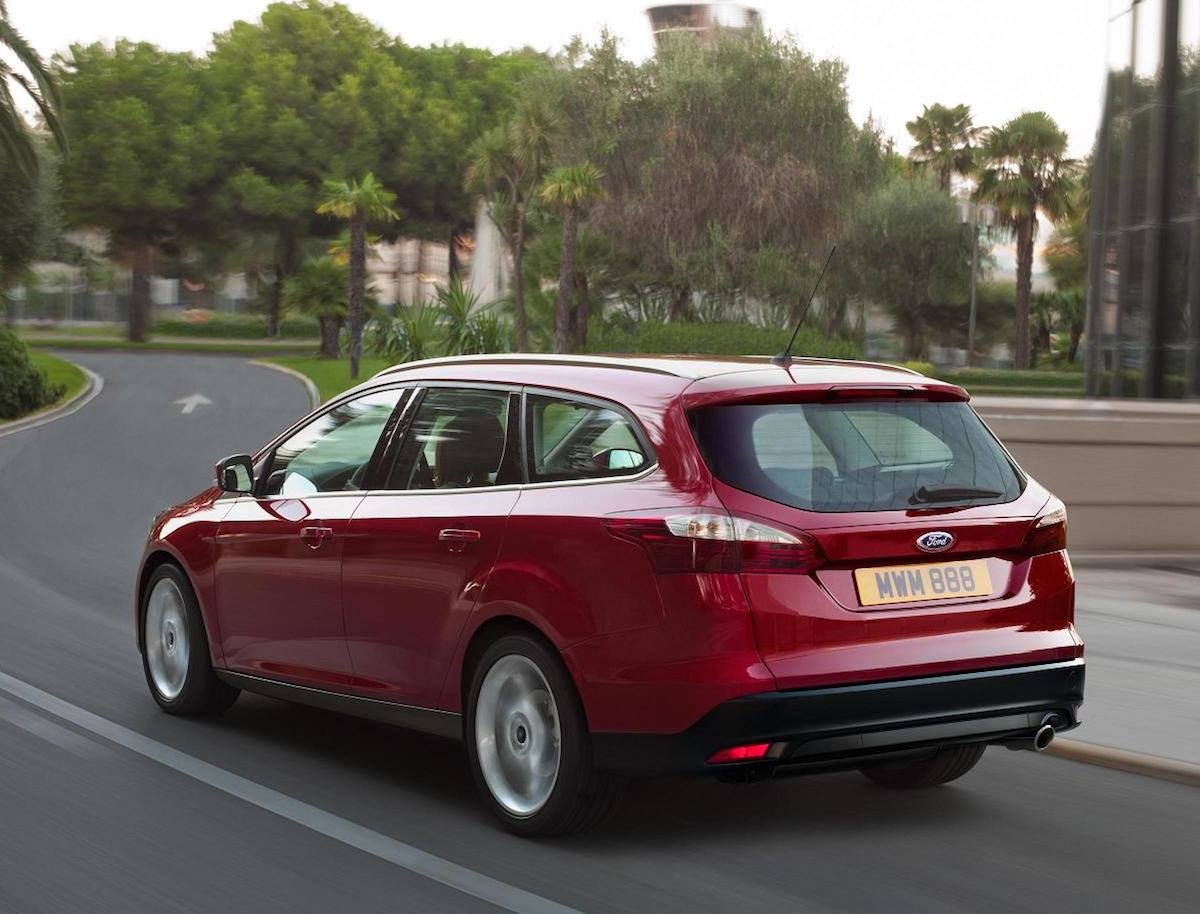
Where the Focus has to give best to its rivals is the boot space stakes, its 316-litre capacity barely any bigger than models from the class below. Folding the rear seats does extend the available space to 1,215 litres, but if you’re planning lots of load-lugging then the estate is probably a better bet. This still trails its immediate rivals, such as the Skoda Octavia and VW Golf, but Ford’s figure of 476 litres is useful enough and can be increased to 1,502 litres by lowering the rear bench.
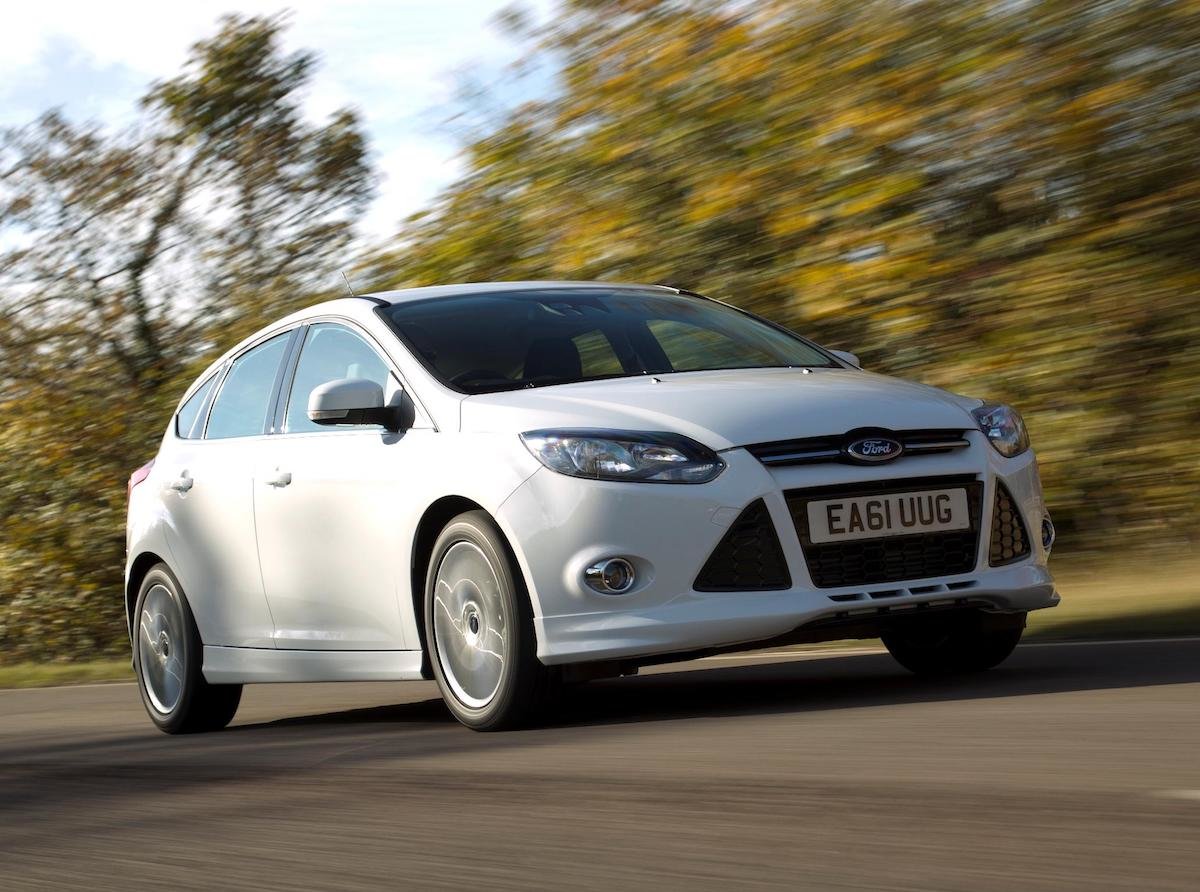
If you’re a keen driver, then few family hatches are as likely to lift your spirits as the Focus. Despite its fairly humble status in life, the Ford is an unusually satisfying car to drive. Its steering is sharp and precise and there’s plenty of grip, inspiring huge confidence. Yet it’s the car’s agility and poise that really mark it out, making it almost as fun to fling down your favourite stretch of twisty road as a hot hatch.
The engines are eager and responsive too, especially the turbocharged 1.0-litre EcoBoost petrol that punch well above their weight. The exception is the entry-level 115hp 1.6-litre petrol, which struggles a little to haul the Focus along, particularly up long and steep motorway inclines. Even if you’re not fussed about the way a car drives, the Ford is a fine choice. Its consistent control weights and smooth gearboxes make it a doddle to drive, while the ride strikes a fantastic balance between being comfortable and controlled.
Those wanting a faster Focus are well catered for, too, with Ford producing both ST and RS versions of the Mk3. The former is available in hatchback or estate guise, with power coming from either a 250hp petrol or a 185hp diesel engine. Yet bear in mind that the increase in driver fun comes at the expense of a fairly firm ride that can become testing over really poor inner-city surfaces.
Right at the top of the range is the RS, which arrived on the scene in 2016 and is a hooligan of a car, complete with a 350hp 2.3-litre turbocharged petrol engine, four-wheel-drive, and even a ‘drift mode’ as part of its stability control system. It might not be particularly discreet, but the RS is certainly a lot of fun. Although as with the ST, stiff suspension means it can get wearing on bumpy surfaces, even with the adaptive dampers in their softest setting.

The Focus line-up includes everything from the base Studio and Edge through to the lavishly equipped Titanium X. However, for many people it'll be the mid-range Zetec that represents the sweet spot, including as it does alloy wheels, a DAB radio, and a (very useful) heated windscreen among its list of standard features.
Move up to the Titanium trim and you get handy features such as automatic lights and wipers, plus keyless entry. For the Titanium X, a power operated driver’s seat was added, as well as part leather trim.
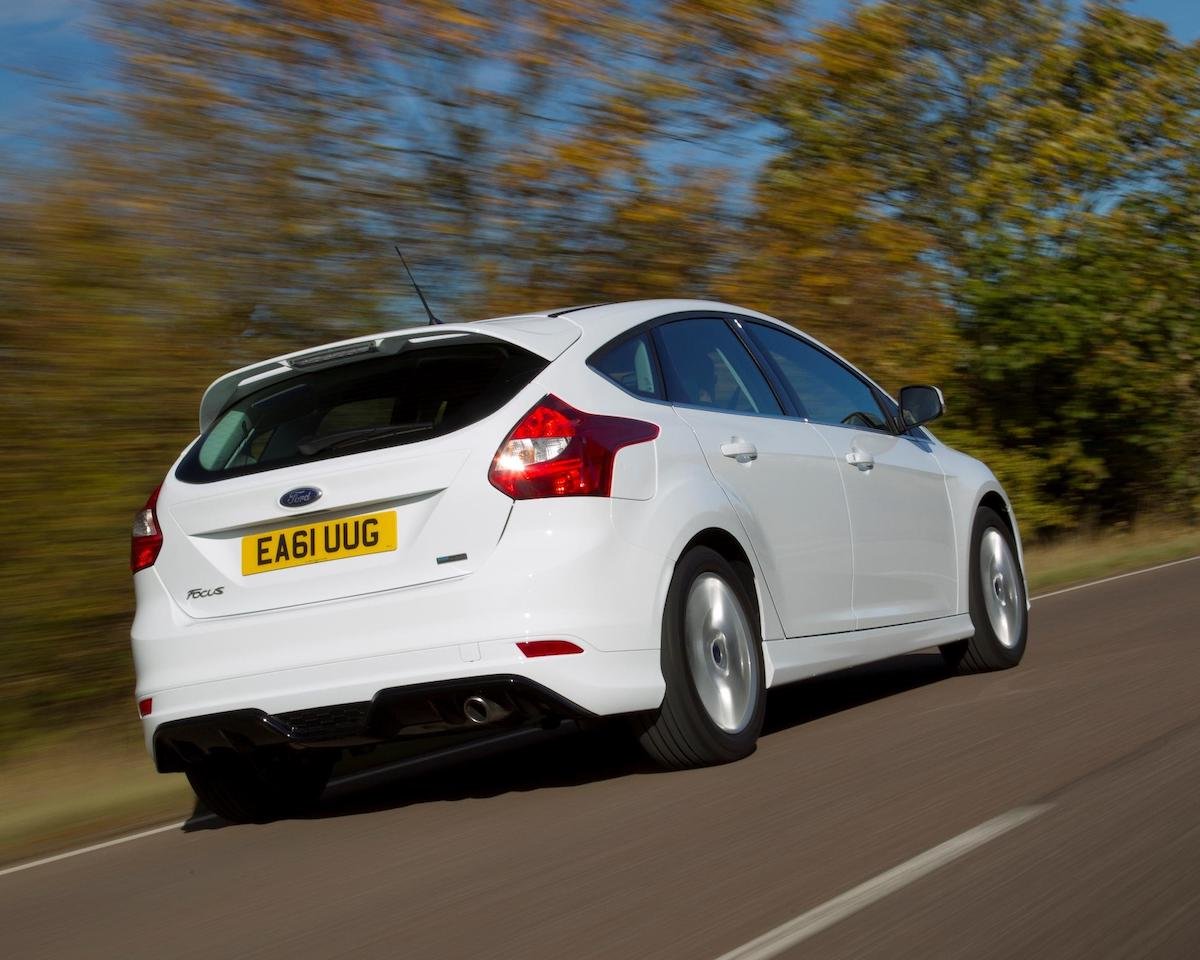
Also worth considering are the later ST-Line models, which effectively replaced the Zetec-S and first appeared after the 2015 facelift. Featuring some sporty additions inside and out it certainly looked the part, while it had all the kit you’re ever realistically going to need.
In terms of infotainment, the pre-facelift cars unsurprisingly featured less capable and easy-to-use set-ups. Entry-level models packed a fairly simple radio and CD set-up that also added Bluetooth and USB connectivity, while Titanium versions and up used the SYNC2 system that added sat-nav and voice control. Both are a little fiddly to use on the move, with loads of small buttons scattered across the centre console and smaller screens with less crisp graphics.
On facelift cars the far superior SYNC3 set-up was made available, which features a large eight-inch touchscreen and easy to navigate menus. Smartphone connectivity is also more straightforward.
The Focus scored a maximum five-star rating when it was tested in 2012, with all models getting seven airbags, electronic stability control and lane departure warning, while autonomous emergency braking and adaptive cruise control were optional.
Ford’s 2.0 TDCi engine might not be as quiet as its petrol stablemates, but with an easy 45mpg or more it is a good option for covering big distances. Or, if you can stretch to a post-facelift diesel, the 1.5 TDCi has the potential to do 55mpg or more. However, the best all-rounder in our eyes is the 1.0 Ecoboost 100 Zetec. Expect a real world 40mpg, or slightly more on a long run, and an engine that is smooth, quick enough, and even makes an enjoyable thrumming noise when revved. With Fords being so popular, spare parts tend to be easy to get hold of, which helps to keep repair costs down.
Early versions of Ford’s Powershift dual-clutch automatic gearbox have been known to wear, at which point the car can judder when pulling away or coming to a stop. Although not universal, it became enough of a problem for Ford to discontinue this particular gearbox for the Focus in 2015. It was replaced with a newer design. As such. if you’re after a Focus automatic it’s worth searching out a newer model.
As far as engines go, there was a known fault with one of the hoses used for the coolant system in 1.0-litre Ecoboost models built before 2013. In extreme cases these faulty ‘Degas’ hoses could lead to problems that ended up wrecking the engine, so it pays to be proactive and ask to see evidence that the remedial work has been done. An upgraded coolant hose was fitted from 2013 onwards.
As with many modern diesels, the Focus is equipped with a diesel particulate filter (DPF) that needs to be periodically cleared by means of a regeneration process. If this process is interrupted by switching off the engine it can lead to reliability issues in the longer term. It is for this reason that DPF-quipped diesel cars are not best suited to those who do lots of short journeys that don’t give the systems time to complete the regeneration process.
- Ford embraced downsizing for this third generation of Focus by introducing its highly acclaimed 1.0-litre, three-cylinder Ecoboost petrol engine. Although it might sound weedy on paper, the Ecoboost has a turbocharger to help it deliver anywhere between 100 and 140 horsepower.
- After a fairly plain looking second-generation Focus, the Mk3 returned with a much more striking exterior design. Post-facelift cars, with their bold grille and more aggressively styled headlights, really do stand out from the crowd. However, while interior space for passengers is fine, the Focus doesn’t offer as much room in the boot as most of its rivals.
- The Focus has always been a standout driver’s car, and this model is no exception. Expect direct steering, well-weighted controls and a ride that combines comfort with good body control.
- If you're on a budget: The 1.6 Zetec uses a naturally aspirated petrol engine rather than the turbocharged Ecoboost unit. As such it lacks a little in the way of mid-range flexibility, but if you don’t mind that it’s one of the most affordable ways into Focus ownership.
- If you want a pre-facelift diesel: 2.0 TDCi Titanium. For strong performance and frugal running costs a diesel Focus can make a lot of sense. Ford’s 2.0 TDCi engine might not be as quiet as its petrol stablemates, but with an easy 45mpg or more it is a good option for covering big distances.
- If you can stretch to a post-facelift diesel: The 1.5 TDCi has the potential to do 55mpg or more, and is available with either 105 or 120 horsepower.
- If you want an automatic: 1.0 Ecoboost 125 Titanium Powershift. Those looking to buy a petrol Focus with an automatic gearbox should aim for a car from 2015 onwards, when reliability gremlins were addressed (see below for more details).
- For thrills: Even a Zetec S can make for a fun driver’s car, but for real thrill-seekers a Focus ST or RS is hard to beat. Expect the kind of storming performance that’ll help to make up for the somewhat higher running costs.
- For the best all-rounder: 1.0 Ecoboost 100 Zetec. Smooth, quick enough, frugal and affordable – this is, in so many ways, the perfect Ford Focus. Hard to beat for all-round appeal.


