Ford S-Max Review (2015-present)
Ford S-MAX cars for sale
4.0
Expert review
Pros
Better to drive than other MPVs
Vast boot with the third row folded
Well equipped
Cons
Third row is cramped compared with the Ford Galaxy's
Hybrid models aren't quite so good to drive
Petrol models are very thirsty

The CarGurus verdict
If you’re happy to be a wee bit out of step with the trendy SUV movement then there are plenty of reasons to consider an S-Max as your next family car. Its relatively unfashionable status means you’ll have plenty of ammunition at your disposal when it comes to brokering a discount and when that deal is done you’ll be driving away in one of the most practical seven-seaters currently available.
While its generous size, easy versatility and excellent all-round visibility are guaranteed to win plaudits from those troops travelling behind, it’s flipped-in-a-jiffy rear seats, will free up sufficient space to carry sufficient rations to feed a small army. The S-Max’s driving experience far exceeds anything you might expect from such a large car, with a comfortable ride, superb agility, beautifully weighted controls and strong performance. It’s a car to be enjoyed, on the motorway, out on the open road and within the confines of a busy city setting.
The Ford S-Max is a seven-seat MPV that has earned a reputation for being a car not just for families but for keen drivers, too. For not only is it incredibly practical and versatile, but it can be genuinely satisfying from behind the wheel. Which, let’s face it, is not something that can often be said about MPVs and people carriers.
This unusual set of talents, along with an evolving engine line-up, has helped the second-generation S-Max, reviewed here, to remain as one of the most recommendable seven-seat MPVs, despite having been around since 2015.

With all models featuring seven seats, the S-Max is off to a good start when it comes to practicality. With the rearmost two seats folded down the boot is vast, with a capacity of 700 litres. Lower all the rear seats and there’s a van-like 2,000 litres of space to play with. With the rearmost seats in place, the boot space drops to 285 litres, which is about what you get in a typical city car, and will handle a few shopping bags with ease. What’s more, folding the seats is a fairly simple process, with just a few levers to pull.
Storage solutions are all part of the S-Max's inherent practicality, including deep door bins and a handy lidded cubby on top of the dashboard, plus most S-Max’s come with handy aircraft-style folding seat back trays for those in the middle row, Better still, the all three middle seats have Isofix mounting points, making it one of the few cars that can accommodate a trio of child seats.
The large windows do a great job of flooding the cabin with light, so even those sitting in the third row won’t feel like they’ve been relegated to the naughty step. That said, anyone out of short trousers will feel the pinch when squeezing into the two third row seats, where there’s less head or knee room than in rivals such as the Citroen C4 Spacetourer (or Grand Picasso as it used to be called). Thankfully, The S-Max’s three individual middle-row seats slide back and forth, so it’s possible to free up a bit more legroom for those travelling right at the back. They also recline, so it’s possible to really relax if there’s nobody sitting in the very back.
You’ll have no issue dialling in the perfect driving position, thanks to a multi-adjustable driver’s seat, a generously spaced pedal box and a wide range of steering column adjustment. The combination of this excellent driving position and large windows provide an expansive view of what’s going on around you, so despite its substantial dimensions, there’s nothing at all daunting about sliding an S-Max through rush-hour traffic or slotting it into that last available parking space.
Although some of the grainier plastics used in lower reaches of the cabin don’t look that great, you’ll be glad of their robustness when it is pouring down and you’re frantically flinging bikes, helmets and wellies into the boot, while simultaneously trying to round up a gaggle of squabbling toddlers.
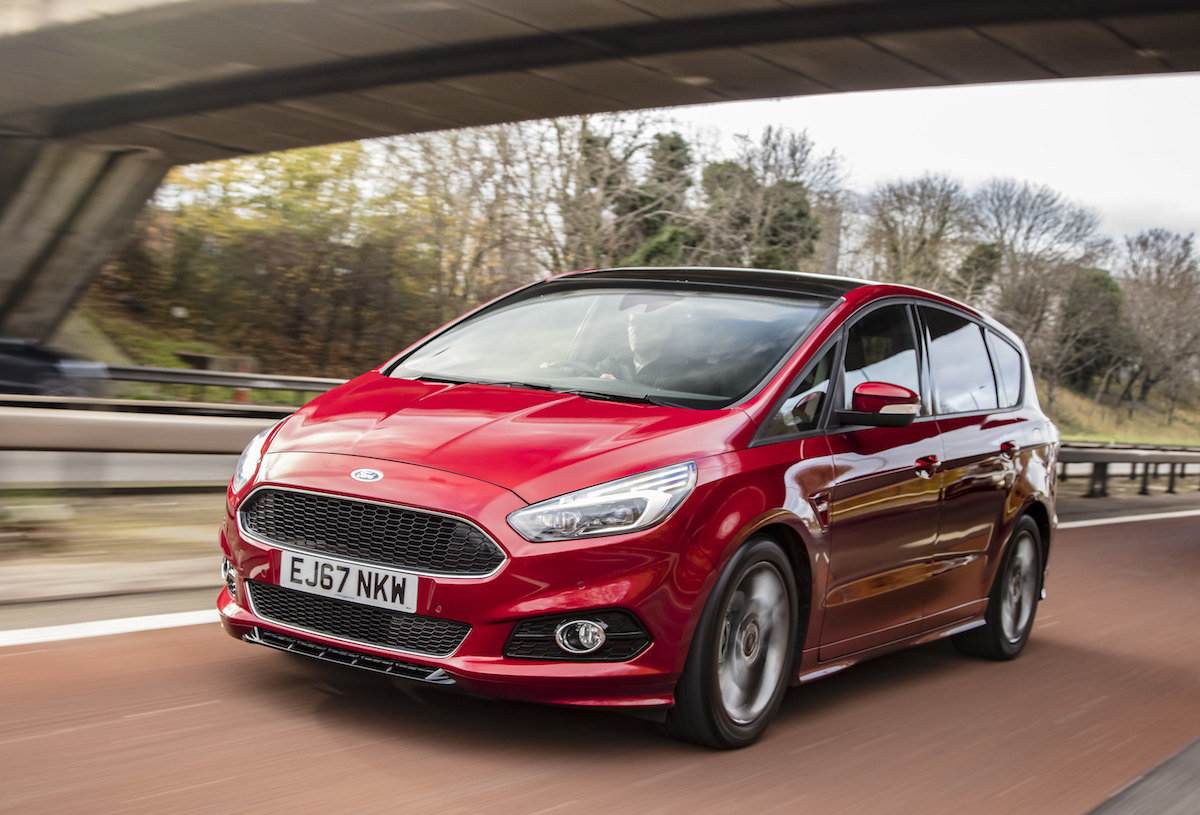
You could be forgiven for taking one look at the S-Max and thinking, "I bet it drives like an old bus". However, you’d be way off the mark with that assessment. Despite its large dimensions and family-friendly first approach, the Ford has been tuned to deliver the same finessed driving dynamics that mark out almost all of its cars.
Even when it is fully laden, the S-Max people carrier rarely feels flustered or clumsy, thanks to its super-supportive suspension. A softer and more refined approach means it’s not quite as sharp as its predecessor, which served-up almost sports saloon levels of driver fun, but it’s still better than most. Despite its inherent haulage brief, it’s actually a surprisingly delicate and engaging car to drive, with impressive levels of grip, precise steering and sweetly-weighted controls. And, it rides nicely, too, keeping life calm, comfortable and civilised for you and your passengers.
There’s also a wide range of engines to choose from, including petrol, diesel and a hybrid. All deliver decent performance, although the least powerful diesel does struggle a little when you’re seven-up and loaded with as much luggage as the S-Max will carry.
Early S-Max models came with a choice of two turbocharged petrol engines (a 160hp 1.5-litre and a 240hp 2.0-litre), or no less than five dieses, ranging from 120hp right up to 210hp. But in 2019, the petrol engines were ditched, and diesels rationalised to just two options, of 150hp and 190hp. By the end of 2021, however, the diesels had disappeared altogether, replaced by just one engine option: a 2.5-litre petrol hybrid, which comes with a CVT automatic gearbox, but isn't available with all-wheel drive.
The petrols are smooth and punchy enough, but both can be thirsty, especially when you’re fully laden. A far better bet are the diesels, which are refined performers and have plenty of mid-range muscle, making them the perfect hard-working choice for an MPV. The hybrid on the other hand is a bit of a mixed bag, its 190hp output looking good on paper, but its slow-witted CVT gearbox and lack of low speed pulling power make it feel a little lethargic on the move.
An automatic gearbox was optional on the less powerful diesel, while on the more powerful version, the automatic was standard, and four-wheel drive could be added as an option. Most S-Max models are fitted with the standard six-speed manual, which is light and precise, combining with the light steering and good visibility to make the Ford very easy to drive.

Being a Ford, you get plenty of kit for your money in the S-Max. Alloy wheels, dual-zone climate control, DAB radio, plus electrically-operated and heated folding door mirrors and remote-central-locking are standard on all, as is an electrically heated Quickclear windscreen, front and rear parking sensors and cruise control.
Stepping up to Titanium trim adds lots of additional kit, as well as a satnav, a 10-inch colour TFT instruments cluster display, keyless entry, automatic high-beam activation, rain-sensing front windscreen wipers, cruise control and lane-keep-assist, you also get those essential seatback trays.
The sportier-looking ST-Line adds lots of body styling enhancements, sports suspension, funky 18-inch alloys and powered front seats. S-Max Vignale models, meanwhile, are expensive, and therefore quite rare, but they do come with lots of chrome bling and oodles of standard kit, including leather seats with heated elements in the front two, a powered tailgate (button and key fob operated) and a rear-view camera.
The vast majority of the materials you come into contact with most, including those on the door tops, air-vent surrounds, steering wheel and gear shifter, look and feel pretty upmarket, providing those up-front with an oasis of escapism from the Ribena and biscuit crumb brigade behind.
It’s even possible to adopt a diplomatic disinterest by busying yourself with the SYNC touchscreen infotainment system, punching in sat nav instructions, making a ‘very’ important phone call, or as a last resort, piping out some soothing tunes through the excellent standard stereo. The latest versions all benefit from the even better SYNC3 set-up, which adds Apple CarPlay and Android Auto connectivity, as well as an even more intuitive and clearer screen layout.
If you only look at Ford’s new car price list, the S-Max seems a fairly pricey car to buy new, but very few are sold for full list price. This helps Ford dealers shift lots of metal but the downside to heavy discounting is the inevitable effect this has on residual values. That’s bad news for the original buyer when they come to sell, but happy times for used car buyers.
The fact that there are also considerable amounts of S-Max models on the used market means you shouldn’t have any problem tracking down a car ideally suited to your lifestyle and your budget.
Unless you can buy one very cheaply, we’d recommend avoiding the petrol-powered cars, as they’re very thirsty compared to the diesel versions. Even according to the official figures of the time when they were new, which we know to be ambitious at best, you’ll be looking at around 30mpg.
As we’ve said, the diesels are a far better option due to their stronger pulling power and superior fuel economy. Even if you get an early diesel model, you should still get between 45mpg and 50mpg on a run. The later the engine, the less impact it will have on your pocket and the environment in terms of both its C02 emissions and NOX output, and in terms of the mpg it returns.
The later Hybrid models are the best of the bunch for fuel economy and environmental friendliness, however; on a long journey, 50mpg is easily achievable, while CO2 emissions are comparable to the diesel models and NOx emissions far lower.
Servicing your S-Max shouldn’t be anticipated with trepidation as labour and parts prices are amongst the lowest of any major dealer network.
As a rough rule of thumb, the S-Max should be serviced every twelve months, but if you’re piling on the miles, speak to your dealer about flexible service plans, which will take in to account the type of driving you do as well as your annual mileage.
Along with the usual fluid and filter changes, a responsible Ford dealer will also carry out a 30-point health check to identify any work that may need undertaking in the future included in the service. They also send a video to your phone showing any areas that require immediate remedial work.

Half the joy of owning a Ford is the knowledge that it will be cheap to run and maintain, and if anything should go wrong, labour rates and the price of replacement parts won’t make you wince.
Not that you’ll encounter too many problems in the first place, mind. Most reliability surveys - including Warranty Direct Reliability Index and the JD Power Vehicle Dependability Survey - place Ford firmly in the top half of their performance tables and given that parts-sharing is rife throughout the Ford world, this bodes well for the S-Max.
The Warranty Direct study reports that if something does go wrong, it is most likely going to be an electrical problem, so before parting with your hard-earned, double-check all the various switches and components are alive and well.
Some owners have reported unexpected engine stalling but this is a well-known glitch that can be fixed with a simple ECU update. If you’re buying from a dealer or a knowledgable seller, check that the most recent updates have been downloaded into the vehicle.
One of the more expensive parts that can fail in any modern diesel engines is the dual-mass flywheel, which is part of the clutch assembly. It’s far more prevalent in cars that spend lots of time in stop-start traffic and this is one of the reasons why high-mileage cars can make more sense than those which only get used on the school run.
Providing an S-Max has been serviced on the knocker, mileage shouldn’t be an issue and any lack of care should be easy to spot from the frequency of the service book stamps and the general state of the interior.
- The S-Max and its larger Ford Galaxy sibling are based on the same basic underpinnings as the Ford Mondeo, which goes a long way to explaining why it drives so well. People may gravitate towards posher badges but no manufacturer knows more about tuning cars to cope with the vagaries of UK roads than Ford. Consequently, although the S-Max was originally introduced back in 2015 it still feels as fresh to drive today as it did when it was first launched.
- If you’re the outdoorsy type, or just after some extra traction for tricky winter conditions, you can choose to add all-wheel-drive to your S-Max. Just be aware that AWD cannot be combined with the self-levelling rear-suspension option.
- Early S-Maxes came with a choice of two turbocharged petrol engines (a 157bhp 1.5-litre and a 238bhp 2.0-litre), or no less than five dieses, ranging from 118bhp right up to 237bhp. But in 2019, the petrol engines were ditched, and diesels rationalised to just two options, of 148bhp and 187bhp. An automatic gearbox was optional on the less powerful diesel, while on the more powerful version, the automatic was standard, and four-wheel drive could be added as an option. By the end of 2021, however, the diesels had disappeared altogether, replaced by just one engine option: a 2.5-litre petrol hybrid, which comes with a CVT automatic gearbox, but isn't available with all-wheel drive.
– If you’re buying an older S-Max, one of the muscular diesel engines will be the most sensible choice. The best engines are badged Ecoblue, and are 150- and 190hp versions of the same smooth-revving 2.0-litre diesel engine found in many other Ford products (earlier diesel engines are badged TDCi, though, and are almost as good). Brand-new or post-2021 cars are only available with the hybrid, however; this setup is heavier, and so it means the S-Max doesn’t handle or ride quite as sweetly – If you’re looking for the best all-rounder: The 180hp diesel version, combined with Titanium trim offers great economy, strong performance, excellent refinement and lots of standard kit. – For those with holiday homes in far-flung destinations: Although the stronger twin-turbo 240hp diesel linked to the standard automatic gearbox is a rare bird, it’s a perfect companion for those long European trips, as it will effortlessly eat up the miles, what’s more, because it is only available with top-end trim, it is crammed with creature comforts. – If you’re on a tight budget: While Zetec is the entry model trim, earlier S-Max models were available with a couple of turbocharged Ecoboost petrol engines. They’re a lot less desirable, so they’ll be cheaper to buy, however, they are quite difficult to track down. If you can find one, provided you’re not a high mileage driver, then either the 1.5 with 160hp or a 2.0-litre with 240hp will do the job more than adequately. – If you’re buying new or nearly-new: the Hybrid version isn’t quite as nice to drive as the earlier diesel S-Maxes, but the trade-off is better fuel efficiency and lower emissions. Steer clear of the ST-Line version, with its stiffer suspension and bigger wheels, and you should mitigate the Hybrid’s extra heft.

