Honda CR-Z Review (2010-2016)
Honda CR-Z cars for sale
4.0
Expert review
Pros
An absolute hoot to drive
Surprisingly economical for a sports car
Good looking
Cons
Not all that fast
Hopeless rear seats
S-spec cars are very basic

The CarGurus verdict
As used cars go, the Honda CR-Z seems to have it all sewn up. It’s fun, economical, and reliable, which is pretty much a perfect combination. It also looks good from the outside, and it’s funky and functional on the inside.
It isn’t a perfect. Despite its sporty looks, it’s not all that fast, and those rear seats are laughable, so if you need space for more than one passenger, you’d best look elsewhere. But if it’s a cute, fun, and frugal two-seater you’re after, the CR-Z is very hard to beat.

What is the Honda CR-Z?
A long time ago (well, the 80s), in a galaxy not so far far away, Honda made a cute little coupe called the CR-X. Small, light, and good-looking, it was simultaneously fun and frugal, with a nimble, agile chassis and a peppy engine. It became a very popular little car, much favoured by young drivers looking for something sporty that didn’t cost the earth to run.
In 2010, Honda revived the idea with the CR-Z. This time around, however, the company used its nascent hybrid technology (badged IMA, or Integrated Motor Assist) to offer performance, much lower emissions than conventional sports coupes, and excellent fuel consumption. To make sure its new car was exciting to drive, Honda fitted it with a manual gearbox, which is a real rarity among hybrid cars.
On the outside, it has the same low nose, teardrop profile and sharply truncated tail as the car that inspired it, rendering it both stylish and compact.

How practical is it?
A small sports coupe is never going to be the last word in practicality, but the CR-Z is what’s known as a 2+2, which means it has a pair of small rear seats. Be warned from the off that these are by no means big enough to accommodate adults - or even children - on anything like a regular basis. However, they’ll do the trick for the occasional short trip.
The boot is actually pretty big for a coupe, though. At 382 litres, it’s about the same size as a Volkswagen Golf’s, and there’s neat a little 19-litre storage area underneath the boot floor for stowing small bits and pieces.
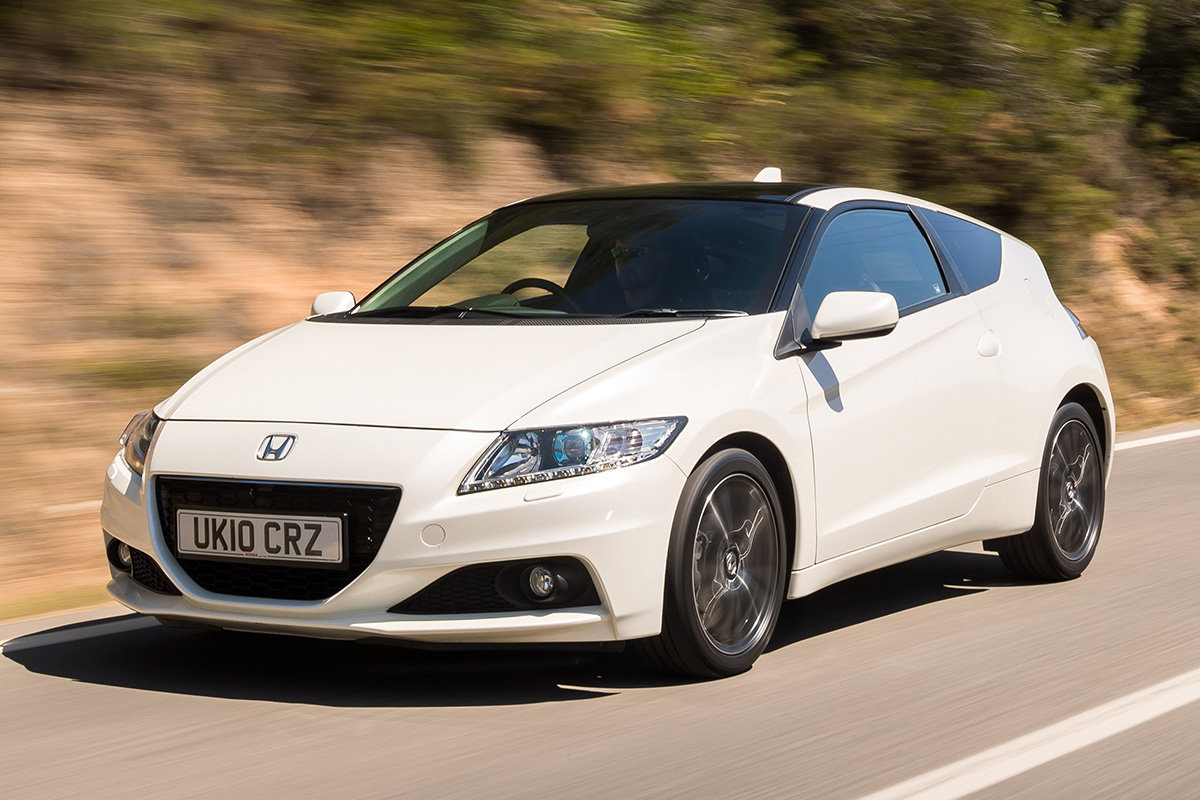
What's it like to drive?
Inside, the CR-Z’s unusual interior puts the major controls directly behind your hands as they rest on the steering wheel. Funky blue dials and swooping lines give the rest of the interior a bit of a sci-fi feel.
The 122bhp power output (increased to 135bhp from January 2013) is well below that of many rivals, so the CR-Z isn't all that fast. However, the 1.5-litre petrol engine emits a snorty rasp as the revs climb, and it’s boosted through the mid-range by the 14bhp electric motor, so it can still put a smile on your face.
The CR-Z handles very sweetly, too. It’s planted and taut in corners, there’s plenty of grip, and the steering is light and responsive, so it turns into corners deftly. Snick down a gear through the slick, short-throw six-speed gearbox, and with a flick of your wrists, you’re zipping toward the apex. Yes, it could do with a bit more steering feel to be truly involving, but it’s much more exciting than other hybrids, such as the Toyota Prius.
Even when you aren’t driving it hard, the CR-Z is a pleasant thing to be in. You might expect that stiff suspension to create an uncomfortable ride, but it doesn’t. It’s firm, as you’d expect from a sports car, but it smoothes off the edges of even the worst ruts, and it doesn’t crash its wheels into potholes.

Technology, equipment and infotainment
There are three versions of the CR-Z. The entry-level S version is a little too basic: it gives you climate control and a CD player, but little else of note.
The Sport trim level adds very appealing features such as cruise control, a subwoofer, rear parking sensors, and ambient lighting.
The top-spec GT trim, meanwhile, gets HID headlights, leather upholstery, heated front seats, Bluetooth connectivity and a panoramic glass roof. On the used market, the CR-Z is now sufficiently old that the GT-trimmed cars are barely any more expensive than the more humble versions, so seek out a range-topper if you can.

Honda CR-Z running costs
This is one area in which the CR-Z really shines, because you can expect to see around 40-45mpg on average. That figure will increase if you mostly use it around town, because urban driving will allow the hybrid system to charge up regularly and improve the fuel economy. What’s more, the CR-Z costs peanuts to tax, thanks to its low CO2 emissions.
Similar fuel consumption and emissions figures are achievable from rivals such as the Audi TT and the Volkswagen Scirocco, but only if you choose a diesel version.
The CR-Z shouldn’t be any more costly to maintain than any of its rivals, and Honda’s parts and servicing costs are known for being reasonable and transparent. However, cars of the CR-Z’s age are often serviced by independent garages rather than those in the franchised network, so it may be worth seeking out a good specialist, particularly one with experience of working on hybrids.
One thing you won’t have to worry about with the CR-Z is replacing a rubber timing belt regularly and at great expense, because it doesn’t have one. Instead, it has a metal chain, which is designed to last the life of the car.

Honda CR-Z reliability
You might be worried about the CR-Z’s electric components failing with time, but even on a car as old as the CR-Z, a failed battery is a very rare occurrence.
Nevertheless, it’s worth checking that the battery is charging and functioning as it should. Keep an eye on the battery indicator, and make sure it goes up as well as down during a test drive, and if the battery light stays on while you’re driving, that suggests there’s a problem.
Common issues with the rest of the car are rare and, for the most part, the CR-Z seems to be incredibly reliable. That said, it pays to check for faults common to all cars, such as knocking suspension, which could indicate perished bushes, or a slipping clutch.
We have heard that the front fog light lenses are made from a very brittle material, and they can crack easily. They shouldn’t be too costly to replace, but it’s still worth looking before you buy.
- One of the things you’ll notice when you drive a CR-Z for the first time is three mode switches to the left of the steering wheel. Normal, which is the standard setting, Econ, which sets the up car for improved fuel efficiency by dialling back the climate control and tweaking the engine mapping, and Sport, which sharpens up the steering and the throttle for those moments when you want to attack a back road. It also adjusts the available boost from the electric motor to give you full power, so if you want maximum acceleration, you’ll need to remember to activate Sport mode first.
- One problem with the hybrid powertrain is that the battery can run out. The petrol engine ticks along fine when the battery is depleted, but you don’t get the extra benefit of the electric boost until the battery has charged up again, which it does through regenerative braking and coasting.
- The CR-Z started life as a concept car at the 2007 Tokyo Motor Show and went into production three years later. It was pretty faithful to the original concept, and hung onto a few quirky features, such as the 3D speedometer and the driver-focussed cabin.
- If you want the best-value: These days, the GT version of the CR-Z doesn’t really fetch much of a premium over the Sport model and, given the extra equipment you get, we reckon that makes it a no-brainer. We’d avoid the entry-level S model, though, because it’s rare and basic.
- If your budget stretches: You’ll want one of the post-facelift models, introduced in January 2013. As we mentioned above, the power output was boosted from 122bhp to 135bhp, with Honda switching from a nickel metal hydride battery to a lithium-ion one for the hybrid system. In short, it’s a bit quicker.


