Hyundai i10 Review 2025 | Is this small car perfection?
Hyundai i10 cars for sale
5.0
Expert review
Pros
Very practical for such a small car
Economical and well equipped
Generous warranty
Cons
Entry-level cars don't have Apple CarPlay or Android Auto
No three-door version
Not as much fun to drive as a Seat Ibiza
The CarGurus verdict
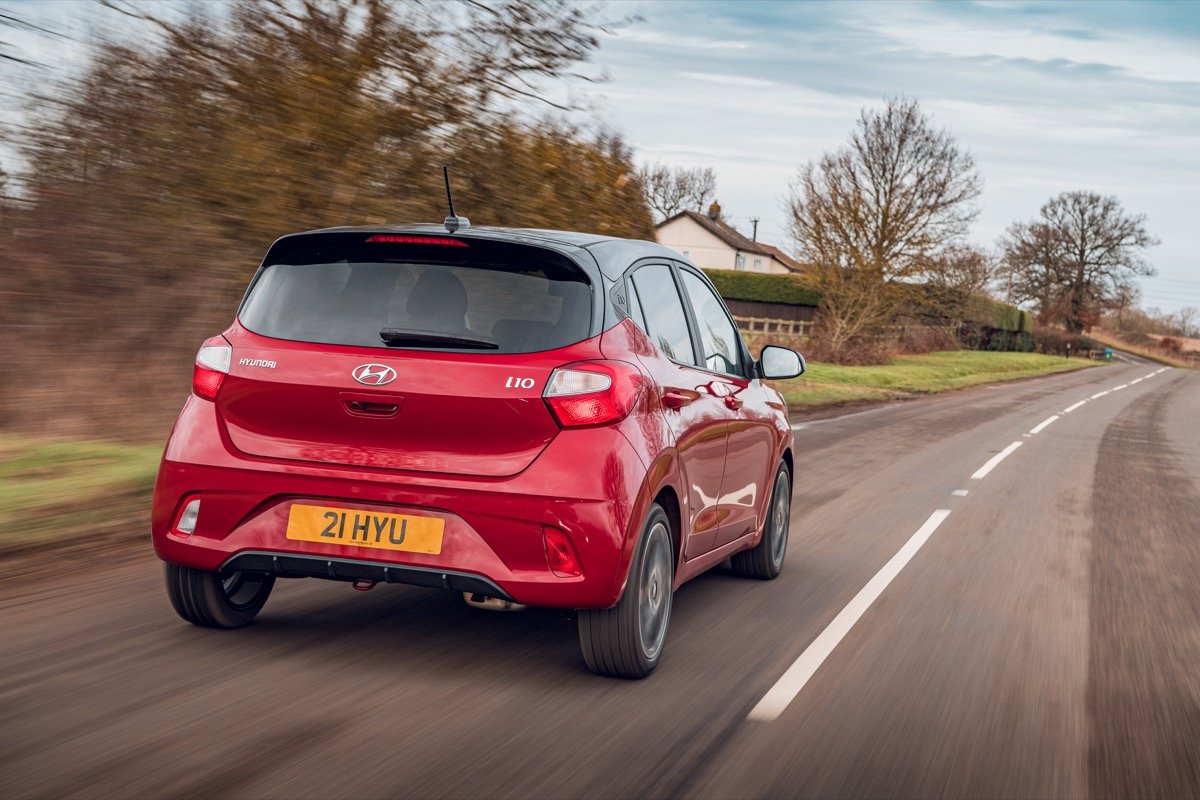
This generation of i10 is one of the best small cars around, and sets a benchmark for others to follow. It’s smart, economical and well-equipped, and on top of that it’s comfortable, practical and good to drive, with a great reputation for reliability. And with a five-year, unlimited-mileage warranty, it makes a great second-hand buy. Highly recommended.

What is the Hyundai i10?
The i10 is the smallest car that Hyundai makes, a supermini that aims to package up everything you need from an everyday runabout into a compact and very affordable product.
We’ll let you make your own mind up about the styling of this generation of i10, released in 2020, but we reckon it’s a smart little thing, especially if you spec or find one with the optional two-tone paint.
More importantly, current emissions regulations mean that the city car class is a dying breed, so the i10 is one of only a handful of options at this end of the market. Happily it’s one of the best, plus it’s backed by Hyundai’s excellent five-year unlimited mileage warranty and breakdown cover. Rarely does buying something so affordable come with such peace of mind.

How practical is it?
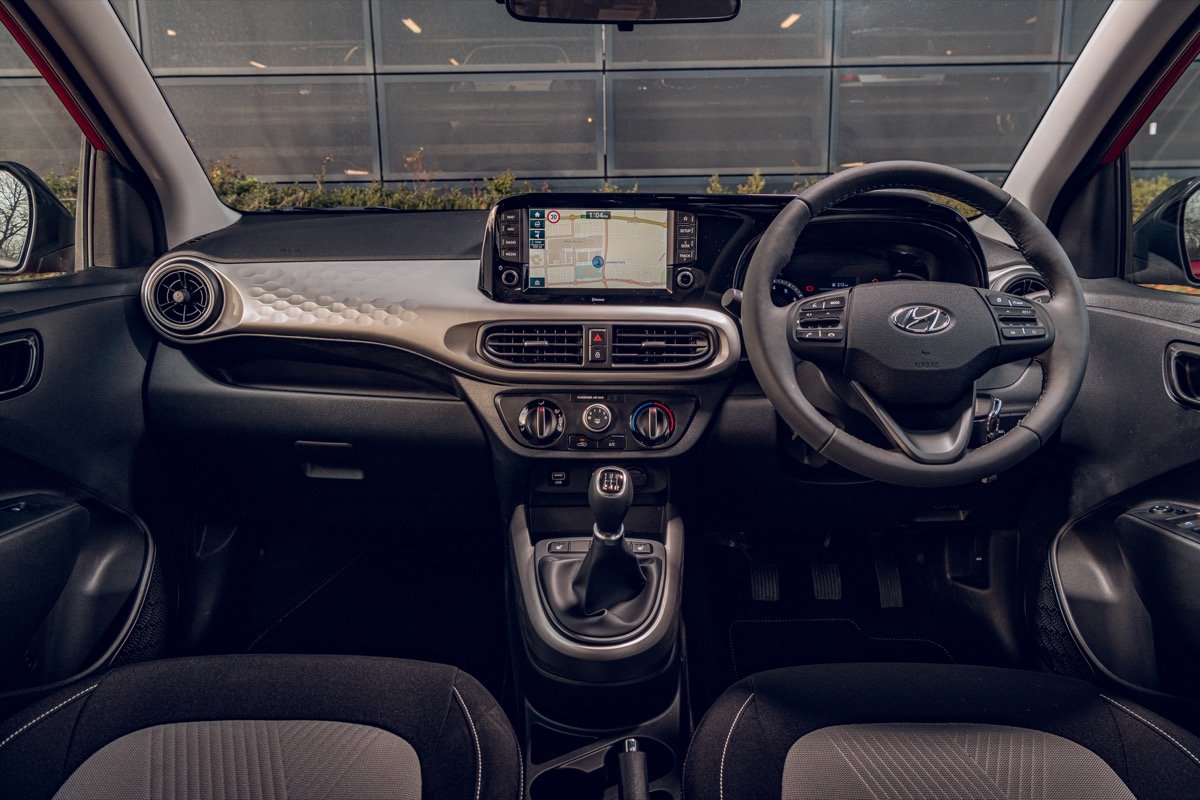
The interior of the i10 doesn’t feature the most daring design in the world, but it's very well thought-out. For instance, the dashboard looks smart and all the major controls are handily sited, including the touchscreen infotainment that sits up high in your eyeline. Sure some of the plastics are a little scratchier than we’d like, but overall the car is robustly built and well up to the demands of hard-working family life.
Speaking of which, while the i10 is a small car on the outside you shouldn’t dismiss it as practical transport. For starters it’s available exclusively with a versatile five-door bodystyle, while in the back there’s a surprising amount of space - even two six-footers should have no problem getting comfortable.
Upfront you’ll find good visibility and supportive seats, while the driving position is comfortable despite a steering wheel that adjusts up and down but not in and out. There’s also a decent array of storage, including some deep door bins, a large glovebox and some cupholders between the front seats. There’s even a tray ahead of the gear lever to place your smartphone, which on the top models is also available with an optional wireless charging pad.
The boot’s a reasonable size for this type of car too, with a capacity of 252 litres, which is two litres more than you’ll get in a VW up!. All versions get 60/40 split/fold rear seats, which when lowered free up a very useful 1,050-litres of carrying capacity. That said, doing so will leave a step up between the boot floor and the folded seats, but that’s the price for a lower boot floor and a bit of extra practicality.
And of course, don’t forget that being a small car makes the Hyundai one of the most hassle-free ways to get about, particularly around town. There aren’t many gaps into the traffic you won’t be able squeeze into, while parking is as quick and stress free as you’d imagine, with no need to worry whether you’ll fit between the white lines.
What's it like to drive?
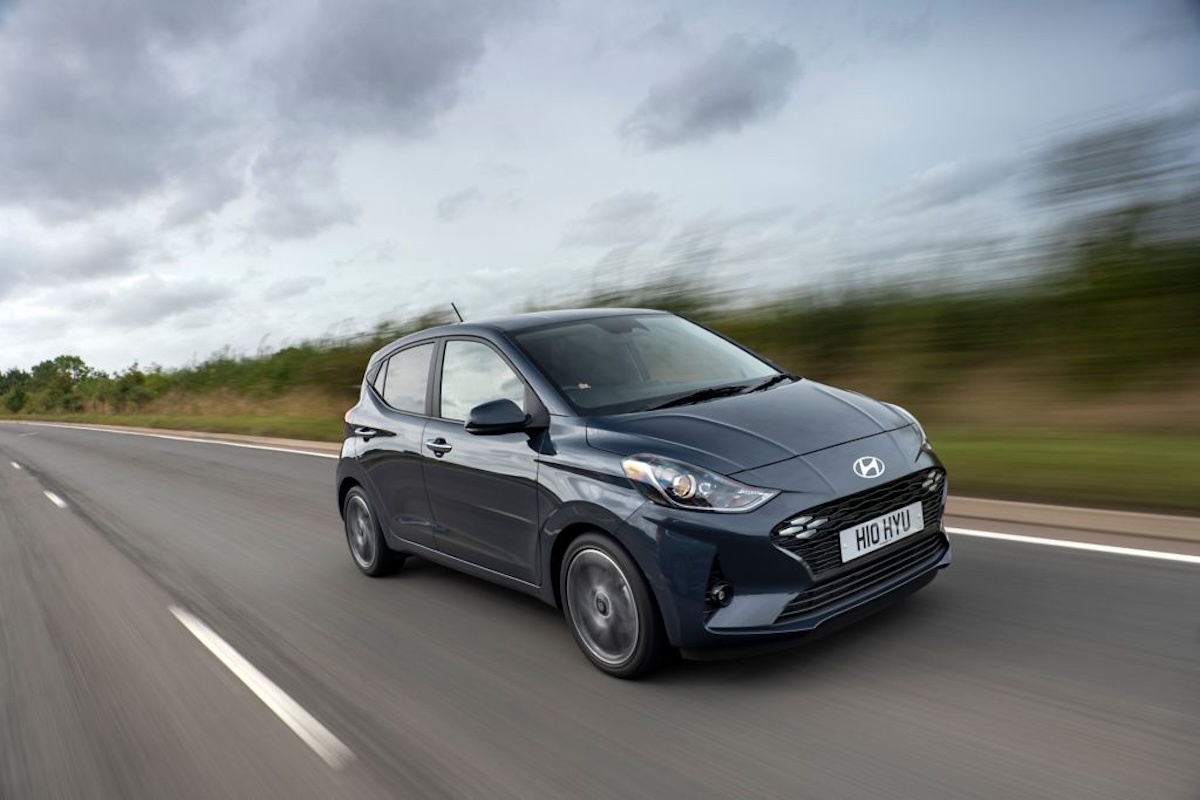
On the road, it’s often difficult when designing a car to strike a balance between comfort and the ability to keep a vehicle composed through corners, as soft suspension can often mean wallowy handling. This is especially true of cars of this price point where complicated, expensive suspension systems aren’t an option. So it’s hugely pleasing to find that not only does the i10 dismiss even vicious potholes with a wave of its hand, it’s also very well behaved when threading it down country roads, and always feels safe, secure and planted on the road. When it comes to cars of this size and price, there’s very little that’s as good as this.
Note, however, that the N Line model has stiffer springs, due to its sporty image, and that will firm up the ride somewhat in the search for nippier handling. All versions have an impressively small turning circle though, and light steering means it’s a breeze to manoeuvre around town. Yet the steering still feels connected enough to the front wheels to make for precise inputs through the bends.
You can choose from four trims and three different petrol engines. We’ll cover the trims shortly, but when it comes to power we’d skip over the entry-level engine, the 1.0-litre MPi, as while it’s OK if you’re only driving around town, it’s not got enough puff when you get to motorway speeds. Instead, look at the 1.2-litre MPi, which has more power, enough to avoid that gutless feeling as you urge it up towards 70mph. If you want even more punch, you could look at the 99bhp, turbocharged 1.0-litre T-GDi, which offers enough performance to surprise some bigger and more expensive machines. However, it’s only available in the top-spec N Line trim, and will therefore cost you more.
Gearboxes? Most i10s will come with a reasonable five-speed manual gearbox, but the two MPi engines have the option of a five-speed automatic.
Technology, equipment and infotainment
The i10 line-up kicks off with the Advance model, which gets you manual air conditioning and cruise control, as well as high beam assist, which automatically dips the headlamps when it senses another car approaching, before reapplying full beam when the road is clear.
You’ll also get 15-inch alloy wheels and a rear-view camera (something that’s absent from much more expensive cars than this), as well as an 8.0-inch touchscreen infotainment display with satellite navigation and all the smartphone connectivity.
For a small amount more, you can opt for the Premium trim, which adds 16-inch alloy wheels, a wireless phone charging pad, some glossy black exterior bits and heated steering wheel and front seats, which are a godsend on a cold morning. You’ll also get snazzy LED daytime running lights and front fog lights, as well as tinted rear glass.
The i10 N Line is the top-spec trim, only available with the most powerful engine. It’s the sportiest i10 (for now, at least), and gets different 16-inch alloy wheels, a sportier look and rear brake discs (rather than drums) for better stopping power. There’s some N Line-branded stuff inside too, including the steering wheel and gear stick, which helps maintain that racy feel.

Hyundai i10 running costs
There’s not a massive difference in prices between the new Hyundai i10 models if you’re buying as a new car, with less than £3,000 separating the entry-level model from the top of the range. The same is true of used examples, too, with a relatively small price walk from the Advance (or as it used to be known, SE Connect) to the Premium version.
As you might expect for a small car with a small engine, the i10 is pretty frugal on fuel, too. Granted, it isn’t quite as parsimonious as the hybrid Toyota Aygo X, but even so, the entry-level 1.0-litre engine, with a manual gearbox, will return an official fuel economy of 56.5mpg. But with the 1.2 returning 55.4, we’d still recommend opting for that, as the difference is so minimal. Cars with an automatic gearbox won’t get quite as strong MPG figures, and the more powerful engine found in the N Line model will return 52.3mpg.
If you’re a company car driver, the entry-level 1.0 Advance might appeal as it sits in the 28% bracket for Benefit in Kind tax thanks to its low CO2 emissions. But upgrading to the 1.2-litre model only moves you up to 29%, which we think is well worth it for the extra flexibility that bigger engine gets you.
Oh, and if you were thinking of choosing a plusher i10 as a company car, it’s worth noting that the N Line model actually kicks out slightly less CO2 than the slower 1.2 Premium – and so it’ll actually cost you slightly less to tax.
When it comes to insurance, the cheapest models will be the 1.0-litre versions, which sit in insurance group 3 of 50. The most expensive – the N Line model – is in group 10, so no i10 is likely to break the bank. Curiously, you’ll get cheaper insurance on automatic models; the 1.2 MPi Premium model sits in group 3 if you get the automatic, but group 6 for the manual. The i10 needs a service every year or 10,000 miles. Go through the official dealer network and the first will cost you around £200, while the second will be a bit pricier at around £300.

Hyundai i10 reliability
The i10 has a truly sparkling reputation for reliability. It finished first in the 2025 What Car? Reliability Study, a position it shared with another Hyundai, the larger Santa Fe.
It was one of just four cars in the survey to achieve a deeply impressive 100 per cent reliability score, which meant none of the respondents to the survey who owned i10s reported any breakdowns, faults or glitches.
Hyundai as a brand has a solid reputation, having come 14th out of the 30 cars to have featured in the same survey. The company also sits well within the top half of Warranty Direct’s Reliability Index, which looks at the reliability of older models. That confirms that Hyundai’s reputation has been well-earned for many years. All of this suggests you’d be unlucky to have any major issues with an i10.
Hyundai offers a five-year warranty on a new i10 so second-hand models will still be covered for years to come. Several rivals only offer three-year warranties, although Hyundai’s sister company, Kia, offers seven years of cover on its Picanto.
- When it comes to safety kit, all i10 models get everything, which includes plenty of airbags, automatic emergency braking and a lane keep assist system (which we found to be a touch over cautious in its warnings. But you can switch it off if you want). It even has an E-call set-up that automatically calls the emergency services when the airbags are triggered in a collision.
- You can have your i10 in N Line trim, and like pretty much every other Hyundai model, this gets you sportier looks and a racier feel inside. But unlike the other Hyundais, with the i10, the N Line also gets its own engine, a peppy 1.0-litre turbo that gives you more grunt than you can have in either of the other two models. As a result, choosing N Line trim turns your i10 into a little warm hatch, and makes it great fun to drive.
- If you want your i10 with an automatic transmission, then bear in mind that the five-speed unit fitted to the Hyundai is actually an automated manual gearbox. It’s lighter and more efficient than a traditional torque converter auto or sophisticated twin-clutch unit, but the trade-off is that it’s not as smooth, with slow and ponderous shifts.
- If you want the best all-rounder: For our money, the 1.2-litre MPi engine with the Advance trim strikes the best balance between cost and features. That means you’ll get punchy enough performance, and a very reasonable amount of kit thrown in as standard.
- If you want the cheapest option: The most affordable i10 is the 1.0-litre Advance. It’s still pretty well equipped for the price, but be warned: that smaller engine runs out of puff at higher speeds, which makes the i10 hard work on the motorway. For this reason, we think it’s worth paying to upgrade to the bigger engine.
- If you want the sportiest model: There’s no ‘proper’ hot hatch version of the i10, but the top-spec N Line version will give you the most zip to the driving experience. As we’ve already discussed, it’s got a zippier engine than the other models, better braking and a funkier look to the outside, as well as some N Line brand bits inside, too.
- If you want the swankiest version: While the N Line model is the most expensive, it doesn’t actually have the most features. That honour goes to the Premium model, and if you want a few extra bits and bobs, look for a car that’s specced with the optional Tech Pack.


