Jaguar F-Type Review (2013-present)
Jaguar F-TYPE cars for sale
4.0
Expert review
Pros
Sublime styling
Great fun to drive
Relatively good value for what it is
Cons
Only two seats
V8 drinks fuel
Tiny boot in convertible models
The CarGurus verdict
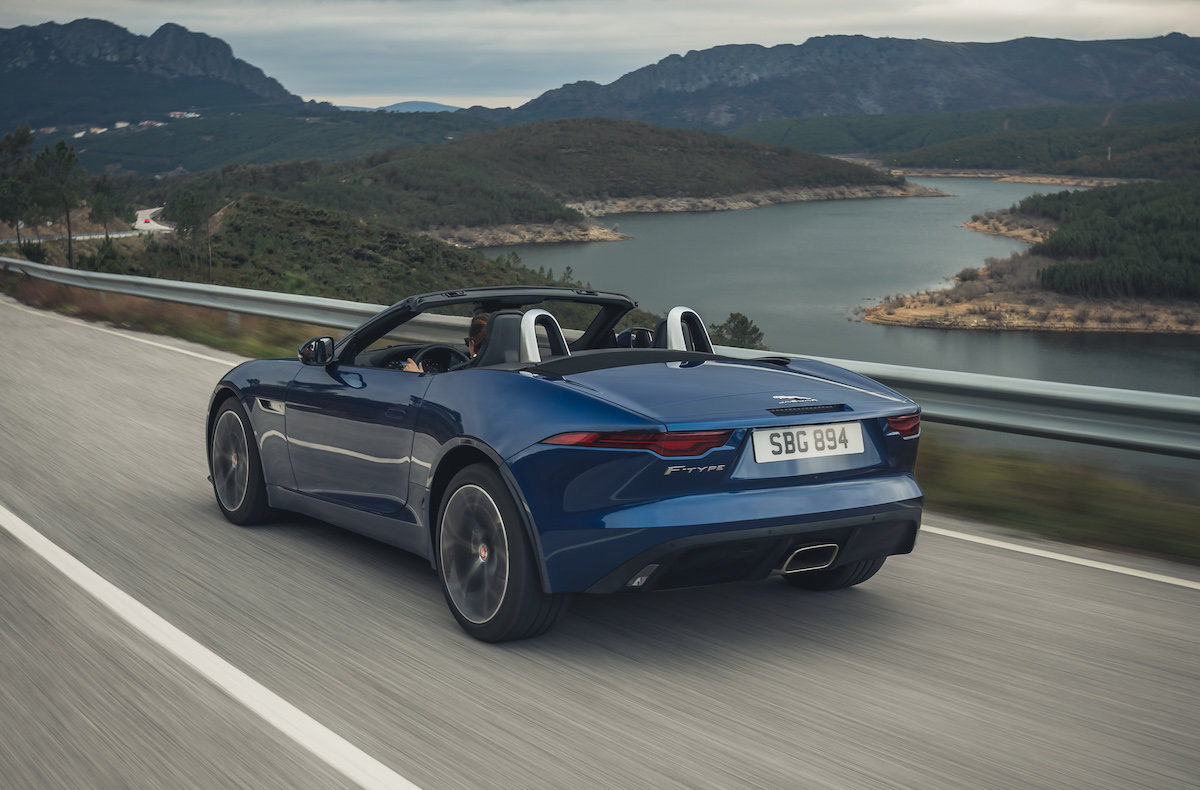
It would be all-too-easy to walk into a Porsche dealership and put your money down on a 718 Boxster or 718 Cayman over the F-Type, but if you’re reading this then you’re at least considering an alternative. The F-Type is a worthy one, too, that’s got good looks, fine driving appeal and a decent standard equipment list in its favour, likewise the fact it’s not a Porsche, or an Audi TT, a BMW Z4 or Mercedes-Benz SLK, is a strong pull to the plucky British car.
Buying the F-Type over those alternatives is a very deliberate choice, and one we’d certainly not discourage. It makes less sense as you climb the range, though, again, apply some different thinking to the mix and you can justify a P575 F-Type R as a cheaper alternative for that Aston Martin Vantage you fancy. A fine car, that’s well worth considering if you’re treating yourself.

Jaguar has long traded on its sporting heritage with its famous E-Type, but it didn’t really have a true successor to its best-known model until the F-Type arrived in 2013. Even its name was a none-too-subtle link to the E-Type, and the looks have just as much capacity to wow.
Available in both coupe and convertible forms, the F-Type was initially offered with a range of V6 engines, alongside the supercharged V8s, but those V6s were dropped as part of a series of extensive revisions in 2020. That saw what was previously the entry-level engine – a 2.0-litre turbocharged four-cylinder – take over as the primary option for the F-Type. Other changes in 2020 included a sharper face with slimmer headlights, revised taillights, an updated interior, and a superior infotainment system.
The F-Type’s most obvious competitor is the Porsche 718 Boxster/718 Cayman. The F-Type’s wide span in terms of performance and price means it also enters the territory of sports cars in the category above, such as the Porsche 911. In its most potent form, the supercharged P575 R – more commonly referred to as the F-Type R – it has the firepower to take on supercars such as the Aston Martin Vantage and the Audi R8, but for significantly less money.
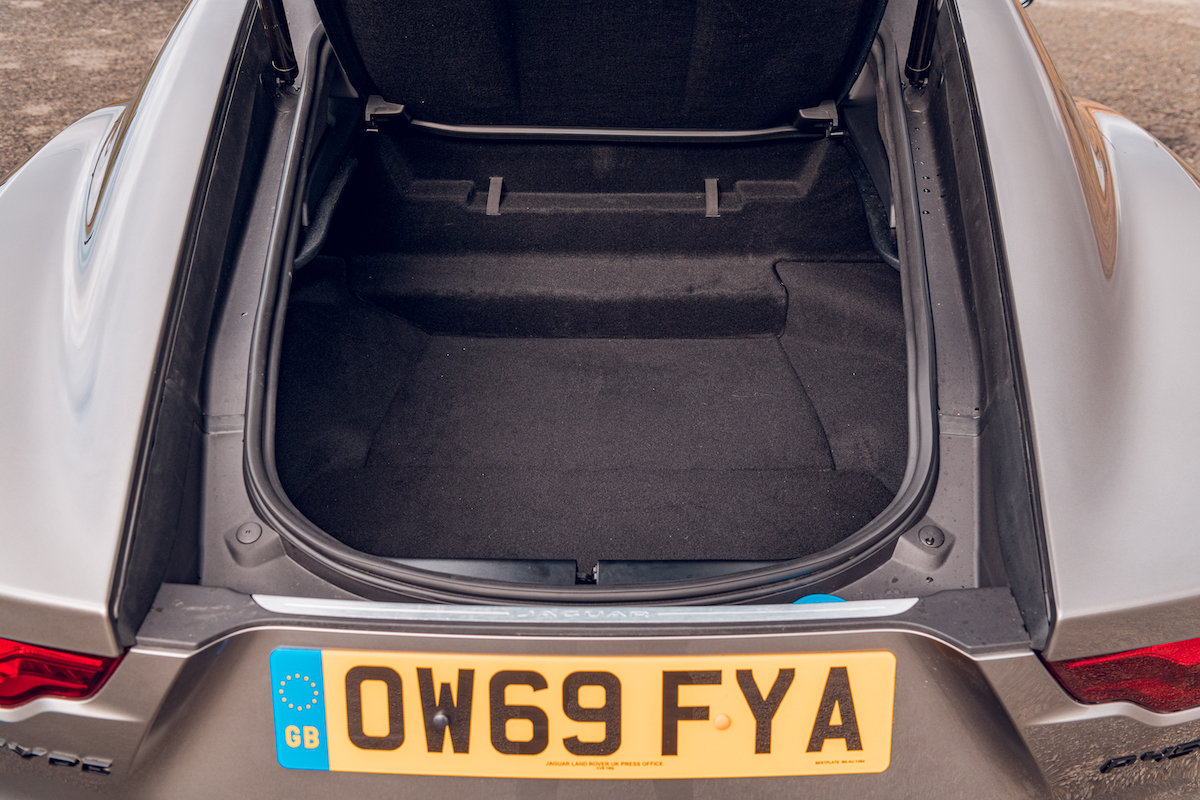
The coupe is the more useful as a daily proposition, not least because the boot is between 299 and 310 litres depending on the age of the car, which is impressive for a compact performance model. The convertible’s boot is smaller at 200-233 litres, and it isn’t as easy to access, but even that’s not small.
Both are two-seaters, so if you’ve children you’ll need a second car, but cars like this aren’t bought with sensibilities in mind, they’re bought because they’re alluring and fun.
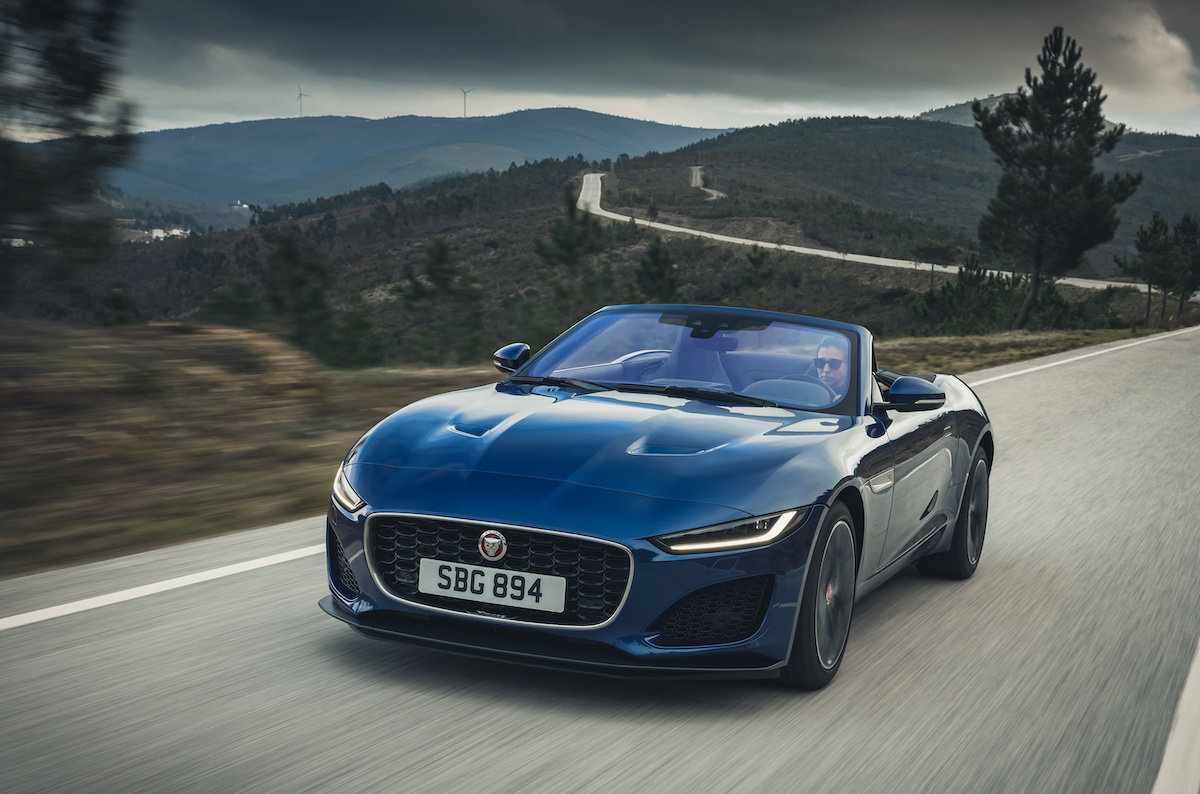
The four-cylinder 2.0-litre turbo F-Type is badged P300 (the 300 relates to metric power output) with the two supercharged V8 models badged P450 and P575 R, and, yes, those are the power outputs of the two V8 cars, which if you prefer good old brake horsepower are 450hp and 575hp respectively.
The P575 R has four-wheel drive to manage all that power, and the P450 is offered with either rear-wheel drive or four-wheel drive. Whatever engine you have, it’ll be mated to an eight-speed automatic transmission, because Jaguar quietly dropped the manual gearbox along with the V6 engines.
The range-topping F-Type P575 R is a rather different proposition to the P300 – it’s loud, very fast, and a lot of fun. That’s not to detract from the lesser-powered entry model, which makes good use of its 300hp, it’s easier to handle the power and, being lighter, it’s more agile and responsive.
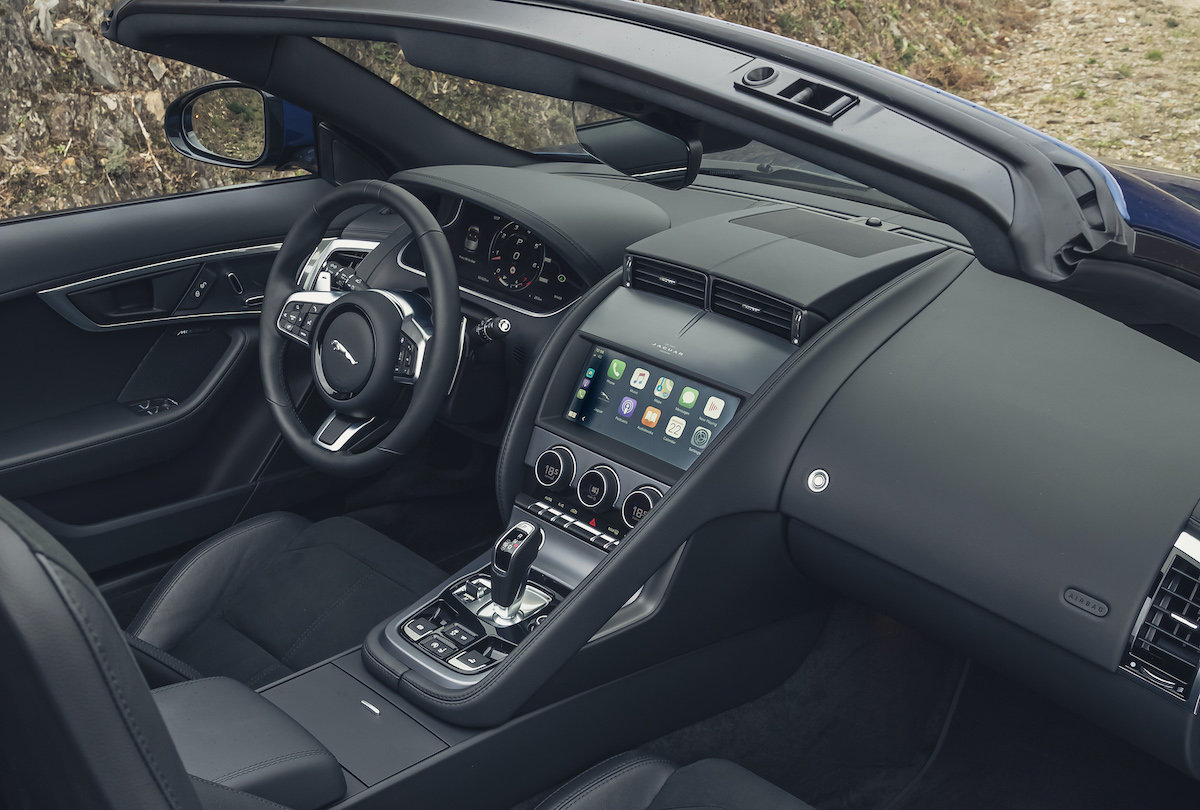
The F-Type is offered in three different trim levels, all of which are generously specified. Even the standard version comes with electrically adjustable sports seats with a leather and suede finish, LED headlights, climate control, and a Meridian sound system including Apple CarPlay and Android Auto.
R-Dynamic trim adds larger alloy wheels – 19 inches with the P300 and 20-inches with the P450 – as well as an R-Dynamic body kit, adjustable suspension and an electronically controlled active differential.
The range-topping R gets its own unique specification, befitting of its higher performance and price point. If money is no object and you’d like it personalised further, the Jaguar’s Special Vehicle Operations (SVO) unit will fulfil any desire you like.
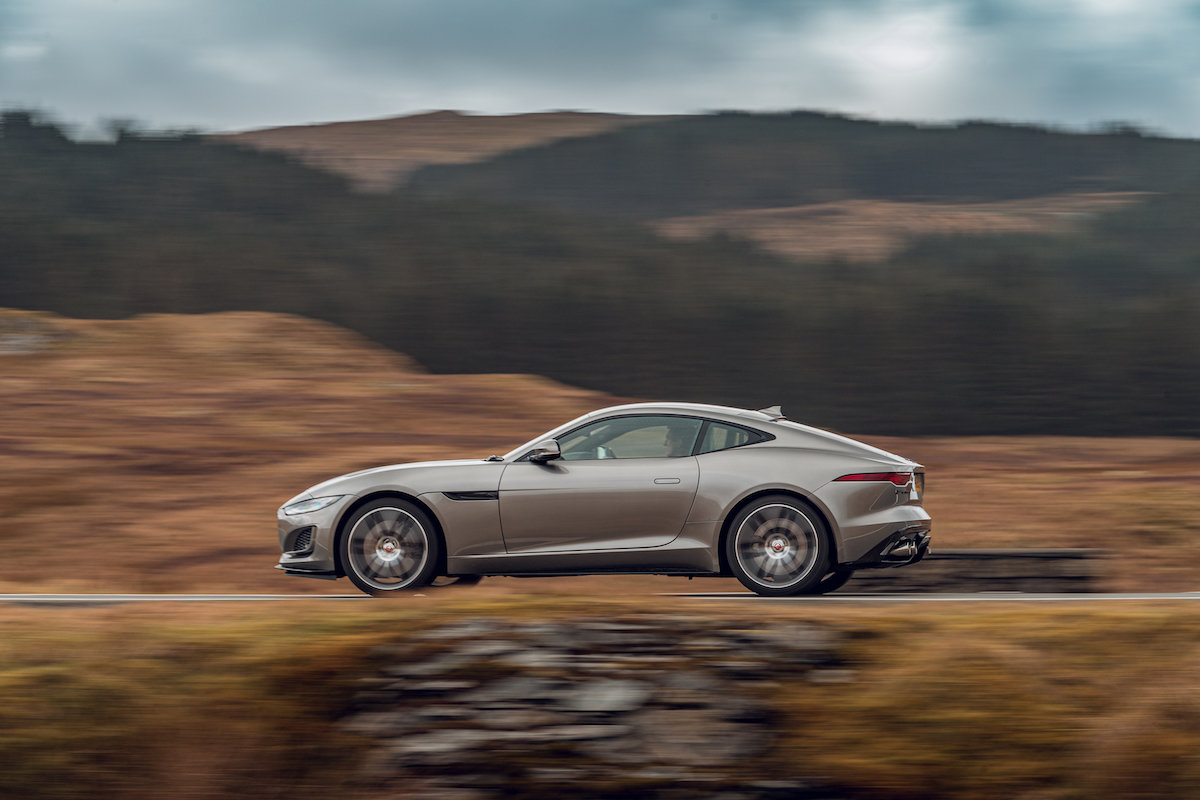
Jaguar quotes an official WLTP tested combined consumption fuel economy figure of 29.1-29.9mpg for the P300, which should be achievable on a longer run if you’re not it too much of a hurry. Drive it as intended and you’ll likely be in the low 20mpg sphere, and if you’re really trying, lower still. That’s not going to come as a surprise to buyers, though, as the F-Type’s a sports car. The convertible weighs a little bit more than the coupe, so it’ll return fractionally less mpg, but it’s not so much it’s likely to impact on your buying decision on any of the engine choices.
The P450 and P575 R F-Types push the running costs a bit higher, as you might expect given they have 5.0-litre supercharged V8s under their bonnets. They’re quoted officially in the 25-26mpg sphere across all models, be it the rear- or four-wheel drive P450 or the range-topping P575 F-Type R. CO2 emissions for the four-cylinder P300 are less, and if you’re really keen on keeping them as low as possible then stick to the smaller standard wheel choice. None manage the top-rate over 255g/km emissions tax payment when new, but all are in the over £40,000 category, that attracts an additional £325 annual VED tax payment for the first five years of ownership, that being in addition to the £150 rate it’ll revert to after those five years.
Servicing on all shouldn’t be too expensive, Jaguar offering a fixed-price servicing plan for all its models, which can be made as a single payment, or a monthly subscription. It costs anywhere from £1,000-£1500 for three years, depending on your usage. Some of the services within the infotainment system will require a subscription payment once the initial free period expires, too. The V8s will work through consumables like tyres and brake pads more quickly than the P300 models, thanks both to their greater performance and weight, and the tyres will be more expensive than those on the lesser-powered car, too.
All fall into group 44 and above for insurance, that in no small part to the fact the F-Type has an aluminium structure, which is expensive to repair if you damage it.
We wouldn’t be being unfair to say that Jaguar hasn’t got the best reputation for reliability, but the F-Type has been around long enough for any mechanical woes to be revealed, and, largely it’s been a reliable car. All come with a three-year unlimited mileage warranty, and should it go wrong Jaguar dealers have a decent reputation for customer service, so you should be treated well. You can, for an additional payment, add a further two years to the warranty should you want the peace of mind.
There have been some recalls over the F-Type’s life, these mostly small items like checking that things like fixings are the correct type, though some early four-wheel drive F-Types were fitted with incorrect anti-roll bars. If you’re buying one used, have a Jaguar dealer check if any recall work has been necessary, or done.
Other faults that have been noted relate to sticking valves in the switchable active exhaust, a leaking rear differential thanks to poor seals and make sure those appealing pop-out door handles and dash-top vents pop up smoothly, as they can fail. Don’t be surprised if there are glitches with the infotainment system, too, it not the best system out there, though it has improved as the F-Type’s aged. Jaguar used to replace the window seals on early F-Types free of charge, because they can get stones caught in them, if the side glass is scratched it’s likely that it’s not been done.
– An extra trim level known as First Edition was introduced when the F-Type was facelifted in 2020. It added 12-way electrical adjustment to the seats and a different interior trim package, among other elements. – Jaguar’s Special Vehicle Operations (SVO) arm has produced some rare, limited-edition F-Types, including the Project 7 – a brutally fast track racer inspired by the 1950s Jaguar D-Type and limited to 250 models. There’s every chance with the current F-Type Jaguar’s SVO department is preparing something equally limited in numbers and special for its most demanding customers and collectors. – The F-Type isn’t short on drama with its looks, but just getting into it involves a little bit of theatre. The door handles are flush, popping out to greet you, and they retract when you pull away. There’s another little surprise inside, because the vents on top of the dashboard raise out above the multimedia screen when you start the car.
- The one we’d use everyday: It’s difficult to ignore the P300, in coupe or convertible guise, in R-Dynamic trim. It’s not quite the entry point to the F-Type line-up, but it’s a compelling choice, the R-Dynamic adding those larger alloy wheels and that switchable sports exhaust. Its performance is adequate rather than outstanding, but there’s enough power to enjoy the F-Type’s fine chassis balance and poise on the road, without ever going too fast. The lighter four-cylinder engine up front actually aids its agility too, and while it’s not got the rousing soundtrack of its V8 relations, even with that switchable active exhaust, nor does it come with the higher price, or running costs.
- The wild one: The P450 R-Dynamic model is arguably the most engaging F-Type. The P575 R model above it might have a decent amount of additional power, but it’s only offered with four-wheel drive. With the P450, its 450hp supercharged V8 can be had driving just the rear-wheels – four-wheel drive being optional. That makes it the choice if you’re a bit of a purist, or like spending time at the tyre-fitters, where you’ll likely be a regular customer.
- The fastest: The P575 R. With 575hp from its sonorous supercharged 5.0-litre V8 engine it’ll manage a 186mph top speed, and reach 62mph in 3.7 seconds. That is just a tenth or so off something like an Aston Martin Vantage. The R revisions to the chassis sharpen it up, too, bringing more focus, leaving the only decision you’ll have to make with it being if you go for it as the coupe or the convertible.
- The practical one: No sports car is truly practical, but if you want to enjoy it more often then any coupe F-Type trumps the convertible choices for practicality. It’s a hatchback, which means good access to its larger boot, into which you can cram quite a lot of stuff. That, and if you’re into activities where the equipment won’t fit in the back; biking, skiing and suchlike, you’ve a fixed roof to attach your gear to.


