Jeep Wrangler Review (2018-present)
Jeep Wrangler cars for sale
2.0
Expert review
Pros
Hardcore off-road ability
Tough styling backed by decades of heritage
Modern infotainment system
Cons
Expensive to buy and run
Poor to drive on the road
Very disappointing safety rating
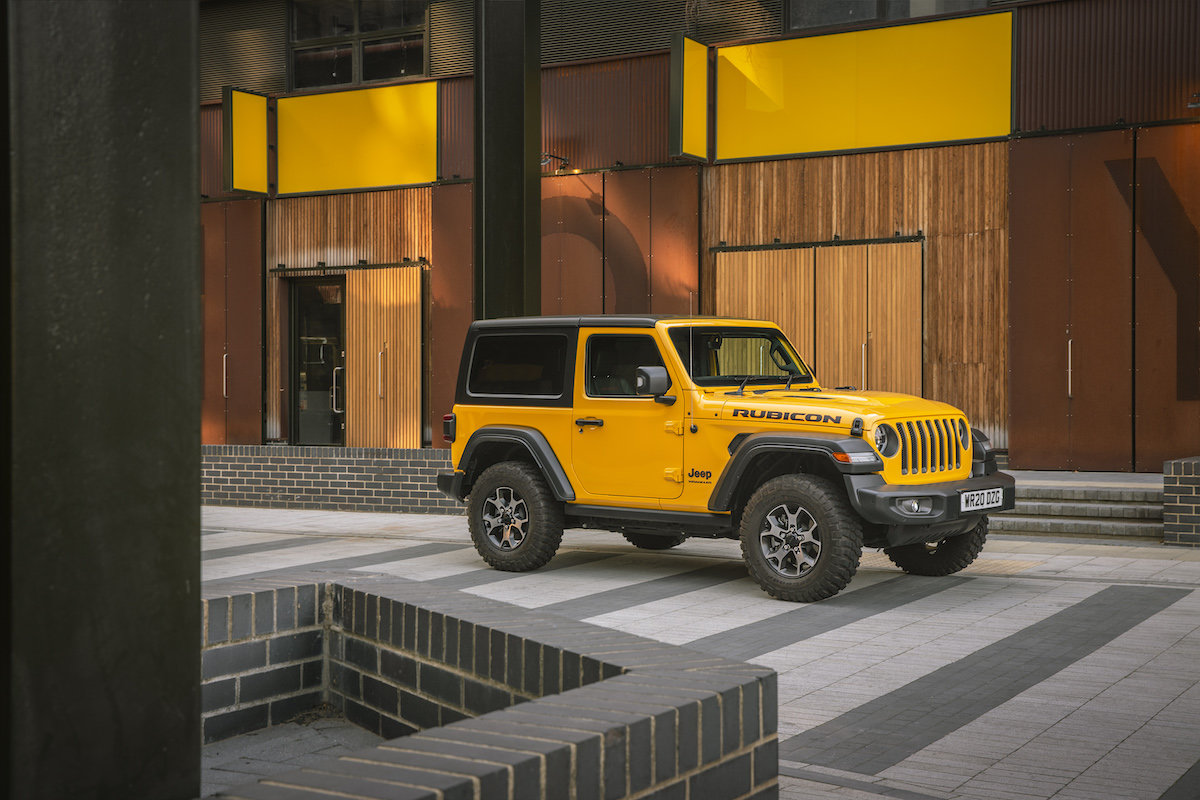
The CarGurus verdict
With new prices starting at more than £48,000 for even the cheapest models, and rising to nearly £60,000 for the most lavish limited edition models, it’s difficult to recommend the Jeep Wrangler to anyone but an off-road enthusiast, simply because its on-road manners just don’t compare to many modern rival SUVs.
Due the limited number of annual sales in the UK, there’s a restricted used market, too, which means second-hand prices have remained fairly buoyant. You need to part with around £30,000 for even the most basic Sahara trim models with 20,000 miles or more on the clock.
Yes, the 2018 refresh has introduced a raft of welcome touches, from a modern infotainment system to a more comfortable interior and better road manners, but it’s still a lot of money for something that isn’t particularly enjoyable to drive on a daily basis, despite its undeniable off-road ability. A Suzuki Jimny is just as fun off-road but costs a fraction of the price, while a Toyota Land Cruiser is arguably the better all-rounder and comes in cheaper. Alternatively, there’s the near-indestructible Toyota Hilux pick-up if you merely want something to bounce around some green lanes in.
But, with its Tonka Toy styling and military heritage, the Wrangler will always remain a special proposition that offers both a driving and ownership experience like very little else on the market. If you absolutely must have that iconic front grille and feel the burning desire to drive without any doors, money probably isn’t a factor.
Vehicles like the Jeep Wrangler are becoming increasingly rare. As emissions regulations become ever stricter and consumer tastes are being pushed towards electrified powertrains – hybrids, plug-in hybrids and electric cars – properly tough off-roaders are largely fading into obscurity in the UK.
It’s a little different in the USA and further afield, where genuinely rugged terrain and adverse weather conditions are a daily challenge for many drivers, which explains why the Wrangler nameplate has endured for so long, with very few updates.
The latest model (codenamed JL) is only the fourth variant since its launch in the late 1980s and went on sale in the UK in 2018 with the choice of either a 2.2-litre Multijet II turbodiesel or a 2.0-litre turbo petrol engine. Other markets get a full-fat 3.6-litre V6, but we’re not so lucky.
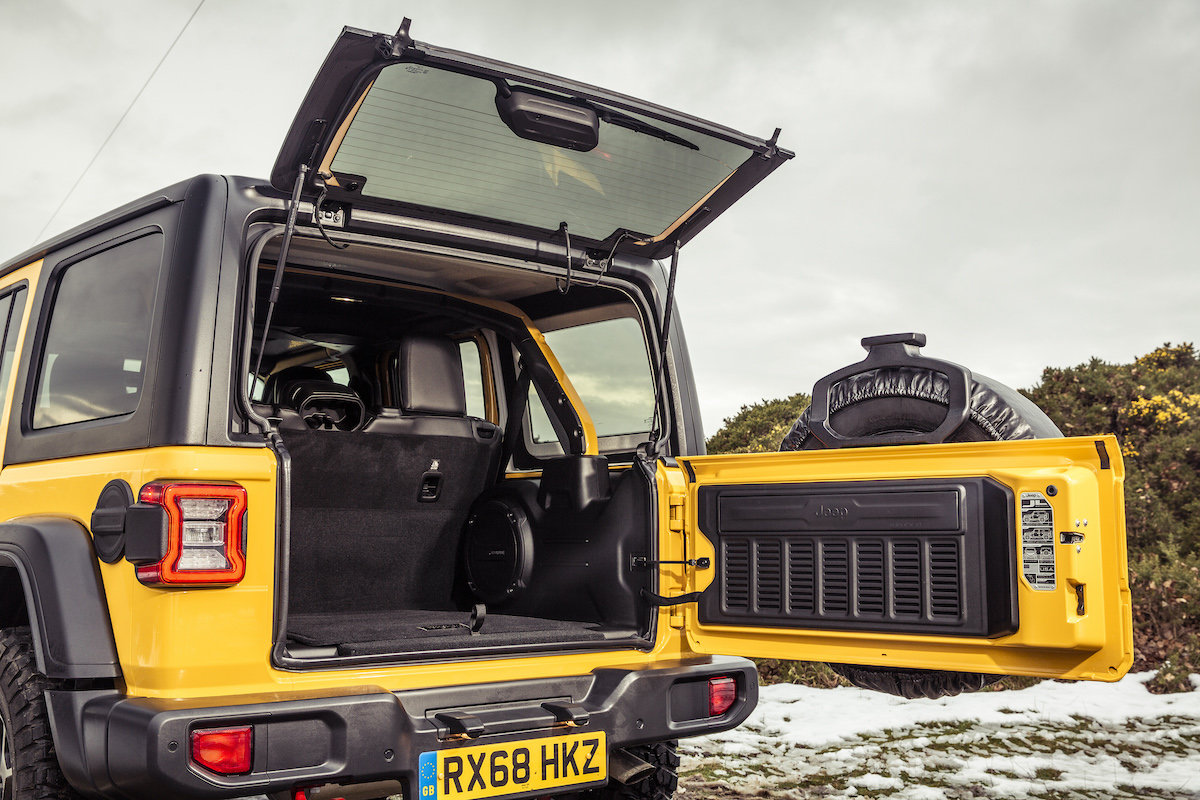
The Wrangler is available in either two-door or four-door body styles. The four-door Wrangler is the most convenient when it comes to practicality for larger families because back seat passengers get plenty of legroom. With the back seats folded, it actually offers a half decent amount of room at 1,044 litres of cargo space. Keep those seats up and boot space is a more measly 533 litres, dropping to a frankly ridiculous 192 litres in two-door variants.
Like models that have come before it, customers also get the option of various roof styles, which range from a ‘Sunrider’ soft top, which zips off for a convertible experience, a much more difficult to remove three-piece modular hardtop and the simplest motorised canvas roof, but this didn’t go on sale until Wrangler JL was a year or so old.
The doors can be removed entirely, which has now been made easier and the doors are now lighter for simpler storage, while the front windscreen can now be dropped flat. Essentially, you can transform your Wrangler from a relatively normal SUV into a Baja racer with the removal of some bolts and a bit of elbow grease.

On-road manners have been vastly improved over previous generations and there is far less wind noise and tyre roar seeping into the cabin. Handling has never really been a strong point, even on the Sahara-spec’s more road-biased tyres, but it has been improved slightly over previous generations. Expect a lot of play in the steering from dead centre and lots of body roll if attacking corners with too much gusto.
Of course, should you want the full mud-plugging look, you’ll have to opt for the chunky off-road tyres, which make the steering even more vague and produce an annoying, monotonous hum when driving at speed. When driving at motorway speeds, it’s often a case of keeping two hands on the steering wheel and, when things get a little twister, anticipating corners properly, as these tough models certainly don’t handle as well or as predictably as rival SUVs.
The 2.2-litre diesel, which produces 197bhp, is the biggest seller in the UK and it does a good job of cajoling the heavy Wrangler up to speed. It’s still pretty poor on fuel, returning 29.4 mpg to 30.7 mpg, depending on wheel size and tyres. The more powerful 268bhp petrol engine is punchier but guzzles fuel. Both options come mated to an improved eight-speed automatic gearbox.
Clearly, every Wrangler comes with four-wheel-drive and a low -range gearbox as standard and the vehicle really comes alive when you venture off the beaten path. With greater ground clearance, shorter overhangs for better approach and departure angles, as well as an impressive 760mm wading depth, this is a vehicle that can handle some tough stuff, even when specified in a fairly tame, road-going trim level.
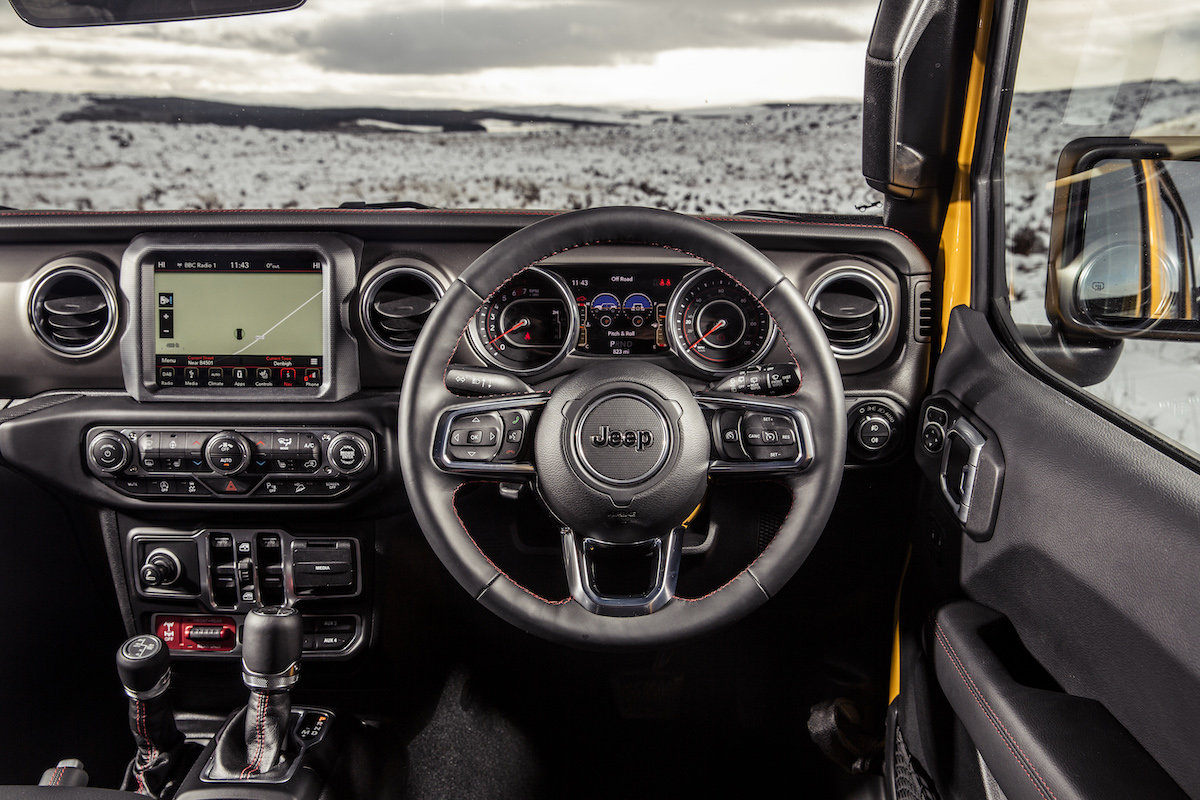
The interior is about as far of a departure from previous generations as it's possible to get. Upper dash surfaces are now wrapped in soft-touch materials, air-conditioning comes as standard and there’s a modern touchscreen infotainment system that’s either 5.0 inches, 7.0 inches or 8.4 inches in size (depending on the trim level).
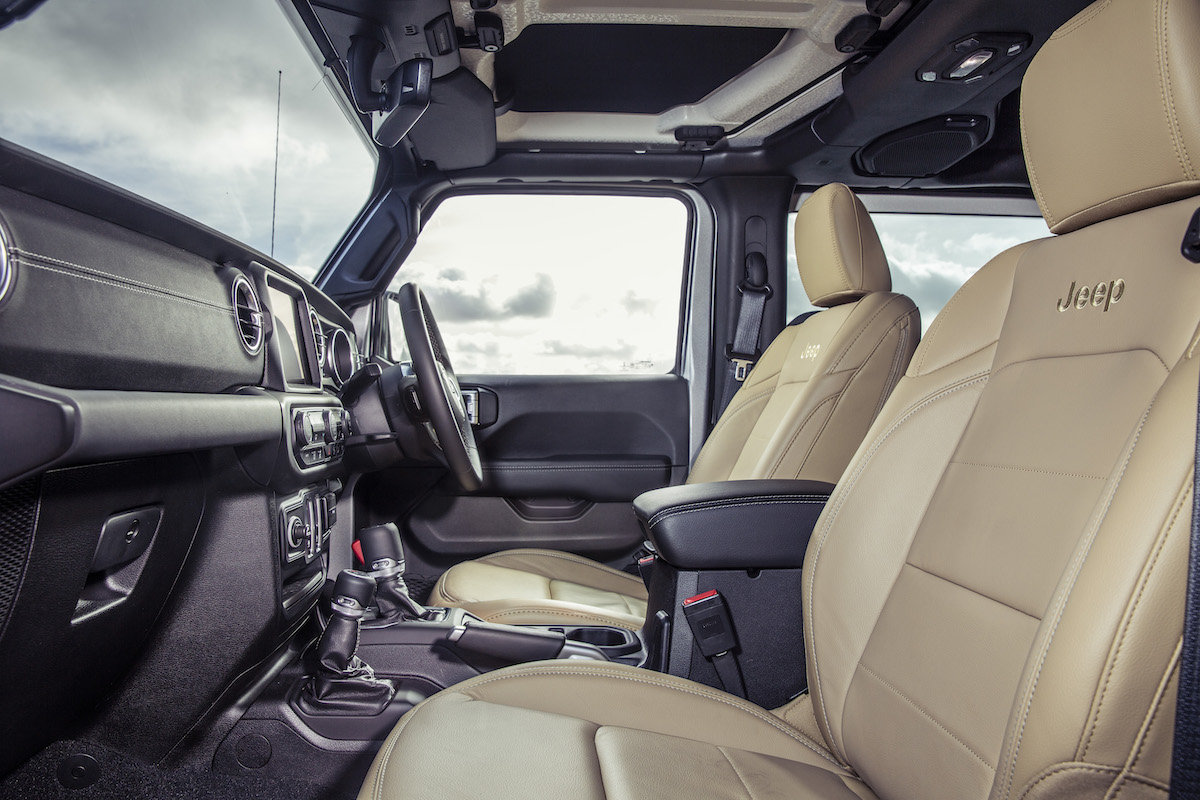
The interior trim and general ambience have been raised to a far more premium level. It’s a genuinely nice place to sit, with just enough chunky buttons and off-road gadgetry to ensure it still feels like an original Jeep product.
Frugality has never really been a Jeep Wrangler’s strong point but the addition of the Fiat Group’s (now Stellantis) 2.2-litre turbocharged diesel engine has improved fuel efficiency and lowered the cost of taxing one every year thanks to lower emissions.
Expect to get around 30mpg on the combined cycle, but that figure could be much lower if you do have lots of shorter, inner city drives. But then the engine is designed for pure grunt and the fact it produces 400Nm of torque should go some way to explain the lofty CO2 figures of between 195g/km to 209g/km for the heaviest and thirstiest four-door Rubicon version.
The petrol engine is thirstier still, with official fuel economy figures of 25.9mpg to 27.2mpg, although you can easily expect to see those figures drop to the early 20s if you are particularly heavy with the right foot. Insurance groups also range from 33 to 41, which puts it at the higher end of the annual insurance cost spectrum.
The Jeep Wrangler sells in fairly limited numbers here in the UK, so there isn’t a great deal of data surrounding ownership experience and its overall reliability. Saying that, there have been a number of recalls since the JL model went on sale in 2018, ranging from transmission wiring harness issues to airbag problems, but recalls are common with modern cars and these will have been covered by the 24-month warranty that come with all Jeep products. The marque also offers a further 12-month retailers' warranty, starting from the date the car was delivered.
Aside from this, the Jeep Wrangler has designed to be tough and, as a result, comes with plenty of chunky plastic bumpers and body parts that can easily be replaced with fairly minimal effort and cost. Some owners have spoken out about prematurely wearing parts, such as shock absorbers leaking after 50,000 miles or so, but anyone who is seriously into off-roading might look towards upgraded Fox suspension or something generally more bulletproof.
In used models, make sure everything works as it should because the Fiat Group has been known to have electronic issues with its UConnect infotainment system. Similarly, check for any excessive play in the steering and suspension, especially if the vehicle has been used for lots of off-road activity. Off-road tyres can also wear quicker if they are predominantly used on road, so check tread depth as a replacement set can be costly.
- Every Jeep Wrangler wears a coveted “Trail Rated” plaque, which means it has been tested in the harshest environments and designed to tackle serious off-road terrain. The most hardcore Rubicon versions come with the marque’s Rock-Trac 4x4 System, which makes thousands of decisions every second to provide the best possible traction in extreme conditions.
- Jeep Wrangler Overland models have been designed to offer the most premium SUV experience of them all and, as such, come with leather finishing to much of the interior, the largest infotainment screen and colour-coded wheel arches, rather than the chunky plastic trim of Rubicon models.
- Euro NCAP awarded the Jeep Wrangler just a single star when it crash-tested the latest model in 2018. This is the worst possible rating for a modern vehicle and the Wrangler scored particularly poorly for adult occupant protection and its performance against vulnerable road users. Its lack of lane support and inter-urban automatic emergency braking technology also contributed to its weak performance. That said, you can option a Safety Pack on new cars that includes a forward collision warning and adaptive cruise control with stop.
- If you want most practical: There is a Jeep Wrangler model to suit most tastes but by far the most practical for everyday and family use is a four-door model in Overland specification with the slightly more fuel efficient diesel engine specified. This vehicle is not only roomier inside, it also features the sweetest in-car entertainment offerings as standard, including a 7-inch TFT instrument cluster, premium Alpine audio system and the largest 8.4-inch touchscreen navigation system with Apple CarPlay and Android Auto.
- If you want to go off-road: Those with more of an off-road leaning should look towards Rubicon models and for the most authentic Jeep experience, this should be a Rubicon model with just two doors. Although among the most expensive to buy, these vehicles come with Tru-Lock electronic-locking differentials, a beefier rear axle and Active Sway Bar Disconnect, which allows the front wheels to drop and compress up to 25 per cent further than other Wranglers for tackling seriously rocky situations.
- If you want lots of customisation: Whatever model you go for, there is a plethora of optional extras to dive into, from differing fabric roof styles to lifestyle additions, such as a bespoke roof rack for kayaks and improved bash guards. Jeep Wrangler owners tend to be involved in the off-road community and as such, personalise their machines with lots of tough extras, so don’t be surprised to see used models with winches and utilitarian roof racks fitted.

