Kia EV9 Review (2024-present)
Kia EV9 cars for sale
4.0
Expert review
Pros
Imposing looks
Hugely practical seven-seat cabin
Even entry-level car is stuffed with tech
Cons
Some slightly disappointing cabin materials
Dynamically very average
Rear visibility isn’t great
The CarGurus verdict
The Kia EV9 is a hugely impressive car in a variety of ways. First off, it’s a technological tour-de-force, with a really good infotainment system with masses of functionality, huge amounts of luxury kit, and just about every electronic driver aid ever conceived by the human brain. It’s incredibly practical, with a roomy cabin and a big boot, it has a good range and super-fast charging capability, and while it’s not cheap by any stretch of the imagination, it still feels like decent value for what you get.
It’s certainly not perfect. For example, while it’s very solidly made, the interior materials don’t have the lustre of those in the premium cars that Kia intends to take on with the EV9. However, if you want a hugely capable all-electric family SUV that’s totally fuss-free to live with, then it simply has to be on your shortlist.

What is the Kia EV9?
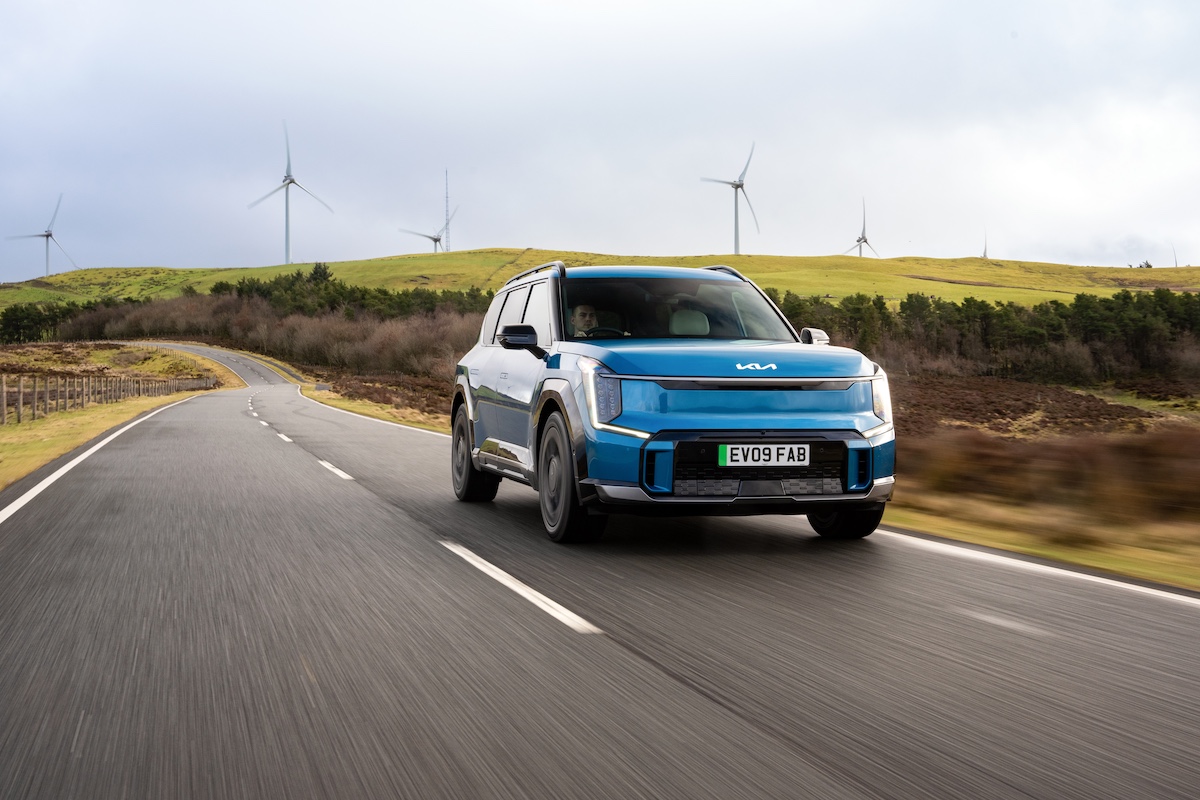
The EV9 is an important step on Kia’s relentless march towards complete electrification, and the brand’s flagship. The EV9 is a large - well, huge - luxury SUV that’s 100% battery powered. Rather than taking on rivals from Toyota and Hyundai, it’s aimed more at premium competition from the likes of Audi, BMW and Mercedes, as well as the seven-seater version of the VW ID Buzz.
Even the most basic 197bhp rear-wheel-drive version of the EV9 has seven seats and is absolutely rammed with luxury kit, electronic driver aids and clever tech, while higher-spec versions have almost double the power, four-wheel drive, even more kit, and can be specified with six seats instead of seven for a more luxurious layout. All versions come with an enormous battery that’s just shy of 100kWh, and a long range that's upwards of 300 miles. If you want an electric seven-seat SUV and consider the Volvo EX90 a bit too much, you might just want to give this Kia a look first.

How practical is it?
If a car as enormous as the EV9 wasn’t immensely practical, then Kia would be doing something very, very wrong. Thankfully, you’ll have no such worries. Space in the front is immense, and there’s loads of electric adjustment in the two front seats, although the driver might wish that the manually adjusting steering wheel came a bit closer to them. The ‘floating’ centre console makes the front of the cabin feel even more open and spacious, and it houses a bunch of useful storage areas, including a large shelf underneath and two big cupholders and a lidded cubby on top. There’s also a decent glovebox and a variety of USB-C ports.
Like in many rivals, the middle row of seats can be slid forwards and backwards according to who most needs the space available. Slide the chairs all the way back, and there’s more legroom in the middle row than you could ever possibly need but very little for those sitting behind in the third row, while if you slide the chair all the way forwards, things become a bit too tight for those in the middle, but those behind will have plentiful legroom. Set them somewhere in the middle, and there’s just about enough legroom for a six-foot adult regardless of which row they occupy, while headroom is always fine in both rows.
Even with all seven seats in place, there’s still a very useful 333 litres of boot space available, which is a decent slice more than you get in an Audi Q7, while dropping the third row of seats into the floor - which is done electrically with buttons in the boot - opens up a vast loadbay that’ll be big enough for anything a family car throw at it. There’s no load lip, either, and the vast hatchback boot opening makes access a doddle. Fold the middle row of seats down - also triggered electrically with buttons in the boot, and occurs in a 60/40 split - and you’ll enjoy sofa-lugging levels of loadspace.
If you’re expecting the EV9 to match its premium German rivals on interior quality, then you might be a shade disappointed. The materials on show are very solid and substantial, and most are textured so that they look nice, but almost none of the surfaces have any sort of cushioning, which means that the EV9 doesn’t have the plush, lustrous feel of an Audi or Mercedes.

What’s it like to drive?
As a large, luxurious SUV that pits itself against the Audis and Mercedes of the world, you might be expecting the EV9 to major on cosseting ride comfort. However, while premium rivals are usually offered with air suspension or adaptive dampers, the Kia has a more basic coil spring suspension setup, which has a great deal of weight to deal with. As such, you might occassionally sense that it jitters and fidgets along at low to moderate speeds, and can thump a bit more than you expect over potholes and sunken drain covers.
It’s by no means uncomfortable, but the EV9 doesn’t feel as slick or as supple as many other big SUVs. The ride does level out once you get up to motorway speed, though, and refinement is also impressive there: road noise is very well contained, and considering the blunt shape of the car’s front end, there really isn’t much wind noise to speak of. And of course, there’s no engine noise. In short, it's a very relaxing car to drive on long journeys.
The steering is reasonably responsive, but not so much that the car feels twitchy, and it’s well weighted most of the time, if not overly feelsome. There is a driving mode called Sport - goodness knows why - but selecting that only adds a bunch of artificial weight to the steering.
As for performance, that much depends on which version you choose. The entry-level Air model comes with a single motor on the rear axle that puts out 200bhp. In a car as vast as the EV9, that’s enough for a fairly leisurely 0-62mph time of 9.4 seconds. It’s not desperately quick, then, but it feels easily punchy enough to get you around at a very decent rate of knots, and getting up to motorway speed is a fuss-free affair.
All the other versions, meanwhile, have an additional motor on the front axle to give rear-wheel drive and a combined power output of 378bhp. So, while the Air isn’t desperately quick, the rest of the range truly is. A meaningful prod of the accelerator pedal results in a fierce surge of forward motion, with the 0-62mph dash taking just 5.3 seconds to complete. That’s frankly way faster than you want to be going in something as huge and as heavy as the EV9, and if you get too carried away, the brakes can have a hard time slowing and stopping the car.
Talking of braking, there are paddles behind the steering wheel that allow you to vary the level of regenerative braking, whereby energy that would otherwise be lost through deceleration is recovered and fed back into the battery as electricity. The modes range from full coasting at speed to full-on one-pedal driving for the city (lift off the throttle pedal and the car will gradually come to a complete halt without you touching the brake pedal), and cycling through the modes is easy and effective.

Technology, equipment & infotainment
While the EV9 may not be able to live with the prestige German competition in terms of road manners or interior quality, it can more than live with them for standard equipment and technology: it pretty much blows them out of the water, in fact.
The Air version is the entry-level model, and even this version has more electronic gizmos than you’d find in a branch of Curry’s. That includes all-round LED lighting, three-zone climate control, powered front seats, heated and ventilated seats in the first two rows, 360-degree cameras, a powered tailgate, and a heated steering wheel. Standard kit also includes 19-inch alloy wheels, rear privacy glass, roof rails, and artificial leather upholstery.
The big news, though, is Kia’s latest infotainment system, an area in which the company has already been excelling for several years. And there have been no backward steps with the EV9. The system is based around twin 12.3-inch digital screens built into a single unit - a central touchscreen on the left for infotainment functions and a screen on the right to serve as your driving instruments - with a 5.3-inch climate control screen in between. The screens look great, with a glossy finish and pin-sharp graphics, while responses are swift and screen sensitivity is good. The logical layout of the menus also means that the system is reasonably easy to find your way around, despite its complexity. There are useful touch-sensitive shortcut icons built into the dashboard beneath the central screen, but these take quite a hard press to get a command to register.
We do have a couple of other minor gripes, too. The digital instrument screen looks good, but there’s very little configuration available: the various layouts contain most of the same information, it's just positioned in slightly different places. And while it’s good that the climate control screen means you don’t need to delve into submenus on the main screen to operate the air-con, it’s still more distracting to use on the move than physical buttons and dials, and the screen itself is perpetually obscured from the driver’s vision by the top left-hand quarter of the steering wheel.
The infotainment system supports all the functionality you’d expect, such as Bluetooth, DAB radio, satnav, wireless operation of Apple CarPlay and Android Auto, a wireless phone charger, an eight-speaker stereo and over-the-air software updates. The standard safety provision, meanwhile, includes adaptive cruise control and pretty much every other driving aid you could possibly think of, and the car has been awarded a full five-star safety rating from Euro NCAP.
Upgrade from the Air to the GT-Line version, and additional kit includes 21-inch wheels, some exterior styling touches, adaptive beam headlights, electric steering adjustment, a remote self-parking function and a terrain mode that primes the traction control system for various types of slippery surface. The GT-Line S is the flagship of the range, and adds a 14-speaker Meridian sound system, a head-up display and a pair of sunroofs.

Kia EV9 running costs
Prices for the EV9 start at around £65,000 for the rear-wheel-drive Air model, and that jumps to upwards of £73,000 for a GT-Line all-wheel-drive model with the higher power output. Speccing a GT-Line S model ups that to around £76,000, while speccing it with the six-seat option will take it upwards of £77,000.
We’re not talking trivial amounts, then, and it puts the EV9 in a similar ballpark to the seven-seat Audi Q7 and the electric Audi Q8 E-Tron, although neither is a perfectly direct rival. The Volvo EX90 is, and that starts at around £95,000, although that should come down significantly once a lower-powered, lower-spec version is introduced.
All EV9s have the same enormous 99.8kWh battery. It give the rear-wheel-drive Air model an official range figure of 349 miles, while the four-wheel-drive versions can officially travel 313 miles on a single charge. That single charge can be delivered very quickly, too, because the EV9 is one of few cars on the market that’s capable of 800-volt ultra-fast charging. It has a peak charging rate of 210kW, and when plugged into a sufficiently powerful public rapid charger, the battery can go from 10-80 percent in just 24 minutes, or if you’re more pushed for time, 15 minutes of charging can give you 155 miles of range.
Obviously, that charging will take a lot longer on your average 7.4kW wallbox home charger, taking about 14 hours to fill your battery to its metaphorical brim. However, home charging will also be considerably cheaper than high-speed public rapid charging. An 80% juice-up at home will cost you around £23 if your electricity is charged at the UK’s national average (it’ll be considerably cheaper if you can take advantage of low-cost overnight charging tariffs), but that cost will likely double at a public rapid charger.

Kia EV9 reliability
The EV9 itself is far too new for there to be any data available on its reliability. However, Kia has a good reputation for reliability, and came 11th out of 31 brands considered in the manufacturer standings of the 2024 What Car? Reliability Survey.
This wouldn’t be a Kia car review without us mentioning the Korean firm’s excellent warranty package, which covers you for seven years or 100,000 miles, whichever elapses first, and that’s way better than most other carmakers will give you. The warranty is also fully transferable to subsequent owners, which will help keep resale values strong.
- Like in other Kia-made EVs, the EV9 features Vehicle-to-Load functionality, or V2L. This allows you to use the power stored in your car’s battery to run 220V appliances, or give other EVs a trickle-charge top-up. There’s a three-pin domestic plug socket for this in the boot, and an adaptor that plugs into the charging port.
- As is very fashionable these days, the EV9 comes with a Digital Key function. This allows you to use your smartphone to perform various functions such as locking or unlocking the doors, starting the car or turning it off, and opening or closing the tailgate. The Digital Key can be shared with up to three people at a time, and the owner can control which features are shared, and for how long.
- One thing that might annoy you about the EV9 is the rear wiper on the back window. The rear screen isn’t the biggest proportional to the size of the car, so your over-the-shoulder visibility isn’t that great to begin with. The rear wiper, meanwhile, is only long enough to clear around half of the screen, leaving a large proportion of the screen unwiped. This means that when your rear wheels kick up rain and road dirt on to your back window, your rear view becomes even more hampered.
- For most people: The entry-level Air model really is all the EV9 you need. It comes with a truly heaving list of standard equipment, providing all the luxury and safety gear you could ever need, and while it’s a bit slower than the other versions, it’s plenty perky enough to satisfy most folk in their daily use.
- If you need to tow: The only reason we can see for swerving the Air model is that it only has a braked towing capacity of 900kg. That’s not at all bad by EV standards, but the four-wheel-drive versions do much better, because they’re rated at up to 2,500kg. They also come with the Terrain Mode Select system, which will be handy if you plan to use your EV9 to pull a caravan or horsebox across muddy fields.
- If you want ultimate luxury: The GT-Line S can optionally be specified with a pair of captain’s chairs in row-two, rather than the three-seat bench, making it a six-seater. This adds an extra degree of space and luxury to the car, and if you like, you can swivel the middle seats around 180 degrees to face the rearmost chairs, turning the back of your EV9 into a space not unlike a living room.


