Kia EV5 2016 review | An electric SUV with a long warranty
Kia EV5 cars for sale
3.0
Expert review
Pros
Roomy interior
Lots of luggage space
Long warranty
Cons
Fidgety, wallowy ride
Plasticky-looking interior
No standard heat pump

The CarGurus verdict
The EV5 is a big, spacious family SUV with eye-catching looks that set it apart from many of its rivals. It should prove to be reliable, too, and for the most part, it’s well equipped. But it isn’t particularly comfortable, or sporting, to drive, and its range and charging speeds look a little average next to its rivals’. It’s a shame Kia didn’t opt to fit it with a standard heat pump and its super-fast 800V charging architecture, too – that could have given it the USP it sadly lacks.
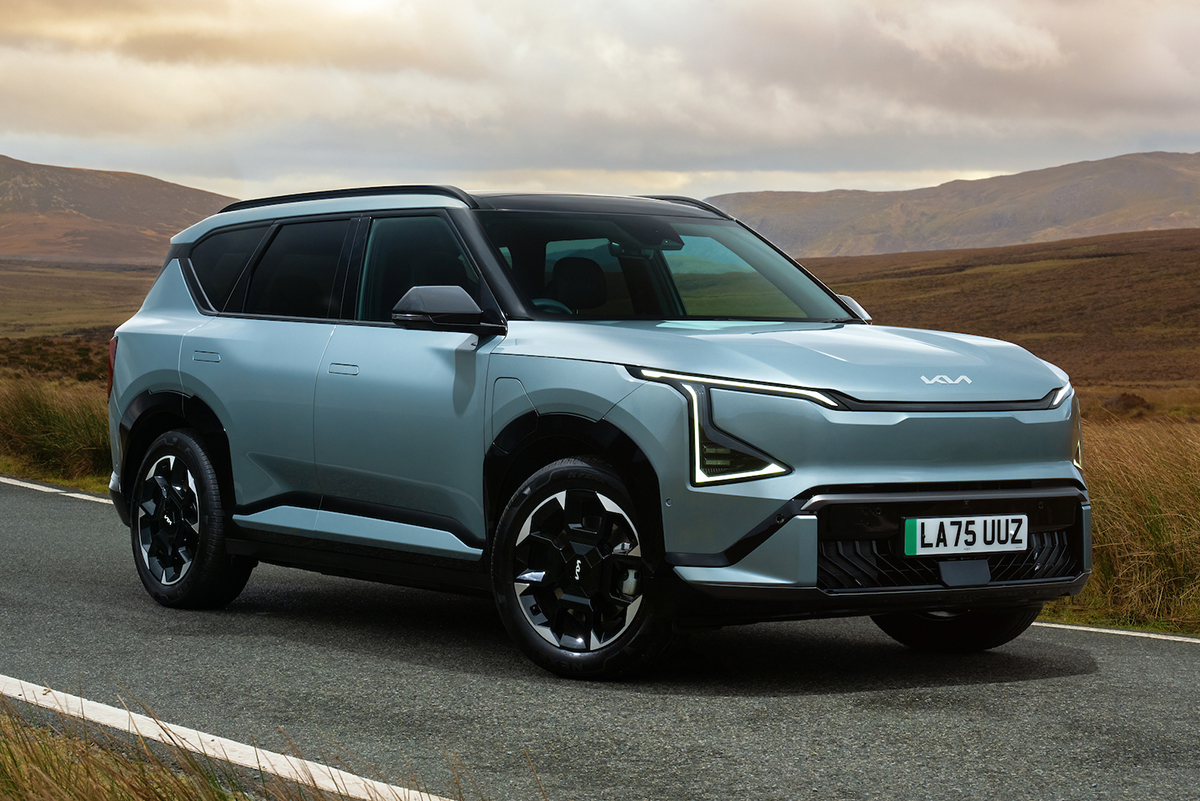
What is the Kia EV5?
You won’t fail to notice the Kia EV5 when one passes you by. Its styling is some of the most unusual and eye-catching of any large electric SUV, with its tall, stacked headlamps, upright profile and blocky tail end.
But beneath those extrovert looks – which remain largely unchanged from the concept car that previewed the EV5 in 2023 – this big, electric SUV is intended as a family hold-all capable of carrying up to five people and luggage for any number of high days and holidays. In that vein, it’s a little bit like an electric version of the ever-popular Kia Sportage – although it’s actually a bit bigger than the Sportage, at just over 4.6 metres long.
That puts it squarely in the sights of the Skoda Enyaq, which currently offers one of the best blends of comfort and space in the electric SUV class; it’ll also vie with the Citroen e-C5 Aircross, the Toyota bZ4X, and the Hyundai Ioniq 5 for the attention of family-focussed buyers.

How practical is it?
The EV5’s boot is pretty chunky, at 566 litres – second only to the Skoda Enyaq in overall volume. But unlike the Enyaq, you also get 44 litres’ worth of extra space in a compartment beneath the bonnet (or ‘frunk’), bringing the total cargo capacity to 600 litres – more than any other electric SUV of this size can muster.
With the rear seats folded down, that boot can swallow 1,650 litres. And because the space on offer is very square, with a big, wide-opening aperture, it’s incredibly useful – meaning the EV5 should easily swallow big bits of furniture for those runs to the tip.
With the rear seats upright, room for passengers in the back is exemplary, and at least on par with the Enyaq, which is about as good as it gets in a car of this type. The seats recline, which allows you to alter the bias between comfort and luggage space somewhat, and they also fold down flat. The only downside is that they don’t slide like they do in the Hyundai Ioniq 5.
Up front, meanwhile, there’s a tonne of clever little spots to store your odds and ends, such as the excellent central tray right underneath your left hand, which can convert to a pair of cupholders at the press of a couple of buttons. There’s oodles of space for both occupants, too, and the high seating position means the view out they enjoy is excellent.
A word of appreciation, too, for the way the EV5’s flat, near-vertical tail and crenellated bonnet. As a result, despite the sense you get that the car is actually even larger than it is, it’s always easy to work out where it ends, so parking it isn’t too much of a chore.

What’s it like to drive?
The EV5 line-up is pretty easy to understand. Each version gets an 81.4kWh battery, which powers a single motor that drives the front wheels. That’s a gross figure, which means around 3kWh of it will be kept in reserve to prolong battery life; we reckon 78kWh of usable capacity is realistic.
This combination promises an official range of up to 329 miles, though you can expect that to mean anywhere between 210 and 280 miles in the real world, depending on the weather.
Unfortunately, those figures don’t compare brilliantly with rivals’. A Skoda Enyaq 85’s battery has only 1kWh more gross capacity, but its 359-mile official range betters that of the EV5 by some margin. Meanwhile, Citroen will soon sell you a Long Range e-C5 Aircross with a whopping 423-mile official range – and that should mean it can manage at least 50 miles more in the real world than the EV5, if not more.
It’s also a bit of a shame that the EV5 doesn’t get the same super-fast charging system as its sister cars, the EV6 and EV9. Charging speeds aren’t exactly pedestrian, but they’re not quite up there with the best rivals’, with a maximum speed of 150kW, and 10 to 80 per cent charge taking 30 minutes, at an average rate of 340mph.
By comparison, an Enyaq’s peak charging speed is lower, but its average rate of 420mph is much better, so it can actually get from 10 to 80 per cent two minutes faster, gaining a touch more range in the process. A long-range e-C5 Aircross, meanwhile, will take 32 minutes, but as its battery is much larger, it takes on more range in that time, at an average of 390mph.
You can get an idea of the EV5’s driving style from its performance figures. While 214bhp sounds pretty beefy, it won’t make for scintillating performance in a big, heavy SUV like this, and a 0-62mph time of 8.5 seconds bears that out; the EV5 certainly doesn’t feel quite as brisk as many of its rivals.
Having said that, it’ll feel perfectly adequate for most family buyers, with enough grunt to keep up. And this leisurely feel continues throughout the EV5; handling is fine, and it changes direction as commanded, but there’s absolutely no sporting intent here, and the light, slow steering is clearly set up with comfort and ease-of-use in mind. Which is appropriate, in a car geared towards family-friendly motoring.
It’s a shame, though, that the suspension doesn’t seem to have received the message. The EV5’s ride is far from perfect, with a combination of brittle, finicky jitteriness over smaller lumps and bumps, and a slightly queasy, uncontrolled waft over larger undulations when you’re up to speed. The result is a car that can actually feel quite tiring on longer journeys.
Later this year, a two-motor, four-wheel-drive version is expected to join the range. It should be quite a bit quicker than the standard car, but there’ll be a trade-off in terms of the car’s range. We don’t know by how much yet, but we’ll update this review when we find out.

Technology, equipment & infotainment
It’s a bit of a shame that Kia has cheaped out on some of the materials used throughout the EV5’s interior, because the design is interesting, with lots of angular shapes and intersecting lines, and the real metal door handles lend a touch of quality.
Elsewhere, though, the finish isn’t as good as you’d hope for in a car costing this much. There’s just too much pale grey plastic – and the shiny stuff used as inserts on the steering wheel and centre console looks like something that’d be more at home on a children’s toy.
The layout isn’t as user-friendly as it could be, either. You do get some nice, big, physical rocker switches to control the temperature in the centre of the dash, but too much else is reliant on touch-sensitive control pads.
That includes the rest of the climate control, which is accessed via a dedicated touchscreen that’s always there, which is a good thing – but Kia’s sited it behind the steering wheel, so that the driver has to peer around the thick rim to see it.
The touchscreen itself is fast to respond, and for the most part, the menu layout is sound. But with so many functions to control, it can be tricky to remember which menu you’ll find things in – and you can often find yourself swiping through the display mumbling ‘Nope, not in there…’ under your breath as you try to work it out.
It’s not what you want to be doing while you’re in motion – and, understandably, it gets the driver monitoring system in a dither, beeping and bonging at you to pay attention to the road. Fortunately, the rest of the EV5’s electronic safety aids are pretty tolerant, tending to help rather than hinder, and they’re easy to turn off if they do get annoying.
The simple three-model range kicks off with the basic Air, which gets 18-inch alloy wheels, automatic lights and wipers, heated front seats, a heated steering wheel, climate control, and adaptive cruise control – a pretty generous specification for the entry-level model.
Upgrade to the GT-Line, and you get lots of extra bells and whistles: 19-inch wheels, two-tone faux leather upholstery, a powered boot lid, ambient lighting, and vehicle-to-load capability, which allows you to use and charge electrical appliances from the EV5’s battery using a standard three-pin domestic plug socket.
GT-Line S then sits at the top of the range, with a tilting and sliding sun roof, ventilated front seats, a Harman Kardon premium sound system, a head-up display, a 360-degree parking camera system, and ‘premium relaxation’ seats, which have a massage function.
However, no version of the EV5 comes with a heat pump as standard, a useful bit of kit that makes the heating system more efficient and therefore helps to prevent range deterioration in cold weather. A heat pump is standard on many rivals, but in an EV5, it’s only available as an optional extra – and then only on the GT-Line S.

Kia EV5 running costs
The EV5 is pretty good value, if not the best. The range kicks off at just under £40,000, which isn’t bad, given it’ll cost you almost £2,000 more to get into an equivalent Skoda Enyaq, though a Citroen e-C5 will cost you less, and of course, there are now quite a few similar-sized Chinese SUVs that offer almost as much space for much less cash (albeit along with less range and sometimes questionable quality).
You’ll also find that the EV5’s pricing puts it squarely in the frame for higher VED costs. Unless you choose an entry-level model in the standard solid white paintwork (metallic paint tips it over the £40,000 threshold), you’ll have to pay the higher rate of tax in years two to six of your ownership.
With an average energy efficiency of 3.6mi/kWh the EV5 is a touch less efficient than some of its big EV rivals. That won’t make much difference if you’re charging at home on an EV-specific tariff, but for those wedded to public chargers, it will. And don’t forget that, as with all EVs, that efficiency figure will drop off further in the winter, too – especially given the EV5’s lack of a heat pump.

Kia EV5 reliability
The EV5 is too new for us to have any data about its reliability yet, but we do know that Kia generally has a pretty solid reputation for reliability. The brand finished eighth out of the 30 manufacturers that took part in the 2025 What Car? Reliability Survey, and some of its cars actually finished at the top of their class.
One of those models was the EV3, which is essentially a down-scaled version of the EV5. That bodes well for the EV5’s dependability – as does the fact that it comes with a seven-year, 100,000-mile warranty from new. So if you’re buying your EV5 second-hand when it’s three years old, you’ll still have four years’ worth of warranty left on it. Mind you, if it’s an EV with a long warranty you’re after, the Toyota bZ4X will give you up to 10 years’ worth.
- The EV5 scored the maximum five stars in its EuroNCAP safety tests, and did a decent job of protecting its occupants in crash tests, with scores of 83% and 85% respectively for adult and child occupant protection. That’s about on a par with its rivals.
- Currently, the EV5 can only be had in front-wheel-drive form, but even so, it manages a respectable towing capacity of 1,200kg, which should enable it to haul a trailer or a small caravan. Later this year, however, the all-wheel-drive version will be released, and with its 1,800kg capacity it’ll be much better suited to towing; indeed, it’ll offer one of the highest towing capacities of any EV.
- Although the EV5 looks as though it’ll have the drag coefficient of a wardrobe, it’s actually surprisingly aerodynamic. Clever tricks like active air flaps in the front bumper, a tapering rear end, and flush wheel designs, all help make it an unexpectedly slippery shape, which means the Air model manages a drag coefficient of 0.29. That’s almost as good as the longer, lower Kia EV6.
- If you want the best all-rounder: go for an EV5 Air. Even though it’s the most basic EV5, it comes fully loaded with kit, and therefore looks like surprisingly decent value.
- If you want the best range: it’s the Air model again. All EV5s have the same battery, but the Air’s slightly lighter weight and smaller wheels mean it manages slightly better range figures than the GT-Line versions.
- If you want all the toys: it has to be the GT-Line S, which is chock full of delightful extras. Don’t forget to stump up a bit more cash for the heat pump, though – you’ll be glad of it when the mercury drops to zero.
- If you need to tow a caravan: don’t buy an EV5 yet. Wait until later on in the year, when the all-wheel-drive model comes out. The 600kg of extra towing capacity will make it much more capable when pulling a medium-sized van.


