Kia Stinger (2018-2023) review | The brilliant sports saloon you may not have heard of

Pros and cons
What we like
Thumping performance with a soundtrack to match
Refined and comfortable on the motorway
Loads of standard kit
What to consider
Cabin materials don't match those of premium rivals
The twin-turbo V6 is thirsty
Kia badge lacks clout in the company car park
The CarGurus verdict
Brisk, comfortable, great to drive, stylish, and well-equipped, the Stinger falls short of the best-in-the class in only a small number of areas. Its cabin materials aren’t up to the standards set by the German opposition, and its badge doesn’t have the same clout in the company car park, but the Kia’s impressive value for money is impossible to overlook. For the price of a modestly powerful 3 Series, you could have a 361bhp Stinger GT S.
Kia hopes the Stinger will appeal to the heart as much as the head, and its style, driving dynamics, and performance make an exceedingly strong case for the former, but its value and warranty mean the head should feel pretty darned smug, too.
out of 5 expert review
What is the Kia Stinger?
Kia set out to challenge perceptions with the Stinger. Throughout Europe at least, the Korean marque had a reputation for building worthy hatchbacks and family cars that were as cost-effective as they were reliable. Perhaps their strongest selling point was the industry-leading seven-year warranty. All very sensible, but not particularly desirable.
That was never likely to change with a single model in the space of a few short years. All of a sudden, the Kia logo appeared on a car with elegant proportions, eye-catching styling and, in the case of its most potent model, the better part of 400bhp. This was an entirely different sort of Kia that appealed not only to the head, but also to the heart. It also took Kia into new territory – going toe-to-toe with established premium rivals like the BMW 3 Series and Audi A5 Sportback
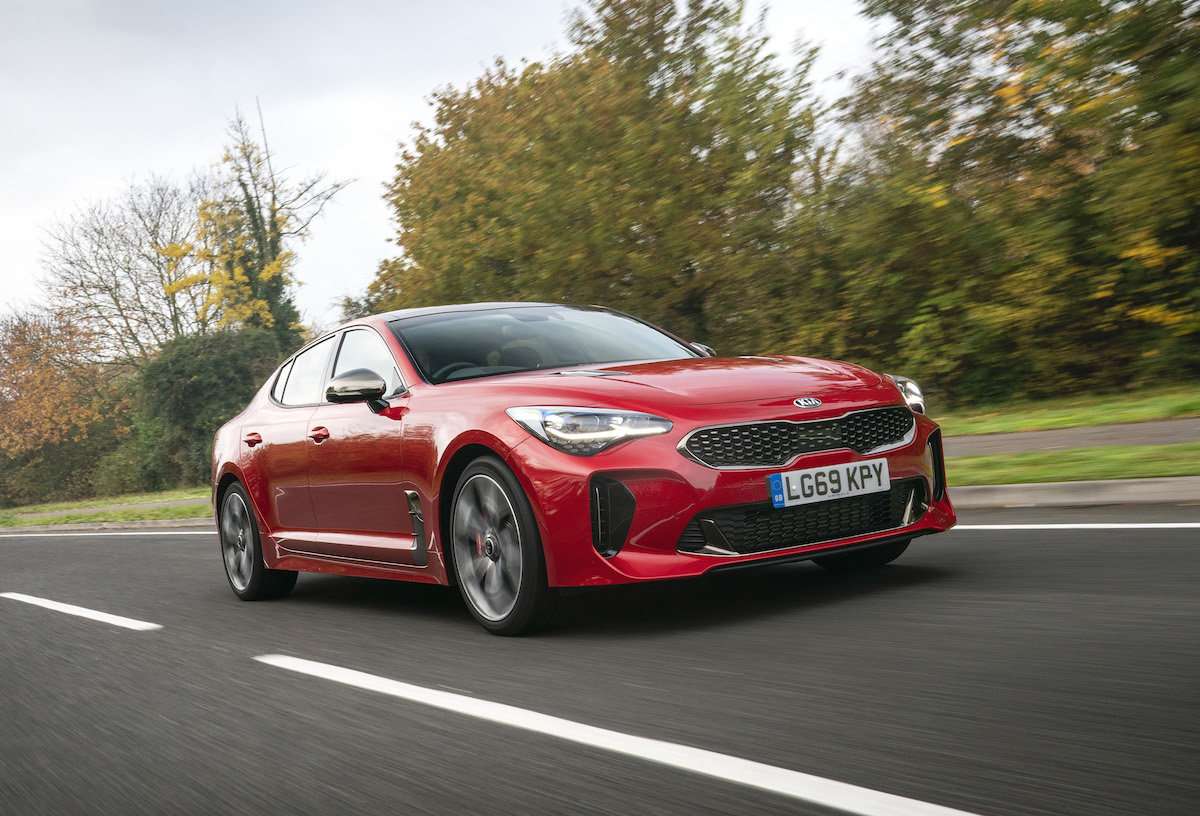
Its design was led by Peter Schreyer – the enormously respected German designer who penned the original Audi TT. A long bonnet, the very short front overhang, a swooping roofline and the distance between the front axle line and the base of the windscreen are clear giveaways. According to Kia, these cab-backward, rear-wheel drive proportions are vital when tackling the evergreen BMW 3 Series head-on for the first time.

Practicality
How practical is it?
The Stinger’s cabin is better-appointed than most of us would expect of a Kia, with bundles of standard equipment and acres of interior space, including a 406-litre boot which extends to 1,114 litres with the rear seats folded flat.
While the Stinger’s German rivals keep their noses ahead of in terms of material quality and a sense of opulence, there’s never been so little in it.
Where the Stinger distinguishes itself from the very well-established German opposition is that, rather than taking on the form of a four-door saloon, it’s actually a five-door hatchback (although Kia refers to it as a ‘fastback’) like the Porsche Panamera. Also like the Panamera, the Kia is billed as a kind of family-sized grand tourer, with luxury, performance, and agility in one package, but not such a focus on handling that all other considerations have been thrown out the window.

Driving
What’s it like to drive?
The Stinger rides comfortably, is effortlessly refined on the motorway, and has spacious rear seats with plenty of legroom. When you find yourself navigating a stretch of winding B-road, it will pull its laces tight and sprint along with strong grip and good body control. Don’t expect communicative steering or the sharpest handling responses because it’s quite a heavy car, but it's nonetheless very impressive.
Sitting at the top of the range, the Stinger GT S is powered by a fabulous 361bhp 3.3-litre twin-turbo V6 petrol engine. It has an eight-speed automatic gearbox and is comfortably the fastest Kia yet. It’ll reach 62mph from standstill in just 5.1 seconds before running on to a top speed of 168mph.
But if you can’t stretch to a GT S, then 2.0-litre turbo is well worth considering. It lacks the outright grunt of the V6, not to mention the terrific soundtrack, but it can still hit 62mph in 6.4 seconds. The 242bhp petrol engine is smooth and offers a broad spread of power that makes it really flexible, and its lighter weight over the front end helps the Stinger’s handling balance even further.
Finally, there’s the 2.2-litre diesel engine. With only 197bhp it’s considerably down on power on the other options here, and its coarse soundtrack and peaky power delivery mean it isn’t as enjoyable to drive as either of the petrol engines. Mind you, it’ll still hit 62mph in 7.3 seconds, so it’s no slouch; if you need a diesel for lots of long-distance motorway schleps, it might be worth considering.
More than anything, the Stinger revealed the scale of Kia’s ambitions. For a long time, its cars were cheap, but they fell short of the standard set by Europe’s car makers. Kia really closed that gap, and its cars became genuine contenders in their various categories, but buttoned-down pragmatism only takes you so far, and it was inevitable that Kia would one day want to inject some real desirability into the mix. The Stinger played that role very commendably indeed.
Tech and equipment
Technology, equipment & infotainment
Kia was very generous with the Stinger’s standard equipment to lure buyers away from their Audis and BMWs. There were no basic entry-level models, and the range kicked off with the GT-Line, which was chock-full of kit. Leather upholstery, with electric adjustment and heating in the front; a heated steering wheel; front and rear parking sensors; adaptive cruise control; a reversing camera; a limited-slip differential; a nine-speaker sound system – all of these came as standard even on the cheapest Stingers.
If you’re prepared to splash out for a GT-Line S instead, you also get LED headlights, ventilated front seats, heated outer rear seats, a powered boot lid, a Harman Kardon sound system with 15 speakers, a 360-degree parking camera system, and a sun roof.
Go for the full-fat GT S model, and in addition to that glorious 3.3-litre V6 engine, you’ll also get a spangly set of Brembo brakes, Nappa leather upholstery, adaptive suspension, variable-ratio steering, and adjustable side bolsters on the driver’s seat.
You’ll need to find a car whose original owner ticked a lot of options boxes to get the same level of equipment in an A5 Sportback or a 3 Series.
Early Stingers came with an eight-inch touchscreen, whose graphics looked a little downmarket compared to the swankier user interfaces on true premium rivals’ offerings. However, a corollary of this was that the system was quick to respond, as it didn’t have to deal with finicky animations or high-quality imagery, and combined with an intuitive menu layout, that meant it was satisfyingly easy to use. Later cars had a very similar system, but the screen was upgraded to one that measured 10.25 inches.

Running costs
Kia Stinger running costs
The Stinger is good value to buy, but that doesn’t necessarily mean it’s a cheap car to run. Fuel costs vary significantly depending on the model. Kia says the twin-turbo V6 GT S will return 28mpg in mixed driving, although a real-world mpg figure of 24 is more realistic. Expect that to fall even further if you drive it hard. Meanwhile, the four-cylinder petrol should return around 32mpg in real-world driving, while the four-cylinder diesel has the best fuel economy of the bunch at 38mpg.
Because the Stinger was introduced after the tax regime changed in 2017, 2.0-litre turbo and 2.2-litre diesel models will be taxed at the same standard flat rate. GT Ss were priced at more than £40,000, which means they’ll incur the luxury car tax premium until they’re six years old, at which point they’ll revert to costing the same as the rest of the range.
Petrol-powered Stingers will also require servicing very frequently – every 6,000 miles or six months, to be precise – and while the interim services are relatively small, it’s still an extra cost (not to mention an extra thing to remember) that you won’t get with one of this car’s rivals. Diesel Stingers stick to a 12-month, 10,000-mile service schedule, which is more conventional.
Insurance groups range from 32 for the diesel model to 42 out of 50 for the GT S. As well as fixed-price service plans, which spread the costs and protect against inflation, Kia offers customers the option of splitting service or repair work into three interest-free payments.

Kia Stinger reliability
Kia has earned itself an enviable reputation for reliability, and it often outperforms the likes of BMW, Audi, and Mercedes-Benz in owner satisfaction surveys.
What’s more, all Kias get a seven-year, 100,000-mile warranty when new, and while only the very latest Stingers will benefit from the balance of this today, it’s something no other car of this type can offer.
Will it be reliable, though? Well, it seems likely; Stingers have an excellent reputation for durability, and we’ve neither heard of nor found evidence of any common problems that affect any of the powertrains it’s fitted with. Even if your Stinger does go wrong, repair costs are likely to be lower than those of the equivalent BMW or Audi.

What owners say
This Kia stinger 3.3V6 GT - S is a highly under rated car. And in comparison to the likes of the bigger named cars such as Audi and Bmw, it really does stand its ground. The Kia definitely looks the part from the outside, and inside its luxurious , comfortable and absolutely packed with things that come as standard with the Kia but.with BMW and Audi you would most likely have to pay extra for, such as Heated and cooled seats, heated steering wheel, heads up display, electric boot. It drives really well putting down some serious power from the rear wheel drive, wit a decent 0-60 in between 4.5 - 4.7 secs. It is 100% value for money, as most 2nd hand Stingers retail between £22,000 and £30,000 for the newer 2022/23 models. YOU WILL NOT BE DISAPPOINTED
28 June 2026We had a 2019 2.0 GT absolutely loved it, lots of power and fully loaded with kit and tech. Fuel is poor around town but on motorway you can get about 33mpg but we didn’t buy the car for fuel economy. Gutted the car had to go back. The boot was a little smaller than my A6 We will get another one but not many come up for sale. Check service history because they need a service twice a year one being just an oil change.
15 January 2026Better Spec than Audi BMW or Mercedes Stunning drive, like its, Stuck To Rails
14 July 2026What owners say
This Kia stinger 3.3V6 GT - S is a highly under rated car. And in comparison to the likes of the bigger named cars such as Audi and Bmw, it really does stand its ground. The Kia definitely looks the part from the outside, and inside its luxurious , comfortable and absolutely packed with things that come as standard with the Kia but.with BMW and Audi you would most likely have to pay extra for, such as Heated and cooled seats, heated steering wheel, heads up display, electric boot. It drives really well putting down some serious power from the rear wheel drive, wit a decent 0-60 in between 4.5 - 4.7 secs. It is 100% value for money, as most 2nd hand Stingers retail between £22,000 and £30,000 for the newer 2022/23 models. YOU WILL NOT BE DISAPPOINTED
28 June 2026We had a 2019 2.0 GT absolutely loved it, lots of power and fully loaded with kit and tech. Fuel is poor around town but on motorway you can get about 33mpg but we didn’t buy the car for fuel economy. Gutted the car had to go back. The boot was a little smaller than my A6 We will get another one but not many come up for sale. Check service history because they need a service twice a year one being just an oil change.
15 January 2026Better Spec than Audi BMW or Mercedes Stunning drive, like its, Stuck To Rails
14 July 2026This car has everything you would want, Its a great saloon but the 1 and only reason I gave mine up was that I was finding it difficult to get out of, getting in wasnt a problem but the getting out was, if I was 10 years younger I would not hesitate,
24 November 2021simply has no competion at this price, you get the same performence and features as a bmw or merc costing 1000s more
2 June 2021Three things to know
- The Stinger was facelifted at the start of 2021, and alongside that facelift, the 2.0-litre petrol and 2.2-litre diesel engines were dropped, leaving the GT S as the only Stinger on sale. Otherwise, though, changes were fairly minimal, and amounted to subtle cosmetic tweaks, including the addition of a new Electric Blue paint colour, as well as a glut of extra electronic safety aids.
- The Stinger is rear-wheel drive, which is a first for Kia in the UK and yet another sign of its keenness to make a proper performance car. There are four-wheel drive Stingers in other markets and Kia sells rear-wheel drive cars abroad.
- A limited-slip differential ensures the muscular power and torque of the V6 engine are delivered to the road with as little wasteful wheel spin as possible. But this clever bit of kit isn’t the preserve of those lucky enough to own a GT S; it was fitted as standard to every Stinger, making the diesel model one of only a handful to come so-equipped.
Which one to buy
- On a budget: Early cars with four-cylinder diesel engines are the most affordable, and they also happen to be the most frugal of the lot, making them not only the cheapest to buy, but also the cheapest to run.
- As a bargain all-rounder: the 2.0-litre petrol models are often overlooked, and while it’s true that they don’t quite deliver the barnstorming driving experience of the GT S, they’re still smooth and capable grand tourers.
- The cheapest GT S: A pre-facelift model with a few miles on the clock is your best way into the most powerful version of the Stinger. It will still be more expensive than the smaller-engined models, but not by as much as you think – and it’s certainly more desirable. Don’t forget that with Kia’s good reputation for reliability, a high-mileage buy isn’t as much of a risk as it is with some rival models.
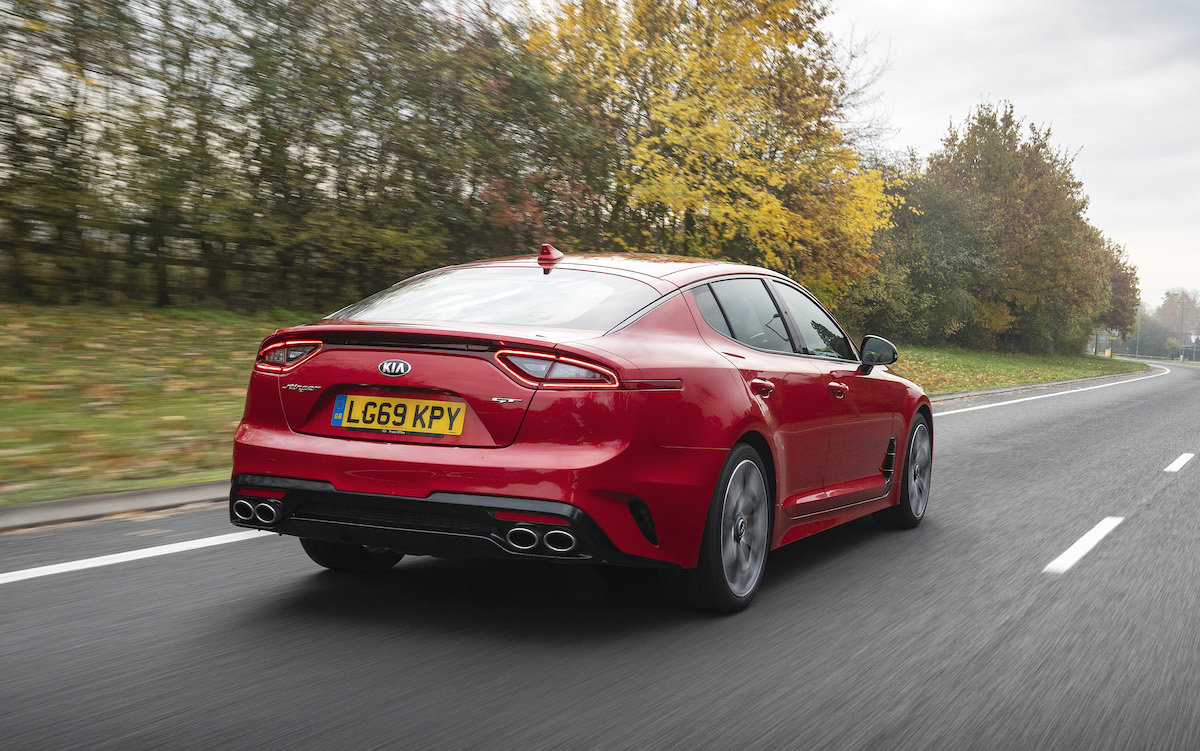
- Money no object: A post-facelift GT S with the improved infotainment screen is the one to have. You can tell these apart by the rear lights; earlier cars’ have white centres ringed by red LED tail lights, whereas later cars feature a more conventional look, with a one-piece red light bar that spans the boot lid, and clear strips below that house the indicators and reverse lamps.


Pricing trends
Starting RRP
£34,538
Current avg. market price
£19,188
Trending up by 13.3% this month
June 2026 - October 2026