Lexus UX 250h Review (2018-present)
Lexus UX 250h cars for sale
3.0
Expert review
Pros
Striking styling stands out in a crowd
Easy-driving hybrid system
Brilliant customer service from Lexus dealers
Cons
Poor infotainment system is fiddly to use
The boot is on the small side for a car of this size
Cramped back seats

The CarGurus verdict
The UX stands out in a busy crowd with its riotous lines, sharp creases and fundamentally different take on styling alongside its somewhat amorphous competition being rather appealing. What’s not is the hopeless infotainment system, a Lexus signature, which really needs addressing. The boot space isn’t huge, either, likewise the rear seat passenger head- and leg room, but that’s forgivable here, because not everybody looks for practicality in vehicles like this.
To drive it’s quiet (mostly), comfortable and economical, the self-charging hybrid an easy-going alternative to the diesels of its numerous rivals. Indeed, the time is arguably right for the UX, this compact crossover bringing loads of head-turning looks along with an easy driving, operating hybrid system. As an alternative to the Germanic norm it makes quite a statement, and certain reliability and brilliant customer service is a very big draw, too.

What is the Lexus UX?
Mention 'premium' in the UK and it’s the German trio of Audi, BMW and Mercedes-Benz that generally springs to mind, but Lexus has long offered an alternative, and so it proves with its UX model. It’s a compact SUV, which in size and pricing lines up against cars like the Audi Q3, BMW X1 and BMW X2, the Mercedes-Benz GLA and a host of others like the Volvo XC40, Jaguar E-Pace, Volkswagen Tiguan and plenty more from a wide range of mainstream manufacturers.
As Toyota’s upmarket brand, Lexus, somewhat unsurprisingly, focusses on hybrid powertrains for its models, with the UX only being offered with a single engine choice: a 2.0-litre petrol combined with an electric motor, which together offer an output of 181bhp and torque of 140lbft.
There is one choice to be made, though. If you need - or want - the assurance of the four-wheel drive that the UX’s SUV styling hints at, there’s the option of an additional electric motor working on the rear wheels, Lexus dubbing this system UX E-Four.

How practical is it?
The Lexus UX might be an urbane, urban crossover, and while those in the front seats are well served for space, there's less of it elsewhere.
The boot space, in particular, really isn't much to shout about by SUV standards. There's 320 litres of luggage space with the rear seats upright, which is roughly equivalent to that of supermini with a big boot or a family hatchback with a below-average luggage compartment. You get 1,231 litres when you fold the rear seats flat which, again, can easily be bettered. There is a recess under the boot floor that adds some capacity, but you lose that if you go for the four-wheel drive version.
Back seat space isn’t overly accommodating, either, and access to the rear seats is tight as well. If you’re looking for space, particularly in the boot and back seats, you’ll be better served by one of its numerous rivals.

What's it like to drive?
It’s impossible not to be impressed by Lexus’s slick integration of the hybrid system. The petrol engine and electric motor are happy bedfellows, working in conjunction or independently with an effortlessness that’s testament to Lexus’s expertise here. Sadly, then, the CVT gearbox - that’s Continuously Variable Transmission - does upset the driving experience. It's fine if you’re not in a rush, but if you are, it holds engine revs at a level that’d be seriously unbecoming if the 2.0-litre engine wasn’t so refined. It all takes a bit of adjusting to, and never feels entirely right.
Unlike so many of its petrol-electric hybrid rivals, which offer plug in (PHEV) potential for a useful electric-only driving capability, the Lexus UX uses what the Japanese company dubs a ‘self-charging’ system. This means it can only store the energy that it collects from regenerative braking or by using the petrol engine as a generator.
If you’ve graduated up from a Toyota Prius, you’ll be completely au-fait with the hybrid system in the UX, and even if not, it’s seamless in its operation, requiring nothing from the driver to operate it. The downside is that it only stores a limited amount of energy and doesn’t result in the transformative difference in fuel economy that you might see in a plug-in hybrid.
Nonetheless, it compares favourably to petrol-only SUVs, with the UX able to return in excess of 50mpg on the WLTP official combined consumption testing schedule, or 47.0 mpg if you’ve optioned the UX E-Four. In normal driving, it shouldn’t be too difficult to match those figures, either. CO2 emissions of 120-128g/km are recorded for the standard UX, or around 136g/km for the all-wheel drive UX E-Four. If those figures aren’t good enough to salve your environmental conscience, then Lexus now offers the fully electric UX 300e.
The chassis delivers a commendably comfortable ride and decent body control – better on the smaller 17-inch wheels – which come with regular tyres, unlike the 18-inch wheels which come with stiffer-walled run-flat rubber. A competent all-rounder on the road, not exciting, but economical, and as long as you’re not in a hurry, quiet and easy, excelling in and around town, which is hardly surprising since UX apparently stands for Urban urm, X, crossover.
Technology, equipment & infotainment
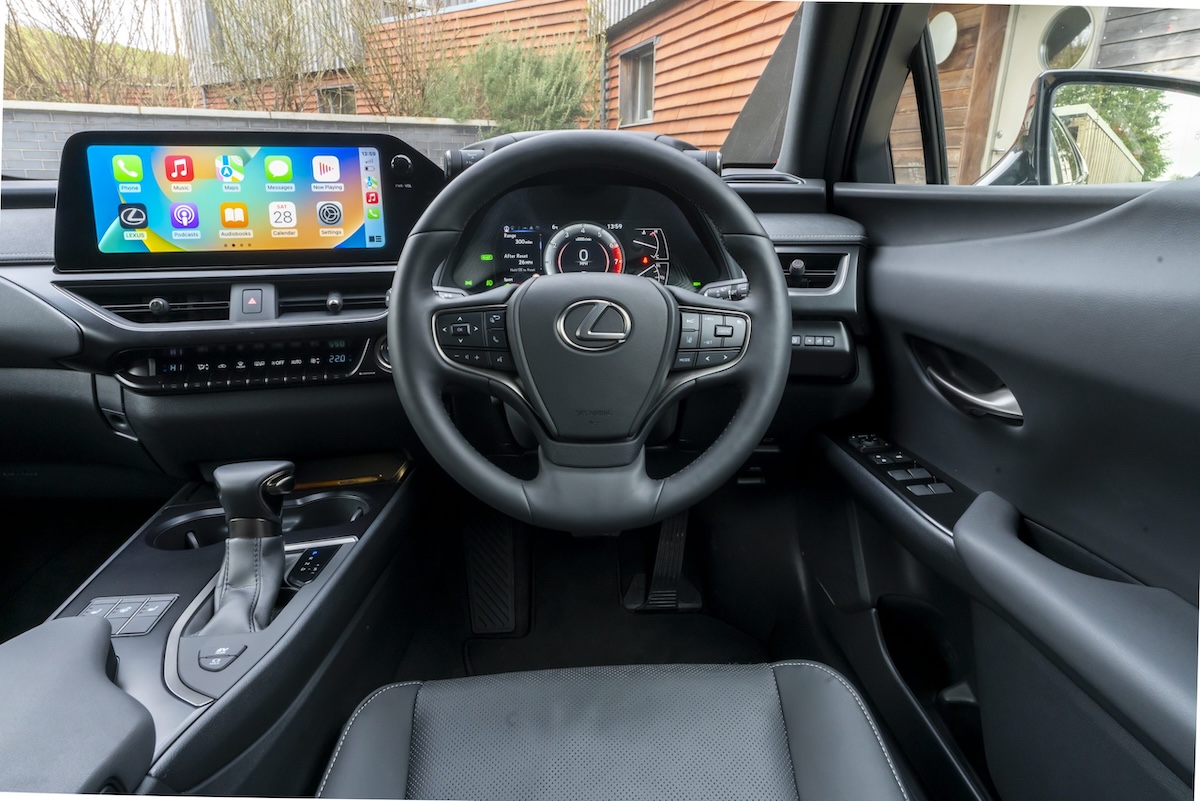
The UX looks sensational and its interior is nicely different to its rivals, but if there’s one area where Lexus significantly trails its rivals it’s the user experience for the infotainment. We’re no touchscreen evangelists here, but Lexus’s alternative, a touchpad that works a cursor like your laptop, is frustrating to operate when sat stationary, and all but impossible to use on the move. At least it comes with Apple CarPlay and Android Auto, which does allow you to mitigate its operational hopelessness a bit, but Lexus really needs a serious re-think here.
On the upside, standard equipment is generous. There isn’t really a base model as such, but go for the standard UX without any packs or options and you’ll still get 17-inch alloys, LED headlights, push button start, Dual-Zone Climate Control and a 10-speaker hifi. It does come without satellite navigation, but frankly that’s a blessing, because a map, or the one on your phone, is far better than spending the time trying to input a postcode or address via that Remote Touch Interface.

Lexus UX running costs
There’s not much information out there on the UX’s residual values alongside its German rivals, but it’s not likely to fare as well as them, because there’s a smaller marketplace out there for it because of its badge. A growing one, potentially, with compact crossovers being a booming market segment, and the Lexus stands out from the crowd with its plentiful creases and body surfacing, as well as the company’s signature front grille. It’s important enough a segment to have seen Lexus bin its IS saloon model to focus on this crossover instead.
The hybrid system helps make a real case for the UX, with the 50mpg combined economy figure being something that should be possible, not least because you’ll not feel inclined to push that drivetrain particularly hard. Its CO2 emissions aren’t exceptional these days, but they’re good enough to make sure you’re not paying over the odds in company car tax. If fuel economy is your ultimate goal, then be sure not to opt for the four-wheel drive version, which dents the UX’s ultimate consumption due to its increase in weight.
Servicing shouldn’t be expensive, and Lexus offers a flexible payment plan to spread the costs of regular maintenance. Avoiding the models in the F-Sport and Takumi trim lines will keep you under the £40,000 threshold, excusing you from inflated VED payments for the first five years of ownership.

Lexus UX reliability
When Lexus arrived in the premium marketplace, its goal was to be disruptive, and in one regard it’s certainly been so. Parent company Toyota is highly regarded for reliability, and Lexus has built on that, substantially, to the point that it’s become the Bryan Adams (Everything I do, I do it for you) of the reliability and customer satisfaction charts, predictably holding the number one position in every chart worldwide.
Lexus’s hybrid technology is well-proven, too, so there are no worries in that regard, while the standard warranty of three years and 60,000 miles is added to with a hybrid battery warranty provided an annual Hybrid Health Check is undertaken. Do that, and you’ll gain an additional year, or 10,000 miles of battery warranty extension, until the UX is fifteen years old. Some elements of the warranty cover hybrid parts for up to five years, too, though, in truth we doubt you’ll ever need to be tapping into the warranty, such is Lexus’s reputation for reliability.
Nobody’s perfect, though, and the UX, like most new cars, has had a couple of minor recalls. Check with your Lexus dealer – though knowing their impeccable customer service they’ll have almost certainly informed you if needed – to check if your UX is needing any remedial work done to it.
- Although sold in the UK simply as the Lexus UX, you may see this car referred to as the UX 250h. That’s the terminology used for this particular variant of the UX in countries where additional engine options are also offered (UX200, UX260h).
- If you’re sold on the idea of a UX, but want even more environmental credibility than the standard hybrid can muster, there is now the Lexus UX 300e. It’s the company’s first ever all-electric model and offers a claimed range of 196 miles. With a 50kW DC charger, it should take an 80% charge in 50 minutes. The only issue is that supply shortages mean it’s currently sold out (as of autumn 2022).
- Similarly, if you want to stick with the Lexus brand and you’re looking for the flexibility of a plug-in hybrid model that’s capable of travelling significant distances on either petrol or electricity, there is a solution. The NX 450h belongs to the NX family, which is the next size up. It sits at the top of the NX line up, which means it is a big step up in terms of budget, although you do get a useful increase in space. Elsewhere, the likes of the Volvo XC40 Recharge and the BMW X1 xDrive25e are closer in size and price to the UX.
- The fully-loaded one: Go large, go Takumi, which comes with a 360-degree panoramic parking camera, a HUD (Head Up Display), keyless entry, power adjustable and heated steering wheel, eight-way electrically adjusted seats with a memory package, a powered hatchback, its own interior specification including smooth leather and a Japanese Washi paper inspired instrument panel and, the real reason you want it, the standard fitment of an incredible 13-speaker Mark Levinson Premium Surround Sound System. Choosing it also circumnavigates the need to wade through the various Premium Packs that will leave you scratching your head as to what you get in the other trim levels.
- The one with most safety kit: The Premium Sport Edition is the one that’s one trim up from the base UX hybrid, that adds to its Lexus Safety System - offering, comprising Dynamic Radar Cruise Control, Pre-Collision System, Lane Tracing Assist, Road Sign Assist and Automatic High Beam, by also including a Blind-Spot Monitoring System with Rear Cross Traffic Alert and Auto-Brake.
- The sporty one: Reckon you want your UX with a bit more sporting appeal? Then the F-Sport will suit. It gets all the accoutrements you’d anticipate for a more sporting model, like aluminium pedals, F-Sport exterior styling, LFA inspired digital instruments – the LFA being Lexus’s short-lived supercar – and F-Sport Suspension with rear performance dampers. It’ll look sportier, then, but the trade-off will be a more compromised ride.


