Maserati MC20 Review (2021-present)

Pros and cons
What we like
Looks fabulous
Wonderful to drive
Engine sounds terrific
What to consider
Very expensive, of course
Limited practicality, of course
Tricky getting in and out
The CarGurus verdict
In the scheme of supercars (or super-sports cars, if you will), the Maserati MC20 does feel different to others and has such a delicious blend of comfort and agility that makes it surprisingly accessible even on UK roads. You could question the value for money it represents versus a Porsche 911, or the potentially better residuals offered by rivals from Ferrari and Lamborghini.
However, the MC20 has a uniqueness and a level of quality that makes it easy to forget such things. It is classically beautiful, has a real elegance to the way it goes down the road, and also blends in impressive tech, including the promise of an all-electric model. For all of those reasons, it earns the full five stars here.
out of 5 expert review
What is the Maserati MC20?
Maserati appeared to have fallen into something of a lull until recently, with very few model launches and an ageing model range meaning that it was being eclipsed by more active rivals including sibling Ferrari, along with McLaren and Porsche.
The introduction of the MC20 was the moment that Maserati shrugged off that apparent torpor, and represented a new era for the Italian brand. MC20 actually stands for Maserati Corse (Maserati Racing) 2020, to mark the company’s comeback in motorsport.
The 1,500kg, 621bhp Maserati MC20 uses a mid-mounted, twin-turbocharged, 90-degree V6 that send power to the rear wheels. Known as the Nettuno engine, it’s designed and manufactured exclusively by Maserati; there’s no sharing with Ferrari here, although there is Formula 1 technology in the pre-chamber combustion that the Nettuno V6 engine utilises.
Designed and built in Modena at the Italian car maker’s Viale Ciro Menotti plant, the Maserati MC20 uses a carbon-fibre and composite monocoque chassis that was conceived in partnership with race car design company, Dallara. It’s designed to be adaptable for a pure electric MC20, and it also keeps weight down while allowing for additional structural changes needed for the Maserati MC20 Cielo. Thanks to that chassis technology, the Cielo spyder weighs only 65kg more than the MC20 coupe despite having an electrically retractable glass roof.
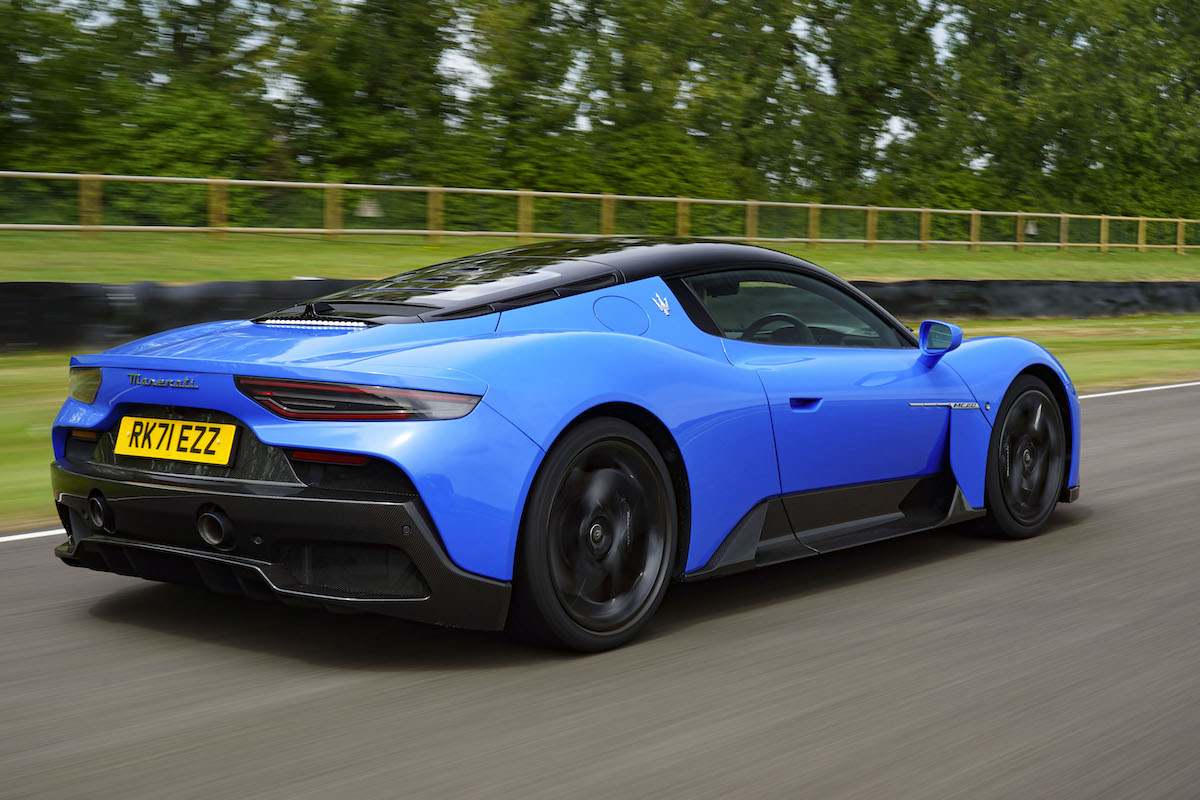
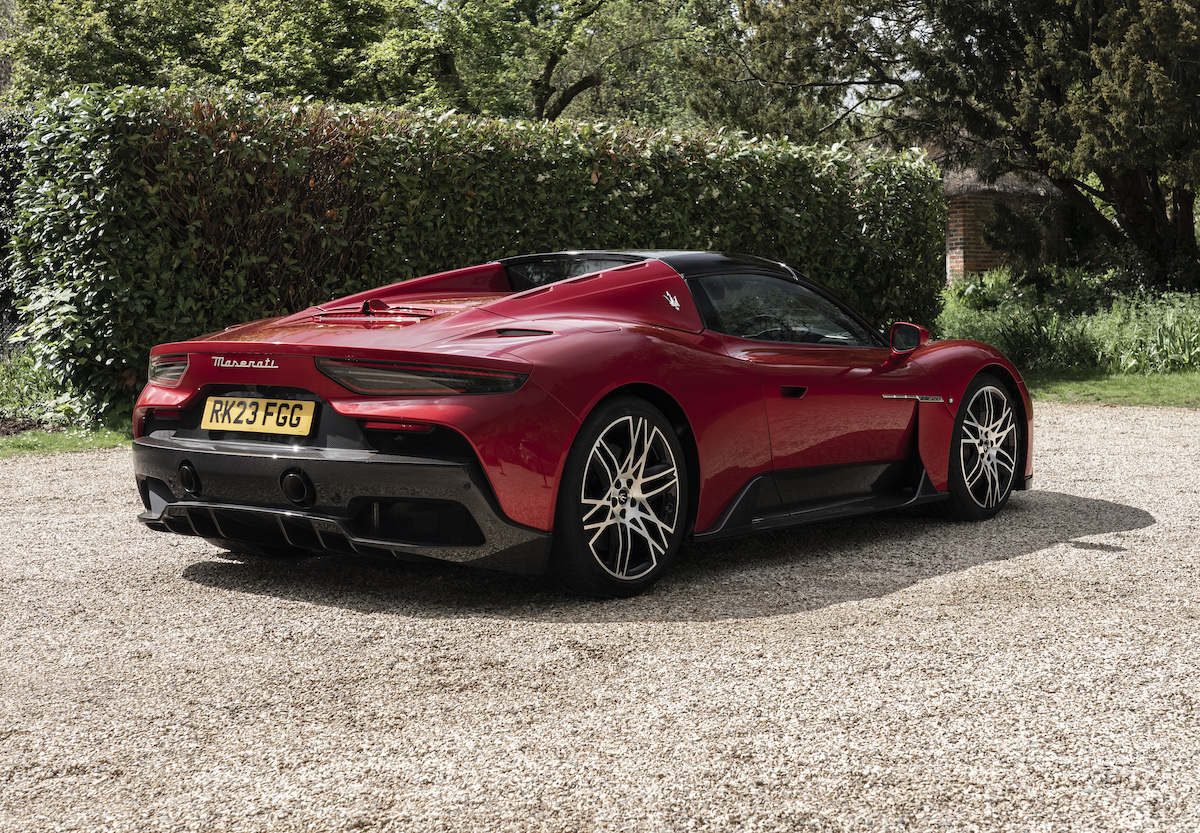
It’d be a shame not to mention the styling of the MC20 here, wouldn’t it? What’s not to like? To our eyes, at least, it is classically elegant, yet with all the right traits of modernity and aggression. Perhaps a bit more understated than most of its rivals, and that’s no bad thing.
The ongoing revitalisation of the Maserati brand - with the MC20, the MC20 Cielo, the recently launched Maserati Grecale SUV and news of other interesting new models coming in the next few years - also serves to reassure those who may have worried about Maserati’s autonomy and ability to remain exclusive under new parent company, Stellantis.
Stellantis is a huge global car-maker that was formed out of the merger of the FCA and PSA Groups in 2021, and now shares parts and resources across many car brands including Maserati and its Italian siblings, Fiat and Alfa Romeo.
Practicality
How practical is it?
You don’t buy a mid-engined supercar for its practicality, but having space for a few bags is undoubtedly still important for those longer road trips, and the Maserati MC20 does indeed have room for a couple of small, soft weekend bags in its 101-litre boot space. More likely is that you’ll be opening the rear hatch to show off the excellent view of that twin-turbo V6 engine, but it will also just about suffice for a weekend away if you pack light.
There’s also a small, 47-litre compartment in the nose of the car, which is just about big enough for helmet storage if you’re on your way to the circuit.
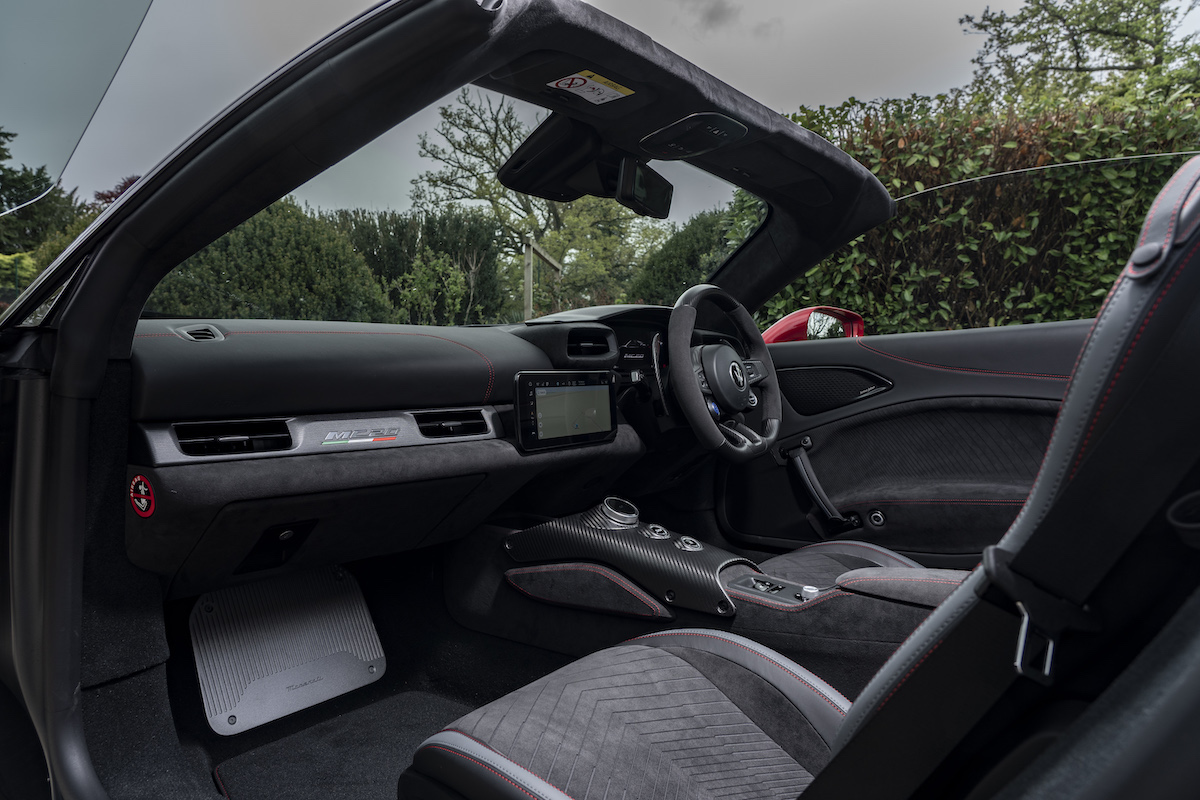
By the standards of this sort of two-seat, high performance coupe, the MC20 is not terrible for storage space, but it’s not great either. Still, the deeply sculpted seats are really comfortable and keep you in place, while not being too restrictive and tight for those with a more expansive waistline. Not only that, but Maserati is a master of the slim steering wheel and big, real metal gearbox paddles that are just where you want them to be, feel gorgeous to the touch, and have a delightfully heavy, mechanical movement when you use them.
Visibility is predictably poor, but you can get a rear view mirror that offers a camera feed, which really does increase the otherwise very restricted view to the back and rear three-quarters.
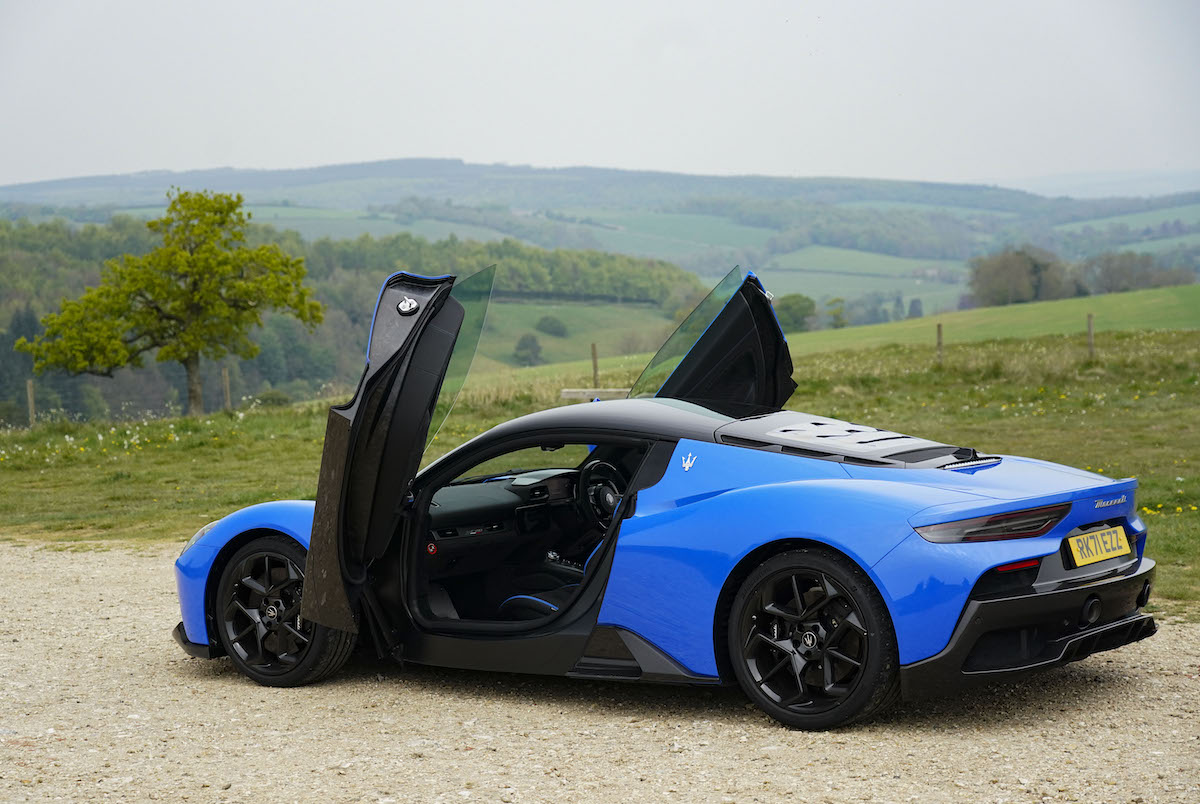
Butterfly doors for the MC20 are the final style flourish for both the MC20 coupe and MC20 Cielo convertible, but are also fairly practical for offering easier access in a tight spot: something that many will appreciate as it can be quite a feat of dexterity to dip and slide over the deep sill and into the low-slung seats.
Driving
What’s it like to drive?
The Maserati MC20 doesn’t really feel like any of its immediate rivals to drive. With a 0-62mph time of 2.88sec, and pricing of more than £200,000 for the MC20 coupe and £230,000 for the Cielo, and with every possibility that you might spend £50,000 and more on options or bespoke finishes, the Maserati has a huge raft of varied and highly desirable alternatives. Everything from the much cheaper yet similarly rapid Porsche 911 Turbo, Audi R8 and Corvette Z06, to the Ferrari 296 GTB or F8 Tributo, McLaren Artura and McLaren GT and Lamborghini Huracan are direct rivals to the MC20.
Not to mention more left-field alternatives like the Lotus Emira, which may be slower and vastly cheaper, but arguably has a similar remit in terms of its mid-engined, two-seat layout and lightweight, road-to-track demeanour.
Speaking of which, the Maserati MC20 does feel like a Lotus on steroids. It has that lightness of touch to its steering, which is quick but not so much as to be nervous, and a natural sense of connection that gives an immediate sense of confidence, even though you’re also always conscious of the level of performance under your right foot.
Naturally, you sit very low to the ground in the MC20, which rides comfortably yet feels ruthlessly rigid in its structure. Its double wishbone setup and ‘semi-virtual’ steering system effectively reduces the amount of camber that the front wheels would otherwise experience as steering angle is applied, improving the tyre’s contact patch and helping to keep more constant steering feedback and response.
Bigger bumps are smoothed over with remarkable finesse and, while sharper potholes can send a real thump through the cabin, there’s never any harsh jarring from the dampers. There is a tangible sense of sophistication to the MC20’s suspension, as it appears to make the car levitate slightly over scruffy surfaces, even while it keeps the body tightly in control for a sense that the car is swivelling effortlessly around you as you steer through direction changes. It’s delicate and 'fingertippy' to drive, and surprisingly delightful even on some rather terrible UK country roads. We should add that our test car came with the optional electronic limited slip differential (E-LSD, in Maserati speak) and adaptive sports suspension with nose lifter, which you should absolutely add if you’re in the enviable position of speccing your MC20. Clearance over bigger speed bumps and car park ramps could be an issue, and the adaptive dampers add some extra breadth of ability for the full track-to-road talents on offer.
All of which is, of course, coloured by the V6 engine sounding bassy and resonant at low revs, before gaining something of the Italian supercar banshee scream at higher revs. And, as you’d expect for a car of this performance level, it’s fast. Plan ahead, because you will get to that spot up the road faster than you expect to, with a bit of a wriggle and squirm from the rear-wheel-drive MC20 as it scrabbles to contain all of its rather monstrous power and torque.
The eight-speed dual-clutch automatic gearbox does a decent job, too. Leave it in automatic mode and it’ll blur through the ratios smoothly enough, albeit there’s sometimes a small but noticeable shunt as it changes down. More than that, the lovely, huge gearshift paddles give you full control if you select Manual mode, resulting in a powertrain that virtually effervesces with enthusiasm and responsiveness.
Mind you, in truth it’s near on impossible to find space to use the MC20s performance on UK roads, so it’s more important that it’s also a delight to drive at a swift-but-moderate ebb and flow along a decent country road. However and wherever you drive it, the natural responses and lightness of touch make the MC20 an utter delight.
Tech and equipment
Technology, equipment & infotainment
The Maserati MC20 and MC20 Cielo are a feast of technology, from the six-piston Brembo brakes to the bespoke Bridgestone Potenza tyres, sublime V6 engine and 12-speaker, Sonus Faber audio system. It’s an impressively modern, tech-focussed piece of kit.
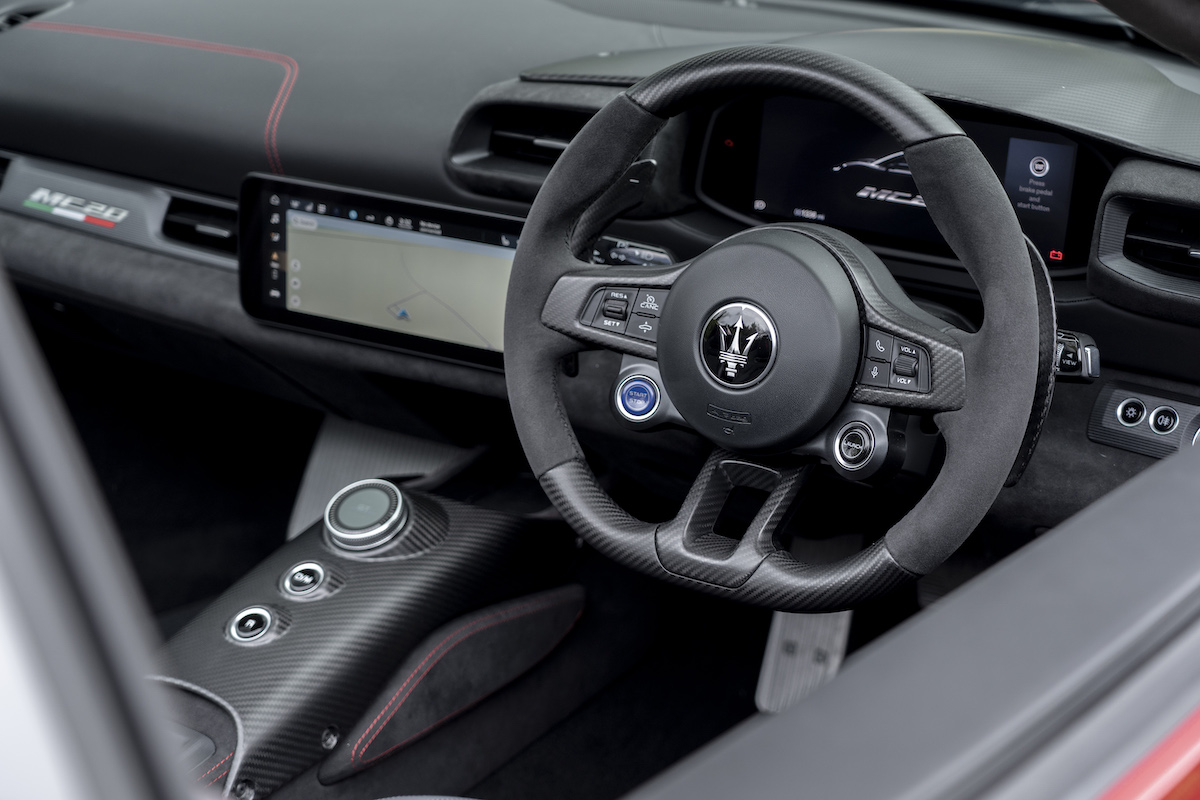
However, anyone familiar with Maserati, or even more everyday Fiat Group products, will recognise the Maserati Intelligent Assistant (MIA) multimedia system. This Android-based system gets two 10.25-inch screens: one a driver’s readout that can be toggled through different layouts, while the other is a touchscreen that’s your window to all of the car’s features. These include wireless Apple CarPlay and Android Auto, and the Maserati app also allows you to connect to your car via your Amazon Alexa or Google Assist home devices.
Most importantly, the screen has great graphics and is easy to see, the icons are fairly easy to hit, and the layout straightforward enough that you can routinely find the setting or function that you’re after without resorting to swearing. It isn’t the graphics wizardry of the best systems from BMW and Porsche, but it is a solid, usable and fully functioning infotainment touchscreen system that offers all the features you want, and generally makes it easy to control them. For Maserati – a company that was far behind the times with user interface until recently – this is a revelation that puts it on a more even footing with its key rivals.
Running costs
Maserati MC20 running costs
The Maserati MC20 isn’t cheap. At well over £200,000 for the coupe and £235,000 for the Cielo, it’s similar to its chief rivals, though. It’s similarly expensive for options prices, too. How about £840 for powered adjustment of the steering column? Or £36,000 for an exterior carbonfibre pack? Maybe £550 for heated seats?
Yes, this sort of options pricing is hard to digest, but you will find precisely the same with Ferrari and McLaren, and even Porsche tends to take advantage of its well-moneyed clientele when it comes to charging extra for items that you find as standard on most Kia models. Even so, the Porsche 911 no doubt makes the Maserati look extremely pricey.
Such is the way of super-prestige cars. In short, you would be well advised to factor in some £30,000-£70,000 of optional extras on your Maserati MC20 depending on how wild you want to go.
Depreciation is extremely hard to predict, and the MC20 may even change hands for more than its list price in the initial flurry after its introduction. Expect it to drop many tens of thousands after that, but it will almost certainly recover after a while and start to gain value in the long run, as most of these rarefied super-sports cars tend to do.
Fuel economy of 24mpg and CO2 of 265g/km is very reasonable for a car of this performance.
Maserati MC20 reliability
Maserati isn’t included in any owner surveys as it’s a small-volume manufacturer. However, there is some peace of mind in that Maserati offers an unlimited-mileage, three-year warranty on the MC20, which can then be extended to five years. A warranty on the main mechanical components of the car can then be purchased to cover the car up until its seventh year, still without a mileage limit. Three year’s roadside assistance is also included.

What owners say
Three things to know
- The Maserati MC20 Cielo’s roof has a large glass panel that can be switched between opaque or clear at the press of a button. It can also be dropped or raised in just 12 seconds at speeds of up to 31mph.
- The Maserati MC20 will gain a pure electric variant from 2024, named the Maserati MC20 Folgore. This is one of six EVs that the Italian car-maker is said to be launching before 2026, and while there are no specific details on range, performance or otherwise of the MC20 Folgore, the company has made it clear that it will be going to extremes to keep weight down, and will make handling flair a priority for the electric super-sports car.
- There are six paint colours to choose from on the MC20, and an additional seventh, called Acquamarina, that’s only available on the Cielo convertible. Naturally, there is also a carbon-fibre pack for the MC20 that adds various carbon-fibre elements to the exterior and interior, and you can also choose bespoke colours and finishes for the MC20 via Maserati’s Fuoriserie customisation programme.
Which one to buy
- If you want the sportiest one: Is there an MC20 that isn’t sporty? Well, no. Take your pick, Coupe or Cielo Convertible. They both have 621bhp and outrageous performance with deliciously accessible handling.
- If you want the best tourer: If you plan on doing a lot of miles in your MC20, it may be worth going with the coupe as it has a slightly more pliant ride. But then, if you’re doing big miles you’ll likely be going somewhere sunny… So, actually, go for the Cielo, for maximum satisfaction when you get to whichever sunny clime you’re heading to. It’s even been designed to minimise wind ruffle with the roof down, so your hair will look great even with the hard top open at top speed.
- If you want the best looking: Either, in any colour. What’s not to like? Go for bright yellow Giallo Genio for maximum ‘look at me’ value, while we rather like the pearlescent white Bianco Audace for a more understated finish. But, hey, paint it any colour and the MC20 is stunning.


