Mazda MX-30 Review (2020-present)
Mazda MX-30 cars for sale
3.0
Expert review
Pros
Classy and unusual looks
Handles well and rides comfortably
Low running costs
Cons
Fairly short range
Awkward rear-hinged back doors
Smaller-than-average rear seats

The CarGurus verdict
The Mazda MX-30 is a very easy car to like but a hard one to justify. If you’re after a compact, retro-cool, and fun electric car, the Honda e does it better, and still has five-door practicality. If you’re after a practical electric family car – more in-line with size of the Mazda MX-30 – the Nissan Leaf and the MG ZS EV have longer ranges, cost a similar amount, and are much less claustrophobic for rear passengers.
The Mazda MX-30 does, however, find some clear air in this increasingly crowded EV arena, given that it has a bigger boot than the Honda e and the MINI Electric, but real style substance and desirability that the Nissan Leaf and MG ZS EV can’t remotely compete with. So, if that sounds like what you’re after and you don’t mind the short range, the Mazda is sweet to drive and lovely to look at.
For those worried about the somewhat limited range of the fully electric MX-30, the R-EV range-extender model is worth considering. In either case, buying a lightly used model will save you thousands of pounds versus a brand new example.

What is the Mazda MX-30?
The Mazda MX-30 is a hatchback-SUV crossover with very few direct rivals. It is offered as a pure electric model with an official range of 124 miles from a 35.5kWh lithium-ion battery, or as a range extender (called the MX-30 R-EV). The latter has a smaller 17.8kWh battery for an electric range of around 50 miles, and uses an 830cc rotary petrol engine to charge the battery when needed, boosting the car's overall range to around 380 miles from a full battery charge and a full tank of fuel.
It’s not the fastest EV going, as the 0-62mph time of 9.2 seconds in the full EV version and 9.4 seconds in the R-EV suggest.
Mazda's aim is that the MX-30 attracts buyers with its quirky-but-classy exterior styling and a smart interior complete with retro-inspired design and cork inserts. It's an unusual car, and not without a certain appeal, although you don't need to look too hard to find compromises compared with more conventional small crossovers.

How practical is it?
The unusual design means the front doors have to be open to release the back doors, but you’re left with a pillarless opening to slide into the rear seats more easily. The downside is that you can end up trapped between the two open doors if you’re, say, trying to get a child out in a narrow parking space.
Rear legroom is also quite limited, despite the fact that the Mazda MX-30 is usefully bigger car than the Honda e and even the Peugeot e-208. It’s actually a similar size to a Ford Focus, a Volkswagen ID.3, or a Nissan Leaf, but there’s much less room for (up to three) rear passengers than you get in those ‘proper’ family hatchbacks.
The MX-30’s boot is a reasonable size, though. At 366 litres and with a useful, squared-off floor, it’s similarly to that of a proper family hatchback, and will accommodate more luggage a Vauxhall Corsa-e or a Peugeot e-208. There’s no underfloor cable storage in the Mazda MX-30, though, nor any space in the nose of the car, which is something that many EVs offer, including the BMW i3.
The front of the cabin is one of the highlights. There’s a comfortable driving position, and the materials are solid and smart, particularly the cork inserts, which really stand out. This harks back to the fact that Mazda was once a cork manufacturer. The cork is said to be sustainably sourced, as are the recycled plastic materials and textiles dotted around the cabin, and it all strikes a happy note of classy yet understated.
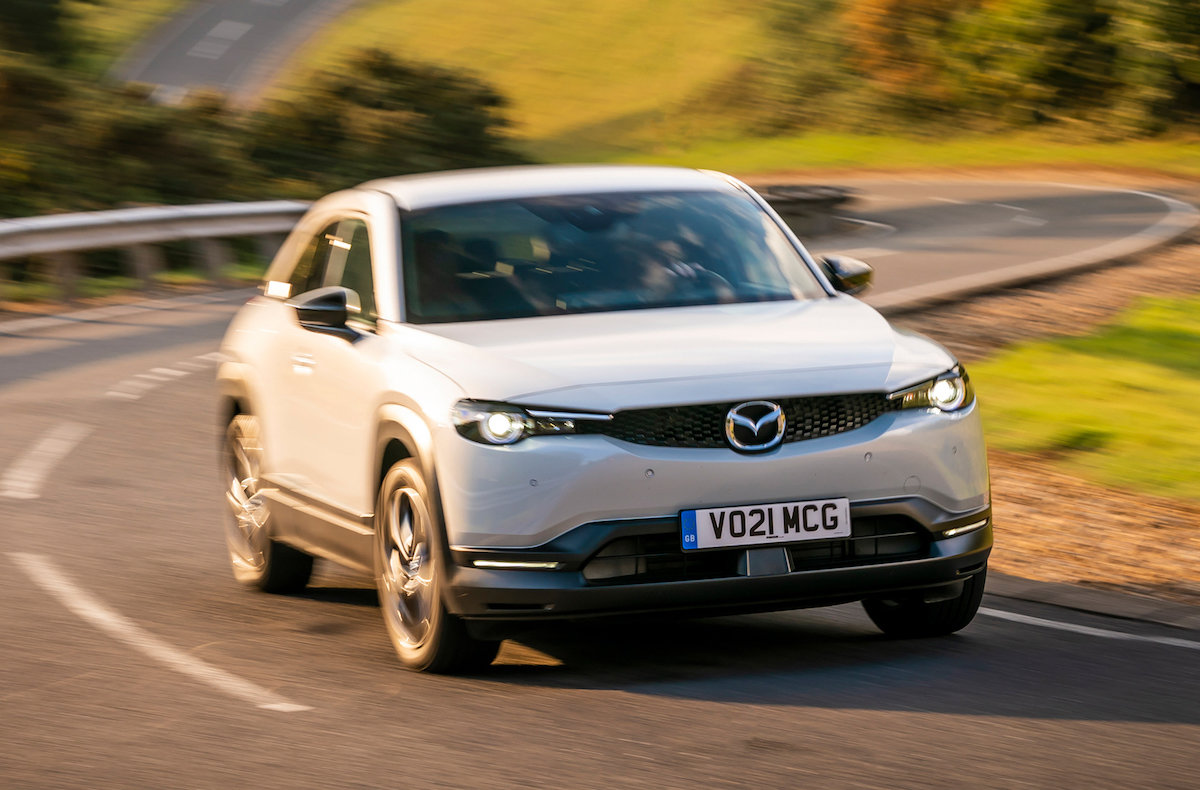
What's it like to drive?
Both versions of the MX-30 are peachy to drive. It might not be fast, but acceleration is good at anything up to motorway speeds, and the light steering responds precisely.
The five brake regeneration modes are easy to toggle through via the paddles on the wheel. They vary from entirely off, so you can freewheel cleanly (best for efficiency on open roads) to very strong braking as you lift off the throttle, which will help to improve driving range around town. It doesn’t quite deliver one-pedal driving like the Nissan Leaf, though.
The ride is cushy much of the time and, while there’s some heavy thumping over potholes, and noticeable body lean in corners, the MX-30 is still one of the most comfortable EVs in the class. More than that, it feels fluid and natural to drive, whether you’re rushing around suburbia or enjoying a good country road.
In the R-EV model you can detect when the rotary engine fires into life to maintain battery charge, but it's not an unpleasant noise and the engine itself is extremely smooth, sending virtually no vibrations through the cabin. This model offers three drive modes: in hybrid mode the car decides when to engage the petrol engine, while in EV mode it'll run in electric mode only, and in charge mode the range extender engine switches on to charge the battery.

Technology, equipment & infotainment
Equipment levels are extremely good in the Mazda. Even in the cheapest of the four trims you get touchscreens and infotainment equipment, 18-inch alloys, automatic wipers, and LED lights as well as a reversing camera, front and rear parking sensors and adaptive cruise control. Traffic sign recognition and lane-keep assist are also included. It even gets a head-up display and a blind spot warning system, which are features for which you’ll typically pay extra most alternatives. You’ll have to go for a higher spec trim for keyless entry, a sunroof, adaptive headlights, part-leatherette upholstery, or a 12-speaker Bose sound system.
There’s a high-set touchscreen system that includes Apple CarPlay and Android Auto, satnav, Bluetooth, digital radio and just about all the digital features you’d want – on every MX-30 trim. It looks smart and – thanks to a straightforward layout and the option of a rotary controller with shortcut buttons – is easy to use.
The second touchscreen – it’s mounted lower down on the dash and operates climate control – looks high-tech, and is also easy to use even if, ironically, the screen is almost entirely unnecessary. The temperature adjustment is easiest with the physical switches that line the screen. Either way, the simple, modern dashboard looks great, and is much more user friendly than the fiddly layouts in rivals such as the Peugeot e-208.

Mazda MX-30 running costs
The Mazda MX-30 has a tough job to justify itself in this price range. New, it goes up against everything from the Nissan Leaf to the Peugeot e-208, the Renault Zoe, the Hyundai Ioniq, the Kia e-Niro, the Honda e, to the MINI Electric. It’s a very crowded price arena for pure electric cars, but much of it comes down to monthly finance prices and the Mazda is very competitive on that front.
Charging is easy, thanks to the Mazda app or the menus in the car’s touchscreen; you can plug in whenever you get home, and the car will only charge during your chosen overnight hours. Time it right, and that can halve the cost of a charge during peak hours.
Service intervals are every 12,500 miles or 12 months, which is a little disappointing, because a number of rivals have longer intervals. Costs are competitive and you can opt for fixed price servicing. Insurance costs are similar to those of a family hatchback, such as a Ford Focus or a Nissan Leaf, if a little higher than those on a Honda e.
Depreciation, however, has not been the Mazda's friend. You can pick up pure EV versions at a year old for around half their original price. While R-EV models seem to be holding their value a bit better, you can still expect to lose around a third of the car's value in the first year. On the flip side, this makes the MX-30 look like something of a bargain on the used market.

Mazda MX-30 reliability
The Mazda MX-30 sits on an all-new platform, complete with new battery and electric motor technology, and we’ll have a better idea of how that fares when it’s a bit more tried and tested.
Mazda in general though does have a good reputation for reliability. It came a respectable 16th out of 31 manufacturers included in the 2024 What Car? Reliability Survey.
The Mazda MX-30 comes with a three-year, 60,000-mile warranty, and the lithium-ion batteries are covered for eight years and 100,000 miles.
- The fully electric Mazda MX-30’s official combined WLTP range of 124 miles is very similar to the Honda e and MINI Electric. Our experience suggests that you’re more likely to get around 100 miles in typical UK temperatures and mixed driving conditions. The city-only official WLTP range figure of 165 miles is very optimistic, but you could get towards 140 miles in the summer if you spend a lot of time in free-flowing town and suburban roads. Cold weather and motorway speeds reduce the range of EVs, so expect the Mazda to do as little as 60 miles to a charge in that worst-case scenario.
- If that kind of range is a deal breaker, look to the R-EV range extender model instead. The EV range of around 50 miles from a full battery will be enough for many commutes, and then there's the petrol engine as a fallback for when longer journeys beckon.
- Charging the Mazda MX-30 is done via a CCS or Type 2 socket, which are the European standard sockets and will be compatible with most public chargers and all home wallbox chargers. Plug into a 7kW home wallbox, and you’ll have a full battery in around five hours in the fully electric model, or 2.5 hours in the R-EV. A normal three-pin domestic socket will take three time as long. Cables are provided for both situations. Plug into a DC rapid charger with 50kW or more, which are a feature of most motorway services in the UK, and you’ll have an 80% top-up in under 40 minutes.
- The cheapest: The entry level Mazda MX-30 SE-L Lux is well equipped and nearly £2,000 cheaper than the next most expensive trim when new. However, there was a limited run of Mazda MX-30 First Edition models on offer from launch. These were priced similarly to a mid-spec MX-30 Sport Lux but had more equipment, including part-leatherette upholstery, adaptive LED headlights, heated seats, contrast roof, piano black window trim and more. If you can get your hands on a First Edition, the additional equipment and better resale values are worth the extra.
- If you’re after luxury and style: Check out the top-spec GT Sport Tech. It’s the most expensive of the range, but it gets a sunroof, leatherette upholstery, and keyless entry, as well as an electrically adjustable driver’s seat, a Bose sound system and even more safety equipment, including a 360-degree parking camera and a system that warns you if there’s traffic coming when you’re reversing out of a parking space.
- For short journeys: If you want the most comfortable option without stretching the budget, and you can’t get hold of a First Edition, the mid-spec Sport Lux trim is for you. It adds keyless entry, an electrically adjustable driver’s seat, and heated seats, all of which are great for convenience and comfort in the morning melee of a wintery journey to school or work.
- If you’re a company car driver: Go for the highest spec Mazda MX-30 that your company will allow, because pure electric cars have usefully low Benefit-in-Kind tax costs.


