Mercedes-Benz S-Class W221 (2006-2013) review | A relatively affordable route to true luxury
Mercedes-Benz S-Class cars for sale
4.0
Expert review
Pros
Exceptionally luxurious and comfortable to travel in
Very well equipped
An awful lot of car for the money
Cons
High running costs
Potential for a very big bill if something goes wrong
V6 petrols can suffer from worn timing chain sprockets
The CarGurus verdict
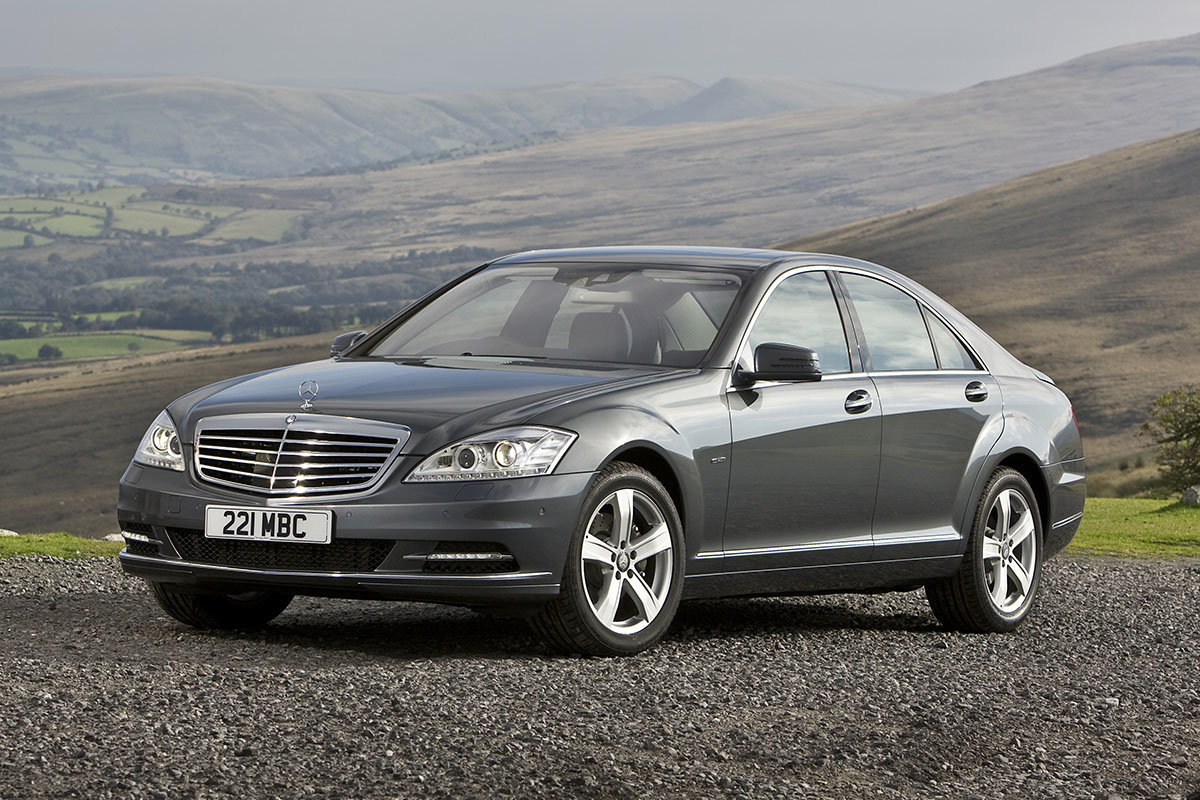
Few cars feel as imperious or as plutocratic as an S-Class, and of them all, the W221 looks like the best value at the moment. Old enough to be affordable, yet still just about new enough to feel slick and luxurious, it’s also about as comfortable a car as you will find for the cash. Pick the right model and it’s even surprisingly economical.
Don’t let that low purchase price fool you into thinking an S-Class will be cheap to run, though. Maintenance costs will still be high, and unless you buy the later diesel model, you’ll also pay a fair bit for fuel. What’s more, when things go wrong – and given there are a few big issues to keep in mind, that’s not impossible – you’ll have to stump up even more big bills. Should all of that worry you, the S-Class W222 that followed will cost you more to purchase, but potentially need less work.
As long as all of that is front and centre when you search the classifieds, however, the W221 S-Class can offer an ownership experience with which few other cars can compete. After all, luxury comes at a price – and given how much luxury the S-Class offers, it feels like good value for money.
What is the Mercedes-Benz S-Class?
New cars are very expensive. To some degree that’s always been true, as car prices are relative; £3,000 won’t stretch to anything new today, but 50 years ago you’d have been able to buy yourself a minty-fresh Ford Capri. However, when a family SUV like the latest electric Ford Capri sets you back at least £35,000, you can’t help but wonder if buying something older offers more bang for your buck.
So, if you’re interested in a lot of used car for not a lot of money, allow us to introduce the fifth-generation Mercedes-Benz S-Class: widely known as the ‘W221’.
When new, the W221 S-Class was often touted as the best car in the world, which is why today it looks like good value. While it’s still without doubt one of the most accomplished luxury cars, depreciation has driven values down so much you can now buy an early example for similar money to a used Volkswagen Golf. Tempted? Read on…

How practical is it?
Just as the current S-Class is top of the tree in terms of Mercedes-Benz saloons today, the fifth-generation W221 S-Class was the biggest, most advanced S-Class of its time.
Up front in the S-Class you’ll find a spacious interior with good storage, lots of gadgets and an extremely high level of fit and finish. It’s a pleasure just to sit in this car, let alone drive it. That said, the S-Class is designed more for being driven in than actually driving. It’s no surprise, therefore, to discover that space in the rear seats is generous, and the seats themselves are extremely comfortable. That’s before you consider that Mercedes-Benz sold a long-wheelbase version, denoted by an ‘L’ after its name, which buys rear-seat occupants an extra 130mm of legroom.
The 560-litre boot is plenty big enough for carrying large suitcases, or indeed the entire contents of Mary Poppins’ handbag. Do note, though, as with its rivals, this is a saloon rather than a hatchback. That means you won’t be lugging an old washing machine to the tip. We should also add that any V12-powered fifth-generation S-Class – the S65 AMG or S600, in other words – has a slightly smaller boot (550 litres in total).
It’ll come as little surprise the W221 was not available with a tow bar, but that’s OK, because there was the option of adding a fridge behind the rear-seat armrest. Furthermore, accessories such as roof-mounted ski and bicycle racks were available when the car was new and can still be hunted down online. Mercedes also made much fanfare of its new paint technology at the car’s launch, as its top-layer clearcoat was three times more scratch-resistant than any previous Mercedes finish.

What's it like to drive?
Air suspension was fitted as standard in-period. In combination with vast quantities of sound deadening, it means the fifth-gen S-Class delivers serene, unruffled progress over even the roughest road surfaces. On the motorway, the S-Class excels, whisking you along at the legal limit in blissful isolation. It would likely do the same on the German autobahn, too, where every version would be capable of an electronically limited 155mph with little fuss.
You might think such a big, heavy car with soft suspension would be hopeless in corners, but you’d be wrong. The air suspension can firm up automatically, which means the body doesn’t lean over too much. Combined with plenty of grip and responsive steering, the S-Class handles like a smaller car.
Beyond the ‘regular’ S-Class, if there is such a thing, the blisteringly fast AMG models come with Active Body Control as standard. This seemingly defies the laws of physics, using hydraulics to keep the car even more level in fast corners.
It’s the diesel versions that are most widely available, though, and much admired for their blend of gutsy performance and remarkable efficiency. To give some ballpark figures, a 2005 S320 CDI with a 3.0-litre V6 diesel can hit 62mph in 7.5 seconds. A petrol V6 S350 from the same year would manage the same sprint in 7.3 seconds, while a V8 S500 would clock 5.4 seconds and the S600 V12 4.6 seconds. Doesn’t it seem strange now that you could buy an ‘everyday’, non-AMG V12 Mercedes, built only for effortless movement rather than cut-throat sportiness?
Mercedes also produced a four-cylinder diesel S250 and an S350 V6 diesel, as well as S420 and S450 V8 diesels. On the petrol front, there was an S450 V8, along with an S400 V6 hybrid. Sadly, however, only the S250 and S350 diesels made it to UK shores. So if you’re intrigued by a V8 diesel or a hybrid, you’ll need to head across to Germany.
Of course, if you’re feeling really flush, there are the AMG variants. With thumping great V8s, the pre-2009 facelift 6.2-litre, naturally aspirated S63 AMG had 525bhp, while the post-facelift twin-turbo, 5.5-litre V8 had 544bhp. The twin-turbo 6.0-litre V12, meanwhile, mustered either 612bhp or 630bhp, again depending on whether it was pre- or post-facelift. These are heinously expensive if they go wrong, but come on, aren’t you tempted by a luxury barge with the power of an aeroplane, a built-in telephone and a champagne cooler?
There's no manual gearbox option with any S-Class, as all models had an automatic transmission. Some were available with all-wheel drive, however, so look for an example with ‘4Matic’ in the name if that’s a must-have for you.
Technology, equipment & infotainment
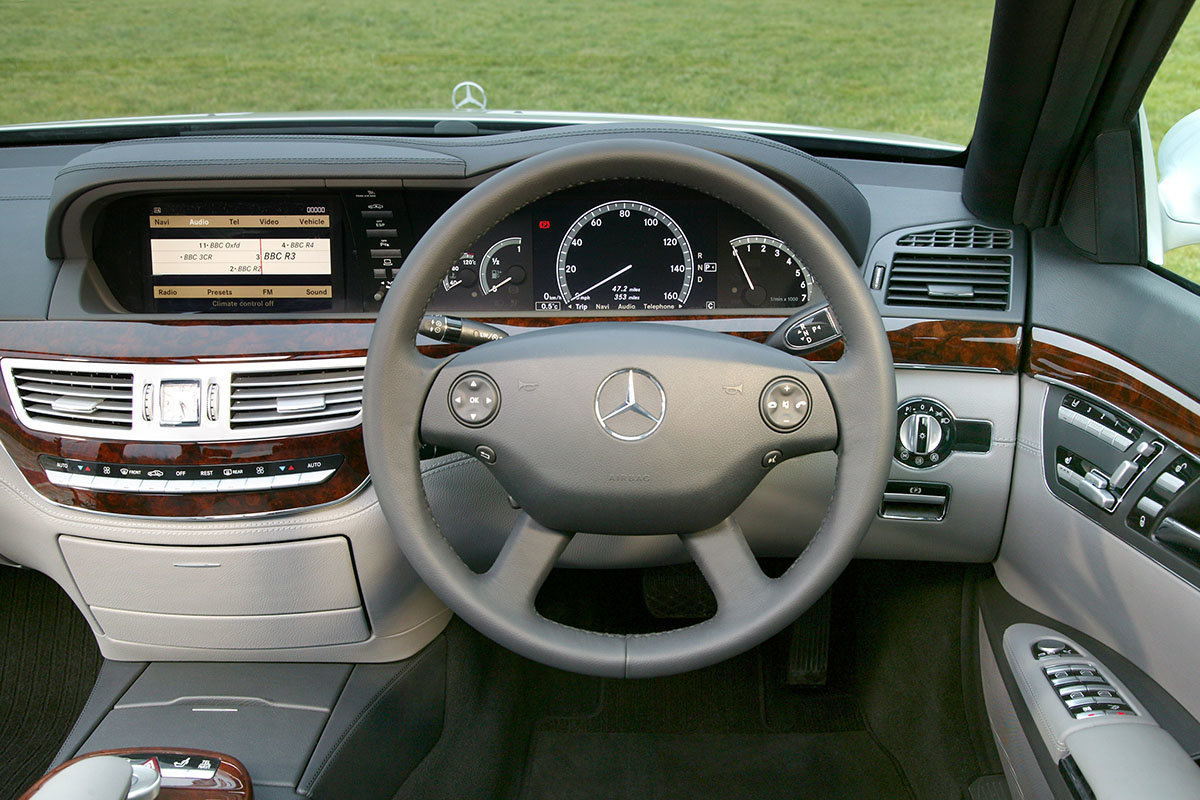
As with all S-Classes, this version was at the cutting edge of automotive technology when released in 2006. The optional infra-red night-vision system was widely marketed, along with a pre-collision safety system the likes of which is now standard on many modern cars.
The equipment list may have been extensive, but the options list was even more so. S-Class buyers could specify self-closing doors, a powered boot lid, electric rear blinds, ambient lighting, adaptive cruise control, a digital TV tuner, and even seats whose bolsters pumped up with air to support you while cornering. There was iPod connectivity (yes, we said ‘iPod’) as well as a physical phone setup, not to mention the white, red and yellow three-pin connectors for a SCART lead, should an in-built TV and DVD player not be enough for you. With all this in mind, if there are particular options you want, it pays to check over the equipment list of any prospective purchase carefully.
There were also many, many options when it came to personalising the S-Class. We don’t mean paint or upholstery, although there were many choices there too, but in terms of which systems did what, when they did it and for how long. For instance, you could set how many seconds you wanted the interior lights to remain on once you’d switched the engine off. Or you could do the same for exterior lighting, and fix a limit for how high the boot lid opened.
Whichever model you choose, if you buy carefully and can stomach the running costs, you’ll see why the W221 S-Class leapfrogged its biggest rivals – the Audi A8 and BMW 7 Series – both on paper and in the metal.
One additional note on technology, Mercedes also offered a W221 S-Guard model. As its name suggests, this was an armoured version of the W221 S-Class, available with either a diesel V8 or a petrol V12. With resistance to handguns, rifles, grenades and more, it takes the phrase ‘it’s a tank’ to a more literal level, and came jam-packed with even more tech than a regular S-Class. It is highly unlikely you’ll ever find one for sale in Europe, let alone in the UK. However, if by some wild coincidence your quest for a luxury saloon bargain brings you across such a machine, rest assured you’ll see more than just iPod connectivity on the specification sheet.
Mercedes-Benz S-Class running costs
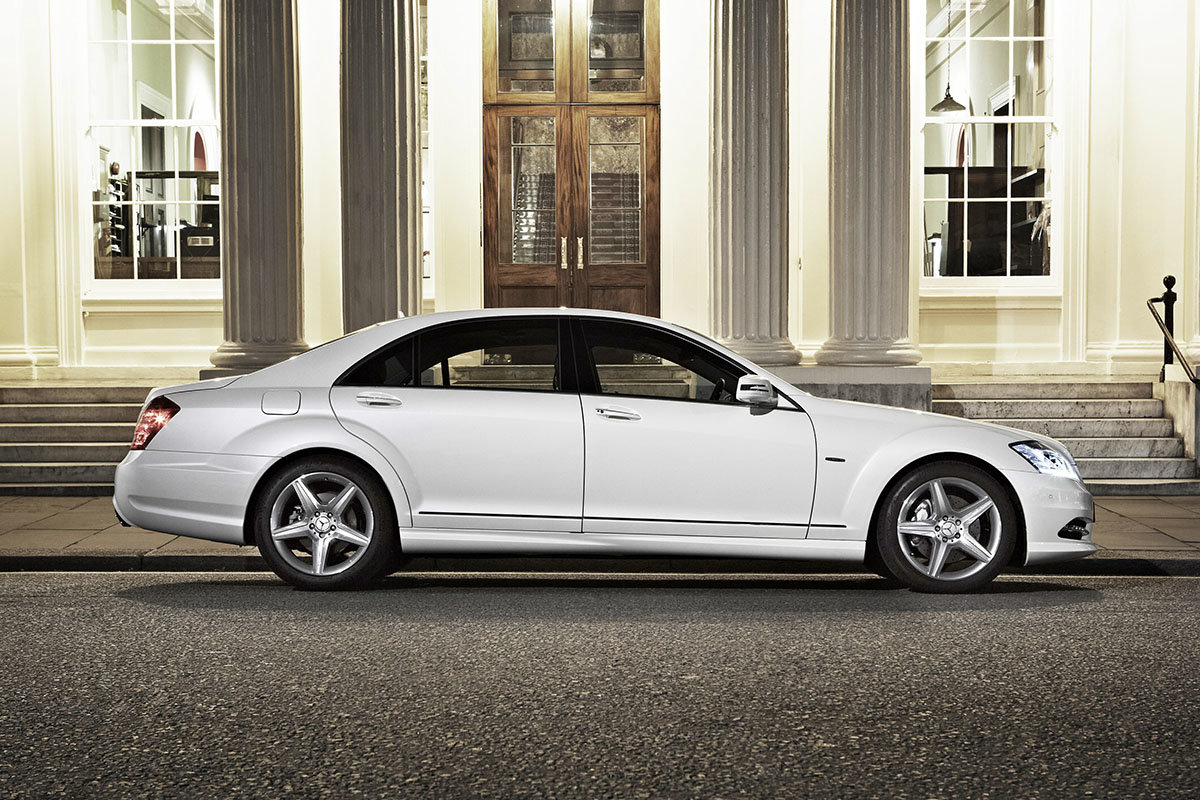
It’s the S350 Bluetec we recommend overall as it’s the most efficient W221 S-Class you can buy in the UK. You should see somewhere in the region of 40mpg on average in regular, day-to-day driving. If you’re planning to buy the earlier, pre-facelift S320 CDI, expect to see around 10mpg less.
Petrol models are thirstier, but 35mpg should be achievable from the post-facelift S350. On pre-facelift petrol models, however, don’t expect to see more than 25mpg on average – less if you choose an S500 or S600. Of course, if it’s an AMG model you’re considering, fuel consumption will probably drop into the mid-to-late teens (if you’re lucky). But who cares, right, because why would you buy an AMG if you were dead-keen on saving fuel?
The W221 S-Class was an expensive car when new, and it remains an expensive one to maintain. It’s worth keeping in mind that while the cost to buy one may have shrunk, the cost to keep one running hasn’t. Parts and servicing are both expensive, and with those big wheels, tyres and brake components will not come cheap.
Thankfully, there’s a plethora of good independent Mercedes specialists out there with whom servicing is less expensive than at a main dealer. They’re often very experienced as well, so we’d recommend finding one local to you and having your car maintained and repaired there. There’s also some good news when it comes to replacing timing belts: you don’t need to. All of the S-Class W221’s engines are fitted instead with a timing chain that should last the life of the car, or at the very least, need replacement very infrequently.
Mercedes-Benz S-Class reliability
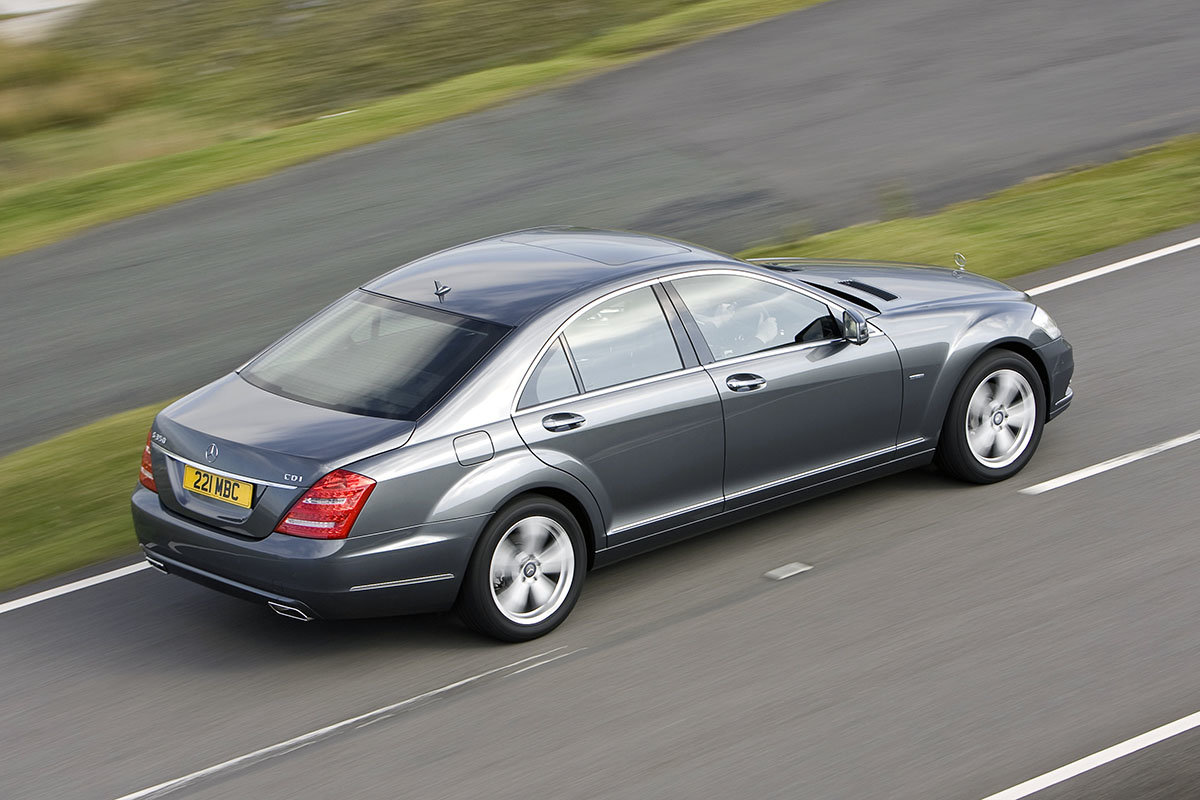
There are many old Mercedes still chugging around quite happily across Europe, particularly in Germany. But it must be said the company’s vehicles have become generally less resilient as time has marched on. It is noticeable today, for example, that Mercedes was placed joint 22nd out of 30 alongside Audi in the most recent What Car? Reliability Survey. However, the W221 S-Class was and still is very solid, so buying a good one shouldn’t be completely ruinous. When researching any potential purchase, go through its service history and study every invoice carefully. Mechanical or electrical issues are going to crop up at some point with any used car, but by checking all the paperwork beforehand you’re less likely to be handed a hefty repair bill.
As an example, the S-Class W221’s air suspension system is not unreliable, but it is known to cause problems from time to time, either with the air springs themselves or with the pump and complex system of compressed air lines and valves. Turn the car on and check the ride height is level front-to-back and side-to-side. If it helps, you can measure the distances from the centre of the wheel to the wheelarch. This should be the same on both sides of the car. Beware any car that looks like it’s ‘sunk’ before the engine is started.
There’s a plethora of electrical systems on any S-Class, so you’ll want to make sure they all work. You need to pay particular attention to the central information display, which has software that can cause issues. Make sure it isn’t slow to respond, and that it doesn’t crash or freeze.
Cars with the petrol V6 engine – in other words, the S280, S320 and S350 – can suffer from worn timing chain sprockets, and this can result in an eye-wateringly expensive repair. Listen out for any odd noises, particularly rattling, when you start the engine up, and make sure any car you buy has a full and complete record of regular, timely servicing.
- A facelift for the S-Class was revealed in early 2009. You’d be hard-pushed to tell the updated car from the earlier version, but you can spot the former thanks to its LED daytime running lights in the front bumper. Additional upgrades include an array of driver assistance features, including adaptive full-beam headlights, blind-spot protection, a torque vectoring system (which gently applies the brake to an inside rear wheel in corners to tighten the car’s line), and the addition of pedestrian recognition to the night vision system.
- Not content with just one, Mercedes-Benz introduced two AMG versions of the S-Class. The pre-2009 facelift S63 AMG with its 6.2-litre, naturally aspirated V8 summons 525bhp, while the post-facelift twin-turbo, 5.5-litre V8 sends 544bhp to its rear wheels. The twin-turbo 6.0-litre V12, meanwhile, produces either 612bhp or 630bhp, again depending on whether it’s a pre- or post-facelift car. Any one of these models will be hilariously fast and yet completely serene.
- For most buyers, the common-or-garden S350 Bluetec is the one to have. Its big V6 diesel engine is quiet and smooth, offers more than enough shove for everyday motoring, and should also offer respectable fuel economy figures. You’ll find this engine in post-facelift examples.
- If you want the best economy: The S350 Bluetec is a fantastically economical and smooth engine, but it only became available after the 2009 facelift. If you’re buying on a budget it might be out of your reach, in which case the earlier S320 CDI diesel is a pretty good substitute. It isn’t as economical, but it’s just as effortless in the way it drives.
- If you’re craving petrol power: The S350 BlueEfficiency is the one we’d recommend if you don’t want a diesel. Thanks to a raft of clever fuel-saving measures, it’s nowhere near as inefficient as you might think a big, V6 petrol engine in a heavy luxury car would be. According to the official figures, in fact, it’s more economical than the pre-facelift diesel.
- If you want performance: Although a V12-powered S65 AMG looks mighty on paper, its extra performance isn’t actually all that usable. With that in mind, it’s the S63 AMG we’d recommend. Pre-facelift S63s boast a better soundtrack, but the later twin-turbo cars are more potent. Either one, however, would be immensely enjoyable.


