Mercedes-Benz S-Class W222 (2014-2020) review | Still a technology tour de force
Mercedes-Benz S-Class cars for sale
4.0
Expert review
Pros
Stupendously comfortable
Luxurious and supremely well equipped cabin
Elegant and discreet looks
Cons
Expensive to buy and maintain
Not as opulent as a Rolls-Royce
Reliability concerns stand between the S-Class and a five-star rating

The CarGurus verdict
As luxury saloons go, the S-Class is one of the best. It always has been, and Mercedes-Benz will no doubt hope it always will be. It’s endlessly comfortable, preposterously well-equipped, enormously spacious and beautifully finished. Few luxury limos come close to beating it.
While it’s true that you can get an even more opulent four-door saloon – something like a Bentley Flying Spur or Rolls-Royce Ghost, for instance – you’ll have to spend a heck of a lot more cash to get one. You’ll also have to live with a car that’s much more ostentatious to look at. The S-Class’s more anonymous styling is arguably a boon at this end of the market, as it makes the car more discreet. Big though it is, the right spec can make a W222 look like just any other Mercedes, which is no bad thing.
Our only qualm is the S-Class’s mediocre reputation for reliability – not to mention the company’s as a whole. We’d also suggest thinking long and hard about choosing the plug-in version if you don’t have somewhere to recharge it at home. Still, these caveats aside, this is quite simply one of the best luxury used cars out there
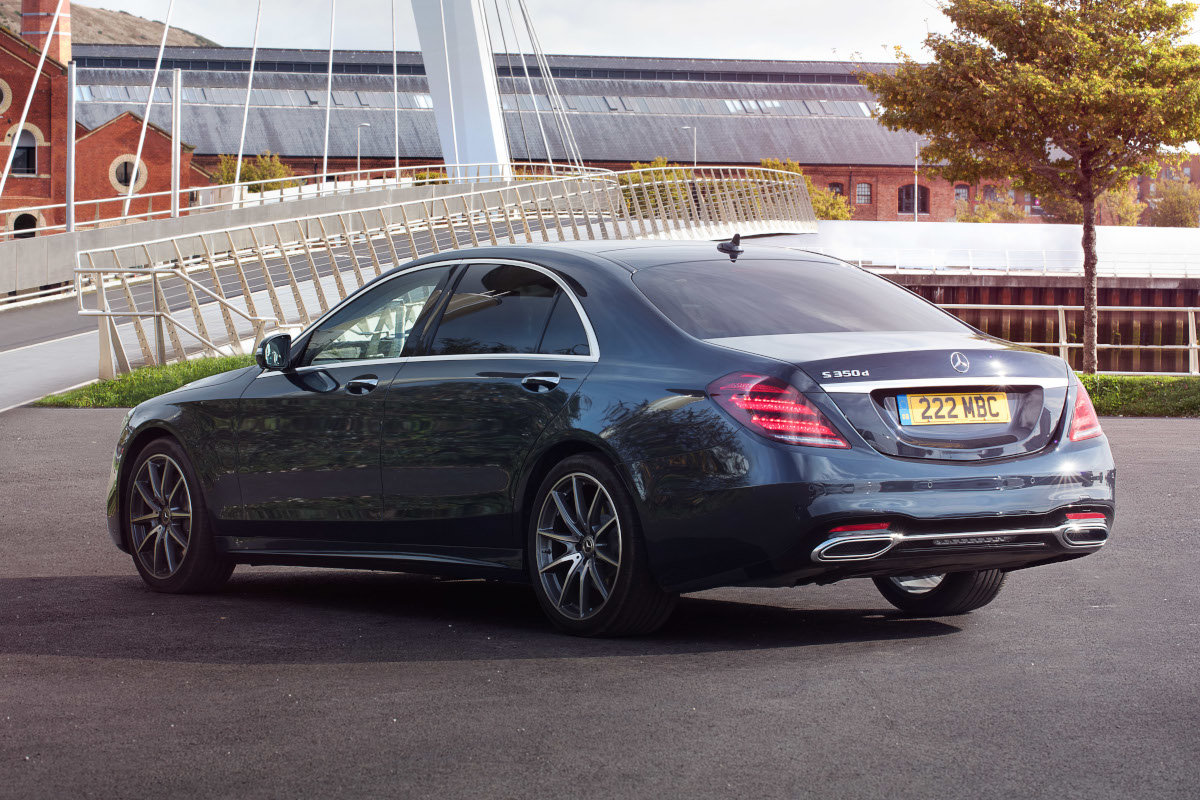
What is the Mercedes-Benz S-Class?
It’d be wrong to say it doesn’t get more luxurious than the Mercedes S-Class. The folks at Rolls-Royce and Bentley would both have something to say about that. However, this large four-door saloon has always been renowned for combining luxury, cutting-edge technology and under-the-radar discretion like no other car.
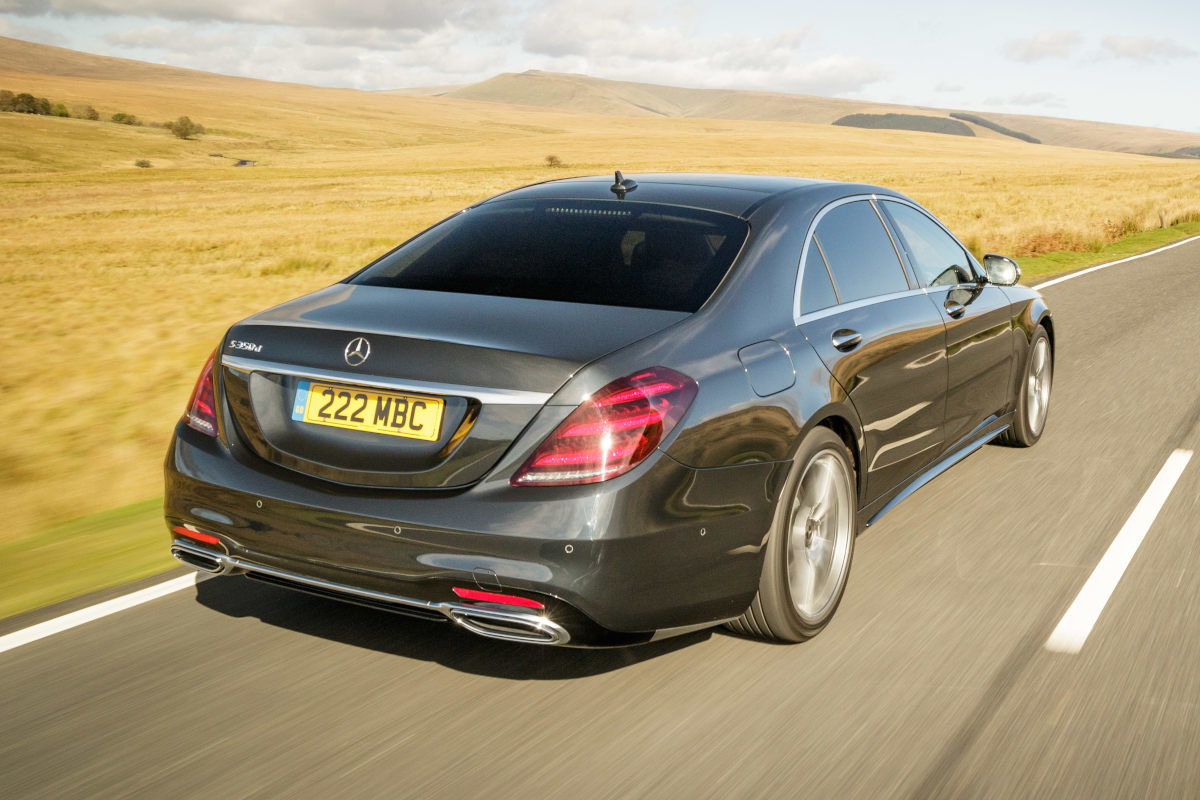
The car reviewed here represents the sixth-generation of S-Class, known as the W222, and was the German marque’s flagship saloon between 2014 and 2020. If you want to be chauffeur-driven in something that’s as plutocratic as they come inside, yet relatively subtle on the outside, the W222 generation of S-Class is about as good as it gets.
Additionally, if you love the luxury and the technology but don’t want a saloon, you could make a sideways step towards the W222’s more style-oriented sibling, the C217 S-Class. Although we’re not reviewing it here, the C217 offers more or less the same car but with a coupe or convertible body.
How practical is it?
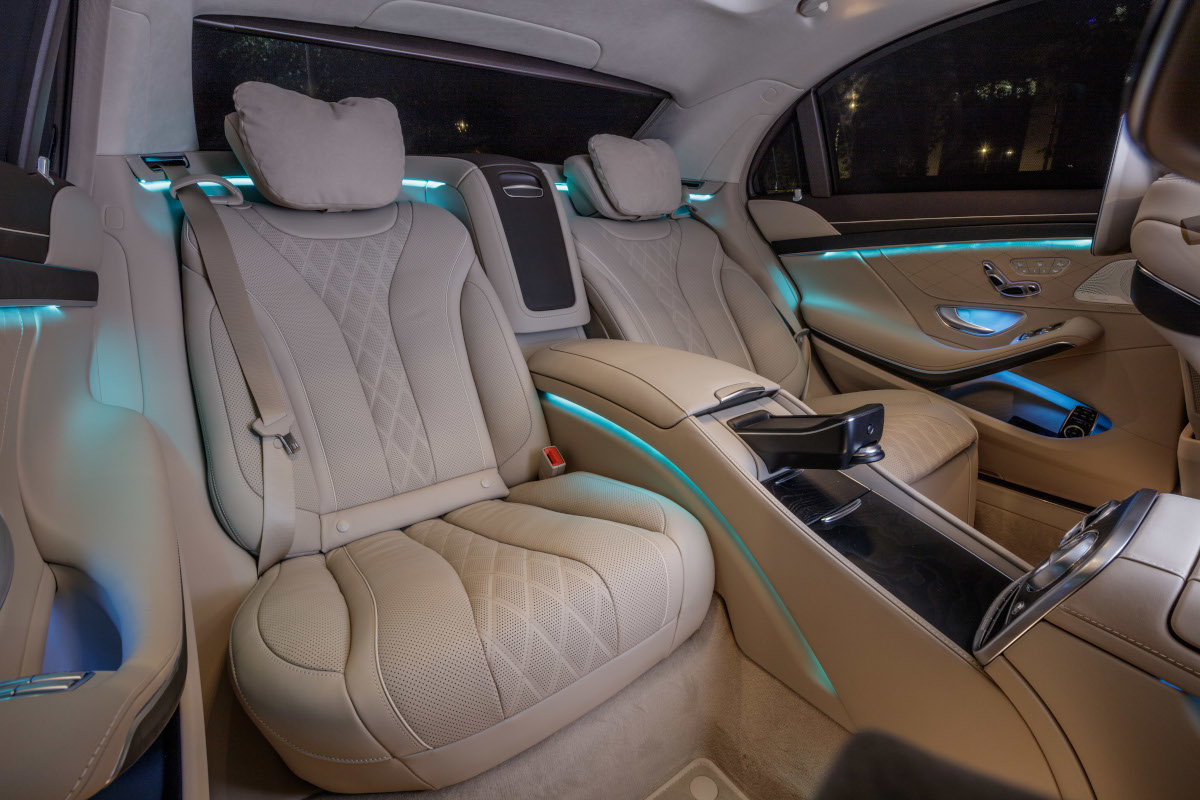
Climb aboard the W222 Mercedes S-Class and you’ll find a faultlessly finished interior replete with swathes of beautiful wood veneer. The level of finish is immaculate, with top-quality leather everywhere, while customisable ambient lighting creates strips of glowing colour that encircle you at night. The previous generation W221 S-Class was a luxurious beast, but it only takes just a few moments to notice how much more fresh and modern the W222 feels by comparison.
From the back seat, which is where many S-Class owners will spend a lot of time, the sense of isolation and calm is unassailable. That’s especially true if you opt for one of the long-wheelbase L versions, which give you even more room to stretch out. That said, even the standard S-Class offers oodles of space, whether you sit in the front or the back.
The boot, meanwhile, is bested by rivals for outright size, but only just – we’re talking a couple of bags of flour here – and it’s still a very usable shape. As a general guiding principle, petrol-powered W222 S-Class models have 530 litres of space, while diesel versions offer 510 litres. The V12 and some hybrid models have less, with 460 litres in a 2014 S600L, for example, or 390 litres in a 2019 S560eL hybrid. Furthermore, these are all very much traditional saloons, with hinged and not hatchback-style boot lids. Whatever you’re stashing behind the rear seats, whether it’s a suitcase or some golf clubs, you need to take the letterbox-like opening into account.
What's it like to drive?
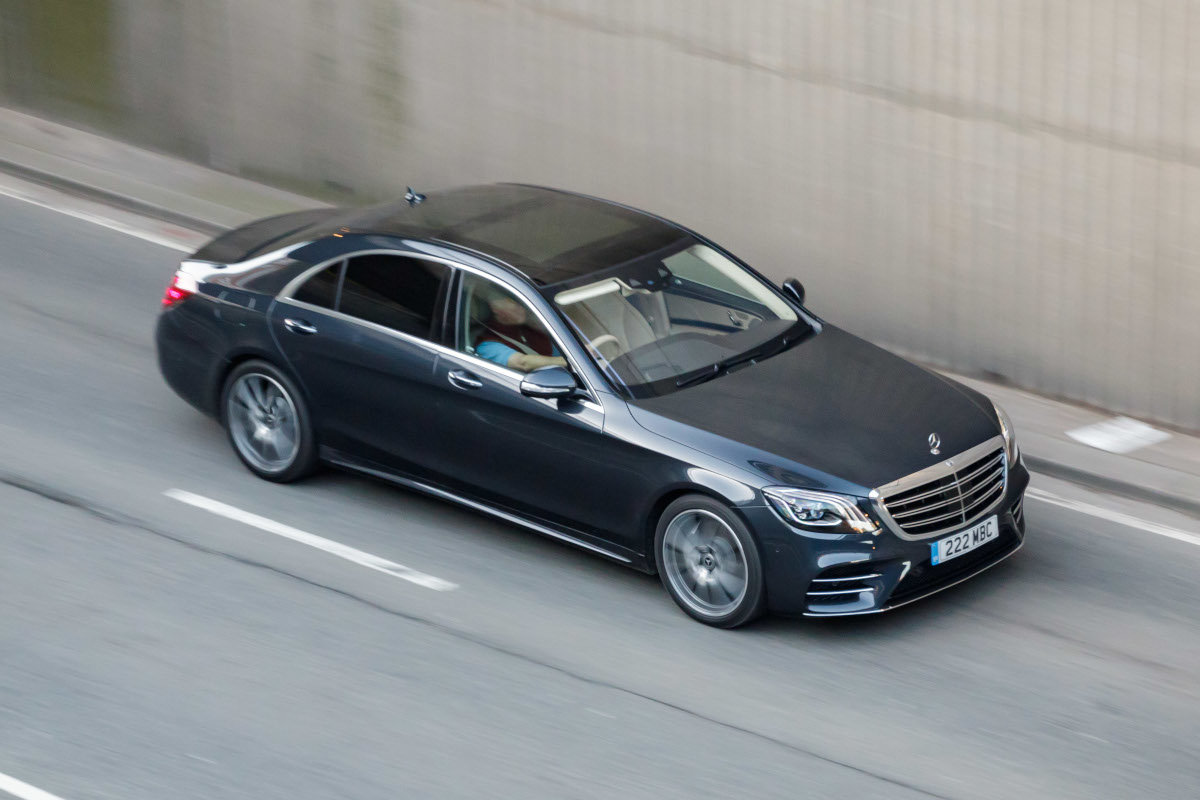
Slide behind the wheel and the W222 S-Class feels imperious. You’re always aware of its considerable size, but it’s still pretty easy to drive, with a seamless automatic gearbox and light, linear steering. Even more of a surprise is the way the suspension ties the car down in Sport mode, allowing you to press on down a back road astonishingly well. For such a big car, the S-Class can feel remarkably agile. Just remember it weighs between between 1,950kg and 2,250kg, depending on the specification, when you stand on the brakes.
Settle back, stick the car in Comfort mode, and the S-Class transforms back into a smooth cruiser, smothering imperfections in the road as if they weren’t there. It’s eerily quiet, too; despite the big tyres and bluff front end, the tranquillity from within is uncanny. Were you to pack one up for a long weekend, you’d arrive at your destination feeling fresh and content, and certainly just as relaxed as if you’d travelled in the very latest W223 Mercedes S-Class.
Mercedes-Benz offered a number of petrol, diesel and hybrid powertrains over the course of the W222’s life. The non-hybrid diesel was a 3.0-litre turbocharged unit, known as the S350 Bluetec on pre-2017 facelift cars and simply the S350d on post-facelift examples. The former was actually more powerful and had more torque, but the latter is faster accelerating and more economical (more on fuel economy later). An S400d with the same engine, but more power and torque was available towards the end of the car’s life. However, this could only be combined with a long wheelbase body.
If you prefer petrol, you could have a V6 S450, a V8 S500 or a V12 S600, all available in long-wheelbase only. The S500 was the only consistent non-AMG petrol nameplate, however, as the S600 was dropped with the facelift and the S450 only appeared afterwards. However, the S500 itself actually went from V8 to V6 power with the 2017 refresh. All of these engines perform exactly as you’d expect: without any fuss whatsoever. With anything in the range of 362bhp to 532bhp, progress will be effortless, if not whiplash-inducing.
Hybrid options included an S300 Bluetech mild-hybrid V6 diesel with 228bhp in 2014, along with an S400 mild-hybrid V6 petrol with 328bhp. An S560e hybrid was available in 2019, with a total of 482bhp from its electric motor and V6 engine. As a full hybrid, Mercedes also claimed an fully electric driving range of 26-27 miles. Again, though, both of these powerplants were only available with long-wheelbase cars.
Finally, the big boys: the AMG machines. Not long after the W222 launch, you could purchase a turbocharged 5.5-litre V8 S63 or a V12 S65, with 577bhp or 621bhp respectively. The V12 remained unchanged after the facelift, while the S63 went from a 5.5- to a 4.0-litre V8. Torque remained the same, with a tyre-shredding 664lb/ft, but power went up to 612bhp. All of these cars will accelerate to 62mph in-between 4.2 and 4.4 seconds before reaching a top speed of 155mph. All you’d need to decide then is which engine you like the sound of most.
Technology, equipment & infotainment
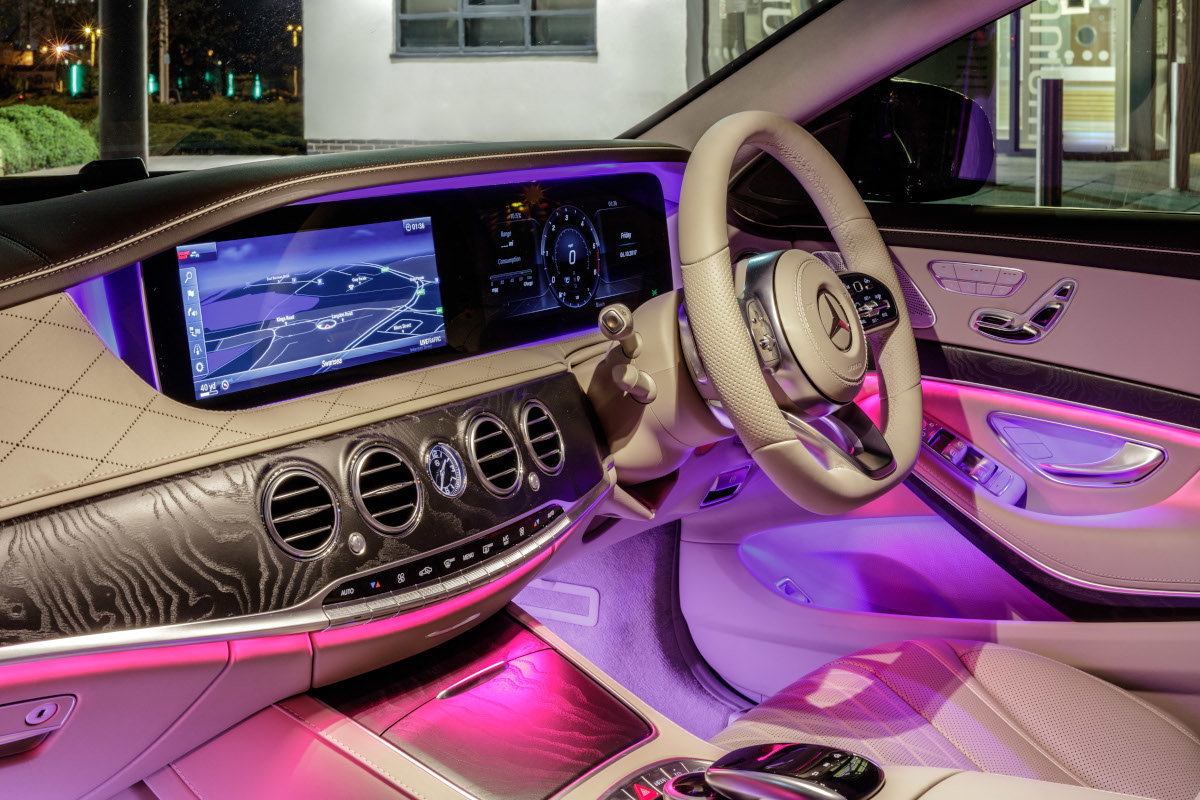
Ahead of the driver sit two 12.3-inch screens – one containing a virtual dial setup, the other to control the navigation and entertainment – and no less than six bullseye air vents, all finished in chrome. Because so many of the car’s functions are accessed through the infotainment system, there are relatively few buttons, so the dashboard looks minimalist and modern.
You might think that makes the screen’s software difficult to navigate, and by dint of the sheer number of functions available, it does take some getting used to. Once you know where everything is, though, it’s relatively easy to navigate. What’s more, the dual display across the dashboard is crisp, clear and very attractive.
In addition, depending on the specification and the model year, you may find screens in the rear of the driver and passenger headrests. That’s right, 10.2-inch screens with wireless headphones can keep those in the back entertained. If you’re looking at a used S600 or an S65 AMG – any model that has a V12, essentially – the screens would be fitted as standard. For other trim levels, they were included as part of an optional pack or a standalone £2,450 extra. Furthermore, facelifted models had Blu-ray players rather than DVD players, if such a thing matters much now.
Away from screens, the W222 S-Class is loaded to the gills with technology, as you’d expect. You’d need to study the brochures from the model year you’re looking at, and the spec sheet of your chosen car, to know precisely what is included. However, LED front and rear lights, air suspension, automatic parking, fully electric and heated front seats, keyless entry, satellite navigation, Bluetooth connectivity, electric door mirrors, two-zone climate control and more were fitted as standard to every car. You even got an analogue clock on the dashboard. Other nice features that were available depending on the trim level were air conditioned front seats, a fancy Burmester sound system, a head-up display, a TV tuner and individual rear seats with fold-out tables. Features like Apple CarPlay and Android Auto smartphone connectivity, along with wireless phone charging, were model-year dependent.
On top of all the fancy kit, there were systems designed to keep you and anyone else in the car as safe as possible. From an attention alert system to road sign recognition, along with autonomous emergency braking, rain-sensing wipers, a system called crosswind assist, and an active bonnet to protect pedestrians were one to walk across the car’s path – all of these were standard or optional on the W222 S-Class.
Mercedes-Benz S-Class running costs
If you believe the official miles per gallon figures, the most economical version of the W222 sixth-generation S-Class is the S560e plug-in hybrid. However, plug-ins tend to do unrealistically well in fuel consumption tests, which suit them down to the ground, so don’t expect to get anywhere near the top-end 128mpg figure claimed unless you keep the car charged and do mainly short, electric-only journeys.
The diesel versions may well prove more economical in the real world, with a mixture of town and motorway miles, and you can take your pick because they were the best sellers in the UK. Expect to see 40mpg in day-to-day use.
As you might imagine, servicing costs for the S-Class are not insignificant. Indeed, you can expect it to cost more to maintain than an Audi A8 or BMW 7 Series. That said, it will set you back less in tyres and brakes than a Range Rover. Additionally, all S-Class engines use a timing chain rather than a belt, and these should last the life of the car. That means you won’t need to worry about costly timing belt replacements.

Mercedes-Benz S-Class reliability
Mercedes didn’t score well in the most recent What Car? Reliability Survey, ranking joint 22nd alongside Audi out of 30 manufacturers. We’d love to say Mercedes models of this vintage are more robust than their modern counterparts, but sadly that isn’t the case. In fact, this generation of S-Class finished eighth out of the nine luxury cars in the 2019 edition of the What Car? survey. However, it’s worth keeping in mind that most of the other luxury cars in that table were smaller and less electrically complex, which might partly explain the result. Even so, the Jaguar XJ – which is a direct rival to the S-Class – managed to finish first, with a score of 94.3 percent to the S-Class’s 88.1 percent.
Does that mean you should avoid a W222? No, you just need to be careful when selecting the car you want to own. Check the service history and all of the paperwork, look around the engine bay and check all the buttons and switches work. Mechanical problems can be costly to fix but aren’t always too complicated. Electrical issues on a car this complex could be horrendously difficult to rectify, though.
A W222 S-Class won’t be covered by a Mercedes-Benz warranty anymore, but there are plenty of knowledgeable specialists who know how to look after one properly, should you decide to take the plunge.
- The fastest S-Classes are the Mercedes-AMG versions. With thumping V8 or V12 engines and trick suspension, these monster machines are capable of serious speeds and acceleration that entirely defies their size. Still, don’t expect an AMG S-Class to magically transform into a sports car. For all their grip and power, they aren’t as involving as smaller AMG models, and on a tight back road their sheer size can be an obstacle to enjoying them at their fullest. We reckon the less sporting models feel more rounded – the S-Class is a cruiser, not a bruiser, and best served as such.
- The W222 saloon was available as a plug-in hybrid, a first for any generation of S-Class. The S560e was fitted with a 3.0-litre petrol V6 mated to an electric motor, a 13.5kWh battery and a 7.2kW on-board charger, all of which allow it to offer around 25 miles of real-world electric range when fully charged (26 to 27 miles is quoted by Mercedes-Benz). Low CO2 emissions also make it a tempting choice as a company car, but keep in mind that unless you plug it in regularly, you’ll be driving a 3.0-litre petrol S-Class with a lot of extra weight on board in the form of a heavy battery – and that’s going to make it thirsty. From a practicality point of view, the S560e also has a much smaller boot than the regular S-Class.
- Every sixth-generation S-Class was fitted with an automatic transmission, but whether it’s a seven- or a nine-speed ’box depends on what year the car was built. Additionally, in the UK it was sold as a rear-wheel-drive model only, meaning you’ll need to look at a smaller E-Class or one of Mercedes’ larger SUVs if you want all-wheel drive.
- If you have someone else to drive it: In the later S400d L you’ll almost never hear the engine as there is so much torque low down it’ll rarely have to work hard. Fuel consumption is no worse than smaller-engined models, either. The car is also a long-wheelbase model, so if you have a chauffeur to drive it for you, you’ll get all that extra space in the rear seats.
- If you want your S-Class to be as fast as possible: May we recommend the S65 AMG? Despite weighing 2,250kg, its 6.0-litre turbocharged V12 will power you to 62mph in 4.2 seconds and on to a limited top speed of 155mph. It’s outrageously fast, and will cost you significantly less today than it would have the first owner.
- If you want the best value: It seems comical to be talking about the best value S-Class, but these big beasts do offer a remarkable amount of car for the money. The later models feel that little bit more fresh, but an early S350 Bluetech diesel is arguably the best value.
- If you want the best fuel economy: Avoid petrol if you’re looking to sip fuel (with the exception of the S560e, which we’ll mention shortly) and stick with diesel. An early S300 Bluetech could manage 61mpg according to Mercedes, although that figure is from a time where combined fuel economy figures were measured slightly differently to today, so you’d likely see less than that in the real world. Nonetheless, it is a very efficient engine, and will eat up motorway miles while barely breaking a sweat.
- If you spend a lot of time in town: Whether you’re being driven around town or are yourself at the wheel, the S560e is the way to go. Mercedes-Benz claimed a fully electric driving range of 26 to 27 miles, plus a combined fuel economy figure of 104-128mpg. There will be few better ways of slinking around a town or city than in an whisper-quiet hybrid W222 S-Class.


