Renault Scenic E-Tech Review (2024-present)

CarGurus expert score
Pros and cons
What we like
Roomy for passengers
Good infotainment system with Google maps
Useful range of more than 300 miles
What to consider
Boot is an awkward shape
Not as practical as a Skoda Enyaq
Rear seats don't slide
The CarGurus verdict
The Scenic E-Tech is a seriously smart, capable and comfortable family EV, that matches great passenger space with lots of tech and one of the longest driving ranges available at this price. It’s also well priced, especially considering the exceptional levels of standard equipment.
Overall this is a welcome return for the Scenic nameplate, with a long-range electric model that could in time (and with better finance deals) stack up as one of the best family cars available.
out of 5 expert review
What is the Renault Scenic E-Tech?
The Renault Scenic name will be familiar to many from the hugely popular (if rather dowdy) French MPV that Renault produced from the late 1990s through to 2019, when the family crossover and SUV market finally killed off the Scenic in the UK.
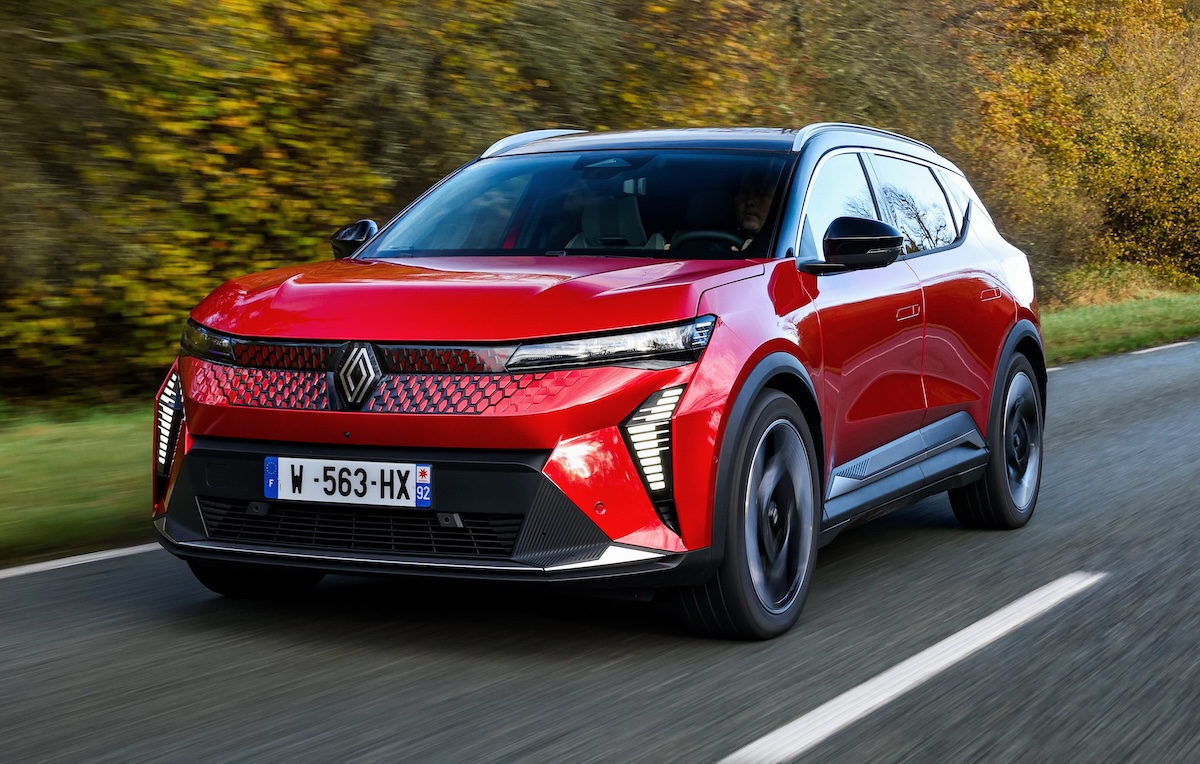
Now, the Scenic name is back in an all-new car, and a very modern take on the family car at that. Predictably, it’s now an SUV-crossover, although Renault would insist that it’s not an SUV but a ‘family solutions’ vehicle. For those of us not in a Renault marketing meeting, it’s a five-door crossover that’s actually a touch shorter than those rivals we’ve mentioned. For some context, at 4.47m long and 1.57m high, it’s very close in size to a Nissan Qashqai and Renault Austral, while a Skoda Enyaq iV is closer to 4.7m long.
The Renault Scenic E-Tech only gets one battery and powertrain option – a 91kWh lithium-ion pack with a usable capacity of 87kWh, which drives a single 215bhp electric motor on the front wheels. That’s good for an official WLTP driving range of up to 379 miles, which makes the Renault one of the longest range cars in this busy class. In fact, the price, equipment and range of the Renault Scenic E-Tech electric might even make you think twice about the Tesla Model Y.
Charging speeds peak at 150kW, which is on a par or better than most all-electric rivals other than the Hyundai Ioniq 5 and Tesla Model Y, both of which can charge at over 200kW. Even so, the Renault will manage a 10-80% charge in some 30 minutes when plugged into a powerful enough charger. A 7kW home wallbox will deliver a full charge from nearly empty in 13 hours.

Practicality
How practical is it?
This big Renault is arguably not practical enough for a car wearing the hallowed Scenic badge; a name that became synonymous with automotive utilitarian greatness. Passenger space is great, and we’ll come onto that in a moment, but the problem with the Scenic is the boot.
The official boot capacity is very good, and at 545 litres, which puts the Scenic almost up there with the Skoda Enyaq iV. However, much of that volume is in the depth of the luggage area, which has a fairly high lip and then falls away into a deep, well of space. Renault assures us that they will introduce a false floor as a dealer-fit accessory to make this a bit friendlier for those lugging big buggies into the boot, or who have dogs that won’t want to leap over the cliff edge of the Scenic’s load lip. But even with this fitted (we haven’t seen the Scenic with this option fitted, yet) the boot floor is still a lot shorter than you get in the Skoda Enyaq iV, Tesla Model Y or Peugeot E-3008, so if you’re after lots of usable floor space in the boot of your car then the Renault will probably disappoint. There’s no ‘frunk’ storage space in the nose of the car, either.
Other than that, practicality is good. The rear seats fold in a 40/20/40 split, and while it’s a shame that they don’t slide or offer any versatility other than that, there’s no doubting that they offer masses of leg- and headroom. There’s also a clever centre rear armrest that doubles up as a stand for up to two phones, complete with twin charging ports, to keep the kids entertained back there.
It's very comfortable up front, too. You get electric lumbar-adjustment and heated seats on every Scenic, so it’s not such a problem that you have to go for top-spec Iconic trim to get full electric adjustment as even the entry-level Techno model has plenty of adjustment and will suit most drivers even on long journeys.
There are a lot of buttons on the steering wheel, as well as a lot of protruding stalks on the right hand side of the wheel including the gear selectror to put the car in drive or reverse, the indicator stalk, and another lower down stalk for media volume and source. It’s all rather a lot of controls to get used to. Another gripe with the Renault’s driving position is that visibility isn’t great, as the rear windscreen is quite narrow and rear three-quarter pillars quite chunky. At least you get blind spot warning and a full suite of parking aids on every model.
The doorbins and various cubbies, including one with wireless charging for you phone, also makes it easy to stop all your gubbins from rattling around.
One incentive to go for the top-spec Iconic is Renault’s clever ‘Solarbay’ panoramic sunroof, which turns opaque in sections. You can have it shaded in the back and clear up front, for instance. It works well and is a very cool feature.
Even so, while the tactile materials and neat touches like the rear armrest and sunroof are great party tricks, overall the Scenic is no more versatile than most of its rivals and that boot may make this a less practical option for some.

Driving
What’s it like to drive?
To drive, the Scenic is comfortable and smooth, which is ideal for a family car. With a 0-62mph time of 8.4sec, it’s not fast but it’s more than gutsy enough to feel confident in fast motorway merges or punchy junction getaways.
There are a variety of drive modes to choose from, which you toggle through using a button on the steering wheel. Eco really neuters the accelerator pedal response and can feel a bit sluggish, while Sport makes it feel a touch sharp, so we prefer the happy-medium ‘Perso’ mode. Even in that mode, the steering can feel a touch quick off the dead-ahead, but with a little familiarity the Scenic is a pleasant, almost serene car to drive.
As with all modern cars, the Scenic sounds an alert when you go over the speed limit, and the soft, dual-tone bonging sounds amusingly like the noise a submarine makes in the movies when it’s diving. Thankfully, the Renault allows you to save all the safety assist systems to your own personalised profile – for instance, you may want the speed limit warning off but lane-keep assist turned on. Then, when you start the car it’s a quick prod on the screen to activate and confirm your profile so that the systems are how you want them to be. A neat touch that, in a world of new cars that can seem very paranoid when it comes to warning beeps and bongs, is very welcome.

Tech and equipment
Technology, equipment & infotainment
Equipment in the Scenic is usefully better than you’ll get in most rivals. Even the entry-level Renault Scenic E-Tech techno gets a heat pump (for better driving range in cold weather running), heated seats, keyless entry, automatic LED headlights, metallic paint, adaptive cruise control, blind spot warning, reversing camera with parking sensors front- and back and 19-inch alloy wheels.
The esprit Alpine model adds some cool style tweaks and natty interior upgrades including carpets in the trademark Alpine (which is a sports car brand in the Renault portfolio) blue. There are no changes to the suspension or mechanicals for the esprit Alpine, so don’t expect it to be any sportier than the other Scenic models. Top-spec Iconic adds the Solarbay panoramic roof, electric seat adjustment, Harman Kardon sound system and 20-inch alloy wheels.
Every Scenic gets a 12-inch portrait touchscreen infotainment system complete with in-built Google software with Google maps. You also get wireless Apple CarPlay and Android Auto, and over-the-air software updates.

Running costs
Renault Scenic E-Tech running costs
The Renault Scenic E-Tech is well priced next to just about all of those rivals we’ve mentioned, especially given the equipment. Only the MG ZS EV (which has a much shorter driving range) makes it look pricey.
Monthly finance is reasonable if not brilliant, with prices from around £450–£500 per month provided you’ve got a healthy deposit or trade-in vehicle. There are no low interest or zero deposit offers yet, but the PCP monthly finance deals are likely to get much more appealing after the Scenic’s initial launch.
We haven’t spent enough time in the Scenic to make an accurate guess of how efficient it may be in the real world – its sister car, the Renault Megane E-Tech – that uses the same platform, hasn’t proved hugely efficient in everyday use. However, the Scenic uses a different battery and gets a heat pump as standard (the Megane E-Tech didn’t, initially). So we’d estimate the real-world range to be around 270-350 miles depending on the conditions.
Charging at home is much cheaper than public charging, and can get electricity costs down to as little as 3p per mile if you routinely use cheap, off-peak tariffs to charge overnight. If you do a bit of public charging, or charge at a higher standard rate at home, costs will be closer to 10p per mile – still cheaper than fuelling a petrol or diesel car provided you don’t rapid charge all the time. A full charge at home, on the current standard electricity tariff of 29p per kWh, would come in at just over £25.
Servicing is required every two years or 18,000 miles, and you can opt for fixed price servicing, at under £400 for three years. The car will also bring up a message to tell you if it needs servicing before this schedule.

Renault Scenic E-Tech reliability
Renault managed a rather middling 23rd out of 32 brands surveyed in the 2023 What Car? Reliability Survey. The long-lived Renault Zoe was similarly underwhelming for reliability when ranked against other electric cars in the same survey, placing 14th out of 20 electric vehicles included, although the faults were typically minor and fixed quickly.
It's also worth pointing out that the Scenic is on an entirely different platform, with new battery tech so, in truth, reliability is something of an unknown at this point. Renault offers a three year, 100,000 mile warranty on its electric cars, while the battery is covered for eight years and 100,000 miles. That’s a shorter vehicle warranty than you get in the Kia Niro EV, MG ZS EV and Hyundai Kona Electric, but the Renault does have a higher mileage limit than many rivals including the Nissan Ariya and Volkswagen ID.4.


What owners say
Three things to know
- There aren’t many options on the Scenic – it just comes with a lot of equipment as standard. It even comes with the rather nice Flame Red metallic paint as standard, but it’ll cost £750 if you want the metallic blue, grey, white or black finishes. You can also add a contrasting black roof for a further £500. We’d stick with red and add the black roof.
- You can add a tow bar to the Scenic, but it’s only rated to tow up to 1,100kg so you’re limited to lightweight trailers rather than large caravans.
- One of the great things about the Scenic’s infotainment software is that, if you use the in-built Google maps, it estimates how much battery percentage you’ll have left when you reach your destination. It’s the same system as you get in the Renault Scenic, and also in the Polestar 2. We love it, as it’s very useful to know how much battery you’ll have at your destination – especially if you might not be able to charge there. It’s always proved very accurate when we’ve used it, too. Not only that, but the Renault will plan your journey with suggested charge stops that you can choose from, estimating how long the charge will take to get enough range for the rest of your journey.
Which one to buy
- If you want the best value: The Renault Scenic techno is our pick of the range, as it gets tons of kit at a very reasonable price. You don’t really need to add anything, either, other than that dealer-fit boot floor to make best use of the luggage space.
- If you want the best company car: If you’re an employee paying Benfit in Kind (BiK) tax, then you may be tempted by the higher spec cars as company car tax remains extremely low on electric cars. However, it is set to start rising in April 2025, so we’d still stick with techno – tempting as the panoramic roof and snazzy wheels of Iconic trim is.
- If you want the best high mileage commuter: Again, stick with techno as it gets the smaller wheels and therefore the best range of the Scenic lineup. That standard lumbar adjustment and the heated seats means you’ll still be comfy, too.
- If you want the best family car: Iconic is the best here, if you can stretch to it, as that Solarbay panoramic glass roof with its clever phased opacity is great for making the rear seats feel much lighter and airier. It’s a big price jump though, whether you’re paying monthly on PCP or not.


Pricing trends
Starting RRP
£0
Current avg. market price
£26,861
Trending down by 3.3% this month
April 2026 - October 2026
Compare 2025 Renault Scenic E-Tech Trims
The Scenic E-Tech offers a blend of value and features, with the Esprit Alpine trim providing a fully loaded experience at an accessible price.
- Starting at £26,968
- Most Popular: 160kw Esprit Alpine 87kwh Long Range 5dr Auto
Trim Overview
Prices updated weekly from CarGurus listings.
| 160kw Techno Esprit Alpine 87kwh Long Range 5dr At | 160kw Esprit Alpine 87kwh Long Range 5dr Auto (Most Popular) | |
|---|---|---|
| Starting MSRP | £39,230 | £41,230 |
| Avg. Market Price | £28,636 | £26,968 |
| Positioning | Best value | Fully loaded |
| Standout Features | Heated Steering Wheel, Heated Seats, Android Auto | Parking Assist, Adaptive Cruise Control, Alloy Wheels |
| Drivetrain | FWD | FWD |
| Listings Available | 13 | 19 |
Quick Compare Table
Listing prices sourced from CarGurus — updated weekly. OEM specs from manufacturer data.
| 160kw Techno Esprit Alpine 87kwh Long Range 5dr At | 160kw Esprit Alpine 87kwh Long Range 5dr Auto | |
|---|---|---|
| AI Summary | Best value for tech-savvy shoppers | Fully equipped for comfort and convenience |
| Avg. Market Price | £28,636 | £26,968 |
| MSRP | £39,230 | £41,230 |
| Engine | 0.0cc 217.0 hp 0 | 0.0cc 217.0 hp 0 |
| Drivetrain | FWD | FWD |
| MPG/MPGe (City/Hwy) | 0.0/0.0 | 0.0/0.0 |
| Heated Steering Wheel | ✓ | ✓ |
| Heated Seats | ✓ | ✓ |
| Android Auto | ✓ | ✓ |
| Keyless Entry/Start system | ✓ | ✓ |
| Parking Assist | ✓ | ✓ |
| Apple CarPlay | ✓ | — |
| Climate control | ✓ | ✓ |
| Backup Camera | ✓ | ✓ |
| Adaptive Cruise Control | ✓ | ✓ |
| AUX/USB connectivity | ✓ | ✓ |
| Cruise Control | ✓ | ✓ |
| Alarm/Immobiliser | ✓ | — |
| isofix | — | ✓ |
| Active Listings | 13 | 19 |
Missing data displayed as "—".
Trim Deep Dives
160kw Techno Esprit Alpine 87kwh Long Range 5dr At — "Who It's For"
The 160kw Techno Esprit Alpine is the pick for shoppers who want advanced tech features without stepping up to the fully loaded trim.
- Avg. market price: £28,636 (updated weekly)
- MPG/MPGe: 0.0 city / 0.0 hwy
- Inventory: 13 listings — lower availability; may limit negotiating room
- View 160kw Techno Esprit Alpine listings
160kw Esprit Alpine 87kwh Long Range 5dr Auto — "Who It's For"
The 160kw Esprit Alpine is the pick for shoppers who want a fully loaded experience with premium features at a competitive price. It's also the most popular trim in the lineup.
- Avg. market price: £26,968 (updated weekly)
- MPG/MPGe: 0.0 city / 0.0 hwy
- Inventory: 19 listings — lower availability; may limit negotiating room
- View 160kw Esprit Alpine listings
Trim Recommendations
Most Popular — 160kw Esprit Alpine 87kwh Long Range 5dr Auto
With 19 active listings, the Esprit Alpine is the clear volume leader in the lineup.
Browse 160kw Esprit Alpine listings
Best Budget Option — 160kw Esprit Alpine 87kwh Long Range 5dr Auto
At £26,968 avg market price — below the lineup median of £27,802 — it's the most accessible entry point.
Browse 160kw Esprit Alpine listings
These recommendations are based on CarGurus' proprietary market data from October 22, 2026, CarGurus experts' opinions, and generative AI.

