Renault Twizy Review (2013-2021)
Renault Twizy cars for sale
2.0
Expert review
Pros
Brilliant as a zippy urban runabout
Eye-catching styling
Nippy low-speed acceleration
Cons
Minimal weather protection
Short range
Useless anywhere outside an urban environment
The CarGurus verdict
The Renault Twizy is one of those cars that has been designed to fill a very specific niche. And if you use it strictly as a city car, it’s brilliant, fitting into miniscule parking spaces and zipping through tiny gaps around town. Of course, whether it works in the UK is entirely another matter; try one in the depths of a British winter, and you may well be less enamoured with it than if you did so on a sunny summer’s day. The short range and low top speed mean it really isn’t suitable for anything other than its intended use.
Ultimately that lack of weather protection, combined with its obvious practicality compromises, make it hard to recommend in this country. But if you’re the kind of hardy soul that doesn’t mind dressing for the elements – or you only plan to use your Twizy when the weather’s fair – it can be a deeply quirky, and very cheap, way to get around.

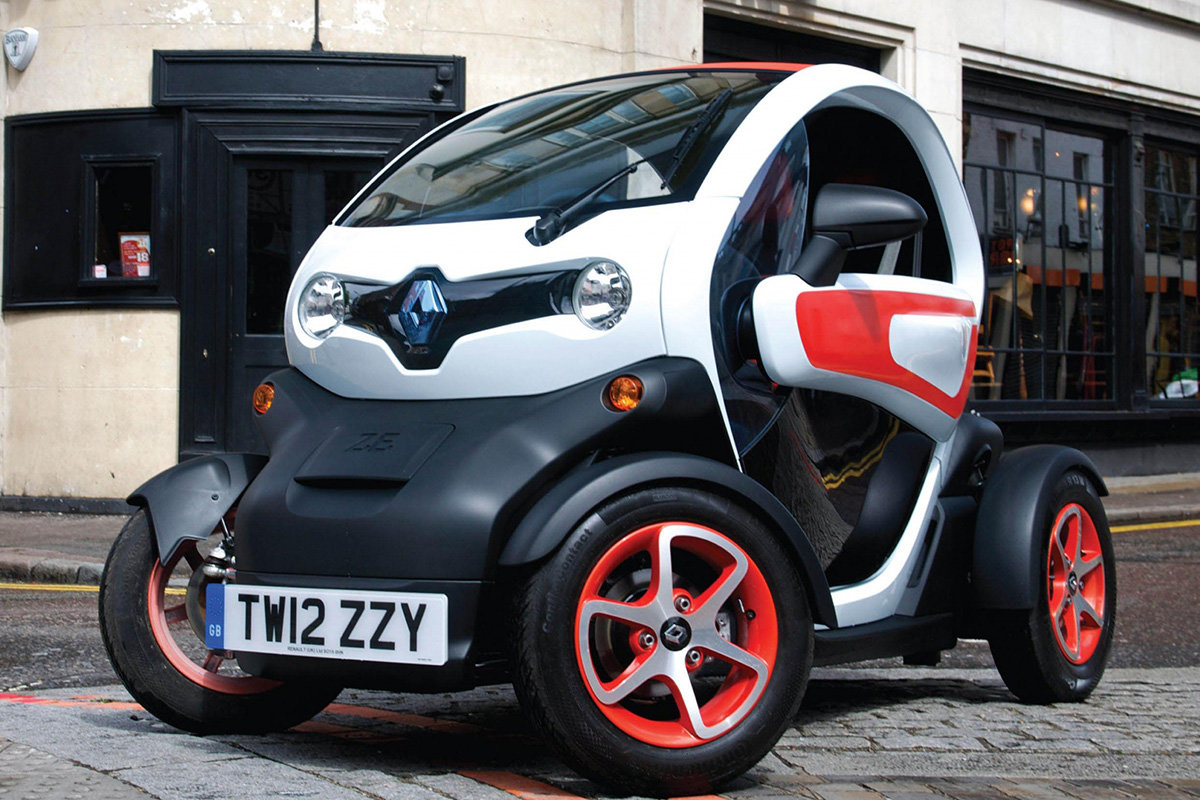
The Renault Twizy is an electric vehicle that's like nothing else on the road. And that isn’t just road tester’s hyperbole; it really is completely unique.
Is it even a car? After all, it has four wheels, and one more with which to steer, but otherwise it’s unrecognisable from the family saloons and SUVs with which it shares space. It's got no doors (they’re an optional extra), no boot, two seats arranged one behind the other, and wheels that stick out like a go kart’s.
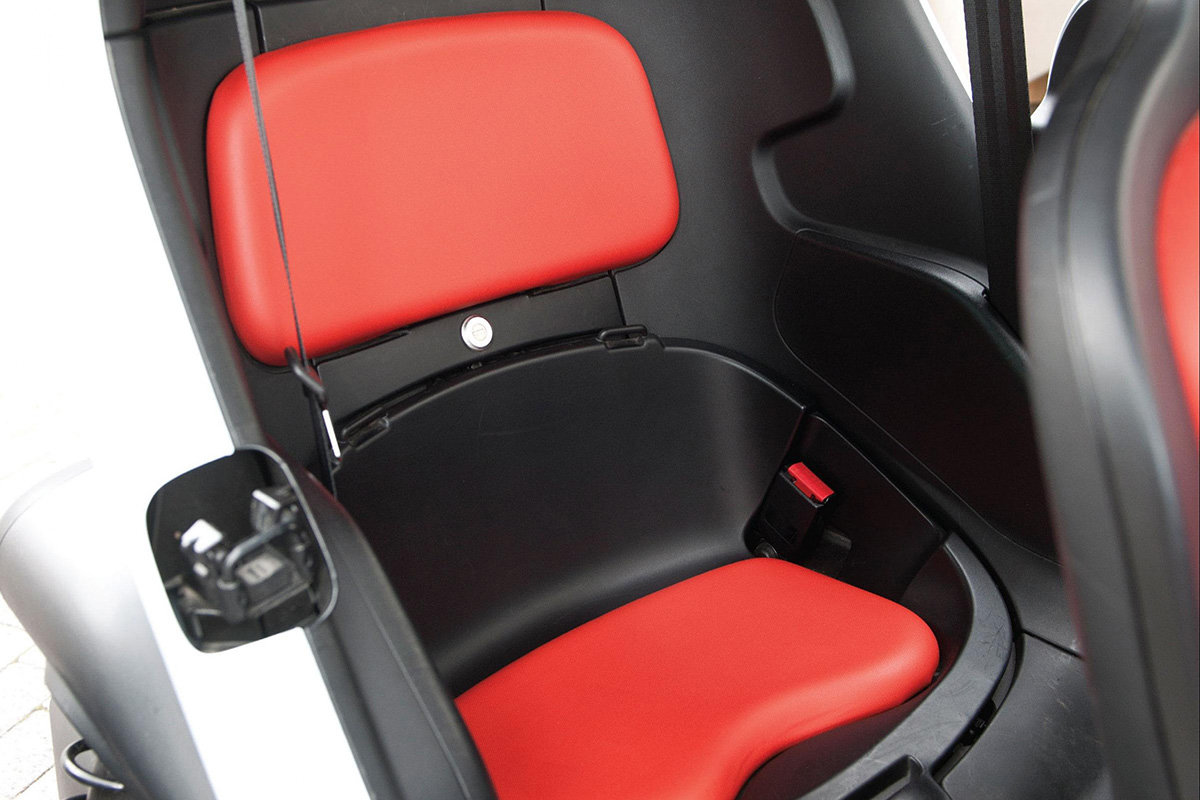
Of the two seats, the front is by far the more capacious; the rear seat is more for occasional than regular use. The boot is tiny too; just a little lockable compartment behind the rear seat.
So if you want to carry anything larger than a shopping bag, you’ll have to forgo carrying a passenger – or ask them to hold your luggage on their lap.
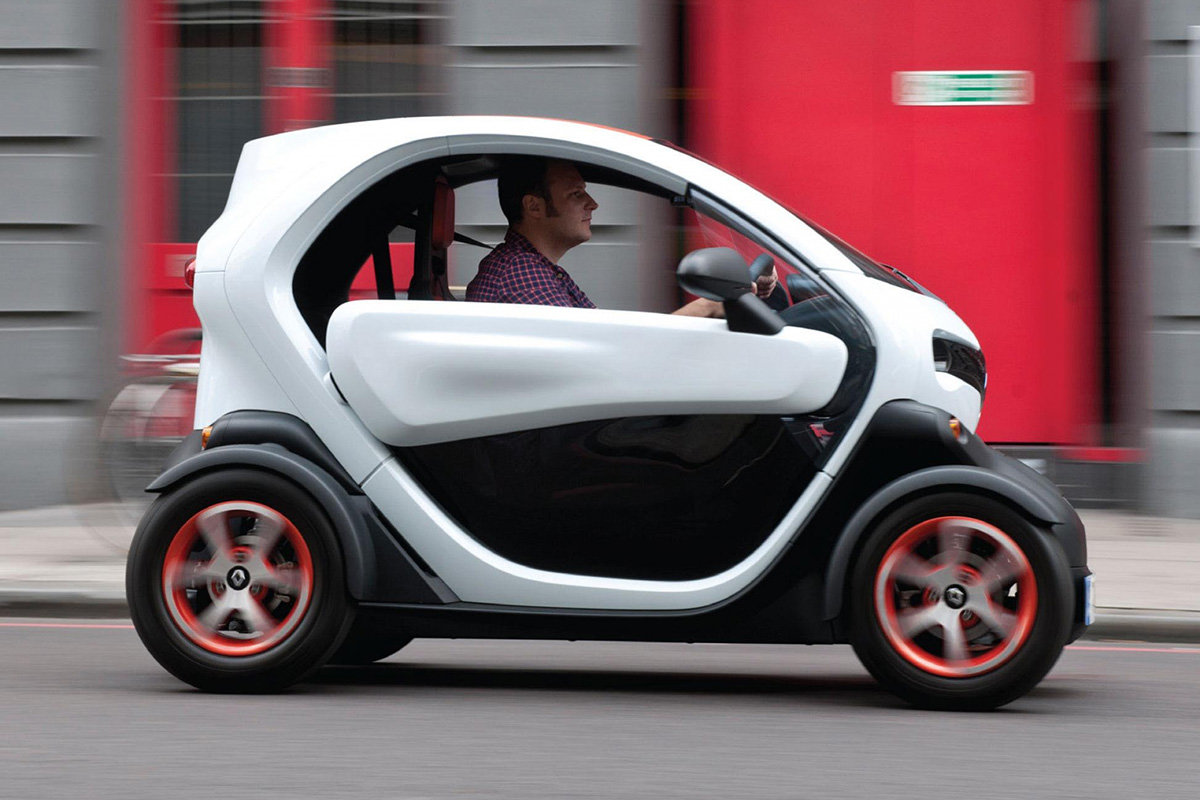
Mind you, the Twizy is simplicity itself to drive, because it’s all electric. Hop in, turn the key, press the ‘D’ button on the dashboard, and you’re ready to go. There are no gears to worry about, and your speed is displayed in front of you on a digital read-out.
Acceleration is brisk at first, but soon tails off; it’s ideal around town, as there’s enough punch to nip into gaps, but as soon as you get it out on the open road the Twizy feels considerably out of its depth. The top speed is just 53mph, which is no surprise given the electric motor produces just 17bhp.
It rides quite firmly, too, and because there’s very little padding in the seat, most of those bumps get transmitted through to your posterior with very little damping.
That does mean the Twizy feels quite nippy to drive, though, despite its narrow, tall shape. It doesn’t really lean over in corners and there’s lots of grip, so while the steering feels quite numb, you can have a bit of fun flinging it around the odd roundabout. It's certainly more stable than a motorbike or scooter, not to mention safer; you get a seatbelt and an airbag in the steering wheel, for starters.
Frankly, though, the Twizy’s main appeal is simply the amusement of driving something so wilfully odd, and the smiles it brings to the faces of pedestrians, not to mention your fellow road users.
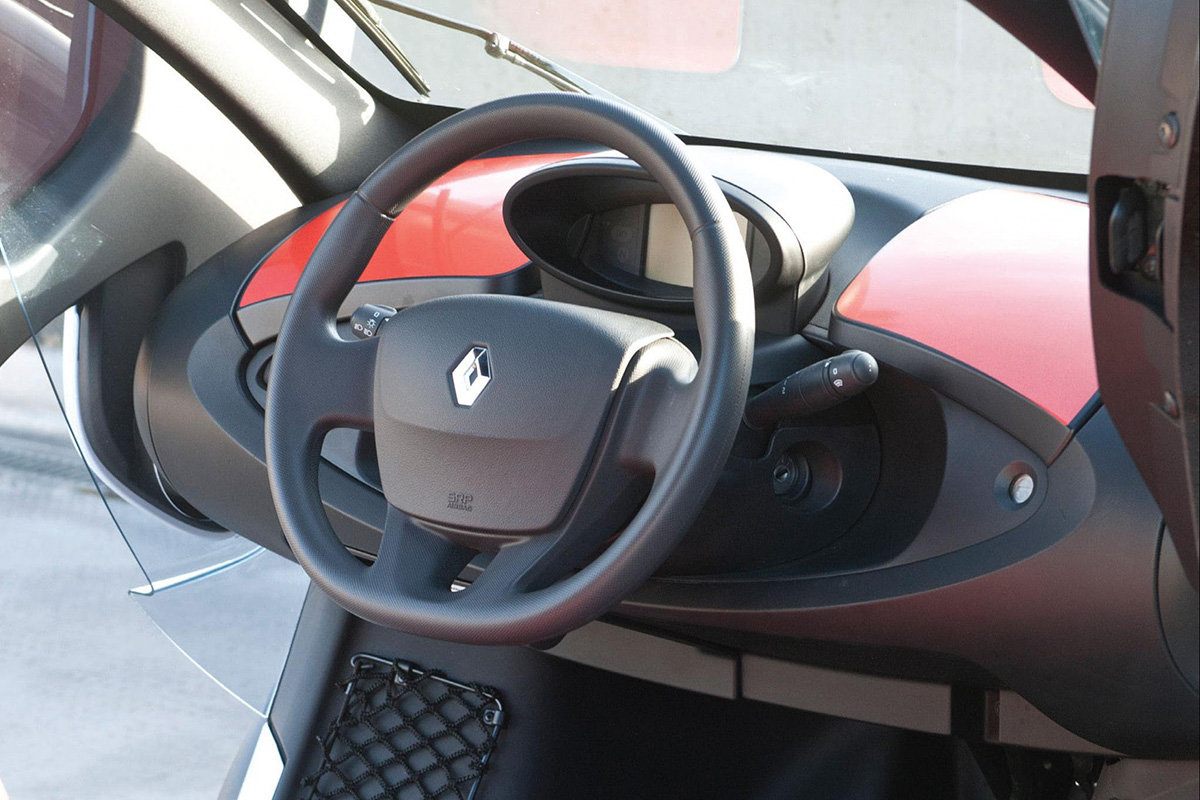
Mod cons? There aren’t any. No radio, no air conditioning – there isn’t even a heater, so you’ll have to be prepared to wrap up warm in winter.
You can add a pair of fairly flimsy plastic doors for a bit of extra weather protection if you want to, but even these aren’t particularly weather-tight, so it makes sense to consider the Twizy an al-fresco motoring experience – and to dress accordingly. As you might expect, the Twizy’s interior is designed to be weatherproof, so expect hard, rugged plastics rather than plush fabrics.
Charging is carried out via an integrated cable, which plugs into a standard three-pin household socket. The battery is just 6.1kWh, so it only takes three-and-a-half hours to charge the Twizy up from empty, which gives you a range of around 40 miles in mild weather, although that will drop to around 30 miles when it’s cold.
The tiny battery means the Twizy costs peanuts to charge up, and running one will certainly cost you less than any of its electric rivals, let alone a petrol or diesel car. And because it's a zero-emissions vehicle, there's no VED (AKA road tax) to pay. What's more, if you live in London, the Twizy is ULEZ compliant as well as free of the congestion charge (until 2025). There are no tailpipe emissions at all, and indeed no tailpipe.
Servicing is as cheap as chips, too – a three-year service plan will cost you £100 from Renault – and because there are so few moving parts and barely any equipment, there’s very little to go wrong, and as such, running costs are minimal.
One thing you will need to keep in mind if you’re buying an older Twizy is the possible extra cost of leasing the battery. Prices start at £45 a month, although they increase depending on how many miles you do each year. You can also opt to buy out the battery, which turns your battery-leased Twizy into a battery-owned example; the cost to do this is often quite high, though, so make sure it makes sense financially given the amount of time you intend to keep the car.
Frankly, we haven’t a clue how reliable the Twizy will be, simply because there's no data. The Twizy hasn’t been the subject of any reliability surveys, which makes it difficult to draw hard-and-fast conclusions about its dependability, although it’s worth pointing out that Renault as a manufacturer finished very poorly in the 2020 What Car? Reliability Survey: it placed 30th out of the 31 companies that were featured.
The usual advice for any test drives applies; watch out for bumps and scrapes from urban use, and check everything works properly. But as electric vehicles have far fewer moving parts than internal combustion engines, the risk of something major going wrong tends to be lower.
All Twizys registered from December 2019 onwards came with a five-year warranty; before that, the warranty was only four years, until February 2018, when it was reduced to three.
- Until 2020, all Twizys were sold on a battery lease arrangement, which meant you bought the car, but leased the battery from Renault, and paid a monthly fee to do so. The advantage of this arrangement is that when the battery wears out, Renault will replace it for free, but it does mean a significant cost each month. However, Renault later offered the option to buy the battery outright, so that you didn’t have to pay the lease fee any more, which makes things less complicated when purchasing a Twizy as a used buy, which it will be now that the vehicle is no longer offered as a brand new car.
- The Twizy was available in a range of four paint colours, but you could also choose to wrap certain parts of the car (or the whole thing) in a contrasting colour of your choice, with a plethora of different options on offer. Renault even allowed you to choose from a selection of patterned designs for your wrap, and on the priciest models you could colour-code the alloy wheels to match, too.
- The law recognises the Twizy as a two-seater electric quadricycle, and that means that you can drive one on a motorcycle licence. Try doing that in a supermini or a hatchback. This is reserved for those that get their motorcycle licence before 2001, though; otherwise, though, you’ll need a full car licence.
- If you want the best all-rounder: There’s only one motor and battery combination in the Twizy, which makes choosing which one you want very easy. You can pick between Urban and Technic on older models, the only real difference being that the more expensive Technic came with snazzier alloy wheels and more personalisation options. Later, the Urban was rebadged Expression+, and the Technic became the Dynamique, though the same logic applied. Depending on your budget, we’d recommend going for the cheaper model, given the pricier one doesn’t really get you any more toys.
- If you have no intention of carrying a passenger: Want to replace a friend with more luggage space? Then it’s worth seeking out the Cargo model. This version features a 180-litre luggage compartment in place of the rear seat. It's accessible from the rear of the car, with a maximum load limit of 75kg. It’s intended for use as an urban delivery vehicle, but it also works well for buyers needing boot space instead of passenger space.
- If you want some extras: Although there isn’t much difference between the trim levels, there are quite a few accessories on offer, including of course those doors. They can be had with or without windows, which give the ultimate in weather protection (relatively speaking). You can also opt for a Garmin satnav, a Parrot Bluetooth kit if you want to listen to music, rear parking sensors, mudflaps to help stop spray finding its way in, and even blankets for the driver and passenger. When buying used, it pays to shop around to find a car with the accessories you want.

