Volkswagen Golf Mk5 Review (2004-2009)
Volkswagen Golf cars for sale
4.0
Expert review
Pros
Broad range of engines and trims means there's a Golf for everyone
Sophisticated suspension delivers great handling
Plenty of interior space
Cons
Lower-spec models are a bit basic
Reliability issues mean you need to buy carefully
Some diesels are a bit noisy

The CarGurus verdict
Were it not for the scale of the Golf mk5’s reliability issues, we’d wholeheartedly recommend most of the cars in the range. They’re pleasant to drive, comfortable to sit in, practical to use, largely refined and understatedly stylish. Everything the Golf is synonymous for, with the added bonus of two excellent sporty models in the GTI and R32.
But you need to shop carefully. Many of the Golf mk5’s more critical problems should by now have been sorted out under warranty or with the cold, hard cash of a previous owner, but you can’t rely on that – it may be why the car is being sold on.
We can’t emphasise enough how important it is to research thoroughly your particular car’s generic issues, ensure that there’s a service history and a pile of bills, to ask lots of questions and not be afraid to walk away. You might also want to take advantage of VW’s Fixed Price Diagnosis service, which will inspect your potential purchase for £60. A good Golf mk5 can be great, but just be sure that's what you're buying...

What is the Volkswagen Golf?
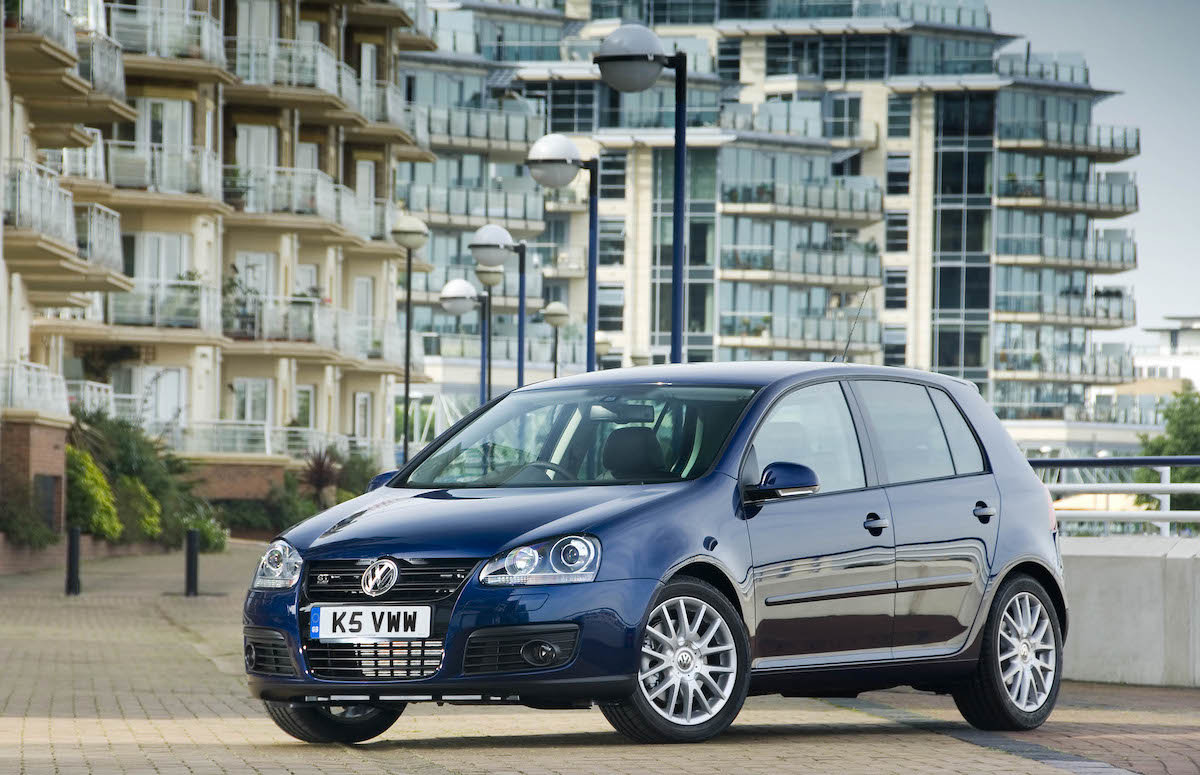
When Volkswagen launched the Golf mk5 on to the UK market in February 2004, it represented a big step up from the rather lacklustre mk4 – it featured a larger cabin for superior practicality, more dynamic styling, a superior engine line-up, an improved rear suspension design, and it was considerably more exciting to drive. The mk5 cemented the Golf’s reputation as the aspirational pick of the family hatchback market.
Initially available in three- and five-door hatchback guises, the VW Golf mk5 range gained a mini-MPV variant in the form of the tall-bodied Golf Plus in 2005, and then a five-door estate in 2007: there was no cabriolet version of the Golf mk5, open-top Volkswagen fans being catered for with a separate model, the Eos. VW resurrected the famous GTI model early in 2005, and then built upon its dynamic success in September the following year with the introduction of the 246bhp 3.2-litre V6 four-wheel drive R32. With the mk5, there was a Golf for everyone.
Despite its popularity, VW gave the Golf a big facelift in 2009, which was major enough for the new model to be designated the mk6. New front and rear ends and a revised interior hid a car that was mechanically very similar, but cost the brand a lot less to build….

How practical is it?
Despite being only a little bigger than its predecessor on the outside, packaging improvement meant the fifth generation Golf was a much more practical proposition with more space for people and luggage. Its practicality credentials were further enhanced by the addition of an estate version that joined the range in 2007.
One of the big areas of improvement over the old car was in its driving position, which featured a wider range of adjustment and more space, meaning even taller drivers will have no trouble getting comfortable behind the wheel. There was an equally impressive improvement for those in the back, and even by today’s standards the mk5 is a roomy compact family hatchback. There’s good head and legroom, plus just about enough space to squeeze three adults across the rear bench, provided they’re reasonably good friends.
The mk5 also formed the basis for the Golf Plus, which is essentially a taller and slightly longer version of the hatchback. It’s not as versatile as contemporary MPV rivals such as the Renault Scenic, but there’s a little more space for those in the back, plus a handy sliding rear bench.
Regardless of version, there’s also plenty of handy storage, including large door bins that will also swallow one-litre bottles of water, a big glovebox and on every model apart from the entry-level machine and lidded cubby between the front seats. One neat touch is a removable bottle opener that doubles as a drinks bottle separator in the space below the handbrake - although many previous owners will have pinched this VW-branded extra.
The upright tailgate opens to reveal a useful 350-litre boot, which can be expanded to 1,305 litres by folding the rear seats. The Golf Plus is even roomier, with 395 litres and 1,450 litres respectively. Yet if you regularly cart around large loads, then the estate is the version to go for thanks to its cavernous figures of 505 litres and 1,495 litres.

What's it like to drive?
In an effort to match the Ford Focus, VW injected a heavy dollop of driver appeal into the mh5 Golf. Like its arch rival, a lot of the German machine’s new found agility was down to a relatively sophisticated multi-link rear suspension set-up. Where its predecessor was soft and stodgy, the fifth generation model was poised and precise.
Point the Golf into a series of corners and you’ll discover crisp and well-weighted steering, good grip and balanced handling, making it a genuine pleasure to drive. Yet it combines this nimbleness and composure with impressive comfort and refinement. The suspension does a good job of soaking up bumps, while wind and road noise are kept to a minimum. The VW is also a doddle to drive, with good visibility, compact external dimensions and light-feeling major controls helping make it easy to place on the road and to park.
During its lifetime the Golf mk5 was available with a wide range of petrol and diesel engines. Bedrock of the petrol line-up is a 1.4-litre four-cylinder that appeared in naturally aspirated, twincharger – that is, both turbocharged and supercharged – and turbocharged configurations, with power outputs ranging from a lacklustre 73bhp to a wholesome 168bhp (in the 1.4 GT TSI Golf). However, the best of the bunch is the 123bhp turbo unit, that’s barely any slower than the more powerful version, but much less likely to suffer from mechanical trouble.
There is also a naturally aspirated 1.6-litre petrol engine producing 113bhp and a larger 2.0-litre FSI delivering 147bhp. The Golf GTI is powered by a turbocharged 2.0 TFSI delivering 197bhp (and 227bhp in the limited edition GTI Edition 30). These last two serve-up effortlessly strong performance that makes them seriously quick on the road.
At the top of the Golf performance tree is the R32, which also combined a 247bhp 3.2-litre V6 with the brand’s 4Motion all-wheel drive. With its bespoke bodykit and twin exit exhausts it looks the part, while that engine sounds glorious too, with a real bark when extended. Yet its extra weight and complexity meant it was barely any faster than the GTI.
Within the diesel engine line-up the naturally aspirated 2.0-litre is too weedy to recommend, but the mainstay 1.9-litre TDI 103bhp turbodiesel is flexible and economical, if a bit gruff: the super-economy BlueMotion version is good for a claimed 62mpg, and there is also a 2.0-litre TDI that developed 138bhp, or 168bhp in the rare GT trim.
For the most part Golf mk5s are front-wheel drive, but the 2.0 GT, both petrol and diesel, was optionally available with VW’s part-time four-wheel drive system, 4Motion, although these models are comparatively rare.
Much more common are Golf mk5s equipped with DSG automatically actuated manual gearboxes. The DSG is a wonderfully effective piece of kit when it works properly, but sadly the gearbox is prone to serious faults.

Technology, equipment & infotainment
For its day, the Golf had a decent haul of standard equipment, although the entry-level S is a little basic. Electric windows and central locking feature, but air-conditioning was an option, meaning many used examples go without.
Much better is the SE, which adds Climatronic air-con, plusher trim and a better specified stereo with CD player. A novel touch at the time was the ‘submarine lighting’, which bathed the front of the cabin in a moody red ambient glow at night. This model was replaced by the desirable match in 2006, which also added must-have features such as a leather steering wheel, cruise control and Bluetooth connectivity.
Sitting above this model is the GT, which had much the same standard kit but added spotier seats and larger alloy wheels to give it a little more showroom sparkle.
In terms of infotainment, the mK5 Golf is starting to show its age, with most having a fairly basic CD player and radio set-up. However, Bluetooth was an option, while some examples will have the optional touchscreen infotainment set-up, although by now the mapping will be out of date and graphics look dated. The good news is that upgrading to a modern touchscreen unit with Apple CarPlay and Android Auto is fairly easy, with VW even offering an official aftermarket unit as an accessory.

Volkswagen Golf running costs
By virtue of Volkswagen’s popularity, there’s a plethora of independent VW specialists up and down the country able to work on your Golf mk5 for less than an official dealer would charge. And yet for regular servicing and maintenance, it’s also worth checking in with your local VW dealer as Volkswagen operates a Fixed Price Servicing scheme for cars 3-15 years old, up to and including 2.0-litre engines.
Under this scheme prices for a minor service start at £179, while a major service is from £349. A cambelt and water pump change is from £549, a DSG automatic gearbox oil change from £199, and you can have your front pads changed from £169. It’s definitely worth checking these prices against what your nearest independent VW specialist charges.
Ignoring the sporty mk5 Golf R32, the rest of the range is fairly economical – even the Golf GTI returns up to 35mpg. Fuel consumption for other petrol models ranges from the mid-30s up to 47mpg. Most of the diesels have quoted fuel consumption figures ranging from the mid-40s to the mid-50s, while the efficiency-focused 1.9 TDI BlueMotion is the least thirsty of all, eking out up to 62.8 miles from every gallon, which some owners say is eminently achievable in the real world.
Predictably the BlueMotion is also the star of the Golf mk5 CO2 emissions table, its 119g/km entitling it to just £30 per year annual road tax. Depending on the model you choose, road tax for the 1.9 TDI, 2.0 TDI, 1.6 FSI and 1.4 TSI starts from £165, rising to £265 for some of the higher trimmed and more powerful derivatives. The petrol-powered GT 4Motion costs £330 annually which is more than the GTI (£305): the R32 tops out at £580.
Volkswagen Golf reliability
A good used Volkswagen Golf mk5 should go on forever, but they’re not as easy to find as VW’s reputation might have you believe. Even when these cars were comparatively young they had multiple problems, and now age and high mileage aren’t helping.
Although dynamically excellent, the DSG automatic gearbox has been troublesome. It really needs an oil change every four years or 40,000 miles and if its microfilter isn’t changed at the same time – which sometimes it isn’t – then the whole gearbox can fail because its lubrication is impaired. A much more commonplace issue is a breakdown in communication between the brake pedal switch and the DSG’s internal control unit, which can cause jerky running and the engine to cut out whilst on the move, say part-way through a roundabout. The DSG’s twin clutches are known to have failed at less than 35,000 miles, along with a deterioration of the differential bearing. Repairs can cost £3,000 or more, which these days can be in excess of what the car is worth.
Plastic timing belt tensioners on both petrol and diesel engines are now breaking with age, whilst on 1.4-litre petrol engines with cam chains, a significant number of chains have been reported to be stretching: with the 1.4 TSI it’s also critical to use exactly the grade of oil stated in the handbook or the chains will rattle and stretch. The turbocharged 168bhp 1.4 TSI is known to suffer from turbo failures and there are also a few reports of cracked pistons: the 1.4 twincharger should by now have had the calibration of its knock sensor reprogrammed, so if you hear knocking you know it hasn’t been done.
The piezo-type fuel injectors on the 2.0 TDI PD engines failed so often that VW was forced to issue a recall, so check up on that. And if a TDI PD feels down on power, it may be the result of its variable-vane turbocharger being blocked with soot. On a similar subject, ask how often the Diesel Particulate Filter has been cleaned out on a 1.9 TDI BlueMotion – we’ve heard of a 43,000-mile example needing a new DPF at a cost of £2,500.
An ESP warning light probably means the car needs its ESP pressure sensor repaired – there’s now a £432 repair kit – and it also affects the ABS. Beware also of rusty front wings, cracked suspension springs, dodgy door locks, radios that turn themselves on and off, and air-con failures that require expensive replacement hardware.
Given the potential for faults, the best advice is to research online the issues specific to the Golf mk5 you’re looking at before committing to buy it.
- The Golf mk5 achieved a coveted five-star rating in the Euro NCAP crash tests, together with a four-star rating for its child occupancy protection. In part this was thanks to the fact that all models have twin front airbags, driver and front passenger side airbags, head airbags, anti-whiplash protection, five three-point seatbelts, and Isofix child seat anchor points. The Golf mk5’s bodyshell is also 80% more torsionally rigid than its predecessors’ and, of course, crash safety technology had improved greatly by the time it was launched in 2004.
- Although Volkswagen has a rock solid reputation for dependability, the mk5 is anything but, as we will cover in more detail in the Reliability section. As a clue to how dire the situation is, in the 2014 What Car? Driver Power customer satisfaction survey, the Golf mk5 was the lowest ranked family hatchback for reliability, languishing in 145th place overall. Although we will touch upon its problems, it might also be worth researching more deeply the particular model you are interested in, as it may be prone to multiple faults. There are plenty of Golf mk5s out there, so don’t be afraid to walk away from any that give you the slightest cause for concern.
- The 2.0-litre TFSI turbocharged engine in the mk5 Golf GTI is best run on super unleaded petrol. This is because fuel is injected directly into the cylinder and therefore doesn’t wash clean the rear of the valves of sooty deposits: super unleaded burns more efficiently and doesn’t leave such deposits. Over time these deposits can prevent the valves closing fully which leads to high oil consumption. This problem is most evident on the GTI, but the Golf mk5’s other direct injection petrol engines also appreciate regular use of super unleaded.
- If you favour efficiency: The Golf mk5 1.9 TDI BlueMotion is engineered to deliver great fuel economy and low emissions: it’s claimed to give up to 62.8mpg while puffing out only 119g/km of CO2. It achieves this through longer gear ratios, a reduced idle speed, a diesel particulate filter, low rolling resistance tyres, and an aerodynamic underbody. It feels sluggish but less frequent and cheaper visits to the filling station make up for that.
- If you want the best value: In September 2006 VW replaced the SE trim level with the Match package which includes 15in alloys, body-coloured bumpers, leather-trimmed steering wheel, gearknob and handbrake lever, and an MP3 audio connection: it makes for a stylish car. As for an engine, we’d like to recommend the twincharger 1.4 TSI but its reliability is too much of a gamble – we’d go for the 1.9 TDI diesel instead.
- If you appreciate winter mobility: Not everyone wants a hulking off-roader all year round, and the mk5 Golf GT 4Motion is perfect for those odd snowy days or for country roads slathered in mud. 4Motion is a part-time four-wheel drive system that comes in to play only when you need it: the rest of the time the Golf remains front-wheel drive. They are rare beasts, though, but are available with a 2.0-litre petrol engine or a 2.0-litre TDI diesel.
- If you want a cracking hot hatch: The mk5 Golf GTI is a superb all-rounder, and while ultimately it’s not as quick as its V6-engined all-wheel drive R32 stablemate, you’re unlikely to be disappointed by its performance. The limited edition Golf GTI Edition 30 is a smidge faster and more desirable, but it’s more costly than a regular GTI and much harder to find.

