Volkswagen Multivan Review (2022-present)
Volkswagen Multivan cars for sale
4.0
Expert review
Pros
Magnificently flexible interior
About as cool-looking as a van-shaped vehicle can get
Car-like driving experience
Cons
Relatively pricey
Plug-in hybrid is heavy – which makes it thirsty
Infotainment system is flawed

The CarGurus verdict
The Multivan is trying very hard - and it largely succeeds - to be the best of both worlds. It’s got the space, practicality and flexibility of a van, like the Caravelle before it. But now it’s got extra car-like appeal, with swisher looks and options, a nicer interior and a much improved driving experience. The plug-in hybrid model could be just the ticket for families that are forever shuttling around town, and have somewhere to keep the battery charged when not in use. The petrol models are better to drive, and cheaper to buy, but we’d put money on the fact that, for those that want to go touring in their Multivan, the fuel economy and extra hauling power of the diesel model will be the best option when it comes out in 2022. Whichever model you go for, though, the Multivan is a very appealing family car, and an all-round improvement on its predecessors.

What is the Volkswagen Multivan?
The Multivan traces its roots way back through the Caravelle name. For decades, the Volkswagen Caravelle was a version of the classic Volkswagen van, set up for carrying passengers. Recent generations have been adapted from a VW commercial vehicle, the Transporter. But this model, known by the code T7, stands on its own. For those that like a bit of tech info, it’s based on Volkswagen’s modular MQB platform, which refers to the engineering underpinnings used on other Volkswagen Group vehicles, including the Volkswagen Golf, the Tiguan, the Audi A3, the Skoda Octavia and countless others.
The move was the result in part of feedback from Caravelle owners, who loved the practicality and space it provided, but were less keen on the quality of ride and handling, or the feel of the interior. In short, they wanted something more car-like, without sacrificing the van-like dimensions. So Volkswagen’s engineers spent years beavering away at a suitable design that would incorporate the best of the van and car worlds, and the Multivan is a result.

How practical is it?
Practicality and space are the main reasons for buying a Multivan, and it delivers in spades. There are two sizes to choose from. Both have the same wheelbase, but the longer version is 20cm longer behind the rear wheels for more boot space. The standard Multivan is 4.98m long, which means the long model is 5.18m long.
So, it’s big. But it’s not just about size. Volkswagen has packed the Multivan with features to make its interior practical and flexible. Both sides feature sliding doors, and on all but the base model, these doors operate electrically. You can have up to seven seats in total, with two up front and up to five behind. The rear seats mount onto tracks in the floor, which lets them slide forwards and backwards for different configurations. You can face them forward or backward, or even remove them completely; Volkswagen has reduced the weight of the seats by up to 25% compared to those in the Caravelle to make them easier to manhandle. The rear seat armrests detach to allow up to three in a row across the back. The outer rails are electrified, which means you can have heated rear seats on some models.
There’s also a central multi-function table, which can either sit between the front seat as a centre console for cup holders and storage, or slide back along the central track, rise and expand to form fold-out tables for the passenger, with storage underneath. General storage is plentiful, with two glove boxes, two door pockets on each front door, and cubbies under all the rear seats, as well as fold down storage from the dashboard.
As all models use a drive-by-wire automatic gearbox, there’s no need to have a central gear lever, which opens up the space between the front seats, and allows easy access to the rear when you need it.
Luggage space in the boot is accessed by a large tailgate. How big it is will depend on your seating configuration, but if you have all the seats in, and all the way back, you’ll get 469 litres in the standard Multivan or 763 litres in the long model. Take all the seats out, and that expands to a literally-van-like 3,672 litres in the standard model and 4,005 litres in the long version. If you're looking for a seven-seater people-mover, it doesn't get much better than this, and with Volkswagen's rich history with camper vans, we can see this becoming a very popular donor vehicle for such conversions.
What's it like to drive?
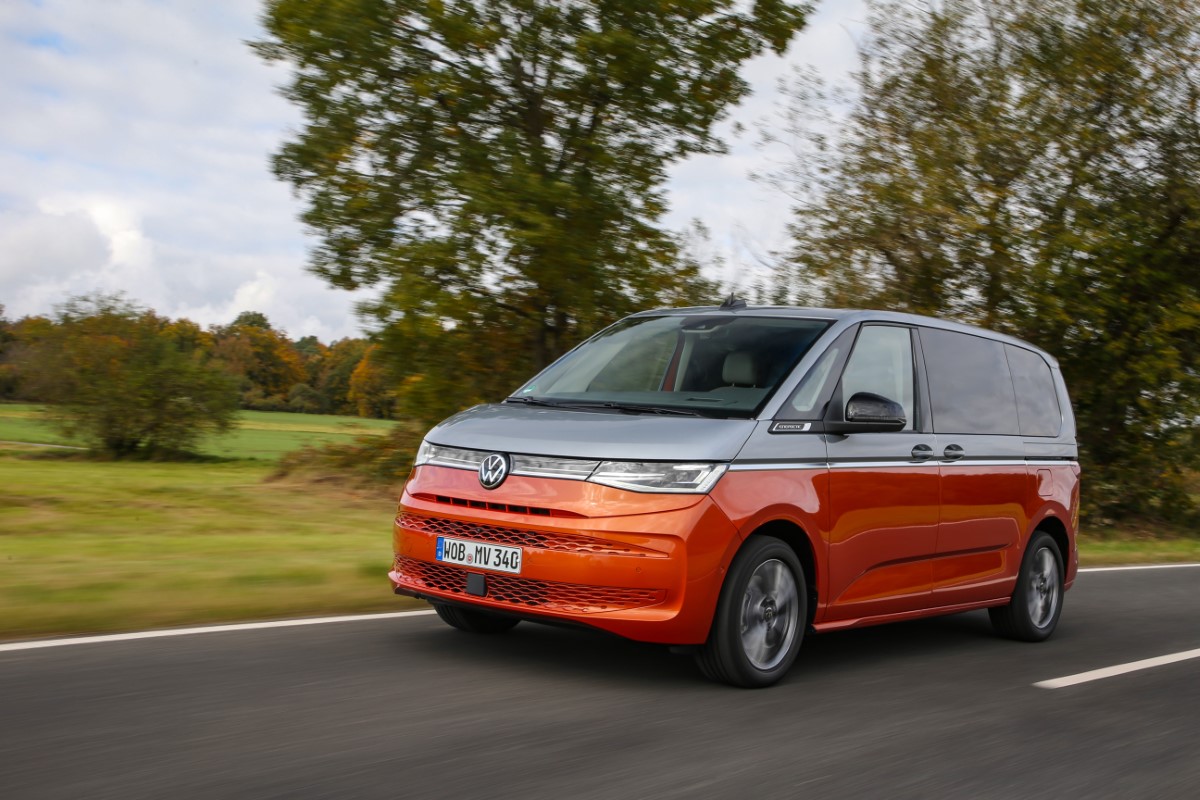
Vans, and consequently cars based upon them, haven’t traditionally been any great shakes to drive, but the Multivan is different. Because it’s underpinnings are shared with other ‘proper’ cars, it’s considerably lighter than the Caravelle, and with more sophisticated engineering. The result is a far better driving experience than many will expect. As cars go, it’s nothing outstanding, but as vans go it’s really very good; overall, it’s much closer to an SUV than something you’d use to transport furniture around in. The steering is well-weighted with plenty of feedback, and the Multivan stays nice and flat when cornering.
All models are DSG automatic only, which makes things considerably more relaxed when driving; combine this with the multitude of assistance systems that you can have in the Multivan, including adaptive cruise control, and long journeys can pass with minimal stress. It rides well, too, which is good news for passengers in the back, although there is a touch more road noise at motorway speeds than you’d hope for.
At launch, customers can choose from three powertrains: two TSI petrol engines or a plug-in hybrid. The latter - badged as the Multivan eHybrid - uses a turbo 1.4-litre petrol engine with an electric motor and 10kWh lithium-ion battery to develop a combined 215bhp. That makes it the most powerful option in the range, although it’s considerably heavier than the other models, which keeps acceleration to a relatively sedate 11.6 seconds. However, its party piece is that it can do up to 31 miles on electric power only, at speeds of up to 70mph, and can be plugged into the mains to top the battery up. This has the potential to keep fuel bills very low, especially if you do mostly shorter journeys.
By default, the PHEV Multivan will rely on electric power as much as possible when you start it up, but you can tell it when to use the petrol engine, too, for example if you want to save some battery power for later in your journey. Otherwise, software will work out when it's best to deploy the engine. It works well, starting and stopping pretty seamlessly. However, the extra weight of the hybrid system means the PHEV doesn’t feel as agile as the petrol models in the range, and the hybrid’s petrol engine can feel a bit strained at full acceleration.
The two petrol models are lighter, and the more powerful of the two – a 2.0 TSI with 201bhp – is much more sprightly on acceleration. It does 0-62mph in 9.4 seconds and feels less lumbering through the bends. No model is bad, but the petrol model is better when it comes to the driving experience. Another 1.5-litre TSI petrol engine with 134bhp is also available, and a TDI diesel model will be added to the range later in 2022.

Technology, equipment & infotainment
As part of the move towards a more car-like interior, Volkswagen has installed a 10.0-inch touchscreen infotainment system and, on most models, there’s a Digital Cockpit, which is VW’s name for a screen behind the steering wheel that replaces traditional analogue dials. This looks great, and is configurable with your preferred information when you’re driving.
The infotainment system is less successful. In common with other contemporary Volkswagen vehicles, it largely eschews buttons and dials in favour of a touchscreen-only approach. This looks very smart and slick, but in practice it’s more difficult to use on the move than a system that lets you jump around sections with buttons. We’ve found it pretty slow to react to touch, too. However, it does include Apple CarPlay and Android Auto, so you can connect up your smartphone and avoid the proprietary systems by just using apps instead.

Volkswagen Multivan running costs
Prices when new haven’t yet been announced for the UK, but we’d expect them to start at around the £45,000 mark, rising to around £55,000 for the hybrid model.
Although it’ll cost you more, the PHEV Multivan will save you the most on fuel, although as detailed above, only if you keep most of your journeys short. Filling up with electricity from a home wallbox will be far cheaper than topping up the petrol tank. Incidentally, it’ll refill the battery at up to 3.6kW, which will take about 3hrs 40min. Use a regular three-pin plug and it’ll take about 5hrs.
The 2.0 TSI petrol promises up to 37mpg and the 1.5 TSI claims 42.8mpg, although real-world consumption will struggle to get near that, especially with a fully-loaded car.
If you don’t want to pay extra for the flashiness of the Multivan, you can still buy the Volkswagen Transporter shuttle from new, which is essentially the Transporter van with seats in it. It’s not as fancy or as good to drive, but it is cheaper.
There’s no pure electric version of the Multivan, so if that’s what you’re after then check out the posh Mercedes-Benz EQV. However, VW does have an electric passenger bus coming soon, called the ID.Buzz.
Servicing and insurance details hadn’t been announced at the time of writing.

Volkswagen Multivan reliability
The Multivan is too new at the time of writing to have any meaningful data on its reliability. However, its mechanical underpinnings are well-used and well-proven in other cars, so we wouldn’t expect too many major issues.
As a brand, Volkswagen came 18th out of 31 manufacturers in the 2024 What Car? Reliability Survey.
All Volkswagen Vans come with a three-year warranty, with unlimited mileage cover for the first two years, but a limit of 100,000 miles for the third year. That’s pretty standard against the competition.
- The interior quality of the Multivan has taken a big leap forward towards the kind of materials you’d expect in a new car. It’s much plusher than you’ll get in VW’s vans, although so much plastic is needed that it’s understandably not as premium-feeling as, say, a Golf. With budget in mind, we can forgive them a few hard surfaces.
- At the time of writing, UK specs hadn’t been revealed. But using the European specs as a guide, we’d expect a range of options that add extra features such as alloy wheels, extra seats and storage, and a panoramic sunroof as you go up the trim levels. Europe gets a base model with steel wheels and three rear seats, and a special-edition PHEV-only version, too, which comes with just about every option available.
- Speaking of options, the Multivan’s looks are enhanced by a range of eye-catching paint colours, including two-tone metallic and pearlescent hues, with chrome strips separating them. There are some fancy matrix LED headlights available, too, which maximise brightness at night without dazzling oncoming traffic.
- If you want the best fuel economy: The plug-in hybrid Multivan will, on paper at least, make a tank of fuel last the longest. On paper it promises up to 188mpg, but like all PHEVs this will heavily depend on how you use it. To get the best performance, keep it plugged in and lean on the electric motor by doing mostly short journeys. Otherwise you end up with just a heavy, petrol-powered Multivan that drinks fuel quickly.
- If you’re likely to be doing lots of long drives: We’d hang on and wait for the diesel model. If you must get a petrol Multivan then the lower-powered 1.5 TSI promises up to 42.8mpg officially, although those published figures use the old-fashioned NEDC testing method, rather than the newer, more realistic WLTP test. Real-world figures are likely to be considerably lower. The diesel will almost definitely be better on fuel over longer journeys.
- If you want the most space: The long model of the Multivan adds 20cm to the overall length of the vehicle. It’s all in the back end, as the wheelbase (the distance between the wheels) is the same on both versions. Neither model is cramped inside, but the long version will give you extra storage space behind the seats.
- If you want the fastest model: Although the plug-in hybrid model is the most powerful, the fastest accelerating Multivan is the 2.0 TSI petrol, which with a 0-62mph time of 9.4 seconds is considerably brisker in a straight line.


