Volkswagen Polo Review (2018-present)
Volkswagen Polo cars for sale
4.0
Expert review
Pros
High quality interior
Impressive practicality
Sophisticated driving experience
Cons
Not a cheap option
A Ford Fiesta is more fun
GTI version isn’t very exciting to drive

The CarGurus verdict
Previous Polos have always been something of a benchmark in the supermini class, and this sixth-generation car is no different. There’s not a single area in which the standard car struggles, and in several of them, it sets the standard outright.
The VW Polo’s compliant suspension and sensational rolling refinement means it’s one of the most civilised cars of its type on the road, and the punchy engines and well-weighted controls make it a very easy car to drive as well. Those looking for a strong dose of fun will be better off with a Ford Fiesta, especially if they’re considering the GTI model, but there’s fun to be had in the Polo, too, and there’s no doubting its capability in corners.
If anything, though, the interior is the most impressive bit. It’s dripping with quality and poshness, the design is an ergonomic masterclass and, with loads of passenger space and a big boot, it’s also one of the most practical superminis you can buy. It’s a slightly pricey option in the class, but if you can stretch to a Polo, you’ll absolutely love it.

What is the Volkswagen Polo?
Think back – if you’re old enough – to 1975; something of a landmark year. The Vietnam war was coming to an end, an unknown little company called Microsoft was just being formed, and the starting pistol had just been fired in the race between Betamax and VHS for supremacy in the home video market.
Something pretty seismic happened in the car market, too, and that was the release of the original Volkswagen Polo. Over the following years, VW’s small hatchback would become the benchmark for desirability and image in the supermini market, and would also go on to become one of the most successful cars of its type. And the latest version – the sixth-generation car sold from 2017 onwards – still trades on those very same attributes today.

How practical is it?
Where does that desirability and image come from? Well, the badge for one thing. While most of the other entrants in this sector of the market come from rather run-of-the-mill mainstream brands, the VW logo carries a little more prestige clout. The sheer quality of the product doesn’t hurt desirability, either.
Practicality is also top-drawer, with plentiful space for four tall adults (a fifth can squeeze in at a push), and one of the largest boots in the class. Aassuming you don’t go for one of the GTI models, which have around 50 litres less space, you'll find 350 litres of carrying capacity available to you... which is good, but a little behind what the 391-litre boot in the Renault Clio can muster.

What's is like to drive?
The Volkswagen Polo is an impressively civilised car to drive, with a really smooth ride at all speeds – one of the most cosseting in the class, in fact – and excellent refinement, too.
Wind and road noise are very well subdued on the motorway, and most of the engines (the exception being the sole diesel) are smooth and quiet. The controls are all responsive and consistently weighted, and although a Ford Fiesta is a bit more fun in twists and turns, the Polo is extremely capable, secure and predictable.
That said, possibly because the model is fundamentally unsporty, the GTI version isn't anywhere near as much fun as it ought to be, which is strange given how good the larger Volkswagen Golf GTI is.
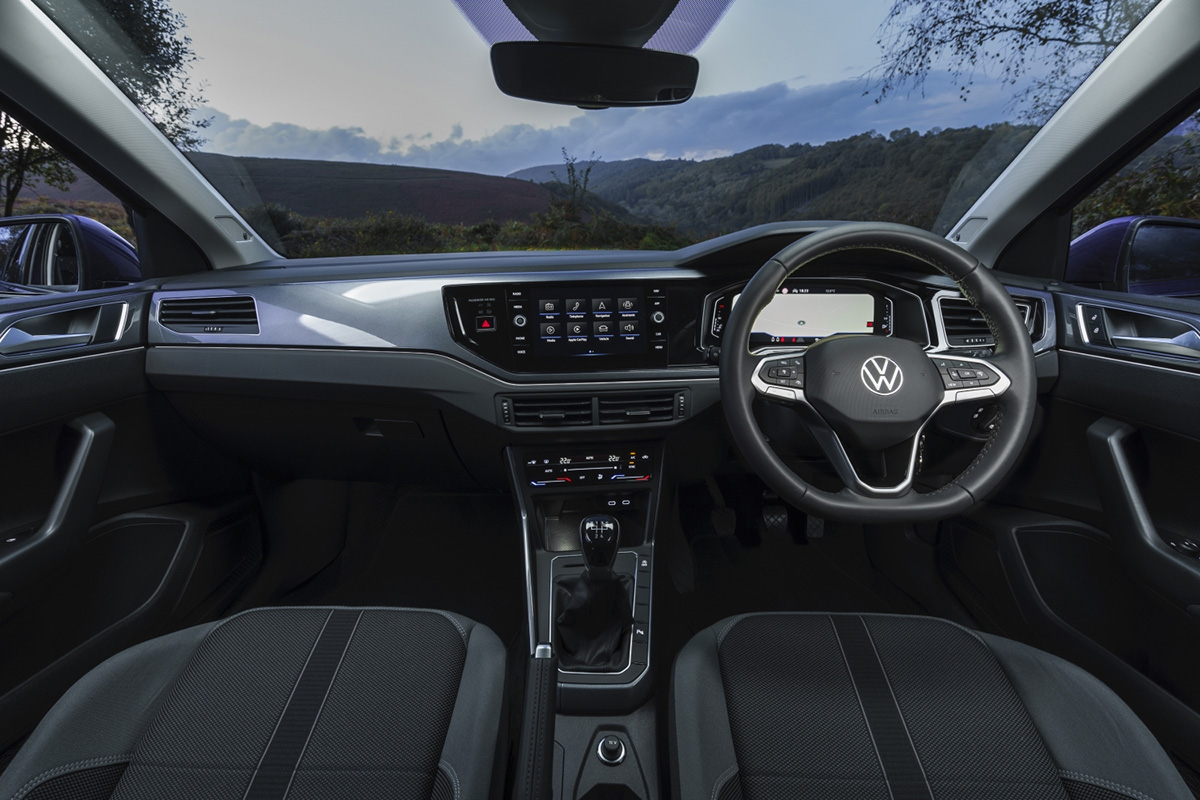
Technology, equipment & infotainment
The level of standard equipment you get is also pretty good. Even the entry-level Life model is reasonably well equipped, with air-conditioning, LED headlights, cruise control, electric front and rear windows and automatic headlights and wipers.
If you can stretch to it, though, you’ll probably want to switch up to the Style, which gets you ambient interior lighting, adaptive LED headlights, satnav, front and rear parking sensors and dual-zone climate control.
R-Line then gets you sportier styling, bigger wheels and a digital cockpit. From there, you can upgrade to the GTI which, along with its more potent engine, gives you sports-tuned adaptive suspension, sports seats and red brake calipers.
The Polo isn’t a cheap option among its peers, but it’s very affordable to run and importantly, it feels worth every penny of the money you pay.

Volkswagen Polo running costs
Sitting at the more sophisticated end of the small car spectrum, the Polo isn’t a cheap option when compared with rivals. Purchase prices were already higher when it was a new car, and with stronger resale values than most of the competition, it doesn’t shed its value as quickly, either. And, having only been released in 2017, prices haven’t had all that much time to drop just yet. So for all those reasons, it’s likely that you’ll pay a bit more to buy a Polo that most other supermini contenders.
That said, once your initial outlay has been and gone, running costs should generally be very palatable. Predictably, the 1.6 TDI diesel engine is the most efficient according to official WLTP figures, with a maximum average return of up to 57mpg. That said, both the weakest 1.0-litre petrols will beat 50mpg when teamed with the five-speed manual gearbox, while the 1.0 TSI 95 will achieve 46mpg when paired with the seven-speed DSG twin-clutch automatic. The 1.0 TSI 115, meanwhile, will deliver a maximum of 46mpg when mated to the six-speed manual ‘box, and 48mpg when teamed with the DSG.
Running costs will be considerably higher for the GTI than for the rest of the range, though. Neither version can quite crack the 40mpg mark according to official figures, while these versions also lie in groups 26 or 28 for insurance. The entry-level engine, meanwhile, sits in group one, the cheapest group there is (of 50), while the 94bhp engines sit in group eight, the diesel in group nine and the 113bhp petrol in groups 11 or 12.
Vehicle Excise Duty, meanwhile, is the same on every variant. The Polo was released after April 1st 2017, when the tax rules changed from being based on a car’s CO2 output to being based on a flat rate on all petrol and diesel cars. As such, you’ll pay £150 per year to tax your Polo, whichever version it may be.

Volkswagen Polo reliability
This generation of Polo hasn’t yet been around long enough for much meaningful reliability data to become available. We’ve heard one or two tales from owners about strange knockings from underneath and strong vibrations from the engine bays, but the (admittedly rather limited) numerical evidence we’ve seen would suggest that these are isolated incidents rather than regular known faults.
You can also take heart from the fact that, as a brand, Volkswagen sits in very respectable mid-table spots in reliability surveys including the JD Power UK Vehicle Dependability Survey and the Warranty Direct Reliability Index. That's not the bullet-proof dependability the firm’s past advertising would have you believe, perhaps, but entirely decent. That said, Volkswagen’s three-year, 60,000-mile warranty is nothing special, especially when compared with the seven-year arrangement you get from rivals such as Kia.
One major recall has been issued regarding the rear seat belts. In rare situations, such as when all three rear seats are occupied and a sudden lane-change manoeuvre takes place, one of the belts can be unintentionally released. It took VW a wee while to come up with a fix, but they cracked it eventually so make sure the work has been carried out on your car before buying.
- This generation of the Volkswagen Polo is offered with a range of petrol engines, most of which are 1.0-litre three-cylinder units. The most basic one is a naturally aspirated unit giving between 64bhp and 79bhp depending on the age of the car, but either way, it’s rather weedy, so most buyers will want to upgrade to the pokier turbocharged version with its 94bhp. There’s also another version with an even more muscular 113bhp. All can be had with either a manual gearbox or a twin-clutch automatic. Diesel fans can have a 1.6 with between 79bhp and 94bhp.
- Most of the materials on display inside the cabin feel dense, tactile and expensive, while all the switches and buttons work with slick precision for a substantial, well-crafted feel. The interior is impressive in other areas, too, with an intuitive dashboard layout, supportive seats and good all-round visibility.
- At the top of the Polo range sits the GTI, with its gutsy 2.0-litre, 204bhp petrol engine. But while it’s fast and extremely grippy in corners, ultimately the GTI is a little disappointing. The problem is that it comes with an occasionally nannying automatic gearbox and only an enhanced traction control system instead of a more involving manual and a proper limited-slip differential. Nor is its engine quite as eager, and as a result, it doesn’t give you the same sort of thrill you get with the Ford Fiesta ST or Hyundai i20 N. And because the Polo’s suspension is just as firm, it isn’t even easier to live with as a payoff.
- If you’re looking to spend as little as possible: You might want to consider the entry-level version with its naturally aspirated 1.0-litre petrol engine. Depending on the age of the car, this came with between 64bhp and 79bhp. However, even the most powerful iteration has to be worked mighty hard to maintain meaningful progress, and even then, that progress is pretty leisurely.
- If you can afford to upgrade: W'd thoroughly recommend upgrading to the 94bhp 1.0 TSI petrol, which will best suit the vast majority of buyers. It has considerably more low-rev urge for far easier acceleration, and there’s a fair bit more zip if you decide to work it harder. It’s so good that it makes upgrading to the 113bhp engine look a bit pointless.
- If you want ultimate fuel economy: The diesel does best on that score according to the official figures, although to be fair, the best of the petrols aren’t all that far behind for fuel efficiency. Bear in mind that it’ll cost you a fair chunk more to buy than the equivalent petrol, and you’ll need to cover a lot of miles before the superior fuel economy pays for itself.
- If your Polo has to be the fastest available: You’ll be wanting one of the GTI models. The 2.0-litre petrol engine delivers a very healthy 197bhp, making the car good for 0-62mph in 6.7 seconds. In truth, though, the car doesn’t feel as fast as those numbers suggest, and the driving experience generally isn’t as racy as you expect.

