Skoda Yeti Review (2009-2017)

Pros and cons
What we like
Versatile rear seats
Good to drive
Gives the SUV look without being huge
What to consider
Spare wheel eats into a lot of boot space
Petrol engines can have reliability issues
Can suffer from rust
The CarGurus verdict
The Skoda Yeti is a brilliant family car that offers many of the benefits of a modern SUV without vertiginous running costs or unmanageable dimensions, not to mention one of the most versatile and spacious interiors money can buy. It drives well, too, so you don’t have to sacrifice driver enjoyment to own one. Its reliability glitches are worth keeping in mind, but if you can find a good one that has been well looked-after, a used Yeti should still be a satisfying car to own.
out of 5 expert review
What is the Skoda Yeti?
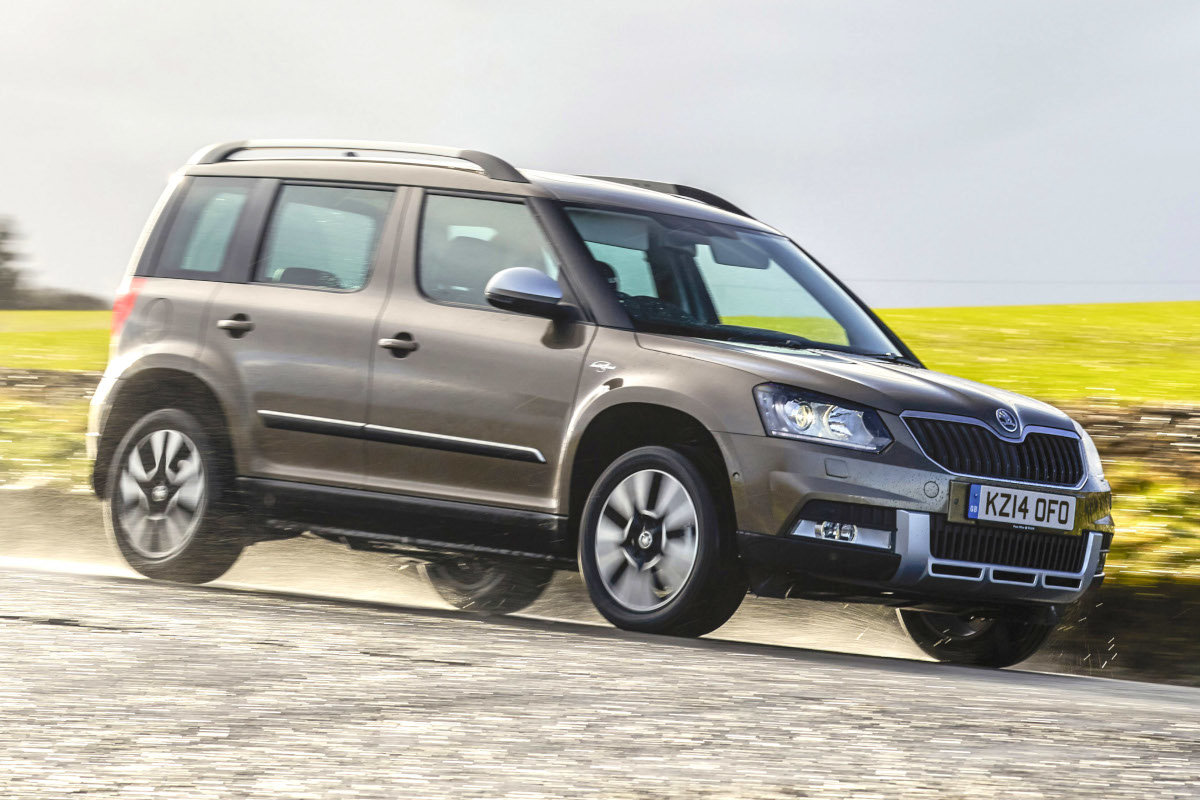
When is an SUV not an SUV? When it’s a Skoda Yeti, of course. The Yeti, launched in 2009, was Skoda’s answer to the rising tide of small SUVs – and yet it offered something rather different, with a slightly lower stance than most of its rivals and a profile more akin to a jacked-up estate car.
It might no longer be in production, but the Yeti still makes a great used buy. It was replaced by the Skoda Karoq in 2017 – which wasn't really a direct replacement, because it's bigger than the Yeti and more of a conventional modern SUV – but it filled the gap in Skoda's model range.

Practicality
How practical is it?
The Yeti is a genuine five seater, with individual rear seats that are capable of housing three adults sitting side-by-side. All three seats can flip down or even tumble forward individually, too, leaving behind them an enormous, van-like rear load bay with a flat floor.
Boot space is a minimum of 405 litres with the rear seats upright, but that can be extended to 510 litres because of the cleaver and flexible back seats.
This astonishing practicality is coupled with robust plastics, decent amounts of equipment and excellent visibility from the Yeti’s raised driving position, and you can also choose your Yeti with four-wheel drive, if you need it. With that in mind, it isn’t hard to see why the Yeti has proven so popular.

Driving
What's it like to drive?
The engine range stretches from a brisk but efficient 1.2-litre petrol turbo right up to a trio of gutsy 2.0-litre diesels, with 1.4- and 1.8-litre petrols and 1.6-litre diesel thrown in for good measure along the way.
Whichever Yeti you go for, you get a reasonably comfortable ride. Granted, the need to stop the Yeti flopping over in bends means it’s quite firm, but not to the point of being unpleasant.
What’s more, the result of this is good body control which, allied to the crisp steering means the Yeti stands out in a class where driving dynamics aren’t always showcased at their best.
Tech and equipment
Technology, equipment & infotainment
There’s a choice of equipment levels, from the cheap-and-not-very-cheerful E right up to the plush Laurin & Klement (L&K) version, with SE and SE Plus the best of these.
The former works well if you’re on a budget, as it comes with dual-zone climate control, cruise control and a CD player, but the latter is even better if you can stretch to it, with Bluetooth, satellite navigation and folding tray tables all coming as standard.

Running costs
Skoda Yeti running costs
The Yeti’s stance – sitting somewhere between that of a hatchback and a fully-fledged SUV – means it also sits somewhere between the two in terms of fuel economy. You can expect to see around 40mpg out on the road from the 1.2-litre petrol, while the 2.0-litre diesels should manage a little better than that, depending on which power output you choose. The 1.6-litre diesel, meanwhile, can achieve as much as 55mpg if driven carefully. The thirstiest Yeti is the 1.8-litre petrol, which is only available with four-wheel drive, so won’t achieve much more than 30mpg in the real world.
Tax costs vary from a very reasonable £30 a year for the 1.6-litre diesel model up to £300 a year for the 1.8-litre petrol variant. Expect to pay £160 a year for the 1.2-litre petrol. The only exceptions to these figures will be the very last Yetis – those registered after 1 April 2017 – which will be subject to the latest tax regulations and therefore cost a flat rate no matter which model you pick.
Servicing a Yeti is a relatively painless affair; Skoda offers a fixed-price service plan for cars aged three years old or more at its dealers, which these days includes most Yetis. A basic oil and filter change under this scheme will cost you £119, a minor service £179, and a major service £289. You’ll need to carry out a minor service or an oil change every year or 10,000 miles, with a major service due every two years or 20,000 miles.
Skoda’s fixed price scheme includes a selection of other maintenance jobs, one of which is the timing belt. Some Yeti engines – notably the early 1.2-litre and all 1.8-litre petrols – come with a timing chain, which shouldn’t need regular replacement. However, those engines that do come fitted with a cambelt will require this to be replaced every five years, at a cost of £429, or £529 if you include a new water pump in the job, which is a good preventative.

Skoda Yeti reliability
As good as the Yeti is, it does seem to suffer from quite a few common problems which suggests it isn’t the most reliable car around.
The first thing to note is that automatic Yetis use Volkswagen’s DSG gearbox, which has a reputation for poor reliability. Smaller-engined models especially have problems with clutch packs burning out prematurely and control units going haywire, while even larger-engined cars can suffer problems with their control units. It’s thought some of these problems were solved from 2016 onward, but there’s no official word from Skoda.
Petrol-engined Yetis can suffer from stretched timing chains or broken timing chain tensioners which results in significant engine damage. Listen out for a metallic rattling sound when you start the car up from cold, which is a telltale sign the chain is about to snap.
On early petrol-engined cars, too, the ignition leads are thought to be routed too close to the exhaust manifold which results in them burning out prematurely. Both 1.2-litre and 1.8-litre models can also suffer from high oil consumption, though Skoda says this is a characteristic of the engine design rather than a fault – you’ll nonetheless need to keep a close eye on the dipstick to avoid running the engine dry.
Diesel-engined Yetis are not exempt from problems; if they’re used only for short journeys, the diesel particulate filter can clog up which is costly to replace. Avoid any Yeti with an exhaust light on the dashboard and if you do buy a diesel, make sure you run it on the motorway every few weeks to allow the particulate filter to clear itself out.
All Yetis can also suffer from rust problems around the doors, so check carefully to make sure the car you want to buy isn’t affected. And because the air conditioning condenser is susceptible to stone chip damage and corrosion, you’ll also want to check it isn’t making any strange noises, particularly when you put the air conditioning on to maximum, and that the air conditioning is blowing out cold air.
Yeti owners have reported quite a few other little glitches over time, so go over any prospective purchase with a fine-tooth comb, and make sure you check that everything works. It also makes sense to seek out only the best maintained Yetis, as these have the best chance of future reliability – so insist on a full service history and look for telltale signs of fastidious care, such as matching tyres from high-quality manufacturers.


What owners say
"The Skoda Yeti has garnered positive feedback from owners across model years for its solid performance, spaciousness, and overall value. Drivers appreciate the comfortable interior and practicality, making it family-friendly. However, some wish for more advanced features in the newer models to match modern standards. Overall, the Yeti is favored for its reliable and economical driving experience, although there are some calls for additional features and technology."
This is a nifty little-‘big’ car! It has all the features expected in a family car: 3 seats and belts in the back, good /adjustable (steering wheel & seat), elevated driving position. It’s nippy and plenty of power in the diesel engine. I love this car!!
11 October 2022Well equipped, drives very well, feels solid and dependable and all this from a car with 126,000 on the clock
3 July 2022This car has a lot of great features compared to other cars in this class and the engine is very nippy all in all very good quality and value
11 January 2023What owners say
This is a nifty little-‘big’ car! It has all the features expected in a family car: 3 seats and belts in the back, good /adjustable (steering wheel & seat), elevated driving position. It’s nippy and plenty of power in the diesel engine. I love this car!!
11 October 2022Well equipped, drives very well, feels solid and dependable and all this from a car with 126,000 on the clock
3 July 2022This car has a lot of great features compared to other cars in this class and the engine is very nippy all in all very good quality and value
11 January 2023The Skoda Yeti is such a useful car for families with children and / or animals . It is roomy but not a massive SUV . The diesel model is very economical to run - makes you think about electrical cars as only way forward . The car has, after 40 years of not liking driving , converted me.
9 November 2023Good solid car,plenty of torque, well set out interior
15 August 2021Good value comfortable good carrying capacity smooth quite engine
19 January 2023Good seating and easy to get into Economical with small turbo engine, not 4 wheel drive Good people carrier , Grandparents and children Older versions not ULEZ
20 September 2021Base model but perfect for our needs.We werent looking for a car with all the toys as we are unlikely to use them.
13 June 2021Its a softer, urbanised Defender substitute. Excellent value. Real character
22 December 2020Great for people carrying, grandparents and children, easy into get into Economical small turbo engine
2 October 2021Three things to know
- A facelift in late 2013 brought a more conventional front end that reflected Skoda’s new family face; under the skin, however, things remained largely unchanged. Skoda did, however, split the range into two: the standard Yeti had body-coloured bumpers, while the Yeti Outdoor had a tougher-looking bodykit with black plastic items. You could also buy a sporty-looking Monte Carlo version with a more aggressive bodykit and a black contrast roof.
- Four-wheel drive was only available the 1.8-litre petrol and 2.0-litre diesel Yetis. The former is a very thirsty – and consequently rare – option; you’re better off going for one of the diesels instead if you do want a Yeti 4x4. Keep in mind that the lower ride height means the Yeti isn’t quite as capable as the best SUVs off road; however, you did get an off-road button on 4x4 models that used the traction control and brakes to help you get up and down slippery slopes.
- Although the Yeti’s raised driver’s seat offers better visibility than a normal car, it isn’t quite as high up as you’ll find in some SUVs. What’s more, the sit-up-and-beg driving position isn’t to everyone’s tastes, so it makes sense to test drive a Yeti before you set your heart on one.
Which one to buy
- The best all-rounder: A 1.2 TSI in SE Plus would make an excellent choice for those who want to enjoy the Yeti’s blend of practicality, low running costs and good driving manners.
- If you need a diesel: 2.0 TDI CR 140 SE Plus. The VW Group’s 2.0-litre diesel engine is a gutsy performer, and although a little noisy at low speeds still suits the Yeti well.
- If you need an automatic: 2.0 TDI CR 140 SE Plus DSG. As above, but with a very good dual-clutch automatic gearbox.
- If you need four-wheel drive: While not a full off-roader, a 2.0 TDI 4x4 SE Plus version of the Yeti is still pretty capable if you want to tackle muddy fields.
- If you want something with a little luxury: The 1.4 TSI is a great turbocharged petrol engine, with effortless and refined performance. Combined with Elegance trim, which includes automatic wipers, heated leather seats and rear parking sensors, it makes for a rather upmarket kind of Yeti.


Pricing trends
Starting RRP
£13,338
Current avg. market price
£6,602
Trending up by 4.1% this month
May 2026 - October 2026