Toyota Prius Review (2016-2022)
Toyota Prius cars for sale
4.0
Expert review
Pros
More comfortable and better to drive than ever
Excellent fuel economy and low emissions
Peace of mind, thanks to long warranty and reliability
Cons
Wacky styling won't appeal to everyone
Not much fun for keen drivers
Plug-in model is more expensive to buy than the regular hybrid

The CarGurus verdict
The Toyota Prius is no longer an oddball choice that's only suitable if you really want to save the planet, or require excellent fuel economy at all costs. Nowadays, beneath that slippery shape sits a smart, sensible and very usable family car that can compete with some of the best around.
OK, you might not be a huge fan of the way the engine starts to wheedle whenever you need to accelerate hard. And there’s no doubting that the Prius isn’t really very much fun to drive, so if you want a family car with a streak of sportiness running through it, you’d be better off looking elsewhere.
But if that isn’t a concern for you, the Prius is sensible and very wholesome buy. Practical, comfortable and well equipped, it should prove both exceptionally cheap to run and endlessly reliable for years to come.

What is the Toyota Prius?
Once upon a time, the Toyota Prius was little more than a curiosity – an unusual looking family car with a bizarre propulsion system that combined petrol and electric power to produce fuel consumption figures that weren’t far short of remarkable.
Little did we know back then that the Prius name would become well-known the world over - even to those with relatively little interest in motoring - as a byword for a new, eco-friendly type of car: the hybrid.
Today the Prius is into its fourth generation. This is the most flamboyantly styled of the bunch, too; early examples feature a wild mix of sweeps, creases and unusually-shaped lamps, and while a facelift in 2018 toned things down a little, its teardrop profile still catches the eye. Beneath the skin, though, it still combines a petrol engine with an electric motor to maximise fuel economy. It was replaced by the fifth-generation Prius in 2022.

How practical is it?
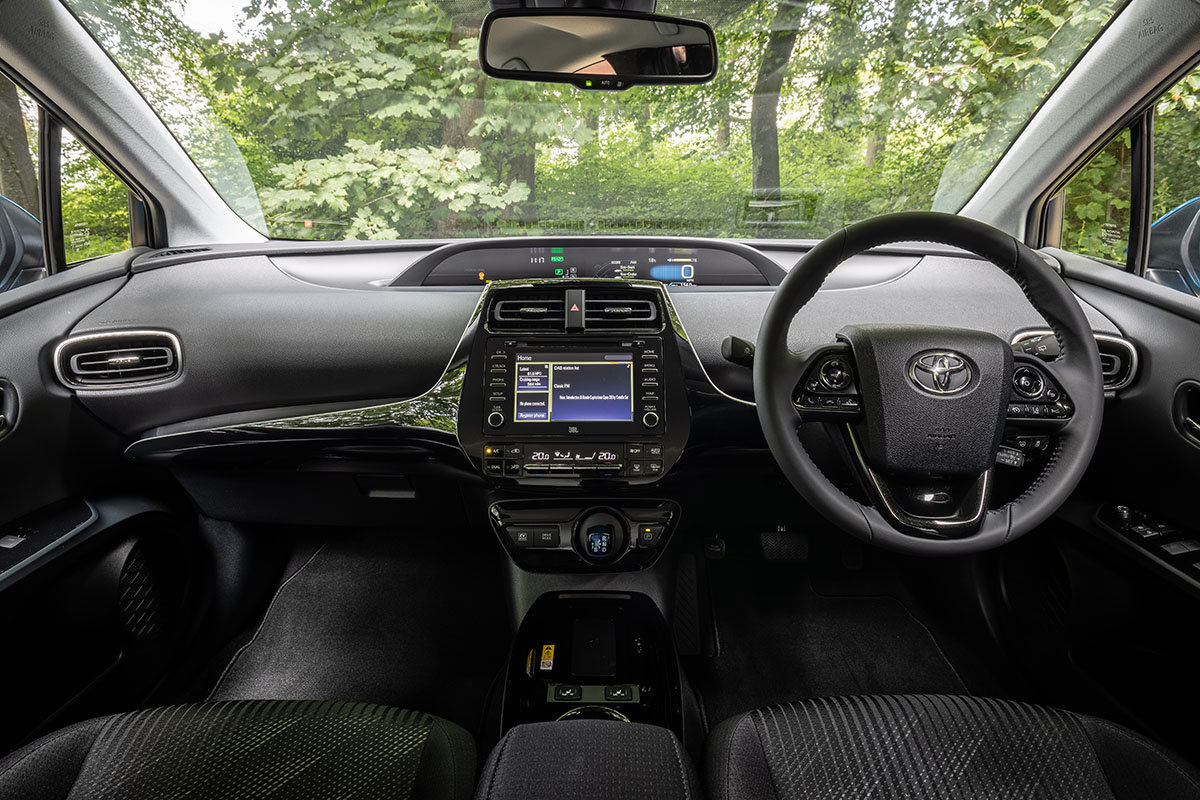
The Prius isn’t just unusual on the outside; inside, the main instrument cluster features colour screens instead of dials, and sits on top of the swoopy dashboard, in the centre of the car.
This layout takes a bit of getting used to, but there’s also a head-up display in all but the most basic version that puts essential information right in your eyeline.
Some of the plastics feel a little cheap to the touch, and the entertainment system can be quite fiddly to use, but on the whole the Prius feels solidly built and well thought out inside.
It’s a spacious car, too, with lots of room in the front and rear seats for passengers, and a long, shallow boot of 457 litres with a space saver spare wheel or 502 litres with a tyre repair kit in place of the spare.

What's it like to drive?
You wouldn’t expect an eco-friendly car to be all that exciting to drive, and in the Prius’s case, that’s certainly true. Having said that, it turns into corners well, with plenty of grip from the front end, and while the steering’s rather light, it’s still precise and responsive.
In short, bowling the Prius down a back lane is no longer the chore it once was, but even so, you probably won’t find yourself taking the long way home out of choice.
You’ll feel big bumps in the Prius, too, although it’s very good at ironing out the smaller ones, and once you get it up to speed on a motorway, it cruises along nicely.
The engine is also reasonably quiet most of the time, although it’ll make quite a bit of a racket if you try to accelerate hard. That's due to the continuously variable transmission (CVT) - the special type of automatic transmission that the Prius uses - which we’ll come back to presently.
Technology, equipment & infotainment
Even the most basic Prius, the Active, is well equipped, with features such as adaptive cruise control, LED headlights and a reversing camera as standard.
Our favourite version, the Business Edition, adds heated seats, classier dashboard materials and automatic wipers.
Business Edition Plus gives you a better sound system and satellite navigation, while the top-of-the-range Excel adds the likes of leather seats and a 360-degree parking camera.

Toyota Prius running costs
The standard Prius is pretty efficient, and should see more than 60mpg on average in your day-to-day driving. What’s more, because of the way hybrid technology works, you should get that sort of fuel economy whether you’re cruising on the motorway or bimbling around town. If you choose the AWD version, however, the extra weight of the additional motor means that mpg figure will drop to around 55.
If you’re planning to choose a Prius as a company car, there’s good news here, too, because low CO2 emissions and reasonable P11D values keep benefit-in-kind tax costs down to very affordable levels. And if you have somewhere to plug in at home, the Prius Plug-In will cost you even less, as its much lower CO2 will mitigate the effect of its higher P11D value.
Prius servicing costs are affordable, too, even at a Toyota dealership. An intermediate service shouldn’t cost you any more than it would for a conventionally powered mainstream family car, and you should find that the rest of the Prius’s maintenance and repair costs are similarly reasonable.
What’s more, the Prius’s 1.8-litre petrol engine is fitted with a timing chain that will almost certainly last the life of the car, instead of a rubber belt that needs replacing every few years.

Toyota Prius reliability
Let’s address the elephant in the room first: the battery. Some used car buyers are put off hybrids because they’re worried about the potential cost of replacing the large battery they come with.
However, this is unlikely to be an issue with the Prius. For starters, Toyota warrants its hybrid batteries for 15 years, as long as you keep your car serviced to Toyota’s standards. What’s more, we haven’t really heard of older Priuses requiring battery replacement yet, unless they’ve done super-high mileages.
If you do need to get your battery replaced outside of its warranty, the cost will be somewhere between £1,000 and £1,500. While that isn’t insignificant, neither would it be enough to write the car off until it’s very old indeed.
As for the reliability of the rest of the car, the signs are pretty promising. The Prius scored 98.4 per cent in the 2019 What Car? Reliability Survey, ranking it highly in the survey as a whole and better than almost all of the other family cars that took part.
Toyota as a brand didn’t do quite so well in the 2019 JD Power Vehicle Dependability Study, mind you, coming 18th out of the 24 manufacturers that took part. That said, the five-year, 100,000-mile warranty the Prius comes with should put your mind at ease either way.
- Every Prius is fitted with a CVT gearbox, which essentially doesn’t have different gear ratios and therefore makes acceleration feel seamless. You use it just like a normal automatic gearbox, and it’s a clever bit of kit as it holds the 1.8-litre engine at its optimal speed, thus improving fuel efficiency. But the downside is that this is usually quite high up the rev range, and that makes the Prius drone along in quite a noisy way if you accelerate hard.
- All-wheel drive (AWD) has been an optional extra on the Prius since 2019. The system adds a second electric motor on the rear axle, which works in tandem with the petrol-electric powertrain driving the front wheels. It’s only available on the Business Edition Plus version, and will cost you a hefty additional sum. It’s also worth noting that the extra motor means the boot floor has to be higher, reducing the amount of available boot space.
- The regular Prius uses what Toyota calls a self-charging hybrid system, which recoups energy from cruising and braking and stores it in a battery before deploying it through the electric motor when required. But there’s also a plug-in hybrid version of the Prius, which you can plug into the mains supply to keep the battery charged. Again, this is only available in Business Edition Plus form, and it comes with slightly different styling, to set it apart from the standard car. You get a larger battery, and the extra weight means the Plug-In is slower than the standard Prius, but the benefit is an electric-only range of up to 34 miles, according to the official figures. Equipment levels are generous, but the price is slightly higher than the standard car’s.
- If you want the best all-rounder: For most buyers, the Prius will be best served as a traditional hybrid, rather than a plug-in, and it doesn’t need the boot space-munching addition of all-wheel-drive either. So we’d choose the standard powertrain, and combine it with the Business Edition trim level, which gives you more than enough toys to feel very comfortable indeed.
- If you want satnav: If you don’t want to use an app on your phone via Apple CarPlay or Android Auto to navigate, you’ll need to upgrade to the Business Edition Plus version to get Toyota’s native satnav software, but don’t forget that doing so will add almost £2,000 to the price tag if you're buying new. You’ll also need to keep in mind that there are two versions of the Business Edition Plus, with 15-inch or 17-inch wheels. The latter is more expensive to buy, slightly less fuel-efficient, and won’t ride as comfortably.
- If you plan to use your Prius for a daily commute of less than 30 miles or so: In this case, the plug-in version might suit you better as you could be able to do all or at least most of the journey on electric power alone, saving you money on fuel. This version does cost more to buy or finance, though, so we’d advise you to do some maths before signing on the dotted line, to work out whether you’ll actually make back the cost of the upgrade in fuel savings.


