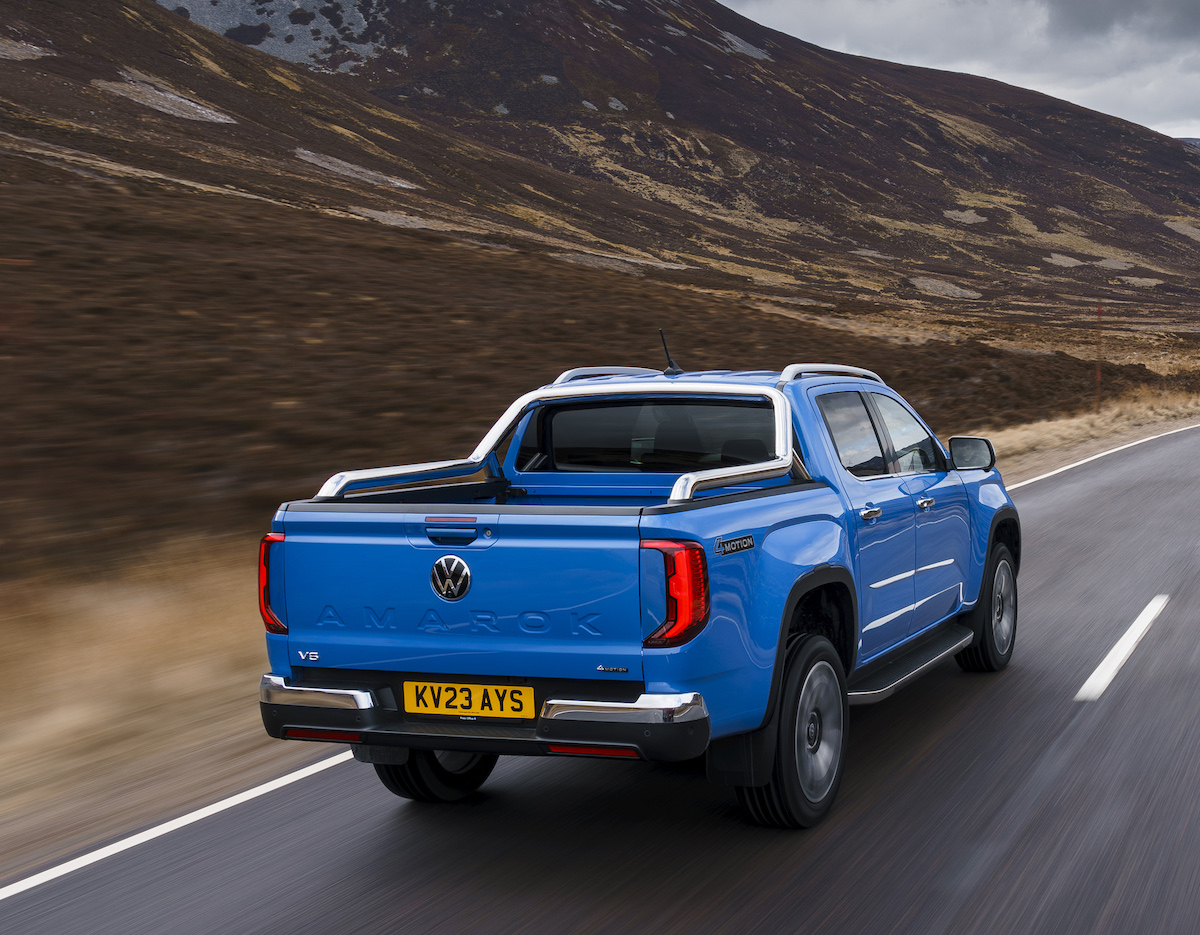
Volkswagen Amarok Review (2010-2020)

Pros and cons
What we like
Hefty payload and a big loadbed
Enjoyable to drive, especially the V6 models
Classy cabin
What to consider
Huge size can be intimidating to drive around town
Tends to cost more on the used market than most rivals
A Toyota Hilux has the edge for reliability
The CarGurus verdict
You can buy more economical pick-ups than the Volkswagen Amarok, and some are better value. But if you can afford to buy and run the Amarok, it's one of the best pick-ups you can buy.
The 2.0-litre models are all well and good, but if you want a posh pick-up the 3.0-litre V6 Amaroks are the ones to choose. There's something very appealing about a two-tonne truck with hot-hatch-like acceleration.
Inside the double cab, there's enough space for five and a good standard of finish – only the Mercedes X-Class outranks the Amarok as a posh pick-up.
It's bigger, quicker, and sounds better than most pick-ups, but the Amarok also does the sensible things well. Tough leaf-spring suspension contributes to a payload of over a tonne, and the load bay is long and wide.
It's not as reliable as a Toyota Hilux, and a Ford Ranger is as good to drive, if not better.. But if you want a pick-up that's enjoyable to drive as well as tough and practical, the Amarok fits the bill.
out of 5 expert review
What is the Volkswagen Amarok?
When Volkswagen first unveiled the Amarok, it caused something of a stir. Up until the German machine’s arrival in 2010, pick-up trucks were rugged and utilitarian machines, little more than hard-working tools for business that needed a go-anywhere machine for tackling muddy building sites or hard-to-reach farmland. However, with its chiseled looks, surprisingly classy interior and that desirable VW badge on the nose, the Amarok helped create a new niche for these otherwise tough trucks.
Classed as commercial vehicles but with double cab layouts that could seat five, models like the Amarok allowed canny business owners to pay much lower company tax rates yet still have spacious, well-equipped and reasonably refined family runaround. In fact, the idea was so successful that it even encouraged Mercedes to launch a pick-up, the short lived X-Class.
Early in its life, the Volkswagen Amarok pick-up truck was sold with 2.0-litre TDI engines with 138bhp or 178bhp. Things got a whole lot more interesting in 2016, when Volkswagen decided downsizing need not apply in the pick-up truck market, and replaced the 2.0-litre diesel engines with a 221bhp 3.0-litre V6, which kicked sand in the face of the earlier models, and comprehensively outmuscled most rivals too. Crucially, the new engine was joined by a more upmarket interior and revised suspension that delivered enhanced refinement.
Further changes came in 2018, when VW upped the ante by increasing the range-topping engine's power output to 254bhp (or 268bhp for brief periods using the overboost function). Torque climbed to 428lb ft. As well as the full-fat version of the V6, VW continued to offer the 201bhp and 161bhp engines in the line-up.
In 2020, VW announced it was winding down production of the first-generation Amarok production, and an all-new version appeared in 2022. Developed in partnership with Ford, it will share its platform and engines with the Blue Oval’s forthcoming Ranger replacement.
Practicality
How practical is it?
UK Amaroks have always been double-cab pickups, although single-cab models have been sold in other markets. This means they can double-up as family transport, making it a versatile choice for those looking to combine work and play. And while the cabin doesn't match the upmarket finish of the Mercedes X-Class, it’s a cut above most pick-up rivals, which means you won’t feel like you’re slumming it in your personal time.
Clambering in and out of the Amarok can be a little tricky as the car sits so high (running boards are a good option, as they provide a handy step into the cabin), but once in there’s comfortably space for five, with plenty of head and legroom in the rear. The driver gets a wide range of seat and wheel adjustment, while the VW is tall enough that you’ll be looking down on most SUV owners, plus you benefit from a commanding view ahead.
Given its commercial vehicle roots, it’s no surprise to find the Amarok is crammed with handy storage. There’s a vast glovebox, door bins that will swallow 1.5-litre bottles, a deep compartment between the front seats, a large dash top tray and a cubby ahead of the gear lever. Neat touches include a small magnet by the infotainment system and a clip for securing paperwork, such as receipts and shopping lists.
With a large 2.52 square meter load bay that will comfortably swallow a euro pallet, the Amarok isn’t short of carrying capacity, plus it has a maximum payload of 1,154kg. A plastic lining makes the pick-up bed look neat and can easily be hosed-down, while the tailgate drops to create easy access.
However, if you’re planning on using an Amarok as daily transport then you’ll need to consider a locking load cover for security, plus some way of securing luggage to stop it sliding around on the vast bed. It’s also worth bearing in mind that the car’s height and large tailgate mean accessing items further back in the load bay can be tricky - you’ll probably have to climb in.
Towing limits range from 3,000kg to 3,200kg for the early cars, while for the most recent V6 models the braked trailer figure is 3,100kg for all versions.

Driving
What's it like to drive?
The Amarok’s upmarket image (for a truck) is translated into a more car-like driving experience than most of its rivals, particularly the later V6-engined machines. Even so, under the skin the Amarok still has a similar suspension layout to other pick-up models, with a live rear axle that’s good for accepting heavy loads but less effective and serving up a smooth ride.
By SUV standards the VW’s steering is slow, but it’s decently weighted and accurate, helping give the car a surprising sense of agility. And while there’s a fair amount of body roll if you attack corners with gusto there’s also decent grip as well. The standard four-wheel drive system also means traction is strong even in slippery conditions.
Less impressive is the ride, particularly on earlier cars, which can feel bouncy and unsettled on bumpy roads. It improves when you add some weight, especially in the load bay, while on smoother roads it's rarely an issue. Combined with the decent refinement and muscular diesel engines it makes the Amarok a surprisingly civilized motorway cruiser.
It also feels surprisingly wieldy in town, despite stretching the measuring tape at more than five metres, thanks to that high set driving position that allows you to see all four corners of the car - although it’ll be a squeeze when slotting the car into a parking space. Most versions also have an automatic gearbox, further taking the strain out of navigating the urban jungle.
Whether automatic or manual, every version of the Amarok all the way back to 2011 (when UK sales started) has been fitted with Volkswagen's 4Motion 4x4 system. In most models the Amarok employed selectable four-wheel drive. In other words, the driver can decide whether they need the extra traction, or the improved economy of running as a rear-wheel drive vehicle. Permanent 4Motion rather than selectable four-wheel drive was an option on early Highline models.
Of the engines, the V6 is the best of the bunch by a significant margin, combining impressive pulling power with a surprisingly urbane delivery, its muted growl proving far more sophisticated than the clattery soundtrack of the early four-cylinder cars. Those 2.0-litre TDI powerplants are effective enough, however, especially the gutsier twin-turbo units, but if your budget stretches then the larger units are vastly superior.
Over the years the V6 was available in a variety of outputs, from 161bhp to up to 268bhp, which helps give the Amarok a decent turn of speed. How decent? Well, if you’re in a hurry to get to the builder’s merchants (or the supermarket), the most powerful version can thunder from 0-62mph in a claimed 7.4 seconds, which is enough to embarrass the odd dedicated sports car.
For pulling heavy loads, however, an engine's torque is more important than its peak power, and this V6 developed a mighty 406lb ft. That's almost 100lb ft more than the earlier Amarok engines, enough to completely transform the big VW's performance.
A six-speed manual was offered on lower powered models, but its notchy action and the minimal increase in cost in upgrading to the automatic meant most Amaroks have a self-shifting gearbox. Early models got a six-speed unit, while the V6’s benefited from a smoother and more efficient eight-speed unit.

Tech and equipment
Technology, equipment & infotainment
Even entry-level Amaroks have always been reasonably well equipped. Alloy wheels, air conditioning, and a CD player were standard on early Startline models. Upgrading to Trendline brought larger alloys (17-inches rather than 16) and a better stereo (six speakers rather than two), as well as a leather steering wheel, cruise control to give your right leg a rest on the motorway, and climate control rather than basic air con.
Amarok Highline models add 18-inch alloy wheels, front and rear parking sensors, heated seats, leather upholstery and more. Later models have different trim levels, ranging from Trendline, through Highline, to Black Edition and the range-topping Aventura Black Edition.
As you'd expect, infotainment has come a long way during the Amarok's decade on sale. The 'Discover Media' system is fitted to the Aventura Black Edition and has been an option on the Trendline and Highline. It has a larger touchscreen than the more basic 'Composition Media' system and a second SD card slot. On the plus side, the system is fairly easy to upgrade with an aftermarket unit that has Apple CarPlay and Android Auto, and many owners of earlier cars have already made this switch.

Running costs
Volkswagen Amarok running costs
In terms of fuel economy, there's very little to choose between the pair of 2.0-litre engines fitted to early Amarok models. Surprisingly, the most economical is the high-spec 178bhp 2.0 BiTDI with the permanent 4x4 system and a manual gearbox. This returns 37.2mpg, or 35.3mpg with an automatic gearbox. With the selectable 4Motion 4x4 four-wheel drive and a manual gearbox, the lower-powered diesel achieves 36.2mpg, the higher-powered 35.3mpg. There's almost nothing in it, so we'd definitely choose the 2.0-litre BiTDI given that there's no penalty to speak of for its extra performance.
You would think the V6 diesels would be thirstier than the earlier cars, but that's not the case. Even the 221bhp version returns 36.2mpg on the combined cycle, which isn't bad at all considering the Amarok's size and weight. Later versions of this engine with 254bhp had their mpg tested to the more realistic WLTP standard, and can achieve 25.9-28.2mpg according to the official figures. We'd expect the earlier models to be similar in terms of real-world fuel economy.
Those figures compare with 38.2mpg for the top-spec Nissan Navara automatic, although that's an NEDC rather than WLTP figure. Even allowing for this, you can expect the Amarok to be thirstier than its less powerful rivals.
Volkswagen offers fixed price servicing for vehicles over three years old across its dealer network, so the cost doesn't depend on where you live. At the time of writing (autumn 2020) an interim Amarok service costs £150, excluding VAT. A major service costs £280, excluding VAT. Genuine VW parts are used and come with a two-year guarantee.
It's possible to finance the cost of servicing and repairs with no interest to pay at participating dealers.
The Amarok has a three-year/100,000-mile warranty. Compare that with a five-year/100,000-mile warranty for the Toyota Hilux, and a five-year/125,000-mile warranty for the Isuzu D-Max.

Volkswagen Amarok reliability
If you want an absolutely unbreakable pick-up truck, it's hard to look beyond the super-reliable Toyota Hilux. The Volkswagen Amarok suffers from more faults than the Hilux, although not often enough to put us off.
One relatively common problem is a faulty EGR (Exhaust Gas Recirculation) valve. If this breaks you'll notice the engine warning light come on, and the engine may not idle smoothly.
We've also heard of Amaroks with faulty water pumps, which can cause the engine to overheat. Some owners also report that the 2.0-litre diesel engines can get through a lot of oil. The later 3.0-litre engines are better in this respect.
As with any diesel fitted with a diesel particulate filter (DPF), the Amarok is none too keen on stop-start journeys that don't include some kind of long run. It can cost over £2,000 to replace a DPF, so it pays to take the VW for a long drive as soon as the warning light comes on rather than risking a failure.
There have been a handful of recalls to be aware of. One concerns Amaroks with the optional hardtop fitted over the load bay. Due to a manufacturing error, the side glass can fall out. Affected vehicles were made between 1 March 2019 and 6 September 2019.
Another relates to the servo return pipe to the steering box becoming damaged through contact with the body of the wheel housing. The damaged pipe can leak hydraulic fluid onto the brake discs, risking a fire. This recall affects Amaroks made from 19 December 2015 to 24 November 2017.
To check if any VW Amarok you are thinking of buying has any recall work outstanding, go to the recall checker on the gov.uk website.


What owners say
Three things to know
- The Amarok is very capable off-road. The exact spec has varied through the pick-up's time on sale, but later cars feature a 4Motion system that defaults to sending 40% of the power to the front wheels and 60% to the rear. An electronic differential lock (EDL) to make sure power is always sent to wheels with the grip to use it. A mechanical differential lock was available as an option. Volkswagen says the Amarok is capable of scaling a 45-degree slope even with a full load, and has a wading depth of half a metre.
- Despite their size, safety isn't always a strong point for pick-ups. The Volkswagen Amarok is better than most, scoring four stars out of five when assessed by Euro NCAP in 2010, although it's worth noting that the tests are now much tougher than they were then. All Amaroks have four airbags and electronic stability control. Later models also have Volkswagen's Automatic Post-Collision Braking System which applies the brakes after a crash to reduce the severity of any second impact. However, the Amarok is short on advanced driver aids if you are considering one as an alternative to an SUV.
- Despite offering a more upmarket experience than many pick-up rivals, the interior of early Amarok models is still a little cheap and cheerful by the brand’s usual standards. The dashboard is well laid out and features easy to read dials, but the plastics are hard, scratchy and clearly designed for robustness rather than premium appeal. Matters improved with the 2016 facelift when the dash was redesigned, getting more soft touch materials and switchgear from the contemporary Golf, helping make the cabin feel more car-like and welcoming.
Which one to buy
- If you are looking at an older Amarok: buy the 178bhp 2.0-litre BiTDI. It's a much stronger engine than the 138bhp TDI, which is a bit weedy for the kind of heavy use pick-ups are designed for. It's not just more powerful, it also has a lot more torque. What's more, there's very little difference in fuel economy.
- If you want a good spec but don't need all the latest toys: choose the Trendline. You may miss out on leather upholstery and the infotainment won't be flashy, but there are practical touches such as storage draws under the front seats and three 12V sockets that you don't get on the basic Startline.
- If you want a high-performance pick-up: pick the 254bhp 3.0-litre V6 TDI. With this bruiser of an engine under the bonnet, the Amarok is capable of 0-62mph in 7.4 seconds. There's plenty of pulling power for hauling heavy loads, or towing a boat or a horsebox. It sounds much better than the four-cylinder diesels that power rivals like the Mitsubishi L200 and Nissan Navara.
- If you want to bring the bling: go for the Aventura Black Edition. This comes with 20-inch alloy wheels, black-framed front fog lights with cornering lights, and heated power-folding mirrors. Inside, the cab is trimmed in Nappa leather, and there's a six-speaker stereo with voice control and DAB, plus Car-Net or App-Connect mobile online services. Climate control and the top-spec 'Discover Media' sat nav and touchscreen infotainment system are standard. It's one of the most highly specified vehicles on the pick-up market.