Volkswagen Tiguan Review (2016-2024)
Volkswagen Tiguan cars for sale
5.0
Expert review
Pros
Very practical, with lots of space for people and luggage
Good to drive
More affordable than premium rivals from Audi and BMW
Cons
A Skoda Kodiaq is cheaper
Mixed reliability record
New car warranty is short compared with those offered by Hyundai and Kia

The CarGurus verdict
The Volkswagen Tiguan is a great family SUV, and it hits a very nice balance between classy and desirable, without having to go to the expense of buying a BMW or Audi. It’s also impressively spacious and the 40/20/40 split and folding rear seats are great for juggling space between passengers and luggage, as well as for keeping arguments between the kids to a minimum. More than that, the cabin – while not as plush as that offered in premium rivals – is seriously comfortable and feels well put together.
Overall, it really is one of the most complete family SUVs you can buy on the used market and it’s not hard to see why it’s so popular. We would like to see better, more consistent reliability record, and we’d also encourage buyers to look to the Skoda Kodiaq or Seat Ateca for a very similar offering at a better price. But while there are cheaper alternatives, the VW Tiguan justifies pricing that splits the difference between the established premium SUVs and more budget brands.
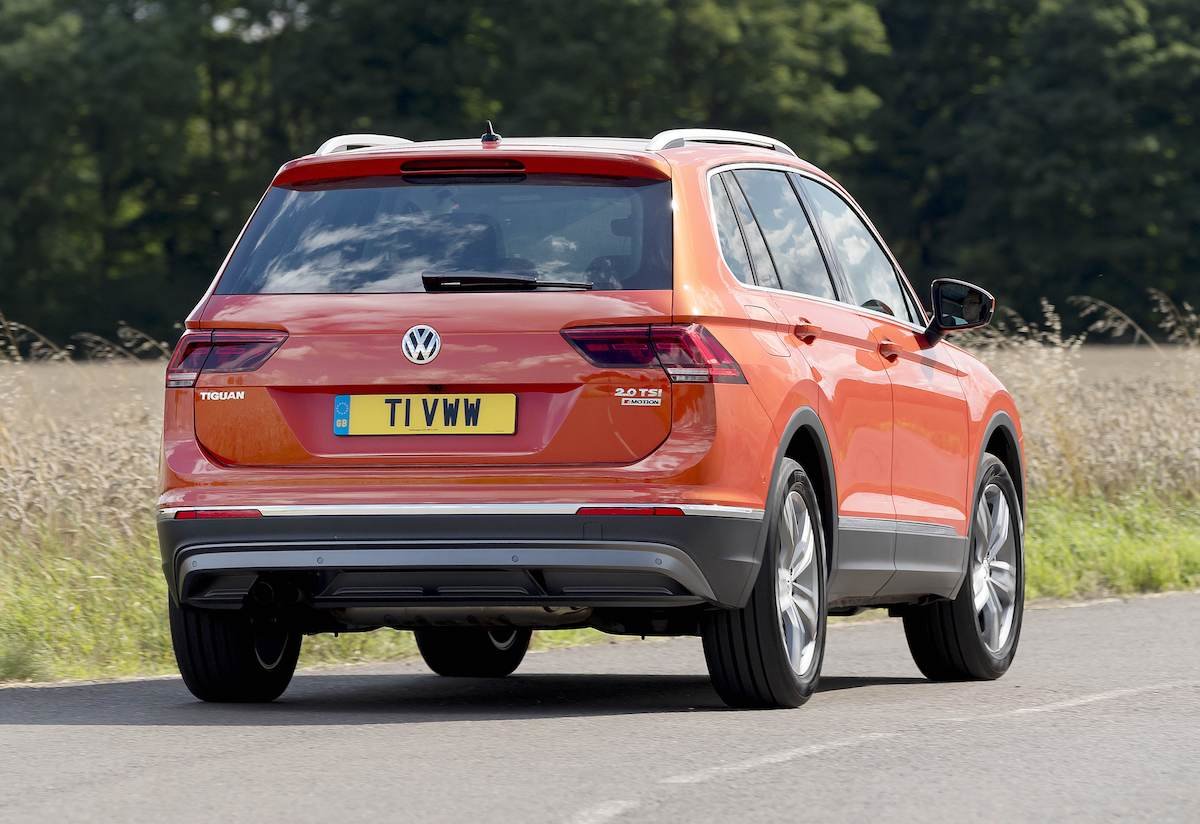
What is the Volkswagen Tiguan?
The Volkswagen Tiguan is a medium-sized, five-seater family SUV that’s a little bigger than a Nissan Qashqai and a little smaller than the Skoda Kodiaq.
It takes on these well-known alternatives as well as a kaleidoscope of similarly priced alternatives including the Mazda CX-5, Ford Kuga, Toyota RAV4 and more. Its trump card is the happy balance it offers between classy interior feel, upmarket kerbside appeal and reasonable purchase costs.
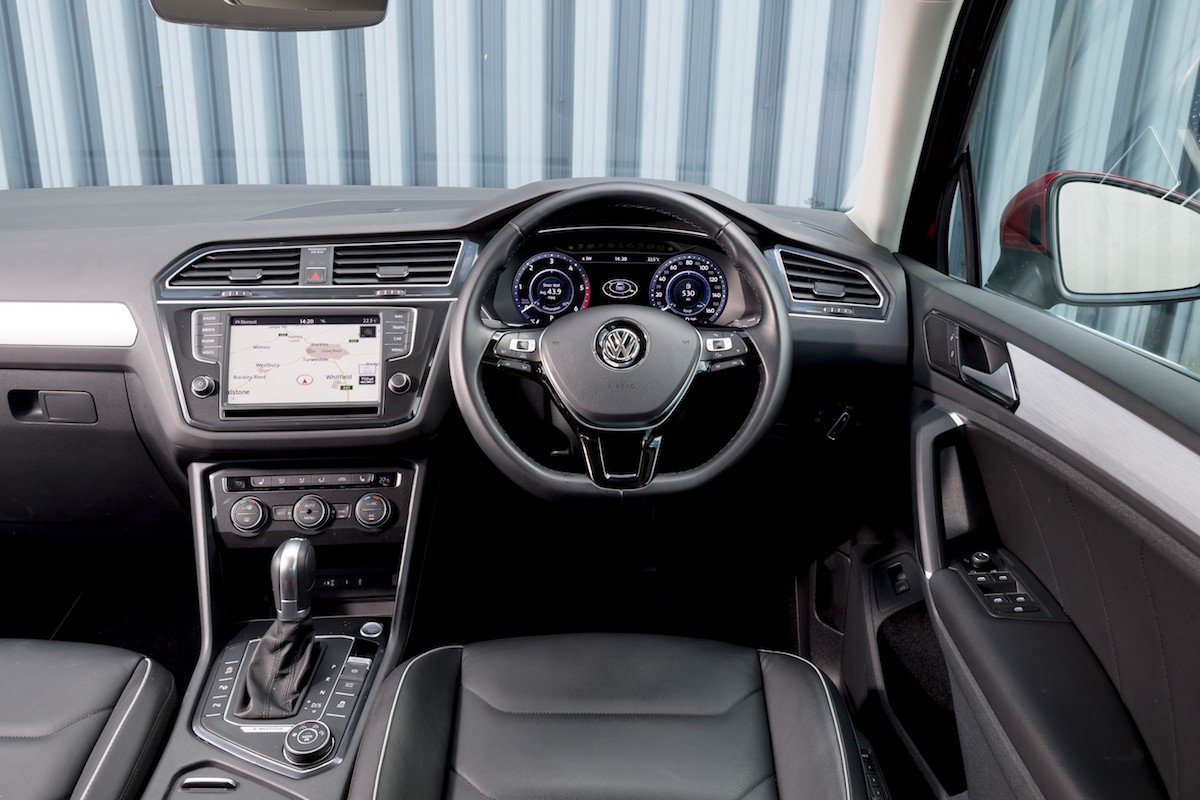
The mk2 Volkswagen Tiguan, introduced in 2016, really nails this, with a smart interior focussed on a large colour touchscreen infotainment system mounted in the dashboard. Volkswagen took that and ran with it when the latest version was launched in 2024.
A second generation Tiguan can still make for a great used buy, however. If you need seven seats, look out for the slightly longer Tiguan Allspace, which crams a couple of (very small) extra seats in the boot.

How practical is it?
Practicality in the Tiguan is as good as you’d expect given its generous dimensions. The rear seats slide back and forth to toggle boot and passenger space and, when they're all the way forward, the 615-litre boot is big even by class standards, and comes complete with a variable-height boot floor. The 40/20/40 split rear seats fold flat easily, and also slide so that you can prioritise passengers or boot space.
With the seats slid back, there’s plenty of space for two tall adults to lounge about comfortably, or for two chunky car seats. If you value seven-seat practicality, the Volkswagen Tiguan Allspace offers just that, as does the excellent Skoda Kodiaq and Peugeot 5008, the latter of which is great for getting three child seats in the middle row.
True to its family friendly nature, the Tiguan also offers excellent in-car storage, with a decent glovebox and enough cupholders and cubbies for your belongings.

What's it like to drive?
There’s a decent range of engines available for the Tiguan, including petrols and diesels with manual and automatic gearboxes, although you have to go for a fairly expensive diesel model if you want four-wheel drive. We favour the 1.5-litre EVO petrol, which is offered with 128- or 148bhp and feels sprightly enough in either power output.
The latter is better if you want to carry the whole family on long trips regularly. It can be had with either a six-speed manual or seven-speed dual-clutch automatic – both of which are really nice to use – and it has loads of traction despite being front-wheel drive.
A 2.0-litre diesel is available with 148- or 187bhp, also with automatic or manual gearboxes, and four-wheel drive if you want it. It’s quiet by diesel standards and manages good fuel economy so will suit high-mileage drivers well.
Eco-conscious drivers or company car users will be more drawn to the eHybrid plug-in hybrid model, available from 2021, which uses a 1.4-litre petrol engine combined with an electric motor to provide 241bhp and an all-electric range of around 30 miles. Fans of performance cars, meanwhile, can go for the range-topping 316bhp Tiguan R, introduced around the same time as the plug-in hybrid. This uses the same drivetrain as the Golf R hot hatch and, while not quite as nimble as that car, is still good fun to drive.
Technology, equipment & infotainment
When new, the Tiguan's touchscreen systemwais one of the best in the class, although you have to go for Match trim or above to get the features that most will want; the bigger 8-inch colour touchscreen, satnav, Apple CarPlay and Android Auto. Even as a used buy, the touchscreen system still holds up well in terms of features and graphics.
Given that Match also includes three-zone climate control, reversing camera, auto lights and wipers, heated wing mirrors and more, it’s the pick of the bunch on balance of value and convenience.
A significant facelift in the autumn of 2020 brought new LED headlights, a redesigned grille and a reprofiled bonnet. Inside, the facelift gained touch-sensitive sliders for the climate control and updated infotainment systems. The model range was also tweaked, with the base models simply badged Tiguan, with Life models above that and Elegance or R-Line at the top of the range.

Volkswagen Tiguan running costs
Once you’ve got the Tiguan on your driveway, running costs are very competitive. Fuel economy on the petrols will be around 35-40mpg in varied driving, or you can edge it up to 45mpg on an easy motorway run. The 2.0 TDI 150 with a manual gearbox will be the most economical, and will likely do close to 50mpg, while the more powerful diesel will be closer to 45mpg. Opting for four-wheel drive and an automatic gearbox could see average mpg figures drop to 40 despite the diesel power. The eHybrid offers a theoretical 157mpg, but expect real-world fuel economy of around 50mpg unless you plan to charge most days.
Insurance costs are low by class standards; groups range from 12 to 16, which is lower than a Toyota RAV4 and Mazda CX-5, and is on a par with the Kia Sportage and Skoda Kodiaq.
The Tiguan holds its value well, so if you’re planning on buying the car outright and then selling on in a few years, it’s a good bet. Fixed price servicing plans are available, with a check-up needed every 12 months or 10,000 miles.

Volkswagen Tiguan reliability
The Tiguan didn’t fare well in the 2024 Auto Express Driver Power survey, being ranked 45th out of 50 cars, and owners have reported faults within the first year, with electrical issues particularly common. In the 2024 What Car? Reliability Survey, petrol Tiguans came 22nd out of 33 cars in the family SUV class, while diesels came 28th. Certainly, the Mazda CX-5, Lexus NX, Honda CR-V and Toyota RAV4 all routinely do better in reliability tests.
There have been a number of recalls. Cars built between August and November 2016 had a potential fault with the seat back, and some cars built in 2016 were also subject to a recall for airbag and seatbelt tensioner. Some models built between November 2018 and May 2019 may need a software update to solve a low torque from the engine, and there may be issues with factory-fit towbars on examples built between May 2016 and November 2018.
The Tiguan scored well in 2016 Euro NCAP crash tests, and all models get autonomous emergency braking, lane-keep assist, seven airbags including a driver’s knee airbag and a space saver tyre. The standard warranty from new was for three years and 60,000 miles. This could be extended at extra cost, but you’ll have been granted a much longer warranty as standard on the Kia Sportage and Hyundai Tucson.
- This generation of the Tiguan was launched with a 1.4-litre petrol engine, which was replaced with a 1.5 in 2018. Don’t discount the 1.4 if you’re buying used – it’s a really nice engine, and the 148bhp version would be our favourite of the early Tiguans. There was also a lower powered 128bhp 2.0-litre diesel but this can feel a little gutless. The 148bhp 2.0-litre diesel is better to drive as well as much easier to find on second-hand forecourts.
- Trim levels were also tweaked over the life of the Tiguan, but R Line (or R Line Tech in later models) has always topped the range and is set apart by its more aggressive styling, including chrome highlights and big alloys, and stiffer suspension. We favour one of the mid-range SE or SE Nav in earlier cars, or Match in later cars. They all have front and rear parking sensors, cruise control and the colour touchscreen system at a very decent price, and Match models include satnav as well as rear parking sensors.
- All but the base S trim in the Tiguan models get Guide and Inform, a service that brings live traffic information, and allows you to send routes and destinations from other devices to your car’s nav. It’ll even tell you the weather and, if you synchronise it with your online calendar, suggest when is a good time to leave for a scheduled appointment based on current traffic information. It’s a three-year subscription that’s included with new cars, but you’ll pay for the privilege after that.
- If you're a company car driver: With CO2 emissions of 38g/km, the plug-in eHybrid model offers the best Benefit-in-Kind tax breaks, plus zero vehicle excise duty. Of the non-electrified versions, the 1.5 TSI 130 engine is the best option. It’s a tax band lower than the more powerful 1.5 petrol, but that doesn’t add up to a huge difference in Benefit-in-Kind tax, so do consider the perkier 1.5 150 if you value more peppy performance.
- If you need to tow: Look to the 2.0 TDI 4Motion four-wheel-drive models, specifically the automatic DSG versions that have a maximum braked towing capacity of 2,500kg. Manual versions can tow 2,200kg, while the petrols will manage more like 1,600-1,800kg depending on the power output.
- If you're on a budget: The base S model is of course the cheapest option. Just make sure that you’re okay with the infotainment system, as you have to go for Match to get the excellent 8.0-inch colour touchscreen and nav. S trim does get Bluetooth handsfree and audio streaming, digital radio, USB input, air-conditioning, alloy wheels and lane keep assist, so it’ll have more than enough comforts for most buyers as well as being cheaper to buy. However, the Match trim will hold its value much better.
- If you want the sportiest version of the Tiguan: The Tiguan R is the one to go for. It’s basically got the same running gear as the fire-breathing Golf R so gets 316bhp, four-wheel drive, adaptive suspension with a ‘Race’ setting and sporty-looking 21-inch alloy wheels.


