Mazda CX-5 Review (2017-present)
Mazda CX-5 cars for sale
4.0
Expert review
Pros
Agile and involving to drive
Eye-catching looks
Diesels combine strong performance and fuel economy
Cons
No seven-seat option
Some rivals have bigger boots
Petrols feel a bit gutless at low revs

The CarGurus verdict
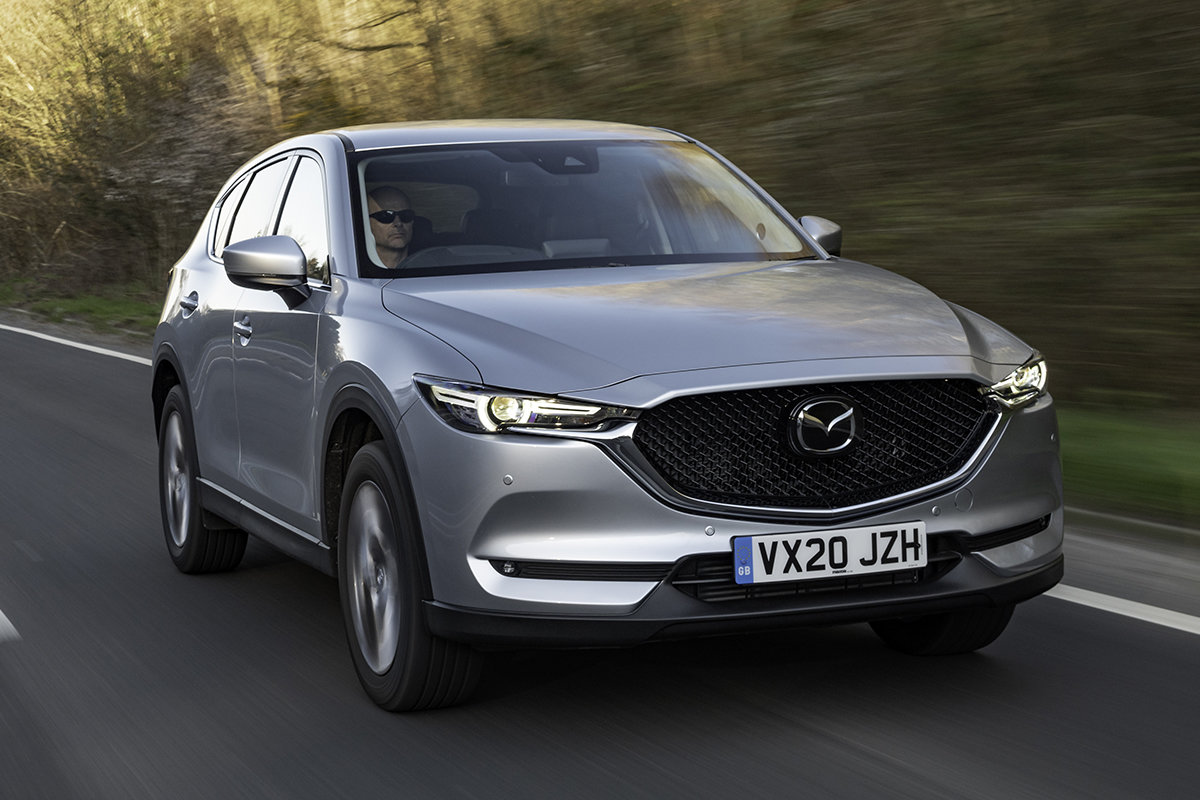
We really like the Mazda CX-5. It’s a feel-good car, with eye-catching styling, and simply one of the best SUVs to drive.
It isn’t flawless. The boot and the rear seats are a bit on the small side, and it’s a shame there’s no way you can add an extra row seat seven, as you can with some of its rivals. You might also grow a bit frustrated with the petrol engine’s lack of low-down grunt.
That’s why we suggest choosing a diesel version instead. Do so, and you’ll grow to love the slick way the CX-5 drives, not to mention its comfortable ride and that tasteful interior. You’ll also appreciate its reliability and the way the switchgear and the entertainment system are both clearly laid out and easy to use. This, in other words, is a hassle-free SUV with a touch of class and more than a dash of flair.

What is the Mazda CX-5?
The acronym may well stand for Sports Utility Vehicle, but SUVs aren’t very sporty very often. Small wonder, really; sports cars tend to be low and lithe, but the tall stance and high ground clearance you need for the ‘utility’ bit of the equation rather precludes that.
But there’s always an exception that proves the rule and, in this case, that’s the Mazda CX-5. This is, after all, a car engineered by the same people who came up with the sublime MX-5 sports car, and there’s more than a hint of that in the way the CX-5 drives.

There’s no seven-seat option, which puts the CX-5 at a disadvantage against cars such as the Skoda Kodiaq and the Volkswagen Tiguan Allspace. What’s more, the 522-litre boot isn’t the biggest in the segment, and that sloping rear screen means that, even with the seats folded, you might struggle to squeeze in bulkier objects.
At least the rear seats split in a versatile 40/20/40 formation, and while they don’t slide back and forth as they do in some SUVs, you can choose between reclined seat backs for passenger comfort, or a more upright position to increase boot space without having to fully flatten the seats. There’s enough space in the back for two adults to sit comfortably, and even three will be fine on short journeys.
What's it like to drive?
From the slick, short gearchange in manual versions, to the excellent driving position, the direct and beautifully weighted steering, and the way it dives eagerly into every corner, the CX-5 is fabulously nimble, with far superior driving dynamics than rivals such as the Nissan Qashqai and the Seat Ateca.
Of course, all this would be for nought were the CX-5 bad at an SUV’s principal raison d’etre, which is shuttling your family around in safety and ease, but it’s not bad at that, either. While perhaps not as comfortable as it is in some rivals, the ride is certainly supple enough for the job.
There’s a 163bhp 2.0-litre petrol engine and a 2.2-litre diesel, which can be had in either 148bhp or 181bhp variants. Both the petrol and the least powerful diesel come with front-wheel drive, although if you opt for the more potent diesel, you get all-wheel drive thrown in.

Technology, equipment & infotainment
The CX-5 is as smart inside as it is outside, with a classy dashboard housing clear instrumentation and a central touchscreen system that’s very easy to use. It’s all put together well, too, with tactile materials and the sort of solid build quality that suggests you won’t hear any rattles for years to come.
There are three different trim levels to choose from: SE-L, Sport, and GT Sport. Some rival manufacturers have cheap entry-level models so they can boast of a low starting price. Mazda doesn’t do this, and every version of the CX-5 comes with lots of standard equipment. Even the SE-L has LED headlights, dual-zone climate control and adaptive cruise control, while Sport adds heated front seats, a heated steering wheel and leather upholstery; GT Sport versions get a Bose sound system and adaptive headlights.

Mazda CX-5 running costs
It’s our recommended engine, the 2.2 Skyactiv-D 150, that offers the best fuel economy in the range. You should be able to bank on achieving around 40-45 mpg in day-to-day driving, which is reasonable, but it means the CX-5 isn’t the most fuel-efficient car in its class.
By comparison, you’ll struggle to get the more powerful AWD diesel above 40 mpg unless you’re on a gentle cruise, and don’t bank on getting any more than 35 mpg from the petrol.
Mazda’s servicing costs are a little pricier than, say, Ford’s or Vauxhall’s, but they’re cheaper than those of Mercedes or BMW. The same goes for parts and repair prices.
One cost you won’t have to worry about, though, is that of a replacement timing belt; the CX-5 is instead fitted with a metal timing chain, which should last the life of the car without needing to be changed.

Mazda CX-5 reliability
A petrol CX-5 shouldn’t incur too many other unforeseen costs, because it has a good reputation for reliability, finishing ninth out of 33 cars in the family SUV category of the 2024 What Car? 2024 reliability survey. However, the diesel CX-5 came 27th, and Mazda as a brand ranked a middling 16th out of 31 manufacturers.
It’s a bit of a shame that reputation isn’t backed up by a longer warranty, too. Mazda only offers three years and 60,000 miles, which is about the minimum you can get away with these days. Others like Kia, Hyundai and Toyota offer far longer warranties.
- Mazda has bucked the trend for smaller engines boosted by a turbocharger and tried something different. The CX-5’s engines are larger, and in petrol form, naturally aspirated – which means there’s no turbo – but Mazda says they’re just as economical thanks to a range of special features within the engine. It calls this philosophy Skyactiv, and you’ll see that badge on its engines. Does it work? On the whole, yes. Mazda’s engines tend to be about as economical as rivals’ in the real world, while being less mechanically complex and, in theory, more reliable. The downside is that they generate their power much higher up the rev range, which means you have to drive them a bit harder.
- The Mazda CX-5 is best served with a manual gearbox. A six-speed automatic is available, and while that does what it says on the tin, it isn’t as fast or as clever as those of rivals, which means it can take the shine off the CX-5’s otherwise very rewarding driving experience.
- If you’re comparing prices with rivals’ and the Mazda looks expensive, make sure you compare specification lists to check that the other cars you’re thinking of buying come with as much equipment. As we mentioned, the company doesn’t really do cheap, base-spec models, so make sure you’re comparing like-for-like with competitor SUVs.
- The best all-rounder: Diesel might not be as fashionable as it once was, but in the Mazda CX-5, the diesel engines work best. They have more low-down grunt than the petrol, which is better for hauling your passengers and their stuff around. We reckon the 148bhp 2.2-litre Skyactiv-D 150 SE-L is the best of the bunch.
- The all-wheel drive option: The 181bhp diesel engine has the extra weight of that four-wheel drive system to haul around, so it’s thirstier and not all that much faster. That said, if you’re planning to pull a caravan regularly, its greater towing capacity might be useful. You’ll need to upgrade to the Sport model, though.
- The petrol: If you really don’t want a diesel, the 2.0 Skyactiv-G 165 SE-L is the best option. It’s the cheapest petrol model in the range, is well equipped, and its list price is lower than that of the diesels.
