Dacia Sandero Stepway 2026 review | A supermini with crossover appeal
Dacia Sandero Stepway cars for sale
3.0
Expert review
Pros
Undercuts its rivals by thousands of pounds
Improved quality and comfort compared with the previous model
The optional automatic gearbox is smooth
Cons
More expensive than a regular Sandero
Lags behind the latest safety standards
Entry-level cars are quite basic

The CarGurus verdict
By the standards of your average micro-SUV, the Sandero Stepway is a bit rough around the edges. It’s slow, it’s noisy, there’s not much finesse to its controls, the interior quality is behind that of most other cars in the supermini class, and despite vast improvements, it’s still not the safest car on the road by the latest standards.
But what you have to remember is that the Stepway costs far, far less – we’re talking thousands, not hundreds – than pretty much any of those rivals. Not only are these sacrifices worth making for such a low price tag, we’re frankly astounded that more sacrifices aren’t necessary.
Granted, the Stepway’s financial argument isn’t quite as compelling as that of the regular Sandero hatchback, but it’s operating in a different ballpark, mixing it with different, more expensive players, so it’s still terrific value compared to its rivals. Splash out on one of the posher trims, and it might even be better equipped, too.
What is the Dacia Sandero Stepway?
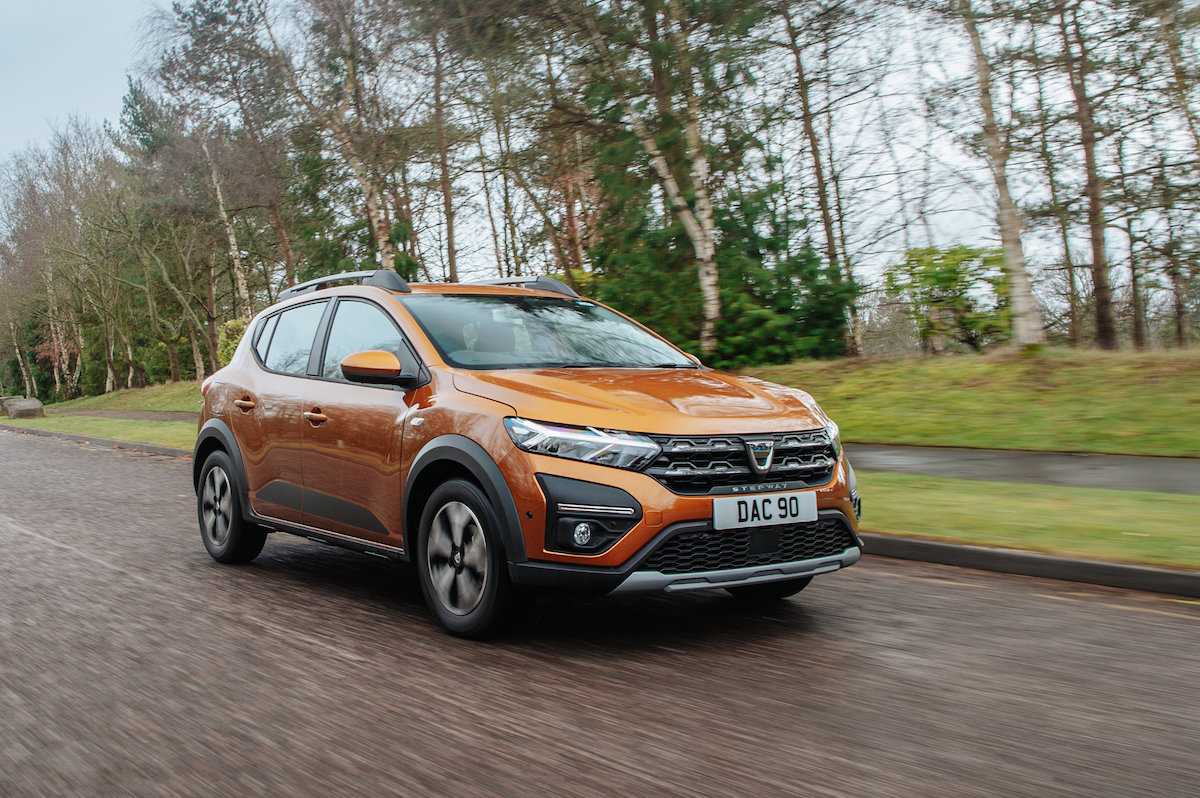
Like its Sandero sibling, the Dacia Sandero Stepway offers a simply vast amount of car for what seems like a ludicrously small amount of money. Yet where the Sandero hatchback has traditionally done so in a plain - perhaps even slightly awkward-looking – package, the Stepway has offered buyers more on-road presence due to its fashionable SUV styling and 41mm of extra ride height. Who says you can’t have it all?
It’s not just a low price, some roof rails and some chunkier bumpers that account for this success, though. Yes, the Stepway is a slightly more aspirational offering than the regular Sandero (Britain's cheapest car to buy new), but it’s still managed to preserve the hatchback’s appealing, no-nonsense honesty that buyers love, so much so that these buyers have made the Sandero Europe’s biggest-selling retail car, a title it’s held since 2017.
This latest Stepway has been around since 2020, when Dacia introduced it alongside the normal Sandero. But where the previous Sandero had been based on an ancient Renault Clio platform – Renault owns Dacia, by the way – this latest version was built around the same platform as the contemporary Clio, meaning it felt much more modern to drive.
A series of revisions to engine and specifications throughout the Sandero Stepway’s life culminated in the introduction of a facelifted model in 2026. This latest version has taken a step(way… sorry) upmarket, with new creature comforts and suede-effect trim on the dashboard on top models, the better to do battle with more upmarket rivals like the Seat Arona, Ford Puma and Honda Jazz Crosstar.

How practical is it?
Just like the Sandero hatchback, a big part of the Stepway’s appeal is that it offers really generous space despite those low prices. There’s enough headroom and legroom in the back to comfortably accommodate a pair of tall adults, and it’s even better than most supermini-sized SUVs at carrying three in the back due to the wide middle seat and the fact there’s not much of a hump in the centre of the floor.
At 410 litres, the boot space is nothing special for size compared with most supermini-sized SUVs, yet every model comes with split-folding rear seats, while the top-of-the-range Extreme model introduced in 2024 comes with a false boot floor that levels off both the boot lip and the step to the rear seatbacks when they’re folded. That all adds up to very decent practicality.
What's it like to drive?
The latest Dacia Sandero is better to drive than ever. It’s still not the last word in precision or plushness, but it does a thoroughly decent job on both counts. It always feels secure and predictable when changing direction, while the suspension generally does a good job of mopping up bumps and ripples of various sorts.
The Stepway has 41mm of extra ride height compared with the regular Sandero hatchback, but you’ll notice virtually no difference between how the two cars behave on the road. It also probably doesn't need mentioning that despite its increased ground clearance and chunkier cladding around the wheel arches, the Stepway is no off-roader, with only front-wheel drive versions available.
It's not all positive, because you will feel a rather spongey character to the controls. The gearshift feels hollow and notchy, the steering is slow – to react, to turn, and to self-centre – and the mushy action of the pedals means that pulling away smoothly takes some practice.
Searing speed is something else you’ll have to sacrifice if you’re sold on the Sandero Stepway. Until the 2026 facelift, Sandero buyers could pick between an 89bhp turbocharged, three-cylinder 1.0-litre petrol engine badged TCe 90, which most went for; there was also a ‘TCe 100 bi-fuel’ version of the same engine that could run on petrol at 89bhp, or LPG at 99bhp.
While there’s sufficient grunt in both of these engines to keep up with traffic, the Sandero Stepway’s power reserves are not vast; steep inclines can therefore require you to change down a gear and thrash the throttle pedal. No matter how hard you work it, though, the Sandero Stepway’s gathering of forward momentum is never any better than merely adequate.
Not that you’d want to work it hard, mind, because even when you aren’t flogging it, the engine gets vocal pretty quickly. You can still hear the transmission whining away in the background, too, and you also get quite a bit of engine vibration transmitted up through the pedals and steering wheel.
Sandero Stepway buyers choosing a new example produced from 2026 onwards get the choice of only one engine – an uprated version of the TCe 90 that kicks out 99bhp and has had its badging swapped round, and is therefore known as the 100 TCe.
We haven’t been let loose in the new model yet, so we’ll add some proper driving impressions when we have. Mind you, it’s a fairly safe bet that it’ll be much like the old one, just with a fraction more get-up-and-go.
The TCe 90 could be had with an optional CVT automatic gearbox, and if an auto appeals, this one’s worth having. Happily, it doesn’t suffer the droning engine note you’d usually associate with a CVT. When you ask for more power, it doesn’t flog the engine to within an inch of its life until you lift off.
Instead, it backs the revs off by itself, and which helps keep things relatively tranquil. It also works pretty smoothly, and it means you don’t have to deal with the vague clutch, notchy gearshift and noisy transmission of the manual car.
The automatic has taken a leave of absence from the Sandero Stepway range since the new version was launched in 2026, but we’re told it’ll be re-launched later in the year.

Technology, equipment & infotainment
This is one area in which the latest Sandero Stepway has taken a huge step forward from its predecessor, with vastly improved interior materials as well as fit and finish. Even so, you shouldn’t go into buying one expecting it to feel like a luxury car.
The Stepway’s always been just a tad more upmarket than the normal Sandero, so it’s never been available with the puritanical Access specification you get on the standard car. Instead, the latest model’s range kicked off with the Essential model.
This still felt quite bare inside, but you did get a few creature comforts – for example, cruise control, electric front windows, air conditioning, and a Bluetooth-enabled stereo with DAB radio.
The next model up in the range, Comfort, added rear electric windows, rear parking sensors, modular roof bars, front fog lights and automatic wipers, while the top-of-the-range Prestige got climate control, front parking sensors, a central arm rest, and alloy wheels.
In 2024, Comfort versions were renamed Expression, while the Prestige model was replaced by a new, more rugged-looking Extreme model. At the same time, rear parking sensors were added to the Essential version.
The Extreme model was particularly interesting as it came with some real luxuries, such as heated front seats, faux suede upholstery, a multi-view parking camera, and a digital driver display. Dacia also added a system called Extended Grip, which is essentially a reduced traction control setting that makes it a little easier to pull away on slippery surfaces.
By and large, these specifications remained unchanged when the Sandero Stepway was facelifted in 2026, with one exception: the Extreme got a wireless phone charger fitted as standard.

Dacia Sandero Stepway running costs As we’ve already stated, the Stepway isn’t quite as ludicrously cheap as the regular Sandero – it misses out on the entry-level trims and engines and is also appreciably more expensive version-for-version – but it’s still very affordable next to other small SUVs and represents great value.
It’s not quite as efficient, either, but it does get a lot closer to the regular Sandero on that score. The pure petrol engines return fuel economy of just over 50 mpg according to official figures, and used gently, you should have a reasonable chance of getting somewhere close to that in the real world.
The Bi-fuel version falls slightly short of that average, and delivers a lot less when you’re running on LPG, but the stuff you put in will cost you significantly less. The thirstiest version is the TCe 90 fitted with the automatic gearbox, with an official average of around 45 mpg. Bear in mind that the range no longer includes a DCi diesel option.
Insurance groupings range between 11 and 15, which is about par for the course in the small SUV class. Servicing and maintenance costs will also be pretty reasonable. Dacia offers a range of fixed-price servicing plans, the cheapest of which will take care of all routine work for three years/30,000 miles for just over a tenner per month.
Perhaps the best news on the running costs front is the fact that both the Sandero and the Stepway provide such incredible protection for your modest investment thanks to their scarcely believable residual values.
After the standard three-year, 60,000-mile ownership period, the Stepway will retain up to 57% of its value according to the experts, compared to figures of more like 35% for most rival cars. That news is far less advantageous if you’re buying used, but when prices are so low to begin with, it’s not like you’ll ever pay top dollar for one.
Dacia Sandero Stepway reliability
Dacia recently introduced a new scheme, called ‘Zen’, by which Sandero Stepway owners can keep their cars in warranty for up to seven years. Once the standard three-year, 60,000-mile warranty ends, servicing a Dacia at a main dealer entitles the owner to a warranty extension of a year, as long as the car is less than six years old and stays within the 75,000-mile limit. Owners of used Sandero Stepways will qualify for the scheme, too, as long as their car still has a full Dacia service history.
With luck, you won’t have to call upon that cover, as common faults are relatively rare – though check for coolant leaks around the thermostat. And bear in mind that older Dacias tend to suffer with more trim rattles than pricier cars, a net result of the cheaper components from which they’re built. Water ingress from door seals is not unheard of, too.
For all that, this latest Sandero’s reliability can be patchy. It came 19th out of the 24 small cars that were included in the latest What Car? Reliability Study – though the score of 93 per cent suggests that this still isn’t an unreliable car.
- The Sandero Stepway scored just two stars in Euro NCAP crash tests – but don’t take that score at face value, because it’s not quite the whole story. Dacia is keen to point out that the Sandero Stepway was marked down because its electronic driver aids were more basic than those offered in rival cars – despite the fact that they are there, and they do work. It has a point – but what Dacia would like you to overlook is the fact that the Sandero Stepway scored 70 per cent and 72 per cent for adult and child occupant protection respectively in the physical crash tests themselves. Those aren’t appalling scores, but they also lag a fair chunk behind the Stepway’s pricier rivals, and they suggest that irrespective of the electronic driver aids, the Sandero won’t protect you or your family quite as well in an impact.
- Despite the fact that the Stepway isn’t quite as much of a value-led proposition as the regular Sandero, it’ll still prove more popular overall. Around 60% of the Sanderos that are sold in the UK are of the Stepway variety.
- Select second-rung Comfort trim or above, and your Stepway will come with fiendishly clever modular roof bars. In normal circumstances, these look like any other roof bars, lending the Stepway some extra visual chunkiness. But depending on the nature of the load you’re looking to carry on them, you can unscrew the bars using an Allen Key, turn them through 90 degrees across the width of the roof, and reattach them in their original mountings, turning them from longitudinal bars to latitudinal bars without the need for extra fixings.
- If you want the cheapest Stepway possible: Because there’s no Access trim on the Stepway like there is with the regular Sandero, the Essential is your entry point to the range. Yes, it’s a lot more expensive, but it does also come with a lot more kit. Essentials (no pun intended) such as a DAB-equipped stereo, air-conditioning, electric front windows and remote locking are included, as are niceties such as cruise control, LED headlamps and decorative wheel caps.
- If you want the best balance between kit and cost: Expression trim (known as Comfort in older models) is the one for you. Key to its appeal is the 8.0-inch infotainment touchscreen which looks slick, is a doddle to use and comes equipped with satnav, DAB, Bluetooth, six speakers, Android Auto and wireless Apple CarPlay. That last item is a properly cutting edge one that’s still not available in many very exotic cars. Other important upgrades include reach adjustment for then steering wheel, split-folding rear seats, electric rear windows, those clever roof bars, parking sensors, a reversing camera, keyless entry and automatic wipers.
- If you want the all the toys: The most sophisticated Stepway is the Extreme version. This gets genuine alloy wheels rather than plastic wheelcaps designed to look like them, along with an electronic parking brake and automatic climate control aircon. A blind spot warning system also gets added to the roster of safety kit.
- If you want to be lazy with an auto: You’ll have to stick with a used Sandero Stepway for now, because Dacia hasn’t yet released the automatic version. But you can still by nearly-new examples of the TCe 90 Auto, which we rate, with low mileages on the second-hand market.


