Citroen e-C4 X 2026 review | Quirky but appealing electric saloon
Citroen C4 X cars for sale
3.0
Expert review
Pros
Dramatic – if divisive – styling
Competitive pricing and equipment
Very smooth low-speed ride
Cons
The driving experience gets less smooth the faster you go
Range isn’t as good as in many rival EV
Interior quality is patchy

The CarGurus verdict
The Citroen e-C4 X is one of those rather baffling cars. It provides more boot space than its C4 hatchback sibling, yet somehow manages to be less practical and versatile overall. And while its electric powertrain is smooth, quiet and pleasant to use, it trails key rivals in areas such as driving range and interior quality.
Still, it remains a thoroughly likeable car. The distinctive styling gives it real individuality, while the driving experience prioritises comfort over sportiness in a way that feels refreshingly different. It’s a leftfield choice, certainly, but for the right buyer, it could prove very satisfying to live with.

What is the Citroen e-C4 X?
In some ways, the e-C4 X is a car that breaks entirely new ground for Citroen, and in others it’s an example of Citroen doing what it has done countless times before. Early UK cars were offered only as a fully electric model, reflecting Citroen’s growing focus on electrification. More recently, however, the wider C4 X range has expanded to include a hybrid. This review focuses specifically on the electric e-C4 X.
In other respects, the car follows familiar Citroen traditions. It’s unconventional in its styling – something the brand has long embraced – and blends several different genres into a single design. The Citroen C5 X offers a similar approach, mixing estate, hatchback and crossover elements to create something more distinctive than a conventional family car.
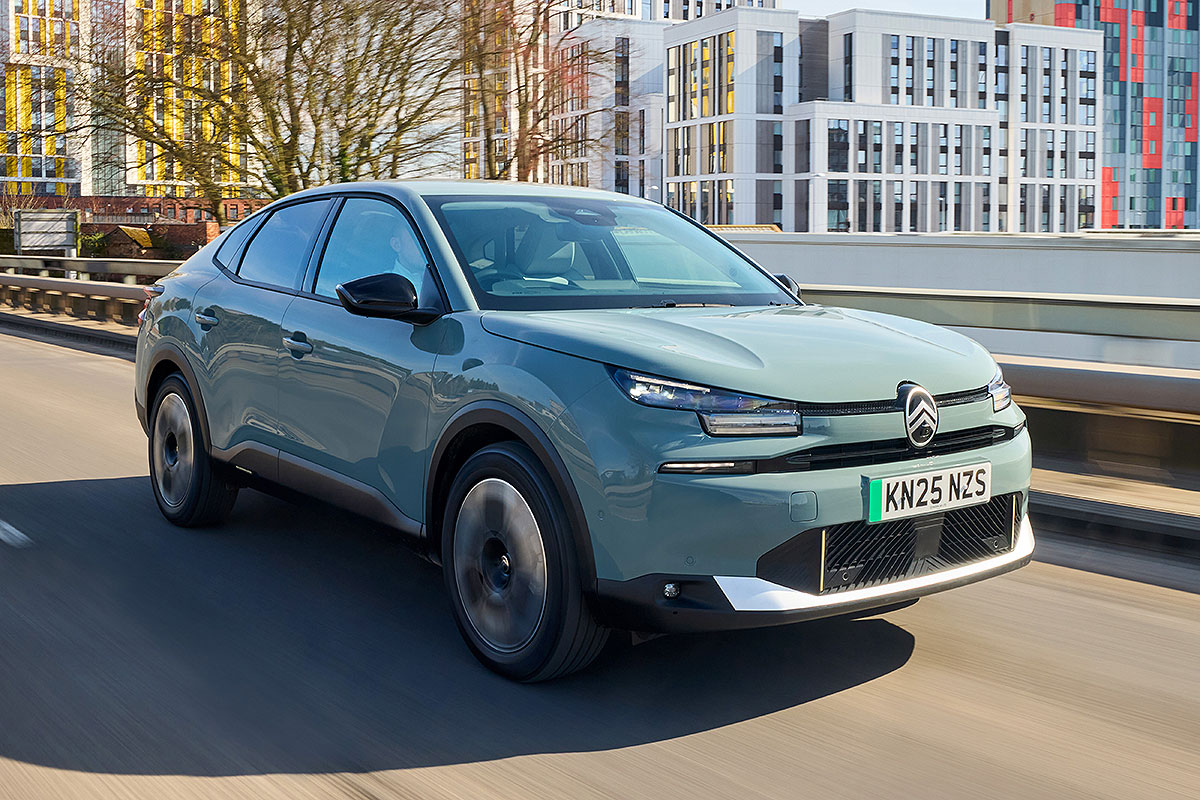
Viewed from the front, the e-C4 X has the raised ride height and visual chunkiness of a crossover, traits it shares with the regular Citroen C4 hatchback. From the side and rear, though, the sloping roofline and extended tail give it more of a fastback saloon appearance, creating a shape that sits somewhere between a hatchback, SUV and traditional four-door saloon.
Electric versions are available with a choice of two power outputs: a 134bhp model with a smaller battery aimed at everyday efficiency, and a newer 154bhp version with a larger battery for greater range and flexibility on longer journeys. Rivals include the Renault Megane E-Tech, Volkswagen ID.3 and Hyundai Kona Electric, while larger EVs like the Nissan Ariya and Skoda Enyaq feel like a step up in both size and price.

How practical is it?
Part of the reason for messing with the body shape was to improve practicality, and we’d say that’s been a partial success. Things look good on paper, with a generous 510-litre boot provided – a very useful improvement on the 380-litre boot you get in a regular C4 SUV.
That’s not the full story, though, because access isn’t as good due to the X switching to a saloon-style bootlid, rather than the regular C4’s SUV-style hatchback (where the rear window lifts with the tailgate). As a result, the opening is rather narrow, and, because the rear window is fixed, also rather shallow compared with that of the C4 hatchback.
There’s more. In the regular C4, you get 60:40 split-folding rear seats that drop to extend your cargo-carrying capacity, plus a movable boot floor to level out both the resulting step in the load area and the substantial lip on the boot opening. In the X, you get the same split-folders, but for some reason, not the movable boot floor, so there’s a significant step down from the boot lip to the load floor, then a sizeable step up to the backs of the folded rear seats. That can be a pain when loading heavy items.
Rear-seat accommodation is similarly hit-and-miss. On the plus side, kneeroom is generous enough for even tall passengers to stretch out comfortably. Less positively, however, the changes to the C4 X’s roofline haven’t done rear headroom any favours, and passengers of a six-foot-stature will find their hairdos rubbing on the ceiling. Anyone much taller than that will likely be uncomfortable. Things are even worse if you’re consigned to the central seat, because there’s a plastic lighting unit on the ceiling above it, which eats into your headroom even further, and rather than your scalp nestling against the fabric headlining, it’ll be rubbing against hard, sharp-edged plastic. You’ll also have to sit with your feet splayed either side of a hump in the floor.
What's it like to drive?
It’ll come as no surprise that the drivetrain in this car is exactly the same one found in pretty much every other battery-electric vehicle made by parent company Stellantis. That means the Peugeot e-208 and e-2008, Vauxhall Corsa Electric and Mokka Electric, DS3 E-Tense and so on. And the application of it here is as familiar as you’d expect, which is to say it’s entirely pleasant.
The e-C4 X uses either a 134bhp electric motor with a 50kWh battery, or a punchier 154bhp motor paired with a 54kWh battery. Neither delivers that blistering, all-at-once shove you get in some electric cars; instead, it prefers to deliver its acceleration in a more steady, progressive manner. That said, it’s still punchy and responsive in pretty much every situation, so you always feel like you’ll have enough get-up-and-go when you need it. You’ll also enjoy the pleasantly unbroken nature of the power delivery. It just keeps on pulling without any pesky gearchanges to get in the way. And because it’s electric, your progress is also nice and quiet, although the lack of engine noise means you can occasionally hear the suspension working underneath you as it deals with bumps.
Talking of suspension, that’s another thing that Citroen takes great pride in. The brand has been famed in the past for producing cars with a pillowy soft ride, and in the modern era, the firm has tried to recapture those days with something called Citroen Advanced Comfort Suspension, which comes fitted to every e-C4 X as standard. It uses conventional springs and dampers like most other cars, but teams them with hydraulic bump stops to further isolate you from the effects of ripples and ruts in the road. Combined with the soft suspension setup, it’s really effective, because the car rides beautifully especially at low speed, where bumps are dealt with almost imperceptibly. Factor in the effortless performance and whisper-quiet characteristics of the all-electric drivetrain, and it all works together really nicely.
There is a payoff for that soft suspension, though, and that is lots of body movement. You can feel the nose of the car rising and falling as you operate the accelerator and brakes, which can sometimes make you feel like you’re on a fishing boat in choppy waters. Some people will be fine with it, but others will be sensitive to it and feel it in their gut. More than ever, we recommend a test drive before you buy to figure out which camp you fall into.
And that’s when you’re going in a straight line. Arrive at a bend, and you’ll also experience lots of body-roll. This isn’t necessarily a problem in terms of handling precision, because the e-C4 X really isn’t that kind of car anyway. It’s more that such pronounced lurches of movement as you change direction might have the kids feeling queasy, especially if you accidentally enter a bend quicker than you meant to.
And it would be by accident, because this isn’t a car that encourages you to press on. There’s decent grip, but the steering has zero feel, it’s extremely light – probably too light for some tastes – and it’s also pretty slow to respond. So you’re much better off just taking a relaxed approach to your driving and enjoying the car’s laid-back, wafty nature.

Technology, equipment & infotainment
Up front, you’ll recognise plenty in common with the regular C4, because it’s all pretty much identical. There’s a digital instrument screen set deep into the dashboard in front of you, complemented by a 10-inch touchscreen infotainment system that has all the functionality you’d expect in this day and age. And it’s reasonably easy to find your way around once you’re familiar with it. Physical controls remain for basic air-con functions such as temperature and fan speed, but anything more detailed requires diving into touchscreen menus. Quality-wise, it’s pretty much identical to the regular C4, which is to say that while there are some interesting flourishes, the majority of the materials are just a little bit drab and unpolished, so it’s not the classiest-feeling car of its type. You certainly won’t be fooled into thinking that you’ve mistakenly wandered into an Audi or BMW.
While the e-C4 X was launched with three trim levels (Sense, Shine and Shine Plus), later versions simplified the range to just Plus and Max. Even Plus models come well equipped, with 18-inch alloy wheels, LED headlights, dual-zone climate control, rear parking sensors, wireless Apple CarPlay and Android Auto connectivity, and the 10-inch infotainment system. The latter was updated as part of the facelift, bringing improved connectivity and a clearer interface, while a new 7.0-inch digital instrument panel improves clarity for essential driving information.
Step up to the Max trim and you get additional comfort and technology features, including heated front seats and a heated steering wheel, upgraded driver assistance systems, adaptive cruise control and cosmetic upgrades such as tinted rear windows.

Citroen e-C4 X running costs
The e-C4 X with the 50kWh Standard Range battery pack has an official WLTP range of 222 miles, slightly more than the e-C4 hatchback, probably due to its more aerodynamic shape and improved drag coefficient. That’s a laboratory figure, remember, so expect more like 190 miles in favourable conditions, and that’ll drop to more like 140 miles when undertaking long motorway drives in cold temperatures. Upgrade to the 54kWh Extended Range and the official figure rises to 263 miles, so achieving 200 miles in the real world is more likely.
In terms of efficiency, our drive in an e-C4 X with a 50kWh battery took place in chilly temperatures, and was made up of a mixture of A-roads and motorway – so not exactly optimum conditions. Nevertheless, we saw a figure of 3.7 miles per kWh, which isn’t at all bad.
A full charge from a 7kW home wallbox will take around seven-and-a-half hours, and the Citroen can rapid-charge at up to 100kW via its now-European-standard CCS port, earning you an 80 percent charge in just 30 minutes. Home-charging will cost you significantly less than filling up a regular petrol or diesel car, especially if you utilise off-peak energy tariffs by charging overnight when electricity is cheaper. However, do bear in mind that public rapid charging is much, much more expensive, so if you regularly have to rely on the public charging network, your costs could spiral.
In terms of purchase prices, the e-C4 X costs a little more than the regular e-C4 SUV, but it’s still very competitive when compared with mainstream EVs of a similar size.

Citroen e-C4 X reliability
It’s always difficult to make any, erm, reliable predictions about a car’s reliability when it’s still so new, because there’s very little data to go on. We can take an educated guess by looking at the performance of the Citroen brand as a whole in this area, and the news on that score is encouraging. The company finished a creditable 10th out of the 30 manufacturers included in the 2025 What Car? Reliability Survey.
You can also find peace of mind in the e-C4 X’s EV status, as electric motors have only a handful of moving parts, while combustion engines have thousands. That means there is generally less potential for something to go wrong with an electric car. And when issues do arise they can often be simpler to diagnose and fix.
Citroen’s warranty programme has no mileage limit for the first two years, but cover in the third year is limited to 60,000 miles. That’s about the bare minimum you can expect these days, especially compared with rival brands offering much longer warranties.
- The e-C4 X is designed for comfort. Citroen makes a lot of this car’s ‘Advanced Comfort Seats’, which it says have been specially designed and made to deliver a cosseting feel. They’re certainly nice and wide, and you’ll notice the relatively soft padding in certain key areas. Whether you actually find them any more comfortable than a regular car seat will probably be a matter of personal taste, though.
- The trim structure and safety aids are now much simpler. The e-C4 X gets different safety kit depending on which trim level you go for. Entry-level Plus cars come with a good level of equipment, but you’ll need the Max trim for the full suite of driver assistance systems. Euro NCAP says that the regular C4’s crash test rating also applies to the C4 X, and that car scored a slightly disappointing four out of five start when tested in 2021.
- It isn’t EV-only in the UK any more. When the C4 X arrived in the UK, Citroen decided to only offer the electric version, predicting it would have been the biggest seller anyway, while also making a point about it being its first EV. All that has changed now, with the e-C4 X now joined by a C4 X with a petrol-electric hybrid powertrain.
- If you want the best value: Look for the entry-level Plus trim, which already includes a generous amount of standard kit such as the 10-inch touchscreen with smartphone connectivity, climate control and a good selection of driver-assistance systems. It delivers the core e-C4 X experience without pushing the price into premium territory.
- If you want the longest range: Choose the 154bhp version with the larger 54kWh Extended Range battery. This offers an official 263 miles, making it ideal for those with longer commutes.
- If you want the most equipment: Max trim adds desirable extras including heated seats, adaptive cruise control and additional driver assistance features.
- If you like the concept but want more practicality: Consider the regular e-C4 hatchback instead. Mechanically, it’s identical, but the hatchback tailgate makes loading larger items easier, improves everyday usability and means you can take the dog.