Audi RS3 2026 review | Hot hatch practicality, sports car performance
Audi RS3 cars for sale
4.0
Expert review
Pros
Ludicrously fast
Optional adaptive suspension is brilliant
Sounds good
Cons
Interior quality not up to previous Audi standards
Rather small boot
Remote steering limits engagement

The CarGurus verdict
Hot hatch? Hyper hatch? Call it what you want, but the Audi RS3 sits in a class of two, alongside its only real rival: the Mercedes-AMG A45 S. No other hot hatchbacks get anywhere close to these two in terms of power, pace or indeed price.
Interestingly, the two offerings are actually very different. The Mercedes is an angry, pointy aggressive car to drive, whereas the Audi has a softer-edged and more civilised approach. One thing that cannot be disputed is that the RS3 is a very capable and very impressive machine.
Should you buy one? Well if you do, you’ll be buying a very competent and very fast car, and you’ll have a good deal of fun. But we’d also recommend slotting yourself into a S3 before you sign on the dotted line. It might not have an RS badge and, ultimately, it isn’t as fast or as bonkers as the RS3, but it offers hot hatch performance with an Audi badge for a lot less money.
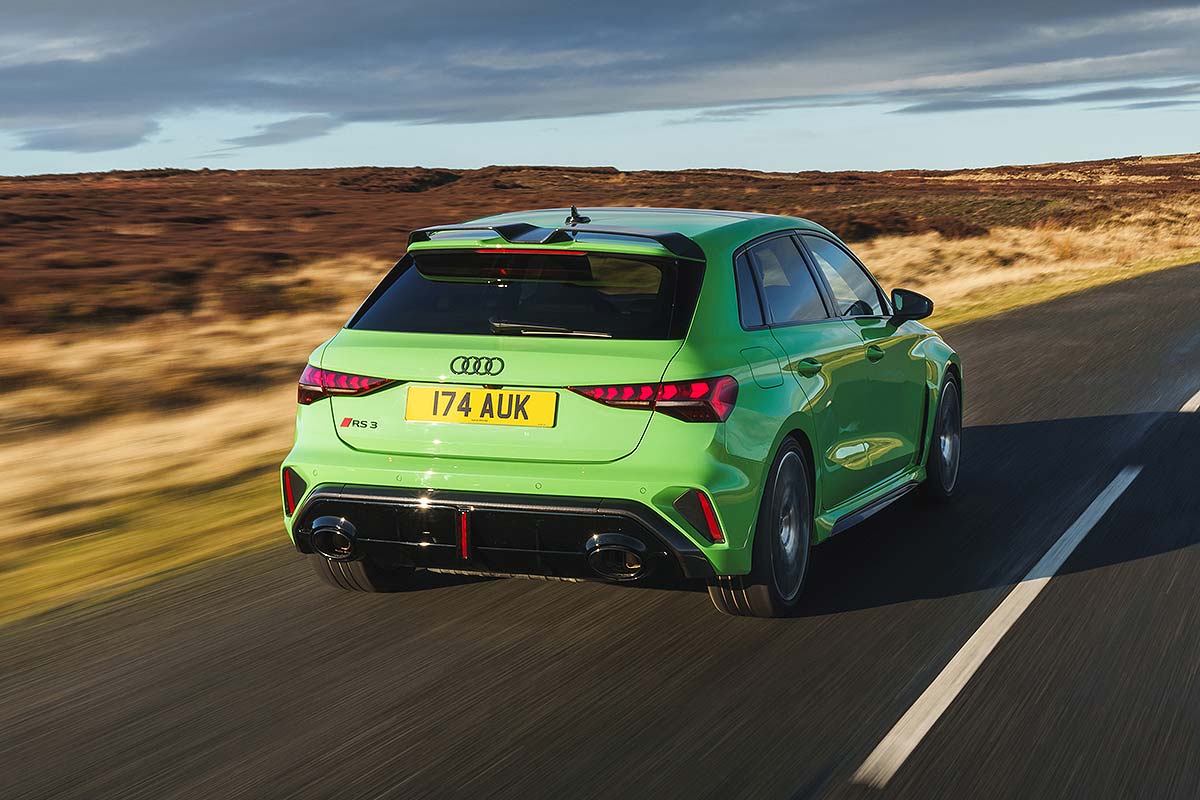
What is the Audi RS3?
Well, we’ll tell you what it’s not, and that’s a hot hatchback. That statement might sound odd, but hear us out. You see, in our book, a traditional hot hatch is a regular family hatchback with a good slug of extra power, firmer suspension and a smattering of extra skirts and spoilers to make it look sportier. Cars such as the Audi RS3 – and its arch-nemesis the Mercedes-AMG A45 S – go way beyond that.
Take power output as an example. Outside of these two cars, even the most powerful hot hatches today make somewhere between 300 and and 320 horsepower. These cars hike that figure close to 400bhp and beyond.
Then there are all the other performance-enhancing measures these vehicles have, which go above and beyond those of a regular hot hatchback. Yes, fettled suspension is present and correct, but so are a sophisticated all-wheel-drive system, launch control and numerous other dynamic enhancements. Together, they really push the envelope of what a performance hatchback can achieve.
There’s also the price. With all that extra power and technology comes additional cost, and quite a lot of it. These are not fun-yet-affordable runabouts, they are no-nonsense performance cars that just so happen to be hatchback-shaped.
So, if the RS3 isn’t a hot hatchback, what is it? Well, dear reader, welcome to the age of the ‘hyper hatch’.
Having first launched in 2011 with the second generation A3 (the first Audi A3 had a top-of-the-range S3 version, but no RS3), the RS3 has been a familiar sight on UK roads for a long time. It’s outlived fast hatchback rivals like the Ford Focus RS and Renault Megane RS, and has been a natural step up to anyone who previously owned a Volkswagen Golf R. After all, why have only four cylinders when you can have five?
The car you see here is based on the fourth-generation A3 and, as you might expect, it’s as fast and as raucous as ever. Launched in 2021 and revised in 2024, there’s no doubting this is a very serious performance car.
How practical is it?
We might consider the new RS3 to be a step on from a regular hot hatchback, but it still has to do those same hot hatch jobs of providing performance and fun in a package that offers enough practicality for daily use. So, how does it get on?
Unlike previous versions of the RS3, this one no longer comes as a three-door hatchback, meaning only five-door RS3 Sportback or four-door RS3 saloon body styles remain. Both versions thus have rear doors that make it easier to get in and out.
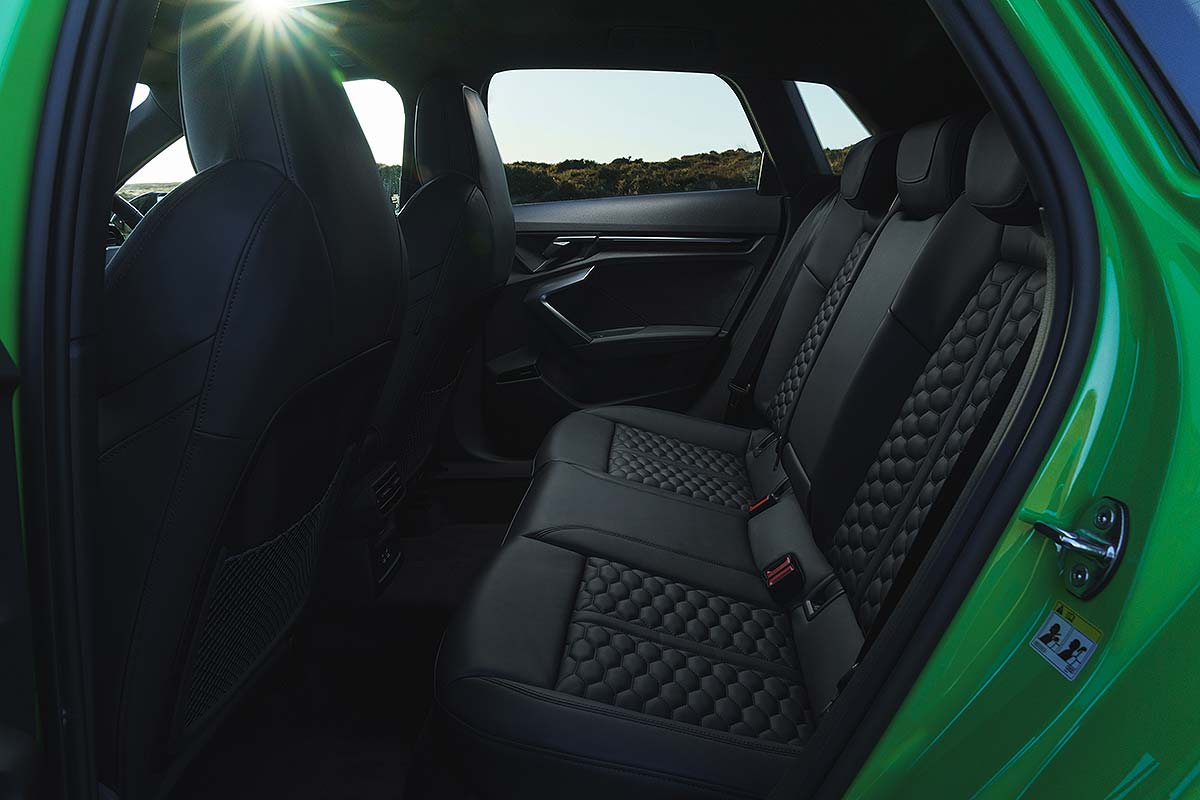
You’re a bit more short-changed for space than you are in the regular A3. The boot floor is positioned higher due to the all-wheel-drive system and various other mechanical components on the rear axle (more on this in a moment). You therefore lose almost 100 litres of luggage space, leaving an overall capacity of just 282 litres. With the rear seats folded, this expands to 1,104 litres. Crucially, that also gives it a big disadvantage compared with rivals such as the Mercedes-AMG, which can carry 370 litres. Having said that, the Audi’s rear seats fold down in a very versatile 40:20:40 split, so that at least provides more load-carrying options.
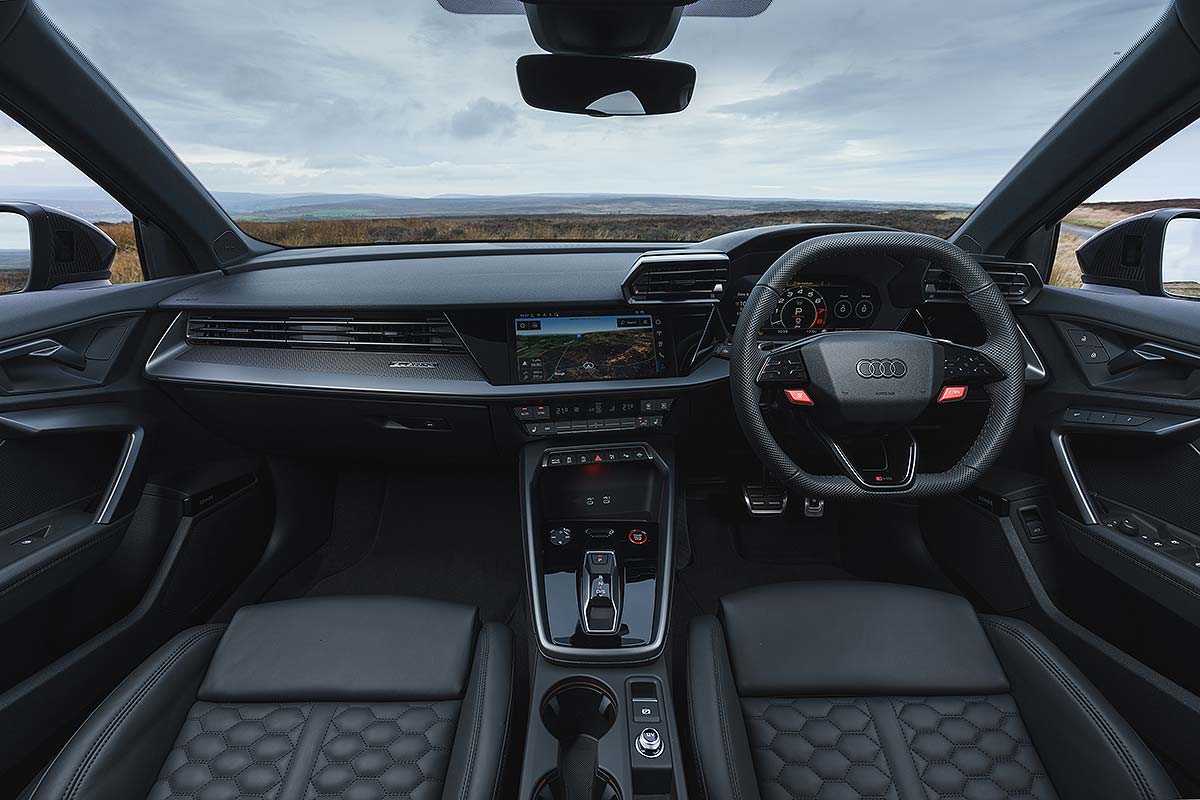
Climb in the front of the RS3, and owners of the previous RS3 – or regular Audi A3, for that matter – might well wonder what on earth happened. Previous A3s were rightly hailed for their sensational interior quality, with lustrous materials, tasteful finishes and beautifully damped switches. Sadly, the latest generation feels like it has taken a significant backward step in this area.
Sure, it’s acceptable in terms of the materials and its fit and finish, but there are too many cheap-feeling panels on show to make it feel as special as it once did. The wow-factor has been lost. The dark, monotone colour scheme makes things feel a little drab, too, with very few additional flourishes to let you know you’re in a flagship Audi RS model.
In the back seats, you’ll find enough headroom and legroom for six-foot adults to get comfortable, even when sitting behind a driver of similar proportions. There’s just as much passenger space as you get in rivals, too.
Audi offers a variety of add-ons for the RS3, including roof boxes, roof rails and bicycle racks. It isn’t the most exhaustive range of accessories, but they add a splash of extra practicality to this muscular pocket rocket.
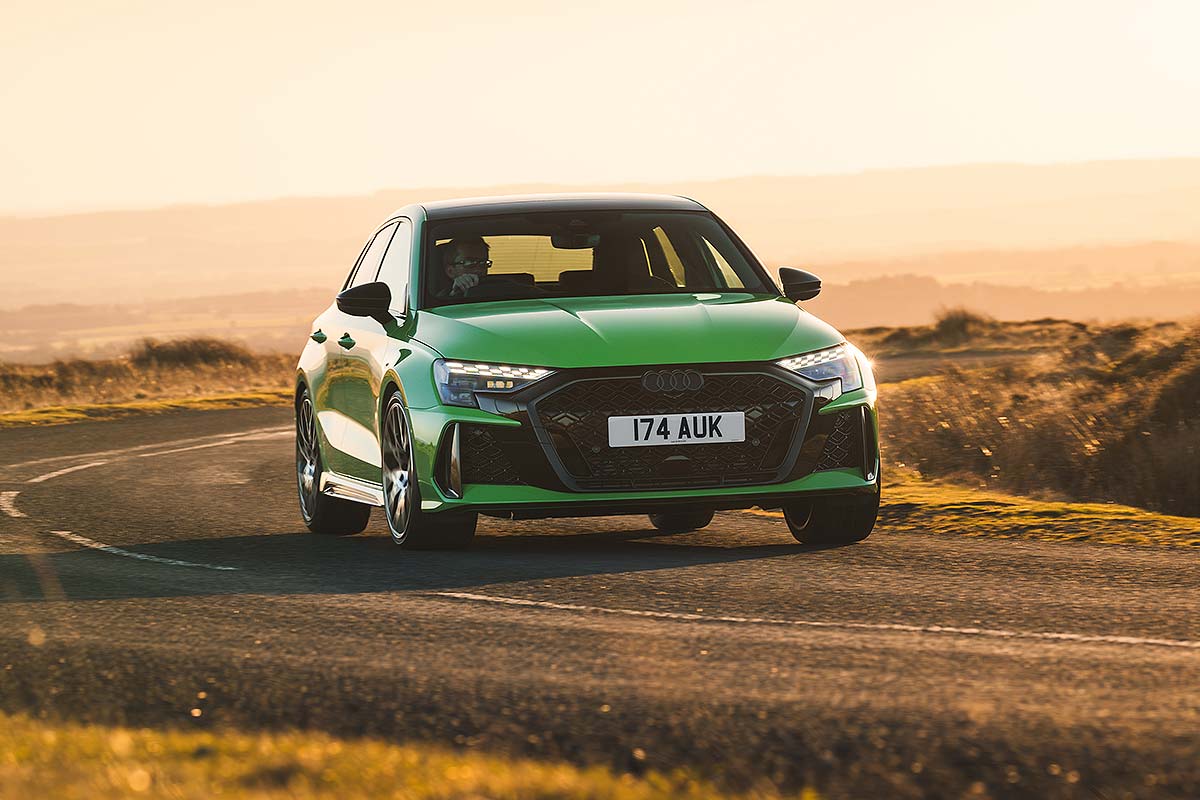
What's it like to drive?
First, let’s talk first about the RS3’s party piece: its characterful turbocharged 2.5-litre five-cylinder engine. It sounds absolutely lovely, with that unique off-beat warble you only get from a five-pot. However, even with the sports exhaust fitted (optional on some models), you can’t make it any louder if the mood takes you. No doubt that’s due to the more stringent noise and emissions regulations compared to earlier iterations of the RS3.
Then there’s the power it makes, which totals 400 metric horsepower, or 395bhp in old money. That’s exactly the same as the power level as the previous RS3, but this new version does offer a shade more torque (a whopping 500Nm), while both the power and torque are available a bit more readily. Now, those 395 horses are undeniably a lot, but in the pursuit of hyper hatch bragging rights, it’s less than the 415bhp you get in the Mercedes. Yet the Audi is still fastest off the line, able to bang in a 0-62mph sprint time of 3.8 seconds – 0.1 seconds faster than the AMG.
Tenth of a second or no tenth of a second, it’s still astonishingly fast for what is still a reasonably practical family hatchback, and the RS3 feels good for every single tenth of the time. Its standard launch control helps greatly on that score, because it dials in the perfect start, so your getaway is always clean, controlled and rapid to the point of being borderline painful. The standard Quattro all-wheel-drive system helps transfer power to the road as effectively as possible, while the seven-speed dual-clutch S Tronic gearbox races through upshifts quicker than any human could hope to.
Still, you don’t need to engage the launch control for this car to feel mind-bendingly fast, and that applies both away from the mark and when you’re picking up speed on the move. It’s even pretty flexible when barely ticking over, but get a few revs on the counter, either by downshifting or by burying your right foot (ideally both), and the sensation of acceleration you feel is genuinely supercar-like. Top speed is limited to 155mph, but if you regularly visit German autobahns you can opt for the ‘Carbon Vorsprung’ model – capable of 174mph flat-out.
Pace isn’t a problem, then, but speed isn’t the only constituent part of what makes a car fun to drive, a fact demonstrated by both previous versions of the RS3. These two cars were also tremendously fast, but they weren’t all that much fun because there was way more understeer (running wide) in corners than you’d expect in an all-wheel-drive car, which limited its handling prowess. The major controls also didn’t provide the level of feedback that rivals did. Is the latest RS3 any better?
On the first point, yes. The rear axle has a new device called an RS Torque Splitter, which is essentially an electronically controlled multi-disc clutch on each rear drive shaft. This allows the car to increase the amount of torque going to the outer rear wheel when you’re cornering. It's designed to reduce understeer and generally make the car feel a bit more agile. And it works. Understeer isn’t completely eliminated, but the latest RS3 feels considerably less nose-heavy and keener to turn than models that came before. And it’s pointier and more nimble on a B-road as a result.
One party trick introduced with this generation of RS3 was the driving mode called ‘RS Torque Rear’. As you may have guessed, it involves that clever rear differential and is for track use only, as it is to all intents and purposes a drift mode. It’s a gimmick, for sure, but it’ll allow you to drift the RS3 in specific circumstances, such as on a skid pad. Whereas something like an old E46-generation BMW M3 can slide around on a skid pad but also give you the feeling of oversteer, adjustability and balance on a proper racetrack, as well as on the road. Still, we appreciate Audi giving people the option to shred tyres in their five-cylinder hatch if they really want to. At this point, it is also worth noting Audi made a number of small changes to the electronic chassis systems with the 2024 update, including how the rear diff deploys its power and torque, and how the brakes on the inside wheels operate to aid turn-in or improve stability. Audi describes it as ‘the compact sports car follows the curve radius more precisely than before, under partial load and in thrust phases’. We simply say it handles marginally better.
The adaptive suspension (available only on the Carbon Vorsprung model, previously optional on the base-level RS3 and mid-range Carbon Black trims) also helps on that score, because it is, frankly, tremendous. Stick it in its comfiest mode and it wafts you along serenely with barely any intervention from the road surface. Select one of the racier modes, and you can feel the dampers hunker down and become stiffer, but it’s still surprisingly comfortable. Grip and traction are absolutely mighty as well. As a point-to-point machine, the RS3 is right up there with even the most exotic of supercars.
All that being said, the latest RS3 still has those remote-feeling controls that just take a bit of shine off the driving experience, particularly where the steering is concerned. Yes, it’s accurate enough, and the weighting will be fine for most drivers, but it’s a fraction slower to react than you’d expect, and it still doesn’t give you the sensations through the steering wheel to deliver that last layer of engagement and reward.
That remains the case whatever you do with the car’s various driving modes, of which there seem to be millions. To be honest, they’re a bit of a faff. Each one delivers different settings for the steering, powertrain, suspension (where the adaptive system is fitted), stability control, engine sound and torque splitter, but many of these modes don’t ultimately feel all that different from one another. There’s also an RS Individual mode where you can program your own settings for each parameter. Yes, this gives you lots of choice, and it makes the car capable in a wide variety of situations and environments, but it takes ages to work through it all.
Technology, equipment & infotainment
The RS3 is available to order in three trim levels: RS3, Carbon Black and Carbon Vorsprung, with the latter previously known simply as Vorsprung. The base-level trim comes with matrix LED headlights, a sports exhaust, 19-inch alloy wheels, heated front sports seats, leather upholstery, dual-zone climate control, cruise control, automatic lights and wipers, plus a comprehensive suite of active safety systems.
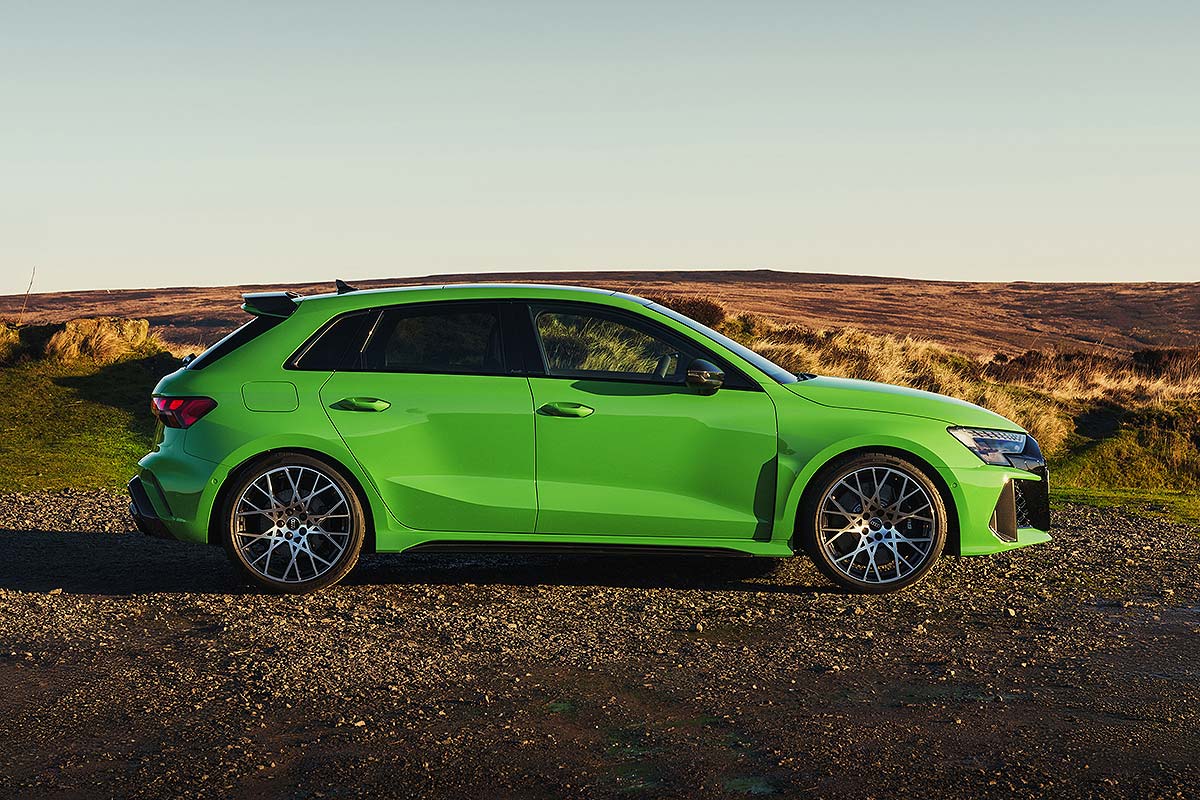
Carbon Black cars add styling tweaks inside and out, swapping black surfaces for carbon on the grille, door mirrors and rear spoiler. There are also 10-spoke wheels rather than five-spoke, plus a carbon engine cover (not the bonnet itself, to be clear). The top Carbon Vorsprung trim comes with adaptive suspension, a panoramic roof, a powered tailgate, electric front seat adjustment, a Bang & Olufsen premium stereo and even more driver assistance systems. Refreshingly, all RS3 models come with 19-inch wheels, a welcome move given how many performance cars have bigger wheels for the sake of aesthetics but at the expense of dynamics.
If you’re looking for an RS3 on the used market, try to find one of the Launch Edition cars, although this might be difficult as only 96 were sold in the UK. These provided many of the same features as the Vorsprung and now Carbon Vorsprung, but for considerably less cash, which will also mean lower prices on the used market.
All versions get the same impressive-looking infotainment system, which combines Audi’s 12.3-inch Virtual Cockpit digital instrument display with a 10.1-inch central touchscreen. As screens go, it’s one of the better ones.. Because the graphics are sharp, it’s reasonably easy to find your way around and it’s very responsive to your inputs. However, it’s still not as intuitive to operate as the system on older Audis, which was controlled with a user-friendly rotary dial. Mind you, there are displays for things like the car’s power and torque output, G-forces, acceleration and lap times. The 2024 update also saw the introduction of an in-car app store, so you can download new applications to your infotainment system should you wish.
Audi RS3 running costs
As we’ve mentioned, the RS3 is not a cheap car. Brand new, all versions will now cost you upwards of £60,000, while the top-end Carbon Vorsprung will set you back £70,660. That makes us feel a little queasy when we cast our minds back to 2011 and remember how the RS3 cost £39,900 at launch. This is not a car that provides cheap thrills, then, and one of the variety of reasons it should be considered a hyper hatchback rather than a traditional hot hatch.
The RS3’s desirable badge and comparative rarity will mean that its resale values are likely to remain strong. This is good news for new buyers who don’t want to lose thousands the moment they drive their new car. However, it’s less positive for buyers on the used market, because it means the RS3 will shed less of its value over time – making it an expensive used car as well.
Insurance costs will also be fairly eye-watering on a car with 395bhp, and the complex engine won’t make servicing and maintenance costs any cheaper, either. You should budget plenty for tyres if you plan to use all that performance on a regular basis, and doing so will also result in fairly astronomical fuel bills. If you can resist that temptation and drive very, very gently, the official WLTP figures suggest you can manage an average of just over 30mpg. But the likelihood is that you’ll succumb to temptation. If you don’t, you’ve probably bought the wrong car anyway.

Audi RS3 reliability
In the most recent What Car? Reliability Survey, Audi as a brand ranked joint 22nd alongside Mercedes-Benz out of 30 car manufacturers. That’s not brilliant, but for the most part the RS3 itself has proved fairly reliable. While there’s no dedicated ranking in the same What Car? survey, owners have reported few major problems. Take some comfort from the fact the RS3’s engine has been around for 15 years, and that wouldn’t have happened if it was hideously unreliable.
The standard Audi warranty is for up to three years or 60,000 miles, whichever comes first. But given this car’s performance focus and therefore the greater chance you’re going to be pushing it, we’d highly recommend the extended four-year, 75,000 mile warranty for £455, or the five-year, 90,000 mile warranty for £970. You can only go for those options if you’re buying from new, however.
If you have a car with a standard warranty and you later decide you want to extend it, there’s the Audi Extended Warranty, which also applies to used approved Audis. There are three tiers: Essentials, Standard and Plus, with prices starting from £129, £162 and £172 respectively. Components such as the engine and gearbox are covered on the Essentials plan, all the way up to water ingress with the Plus plan.
- As we’ve mentioned, the RS3’s turbocharged five-cylinder 2.5-litre engine is definitely one of the car’s high points, thanks to its phenomenal power and characterful sound. It’s not just us that thinks so, either: this very powerplant won the International Engine of the Year award no fewer than nine times in a row, from 2010 to the final year of the awards in 2019.
- Carbon-ceramic brakes are available for an extra £4,885. There’s no real need for them unless you’re going to be taking your RS3 to the track regularly, as they’ll likely be slightly less pleasant to use on the road day to day. They will deliver greater and more consistent stopping power at a circuit, though. What’s more, you can even choose the caliper colour, with a choice of silver, blue and red available.
- When we tested the RS3, we wanted to see what it was really capable of. So, we took it down to Wales, found some amazing mountain roads and conducted a very thorough group test alongside two other £60,000 sports cars: the Alpine A110S and the Ford Mustang Mach 1. All three were very different, but which was the best? Find out by watching the full video here.
- If you want the cheapest RS3: The base-level RS3, known simply as the RS3, is the most affordable version on offer and comes with a decent list of standard kit. But it’s still far from cheap, and you might be expecting a few more luxury goodies for your outlay. It cost around £59,000 at launch, but you’ll now need £61,885 to have an RS3 on your driveway.
- If you want the best-looking RS3: The Carbon Black is the car for you, with various styling tweaks inside and out. But it’s more than £4,000 more than the regular RS3, so only opt for it if you simply cannot live without the additional carbon fibre.
- If you want the best value RS3: Audi sold 96 Launch Edition cars in the UK, which had many of the same features as Carbon Vorsprung cars, but for a price that was more comparable to Carbon Black cars. If you can find one on the used market, the proportional cost savings should be passed on.
- If you want the most tooled-up RS3: The range-topping RS3 Carbon Vorsprung comes with a vast variety of goodies, as well it should for the amount of money it costs. The real benefit is the adaptive suspension, although you also get a panoramic roof and a handful of other goodies.


