Audi RS6 Avant Review (2020-2025)
Audi RS6 Avant cars for sale
4.0
Expert review
Pros
Staggering performance from twin-turbo V8
This RS6 is more agile than previous versions
Quattro four-wheel drive provides secure handling in all weathers
Cons
Only available as an estate car
A Mercedes-AMG E63 S is more rewarding to drive
Running costs to rival a private jet's

The CarGurus verdict
For a very long time, Audi’s performance estate cars had a reputation for being thunderously fast in a straight line and effortless to live with, but somewhat underwhelming to pedal along an inviting stretch of road. The new RS6 puts that right – it’s substantially more rewarding to drive than the model it replaces thanks to its raft of new chassis technologies.
It remains enormously fast, owing to its near-600bhp twin-turbo V8. With a comfortable ride on either of the two available suspension setups and one of the best interiors in the business, none of the RS6’s enduring strengths have been lost in the quest for improved dynamism.
That’s all well and good, but how does it stack up against the opposition? It’s true that rivals from Mercedes-AMG and Porsche are more athletic still when flung down a twisting B-road, but only the very keenest of drivers will appreciate the dynamic edge those two cars have over the Audi.
The RS6 Avant hits back with its peerless all-rounder capability. It’s great to drive quickly, comfortable in normal driving and civilised on the motorway, resolutely secure in poor weather, practical as a family car and, thanks to that rumbling V8 engine, hugely characterful as well. All of that makes it a match, at the very least, for the best cars of its type.

What is the Audi RS6?
Introduced in 2019, this generation of the Audi RS6 Avant is the fourth version in the dynasty of outrageously fast Audi estate cars. Codenamed C8 in internal Audi-speak, it sticks to more or less the same basic formula that made the version that preceded it such a likeable machine: a huge engine and taut handling in a vast, practical estate body.
That means the 4.0-litre twin-turbo V8 is carried over, although peak power output is now quoted as 600hp – although the Performance model of the previous version equalled that.

How practical is it?
Of course, the RS6 has always been as much about day-to-day usability as outright speed and performance. With a vast 565-litre boot, spacious rear seats, one of the best appointed cabins of any performance estate car on the market and a full suite of driver aids and safety systems, this latest effort from Audi is easier to live with and more usable everyday than any previous version.
That being said, the Mercedes-Benz E63 S AMG is more spacious still, with its 640-litre boot.
What's it like to drive?
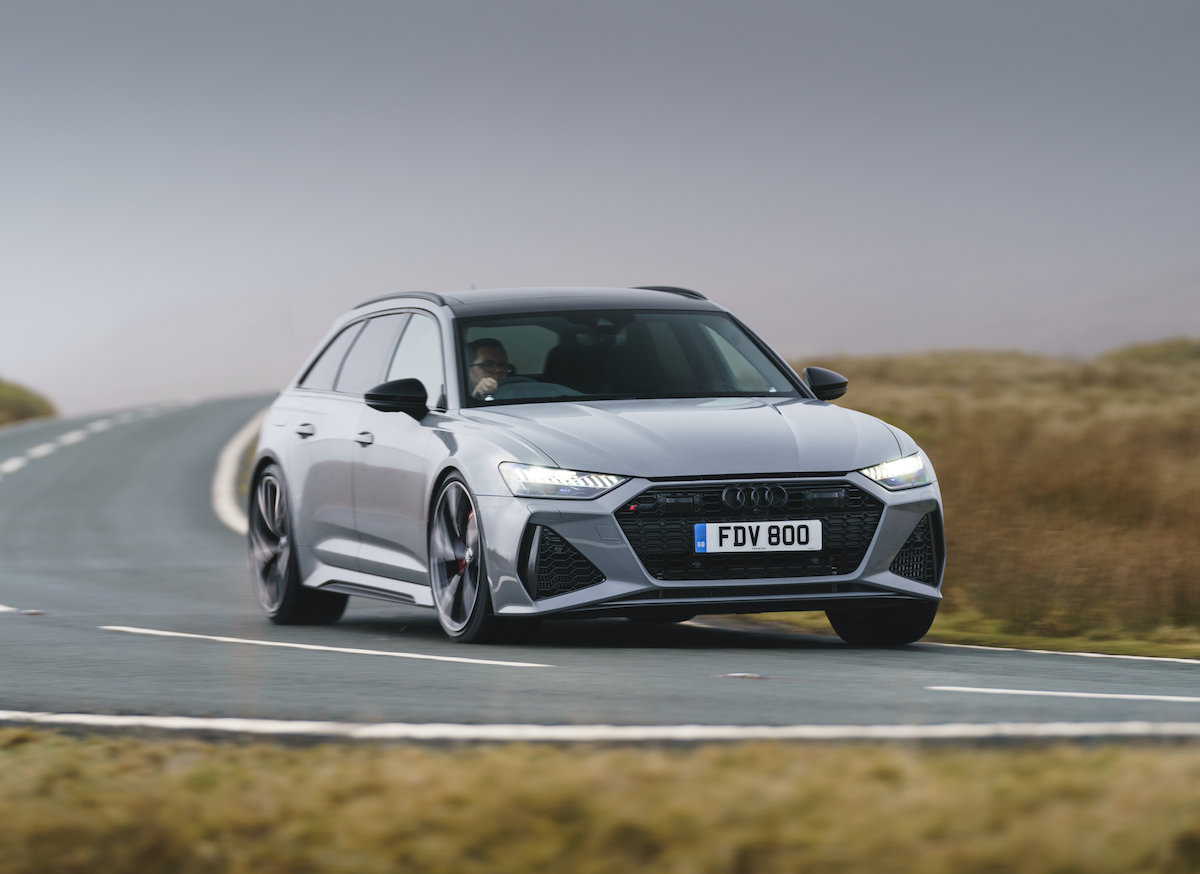
Power is sent to all four wheels via a quattro four-wheel drive system that can, in theory, send up to 70% of available torque to the front axle and as much as 85% to the rear. UK cars come fitted with a torque vectoring differential in the rear axle as standard (it’s an optional extra in other markets) and that, combined with the more responsive four-wheel drive system, helps make this RS 6 a sharper and more rewarding steer than the previous one.
The standard suspension setup uses air springs, which are tuned primarily for ride comfort. Keener drivers can upgrade from the air suspension to conventional coil springs with adaptive dampers for £1,300 (Audi catchily calls this ‘RS sports suspension plus with Dynamic Ride Control’). This option comes recommended – the ride quality remains composed and comfortable, but body control is markedly improved.
Rear-wheel steering is now standard fit, making the car more agile at lower speeds and more stable at higher speeds. With all of those refinements – a clever four-wheel-drive system, that rear differential, coil springs and rear-wheel steering – this new RS6 is far and away the most athletic version yet. Its thumping V8 engine ripples with power and torque, while the optional sports exhaust helps it sound suitably vocal, too. The eight-speed automatic gearbox, meanwhile, is very smooth and civilised in auto mode and lacks only a hint of the snap and immediacy of a dual-clutch transmission in manual mode.

Technology, equipment & infotainment
The basic price of a new RS6 is just north of £90,000, although the majority of UK cars will be rather higher spec than that. Most will be in Carbon Black trim or Vorsprung spec, which can easily take the new price above £110,000. Carbon Black adds a carbon fibre exterior styling pack, 22-inch wheels in place of the standard 21s and the RS design interior package (the additional Nappa leather and Alcantara upholstery make a huge difference to the perceived cabin quality). Vorsprung spec cars come fully loaded with RS sports suspension plus, a Bang and Olufsen stereo, a sports exhaust and plenty more besides.

Audi RS6 running costs
Given the RS6 has almost supercar levels of performance, you should expect supercar-style running costs as well. That being said, it does come fitted as standard with a pair of technologies that help to reduce fuel consumption, those being its mild-hybrid drive system and the cylinder-on-demand capability.
The first of those makes use of the car’s unusually high 48-volt electrical architecture. The system captures energy that would normally be lost during braking and stores it within a small battery. It then uses a motor (the starter motor, in fact) to support the engine as the car pulls away from a standstill. It also generates enough shove to keep the car rolling along at low speeds for very short distances, meaning the engine can shut down altogether. The mild-hybrid system isn’t substantial enough to propel the car along by itself for anything more than a few metres at a time, but by taking some of the strain away from the engine it can, says Audi, reduce fuel consumption by almost a litre every 60 miles or so.
Meanwhile, the V8 engine can shut off four of its eight cylinders when the car is cruising along at a steady speed. This further reduces fuel consumption. Nonetheless, in mixed driving you should expect to see around 20mpg, dropping significantly if you use all of the car’s performance. The official figures suggest the RS6 will return 22.1mpg on the combined cycle.
Tyres will prove to be another significant area of expense when running an RS6. A full set of 22-inch brand-name tyres will set you back the best part of £1,600. Meanwhile, at the time of writing in 2020, Vehicle Excise Duty will cost £2,175 for the first year on a new RS 6, and £475 each year thereafter. An interim service will cost around £370 and major one £780. Finally, should you need a replacement set of front brake discs and pads you’ll have to budget £1,400 or so.

Audi RS6 reliability
The current RS6 is too new to have any known reliability problems, but it’s encouraging that the previous model, introduced in 2013, is widely believed to be a strong and durable machine.
The new car’s three-year, 60,000-mile manufacturer warranty can be extended for additional cost. Owners can choose to pay £630, which buys a four-year, 75,000-mile warranty, or £1,465, which extends the cover to five years and 90,000 miles. This is fairly typical for this type of vehicle – Mercedes-AMG, for instance, also offers a three-year warranty on its E63 S with the option to extend it for two more years.
Audi has built itself an enviable reputation as a premium market manufacturer, but its reliability record doesn’t necessarily stack up. In fact, one 2018 survey of owners ranked Audi’s cars among the least reliable on sale. The marque finished in the bottom five overall, along with fellow premium car makers BMW and Land Rover. The same survey found that mass market manufactures such as Nissan and Hyundai were actually among the most reliable.
However, another survey that was conducted in 2019 found that Audi’s luxury cars were among the more reliable vehicles of their type. Either way, the RS6’s comprehensive warranty will mean that any faults should be put right by the dealership.
- New for this version of the RS6 is a 48-volt mild hybrid system, which basically means it comes with a larger battery and a beefier starter motor, which together can take some of the strain away from the petrol engine when pulling away and run some of the car’s electronics, allowing the engine to shut down a little earlier when coming to a stop. All of this helps to nudge the fuel economy up just a little, though these things are relative – don’t expect an RS6 to suddenly deliver the fuel efficiency of a Toyota Prius.
- As you’d expect, the RS6 is astonishingly fast. Audi says it’ll reach 62mph in just 3.6 seconds, while the top speed is limited to 155mph. If that simply won’t do, you can pay to have that limiter raised to 174mph or, if you absolutely have to be somewhere in a hurry, to 189mph (although you will also have to specify the carbon ceramic brakes, which cost an eye-watering £9,700). Presumably you’ll need to be a regular on Germany’s derestricted autobahn to have much use for those optional higher top speeds.
- The RS6 comes as standard with Audi’s Drive Select programme, which incorporates a full suite of driving modes. There are four main settings – Comfort, Auto, Dynamic and Efficiency – plus a pair of programmable modes labelled RS1 and RS2. The latter modes can be toggled using a button conveniently positioned on the steering wheel. Multiple parameters such as steering weight, throttle response, gearshift speed, engine sound and suspension firmness, and even differential settings and rear-wheel steering calibration, can be tweaked by cycling through those driving modes.
- If you’re set on an RS 6: There’s only one body style of the RS6, that being the estate, known as the Avant. In the past Audi has built four-door saloon versions as well, but not this time. Audi’s RS brand has more or less been built on high-performance estate cars anyway and the lack of a four-door model is no great loss.
- If 600hp just isn’t enough: The Porsche Panamera Sport Turismo doesn’t identify as an estate car, but that’s pretty much what it is. In Turbo S E-Hybrid guise it has a staggering 680hp, thanks to a twin-turbo V8 that’s backed up by a muscular electric motor. It’s stunningly quick, but in truth the 550hp Turbo model is more than fast enough (being significantly lighter than the hybrid means it’s better to drive, too).
- If outright handling matters most: The latest RS6 is comfortably the most dynamic version yet, but the Mercedes-AMG E63 S still edges it for chassis balance and handling response. The AMG also has a switchable all-wheel-drive system that can operate in rear-wheel drive mode only, making the E63 even more sports car-like to drive.
- If you’d prefer a saloon: Whereas the RS6 is estate only, BMW’s M5 is only offered as a four-door saloon. It’s a very accomplished machine in its own right and like the Mercedes-AMG E63 S, its four-wheel-drive system has a switchable rear-drive only mode for that authentic BMW M-car powersliding experience.


