BMW 5-Series Review (2024-present)
BMW 5 Series cars for sale
4.0
Expert review
Pros
Spacious and beautifully trimmed interior
Shedloads of tech
Sensational to drive on adaptive suspension
Cons
Still don’t know how it drives on standard passive suspension
Saloon bodystyle hampers boot access
One too many gimmicks
The CarGurus verdict
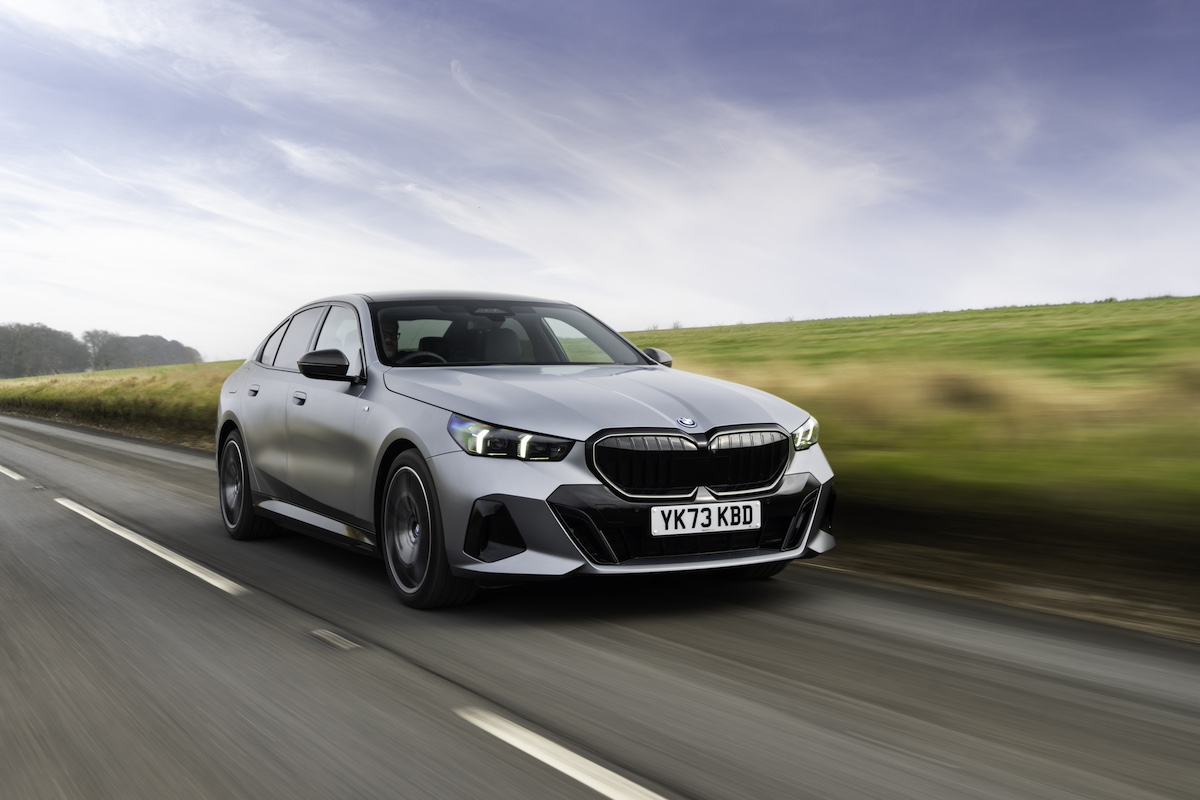
The BMW 5 Series may not be as fashionable a choice as it once was due to the relentless popularity of SUVs, but it is still a tremendously good one. If you’re going to buy any three-box executive saloon, this is the one to have, thanks to its sensational quality, cutting-edge technology and polished driving dynamics.
Granted, there are still question marks. So far, we’ve only had the opportunity to drive high-end versions with their monstrous power and trick suspension systems, so we still don’t know if the car will be anywhere near as good with more modest powertrains and less sophisticated underpinnings. On the evidence of what we’ve experienced so far, though, the latest 5 Series is a truly stunning package.
What is the BMW 5 Series?
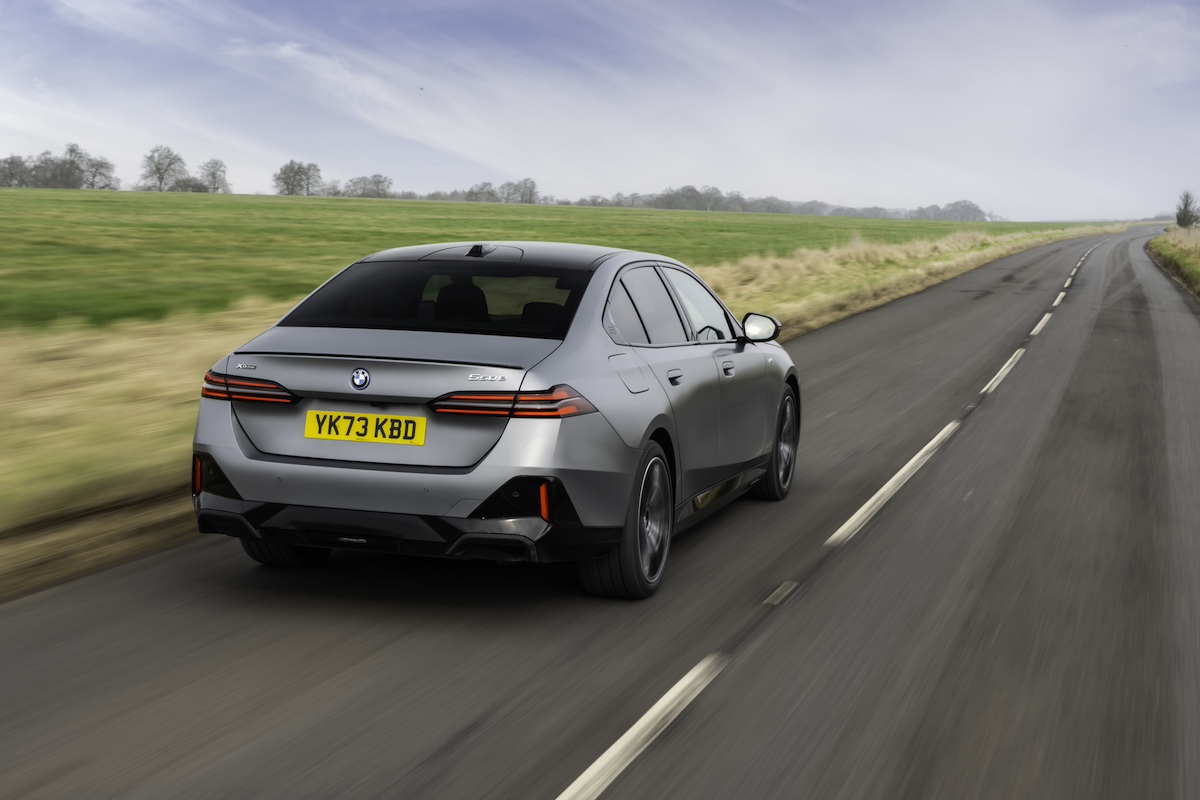
The BMW 5 Series has been the standard-bearer in the executive car class ever since the first-generation car was released way back in 1972, and the latest iteration is the eighth incarnation we’ve been blessed with.
Like with most previous versions of the 5 Series, the new BMW 5 Series is available in both saloon and estate body styles, and it can also be had in both rear-wheel-drive and all-wheel-drive formats. It’s a sign of changing times that diesel engines - which once dominated the sales charts among executive cars - are no longer offered, and instead, petrol engines with mild-hybrid or plug-in hybrid technology are preferred. There’s also an all-electric version in the shape of the BMW i5, but since that’s a significantly different proposition, we’ve reviewed that car separately. Here, we’ll concentrate solely on versions with a combustion engine.
The latest 5 Series arguably has a more difficult job on its hands than ever before. Not only does it have to fend off fierce competition from traditional rivals such as the Audi A6 and Mercedes-Benz E-Class in order to find sales - along with other less popular prestige saloons from the likes of Jaguar and Lexus - but it also has to compete with the vast stable of luxury SUVs currently flooding the market.
Happily, the 5 Series has the quality, technology and practicality to compete, and it also has a fairly sizeable dollop of dynamic polish to go with it. Who said the saloon car was dead?
How practical is it?
The BMW 5 Series wouldn’t be much of an executive car if it didn’t have enough space to comfortably accommodate you and a few colleagues while you travel between weekday business meetings, and also handle ferrying the kids to their various sports clubs at the weekend. Happily, it manages to do all of that without missing a beat.
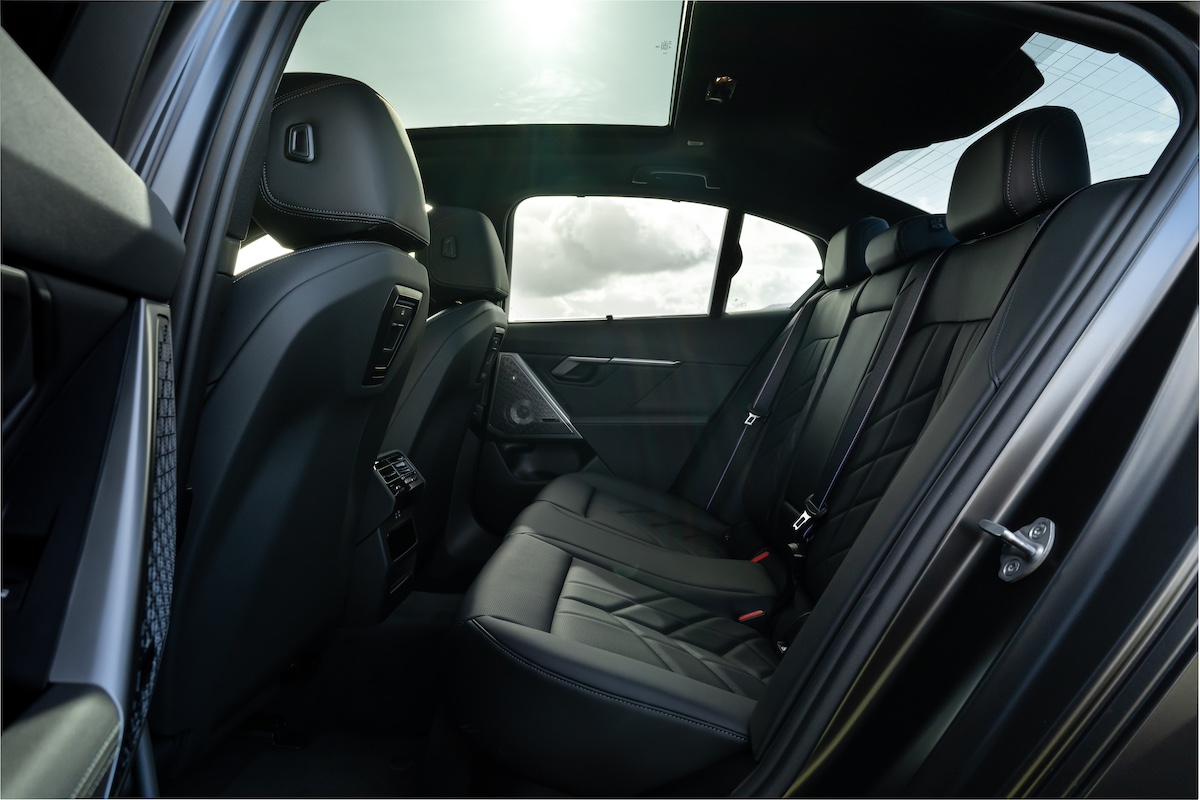
Set the front seats up for occupants of six feet tall or more, and there’s easily enough legroom behind for a passenger of the same size to stretch out in comfort in the back. Headroom is also very generous, so whether you’re carrying co-workers or gangly teenagers, everyone will be perfectly happy.
Provided you don’t try to carry too many people at once, that is. The rear seats are tremendously comfortable for two, but the cabin is rather too narrow for a third to fit comfortably. You’ll all squeeze in for short hops, but travelling three abreast in the back is too cramped to stand for any significant length of time. Whoever finds themselves sitting in the middle will be even less comfortable than those either side, because they sit on a seat that’s harder and narrower, and the hump in the middle of the floor limits their foot space. Having said all of that, though, these are all criticisms that you could also level at any one of the 5 Series’ rivals, so it’s pretty much par for the course.
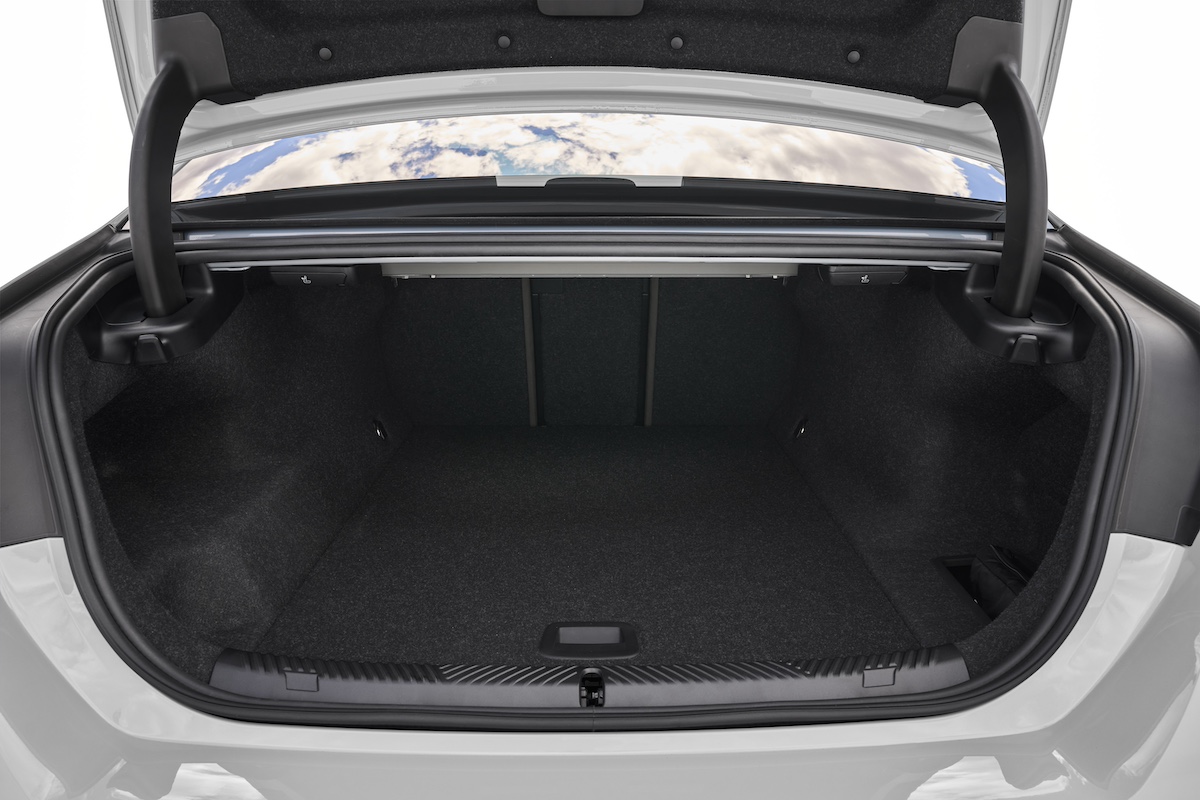
Whether the cargo you need to carry constitutes briefcases or sports bags, the BMW 5 Series saloon has you covered. Lift the bootlid and you’ll find 520 litres of space, and that’s regardless of which of the combustion engines you choose: the plug-in hybrids don’t lose any space compared to the non-plug-in versions. You do lose a little if you go for the all-electric i5 version, though, with 490 litres provided there.
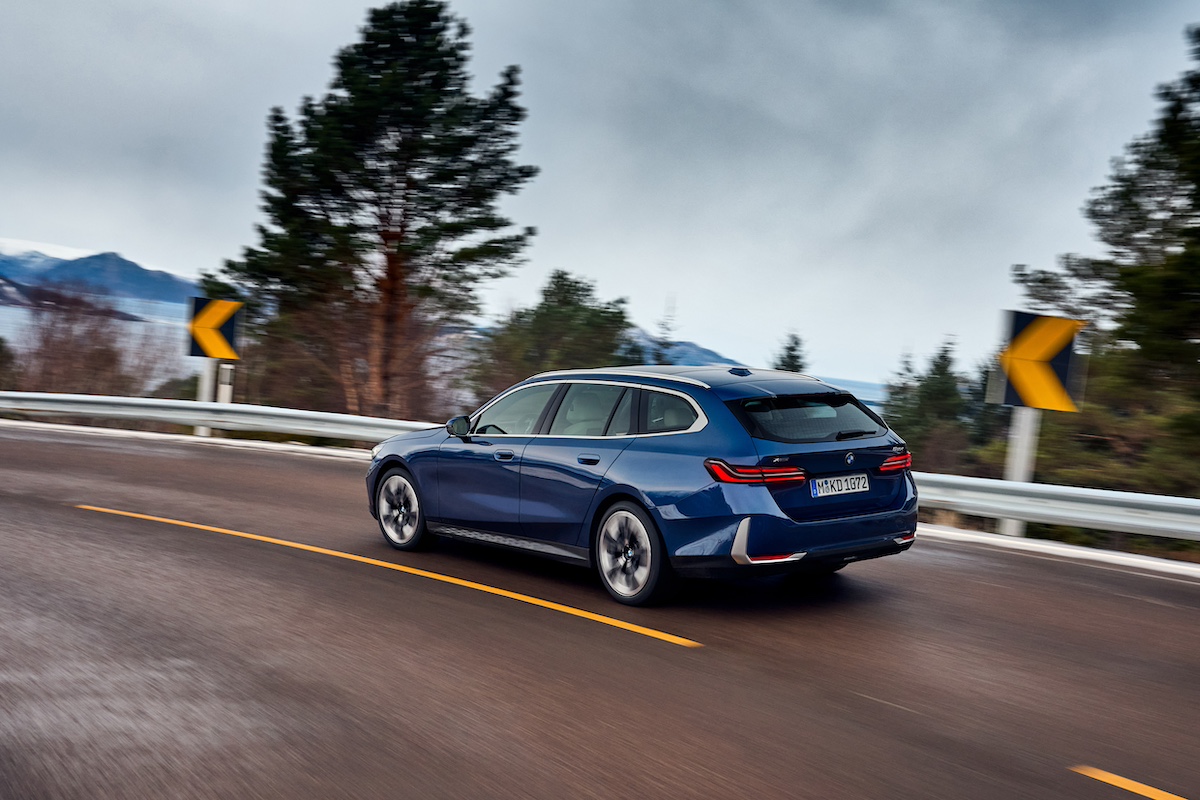
That saloon bootlid inevitably means that access isn’t as clear as it is with a hatchback tailgate, and that the space itself is rather shallow, and there’s also a small lip that you’ll have to lift heavy items over. You get split-folding rear seats that drop in a versatile 40-20-40 layout, but the aperture that opens up between the boot and the passenger compartment is shallow and oddly shaped. Still, if any of that is a problem for you, you can always go for the BMW 5 Series Touring estate version instead, which immediately remedies each of the issues, while also expanding your boot space to 570 litres.
Of course, there’s also the fact that the BMW 5 Series wouldn’t be much of an executive car if it didn’t cocoon its occupants in an environment that’s plush and classy, and again, the big BMW has the brief well and truly nailed. The materials used throughout the cabin are of uniformly exceptional quality, and all of them are a treat for the eyes and fingertips. The mixture of finishes and textures on display is tasteful and interesting, while the switches work with beautifully damped precision. It all makes the 5 Series feel like a real cut above, even by the high standards of the executive car class.
What’s it like to drive?
The 5 Series range begins with the 520i, which uses a turbocharged 2.0-litre, four-cylinder petrol engine fitted with a 48-volt mild hybrid system. This combination delivers 205bhp to the rear wheels via an eight-speed automatic gearbox. Even the most basic of the 5 Series models is capable of seeing off the 0-62mph dash in a swift 7.5 seconds.
Next comes the 530e plug-in hybrid, which takes the 520i’s petrol engine and adds a pokier electric motor to deliver 295bhp to the rear wheels. The 0-62mph sprint is trimmed to 6.8 seconds, and the car can run on electricity alone at up to 87mph.
At the top of the range (if you discount the all-electric i5) lies the xDrive 550e plug-in hybrid. Like the 530e, this can run at up to 87mph in electric-only mode, but otherwise, it’s completely different. It combines a 3.0-litre six-cylinder turbo petrol engine with additional electric propulsion to deliver a stonking 482bhp to all four wheels.
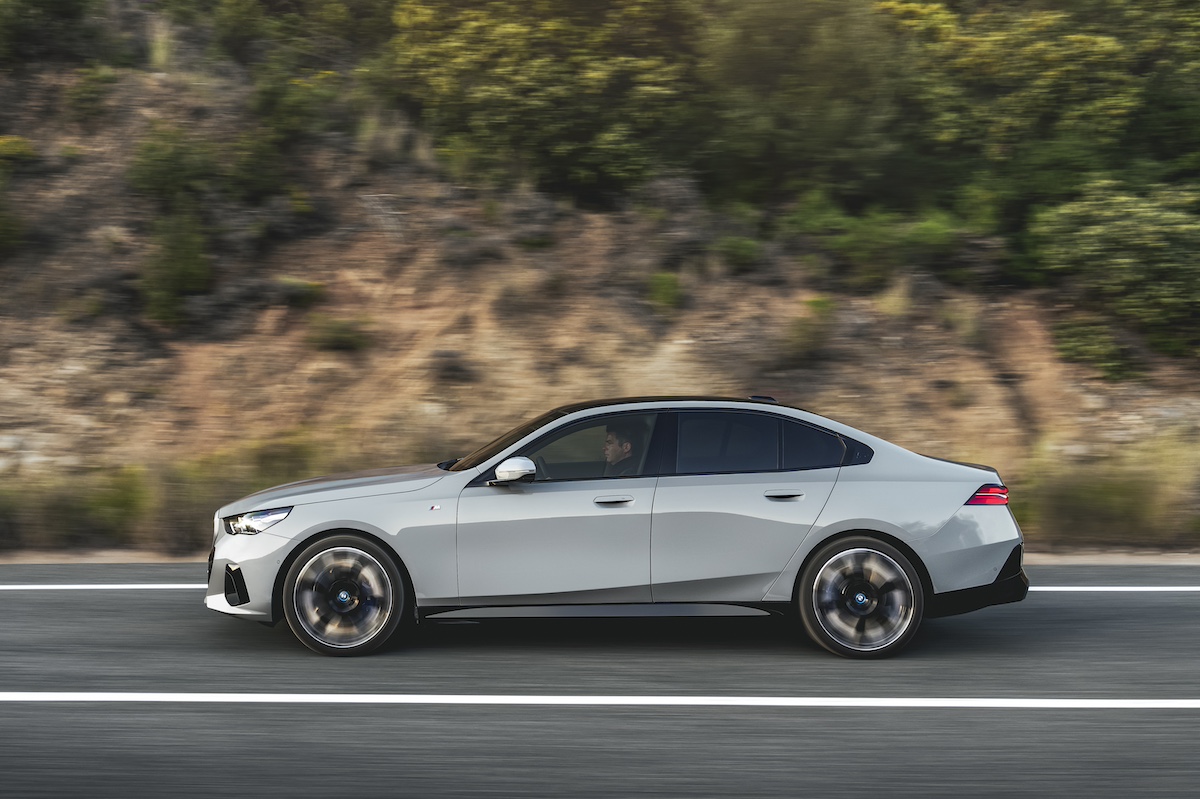
Of these engines, it’s only the 550e we’ve had the chance to drive so far, and given the numbers we’ve just mentioned, it’ll come as no surprise that this version is ballistically fast. The official 0-62mph figure is 4.3 seconds, which is very impressive in itself (and is probably contributed to by the four-wheel-drive traction as well as the prodigious power), but the number is eclipsed by the sensation of speed you get. Whether you’re getting away from the mark of picking up speed on the move, a devastating surge of acceleration is only ever a flex of your right ankle away.
Perhaps even more remarkable than the pace, though, is the smoothness of the powertrain. The petrol engine sounds soul-stirringly fabulous when you give it some revs, but when you don’t, it stays impressively quiet and subdued. Meanwhile, the electric assistance cuts in and out so smoothly that, for the vast majority of the time, you have absolutely zero idea which of the various power sources the car is running on. Wind- and road noise are also exceptionally well suppressed, and that helps make your progress even more serene, and at a steady motorway cruise, the car is whisper-quiet, just like a good executive car should be.
Another thing that a good executive car should be is comfortable, and the 550e has that bit nailed, too. We should point out here that the 550e version comes with BMW’s Adaptive Suspension Professional as standard: the lesser versions have a passive M Sport suspension, or the adaptive system can be added as an optional extra. As such, we still can’t tell you what the 5 Series is like with the passive setup, but with the adaptive one, it’s absolutely mustard.
Like most adaptive systems, selecting one of the sportier driving modes adds a dab of extra stiffness to the dampers, delivering stronger control over body movements and a greater feel of connection with the road. But, whatever mode you select, the suspension delivers a brilliant balance of cushiness and sharpness. It’s forgiving enough to smother potholes and ripples in an effortlessly smooth and sophisticated way, yet the car is nimble enough to flow from bend to bend in a precise and athletic manner. Okay, so you never forget that you’re driving a big, heavy executive saloon, but given its proportions, the 5 Series changes direction with incredible poise.
The Adaptive Suspension Professional package fitted to the 550e also comes with Integral Active Steering included. This turns the rear wheels in the opposite direction to the front ones by a few degrees at low speeds, and this tightens up your turning circle. At high speeds, the rears are turned in the same direction as the fronts to increase stability. It’s all very effective, and the steering feels wonderfully responsive and accurate, while also being beautifully weighted, although some drivers might wish for more feedback through the wheel.
For us, though, there’s one thing that takes the shine off the Five’s driving experience more than any other, and astonishingly, it’s self-inflicted by BMW. Like many of the firm’s other latest models, the 5 Series has the ‘IconicSounds’ function. This is a collection of synthetic wooshing and wailing noises that are designed to make your driving experience more theatrical or more peaceful, according to which of the driving modes you select. The things is, ‘theatrical’ and ‘peaceful’ are not words we would use to describe it. ‘Annoying’ is. So is ‘gimmicky’. Thankfully, it can be turned off fairly easily.
Technology, equipment & infotainment
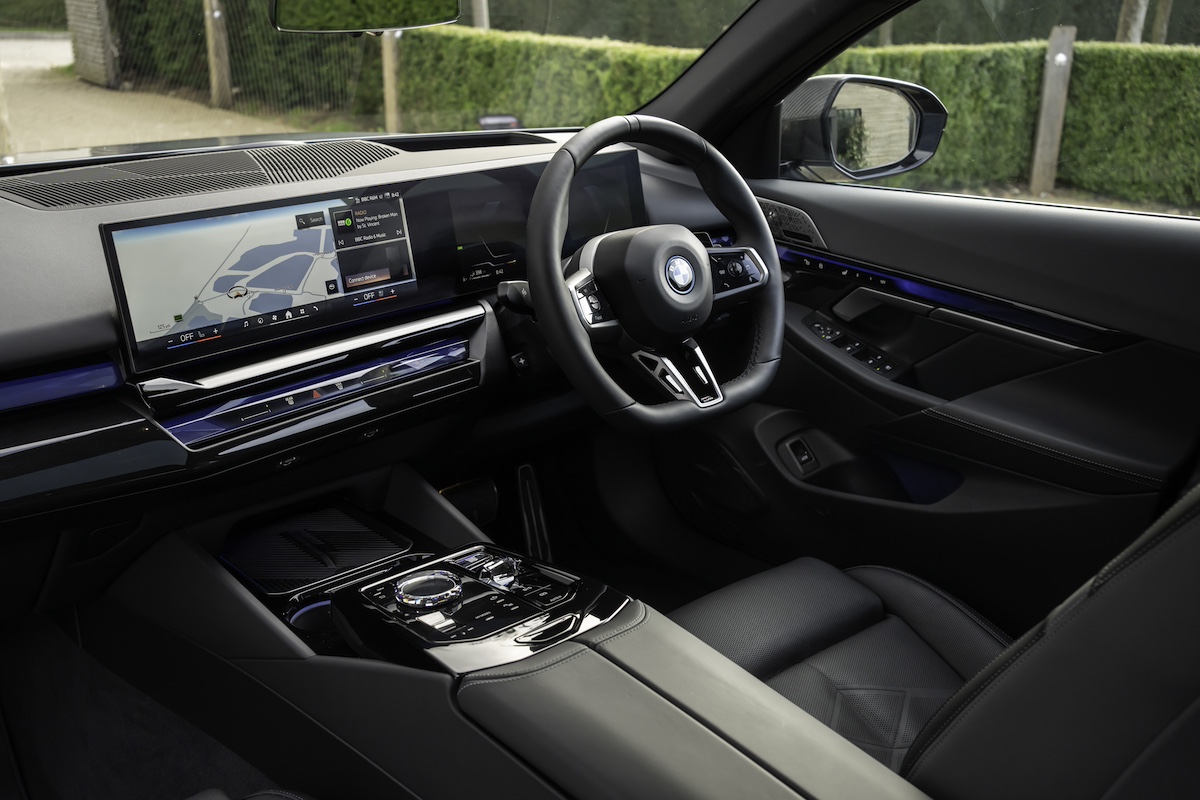
The sophisticated infotainment system in the 5 Series is one of its main selling points, and to be fair, it looks absolutely fab. It brings together a 14.9-inch central screen and a 12.3-inch digital instrument display, both housed together in a single-piece panel that curves gently and satisfyingly around the driver. The screens have a posh-looking glossy finish and sharp, modern graphics, while the screen transitions and animations are as slick as you like.
Importantly, the system has all the functionality that customers demand, including DAB, Bluetooth, navigation, wifi, Apple CarPlay and Android Auto, wireless phone charging, numerous USB points and remote software upgrades. You also get a punchy Harman Kardon surround sound audio system as standard.
The central screen has touchscreen capability, but it can also be operated by turning and pressing a rotary controller on the centre console, in traditional BMW style. This is far less distracting to use on the move than prodding away at a screen. Given this iDrive rotary controller has been removed from several other recent BMW models, so we’re pleased to see it retained here. There’s also a handful of shortcut buttons positioned next to the dial, plus additional shortcut icons running across the bottom edge of the screen. These all provide quicker and easier access to the car’s most-used functions, so useability could be considerably worse, but the system still takes quite a bit of getting used to, purely by virtue of how complicated it is.
And why is it so complicated? Well, because BMW seems to be obsessed with ridding its cabins of any physical buttons and switches. And indeed, there are hardly any left in the 5 Series, meaning that the vast majority of the car’s functions - even minor ones - must be operated through the screen.
And even some of those that aren’t don’t have proper buttons. Like the 7 Series limousine, the latest 5 Series has something BMW calls the Interaction Bar. This is a horizontal trim strip that runs the full width of the dashboard and part of the way into the door trims. It provides ambient lighting that reflects the activity of the car or the driving mode you’ve selected, and it also houses a number of touch-sensitive controls to operate various minor functions, mostly peripheral functions of the ventilation system. It’s a unique and interesting feature, but it’s very gimmicky, and we can’t help feeling that proper physical buttons and switches would be much better from an ease-of-use perspective.
In terms of other luxury equipment, the 5 Series comes with a very decent amount as standard. M Sport is the entry-level trim, and this provides 19-inch alloy wheels, dual-zone climate control, heated front sports seats, imitation leather and suede upholstery, a leather steering wheel, power folding door mirrors and a parking assistant that includes front- and rear sensors and a reversing camera.
M Sport Pro specification adds 20-inch alloys and various sporty exterior styling elements, including illumination of the trademark kidney grille. That’s about it, though, and that’s not an awful lot for the extra three grand you pay. You can quickly send the price of your car skyrocketing even higher if you get carried away with the extensive options list offered by BMW.
BMW 5 Series running costs
Brand new, the BMW 5 Series range starts at around £51,000 for the 520i M Sport, while choosing the 530e plug-in hybrid will hike your starting price to £60,000. The more powerful 550e M Sport plug-in hybrid will cost you around £77,000, while in each case, upgrading to the M Sport Pro spec will cost another three grand on top. The 5 Series is not a cheap car then, but nobody of sound mind would expect it to be, and it doesn’t look outrageous compared with rivals.
As we said earlier, the 520i comes with mild hybrid technology to boost its economy slightly, and its official WLTP figure of up to 49.6mpg is pretty impressive given the size of the car.
These official WLTP figures suggest that the plug-in hybrid versions will do a lot better. On the combined cycle, the 530e achieved a figure of up to 470.8mpg, helped greatly by the car’s all-electric range of up to 63 miles. The 550e wasn't all that far behind, with its electric range of up to 55 miles helping it to an official combined figure of up to 353.1mpg.
However, do bear in mind that these official tests are unrealistically flattering to plug-in hybrids, and the fuel consumption you get in the real world will depend entirely on how you use your car. Keep it charged up and limit yourself solely to short journeys that can be completed on electric power only, and you won’t use a drop of petrol. However, if you make regular and prolonged use of the petrol engine, your car will be very thirsty indeed due to the extra weight of the batteries.
BMW 5 Series reliability
Obviously, it takes a bit of time for any reliability issues with a new car model to come to light, and with the BMW being so new, there hasn’t yet been time for that to happen.
Owners can take a bit of heart from BMW’s reasonably solid reputation for reliability. In the most recent 2023 edition of the What Car? Reliability Survey, BMW placed 12th out of the 32 manufacturers considered, putting the brand ahead of the industry average, and ahead (by quite a distance, as it happens) of German prestige rivals Mercedes (24th) and Audi (26th).
In the executive car class, which contained 24 entrants, the previous 5 Series ranked second as a petrol car and 11th as a diesel, so another solid performance. However, you can’t read too much into that because the latest 5 Series uses all-new technology.
Like all BMWs, the 5 Series comes with a three-year, unlimited mileage warranty, which is marginally more generous than the bare minimum offered elsewhere in the industry.
- Safety is hugely important in any car that’ll carry your family, and the 5 Series comes with standard kit including automatic emergency braking, lane departure warning and correction, adaptive LED headlights with high beam assist, dynamic stability control, cornering brake assist, trailer stability control, rear cross traffic alert and braking, adaptive cruise control and seven airbags.
- The 5 Series was crash-tested by Euro NCAP upon its release in 2023, meaning it was tested against the most stringent standards to date. Nevertheless, it was awarded the full five-star rating, with an 89% score for adult occupant protection, 85% for child occupant protection, 86% for the protection of vulnerable road users and a 78% safety assist score.
- You can make your 5 Series even safer by adding the optional Tech Pack Plus, because this includes something called the Driving Assistant Professional. This brings proper stop-and-go functionality for the adaptive cruise control, plus enhanced steering and lane control. The pack also allows you to park your car using only your smartphone.
- If you’re on a budget: In fairness, no 5 Series is going to be bought on a small budget, but the cheapest version is the 520i M Sport variant. We haven’t tried it yet, but things look very encouraging on paper, with what looks to be an appealing blend of performance and economy.
- If you want a PHEV with the best electric range: The 530e is the 5 Series for you. Its WLTP electric range figure of up to 63 miles is eight miles more than the more powerful 550e will give you, which contributes to an overall official fuel economy figure of up to 470.8mpg. Correspondingly teeny CO2 emissions mean this is the 5 Series to choose for company car drivers.
- If you want the fastest 5 Series: Not including the most brutal versions of the all-electric i5, the quickest version of the 5 Series is the 550e. It’s astonishingly fast, and what’s more, its six-cylinder petrol engine sounds glorious when it’s on song.


