BMW i5 2026 review | Comfortable and tech-laden electric saloon
BMW i5 cars for sale
4.0
Expert review
Pros
Good to drive
Gorgeously trimmed cabin
Spacious for passengers
Cons
Expensive
Patchy ride on standard passive suspension
Too many annoying gimmicks

The CarGurus verdict
The BMW i5 is everything you’d expect an electric 5 Series to be. Like any other version of the world’s most successful executive saloon, it’s spacious, practical, dripping with quality and packed with tech, plus it’s enjoyable to drive. Like any other BMW electric car, it has a decent range, excellent refinement and it goes like stink.
Faults? The ride on the standard passive suspension is a bit brittle, and we wish BMW would cool it a bit with some of the more gimmicky stuff, such as the mood-based driving modes and synthetic whooshing sounds. However, that doesn’t detract from what is an immensely impressive package.

What is the BMW i5?
The i5 is the electric version of the current, eighth-generation BMW 5 Series, which is also available with petrol, diesel and plug-in hybrid powertrains. A Touring estate has also joined the range, giving buyers a rare fully electric estate option. Key rivals include premium electric saloons such as the Mercedes-Benz EQE, Porsche Taycan, Tesla Model S and the Audi A6 E-Tron.
Positioned as a more traditional, business-focused alternative to some newer EV designs, the i5 blends familiar 5 Series practicality and comfort with BMW’s latest EV technology. It borrows heavily from the larger BMW i7 saloon in terms of digital features and interior technology.
As with every 5 Series generation, however, success ultimately depends on how it drives. The i5 aims to carry forward BMW’s reputation for combining long-distance comfort with sporting appeal. It’s also tasked with helping executive saloon buyers who may otherwise have bought a petrol or diesel car make the transition to electric power.
Official WLTP-tested range figures for the saloon are up to 382 miles for the rear-wheel-drive eDrive40 and up to 330 miles for the more powerful M60 xDrive. Both models have an 81.2kWh (usable capacity) battery and support rapid charging at up to 205kW.
How practical is it?
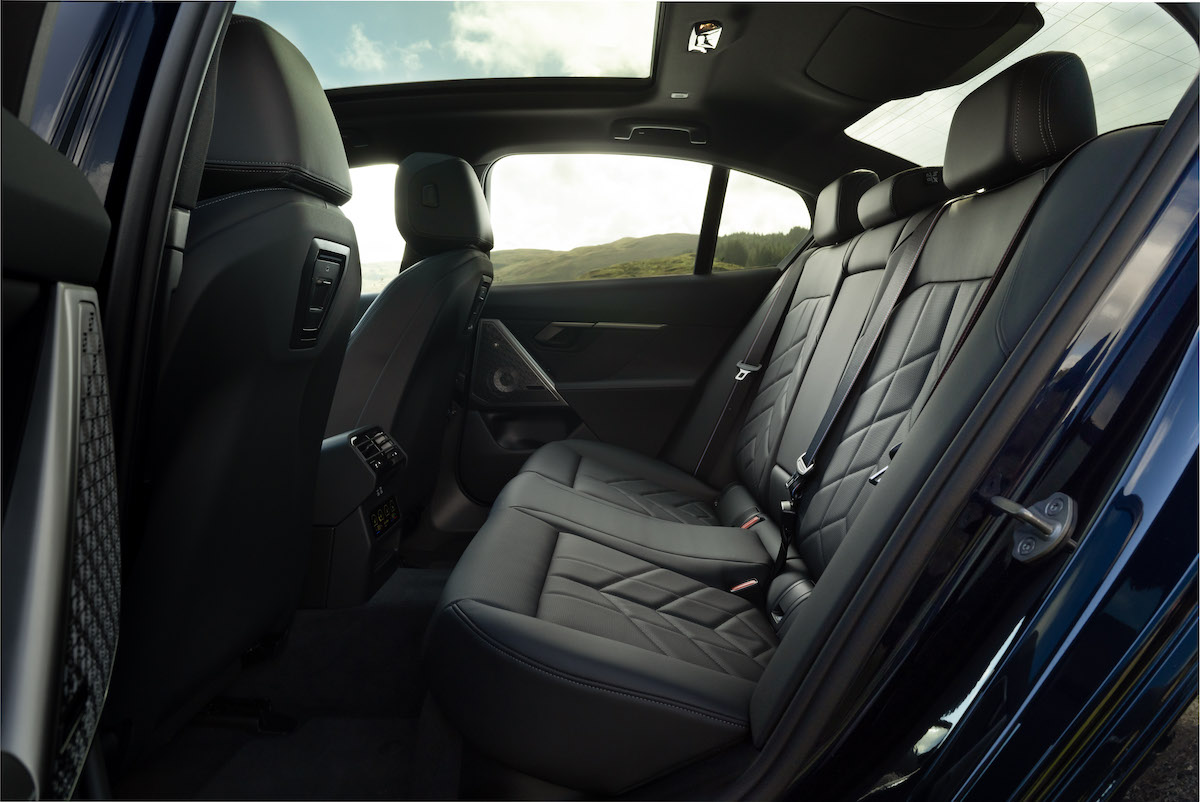
You’d expect any executive saloon to be roomy enough to transport work colleagues from meeting to meeting in comfort, and that’s precisely what the i5 does. Predictably, there’s loads of space in the front, while in the rear, you get generous legroom (not surprising when the car has a wheelbase of almost three metres) and more-than-adequate headroom. Even your tallest workmates should be able to travel in comfort.
Provided there aren’t too many of them, that is. The rear bench is great for two people, but attempt to squeeze in a third and nobody will be very comfortable; the cabin is too narrow to comfortably accommodate three sets of shoulders. The middle seat is hard and narrow, too, and the hump in the middle of the floor impinges on the foot space available.
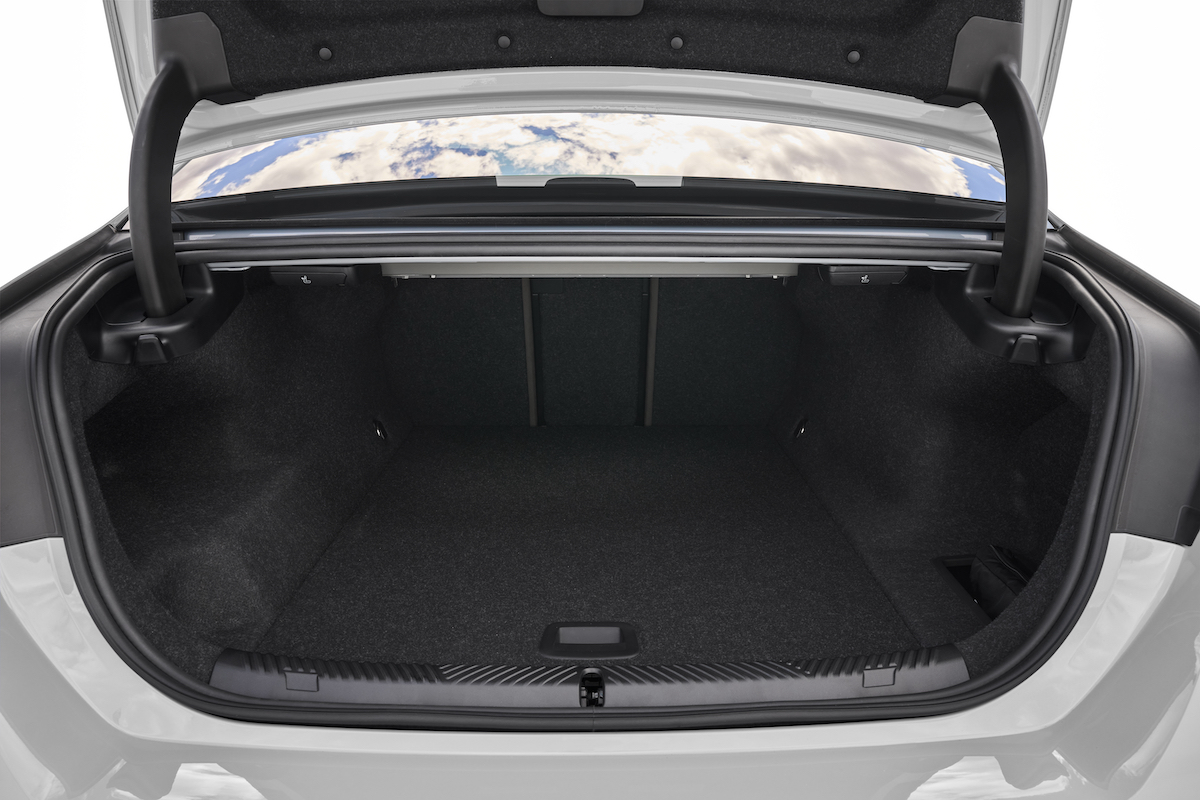
The boot is very competitive for size, with 490 litres of space provided, which is only 30 litres down on what you get in the regular combustion-engined 5 Series. Being a saloon, however, space is rather shallow and access to it isn't as good as in a hatchback. The rear seats fold 40:20:40 for when you need to carry bigger loads, but the aperture between the boot and passenger compartment is rather narrow and oddly-shaped. And because the boot floor sits higher than the backs of the folded rear seats, there’s an odd step in the extended load area that can get in the way.
Buyers needing more versatility can opt for the i5 Touring estate, which offers significantly improved practicality. Boot space increases to 570 litres with the rear seats in their upright position, expanding to 1,700 litres when folded, along with a wider opening and a more flexible load area than the saloon. It's also the i5 version for you if you happen to own a dog or two.
Like you’d expect in any BMW – especially one costing this much – the quality on show in the i5 is really impressive, with lustrous materials, a really pleasant mix of textures and finishes, and a superb standard of assembly.
What’s it like to drive?
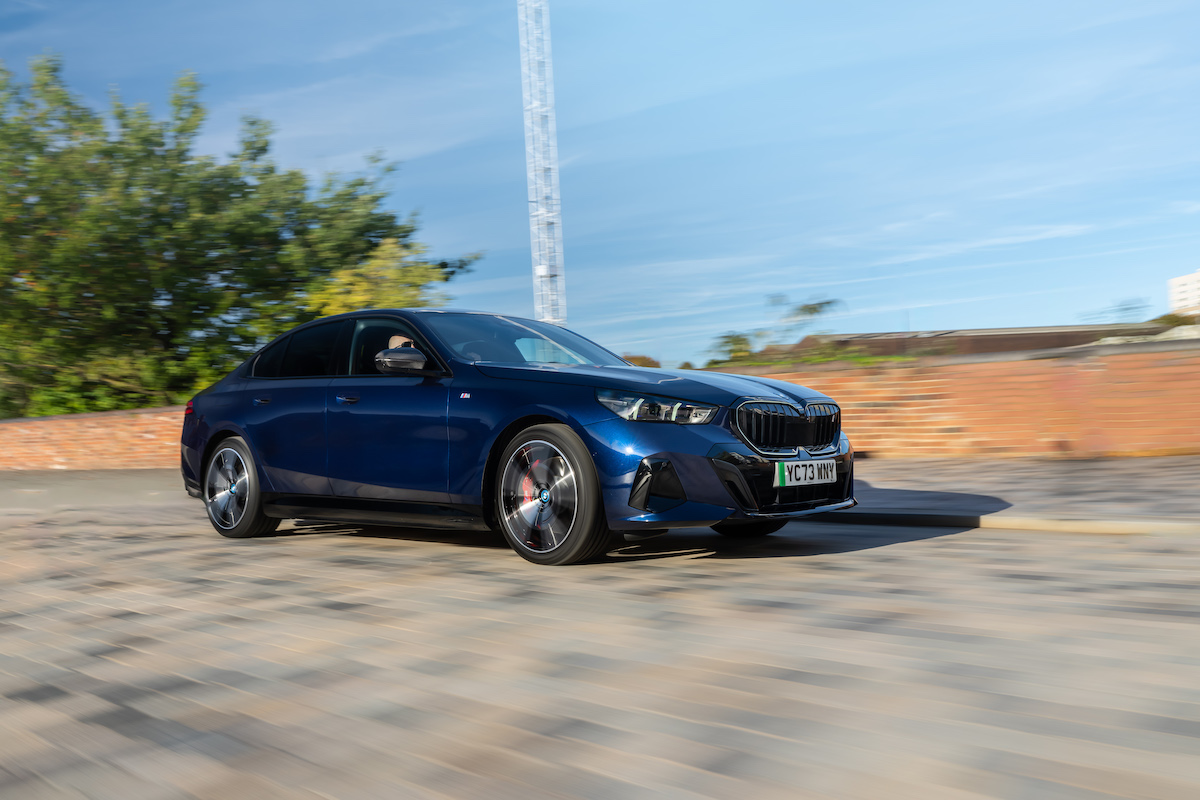
There are two versions of the i5 available. The first of them, the eDrive40, has a single electric motor delivering its power to the rear wheels, so in the best traditions of BMW, it’s rear-wheel drive. This motor delivers 308bhp under normal circumstances, an output that’s hiked up to 335bhp when the car’s Sport Boost function or launch control are enabled. Doing so makes it capable of doing 0-62mph in 6.0 seconds, but regardless of mode, the car is always ready, willing and able to pick up the pace at an impressive rate of knots. Any request for more speed is responded to immediately and emphatically, and there will be very few people for whom the eDrive40 is not fast enough.
For those people who represent the exceptions to that rule, however, there is the BMW i5 M60 xDrive. As its name suggests, this adds a second electric motor to power the front wheels for all-wheel drive, and when everything is cranked up to the max, the total output of this dual-motor arrangement stands at 593bhp and a staggering 820Nm of torque. To be honest, the (very impressive) 0-62mph figure of just 3.8 seconds is fairly meaningless compared with the sensation of speed it delivers: it’s absolutely ballistic. The first time you unleash all that power, you’d be some sort of modern-day saint to not let a swear word slip out.
Even with the car in one of its less aggressive settings, the pickup is still instant and capable of being devastatingly quick. Acceleration is easy to modulate, though, so driving the car slowly isn’t difficult.
Regardless of speed, refinement is sensational. That’s no great surprise given the i5 is a luxurious executive car with an electric drivetrain, but even given those parameters, it impresses at all speeds. Provided you turn off the snappily named ‘BMW IconicSounds Electric’, that is. As in other BMW EVs, this is a suite of futuristic sounds – which BMW proudly declares were developed alongside film composer Hans Zimmer – that mirror your driving behaviour to make your journey either more theatrical or more relaxing. It will be a delight to some drivers, and an intolerable gimmick to others.
All versions except the entry-level Sport Edition come with passive M Sport suspension, while an adaptive system can be added as an option. We’ve not tried the latter, but based on our experience of the former, we can see why it might be appealing. The standard setup is far from uncomfortable, but there is a distinct brittleness to the ride, particularly at low speeds, so it might not cosset you in quite the way you expect from a luxurious executive car. That said, the ride does level off as you go faster, and it feels supremely planted on the motorway.
The payoff for the firm suspension is taut body control when changing direction, while grip levels are strong and responses are quick. Some might wish the steering had a bit more weight and feedback, especially given this is a BMW, but it’s nothing that undermines your confidence in the car’s abilities.
The M60 gets the adaptive suspension setup as standard, or as an (expensive) option, you can choose to upgrade to a system that includes Active Roll Stabilisation. This uses 48-volt electric motors to compensate for lateral forces to keep the body more level when cornering. The car we tried was fitted with the optional system and it’s seriously effective, making the car feel lighter and more agile than something of this size and weight has any right to. Importantly, the ride is much smoother as well. The sportier modes introduce that firmness if and when you want it, but the more comfort-focused settings take the edge off really effectively when you don’t.
Technology, equipment & infotainment
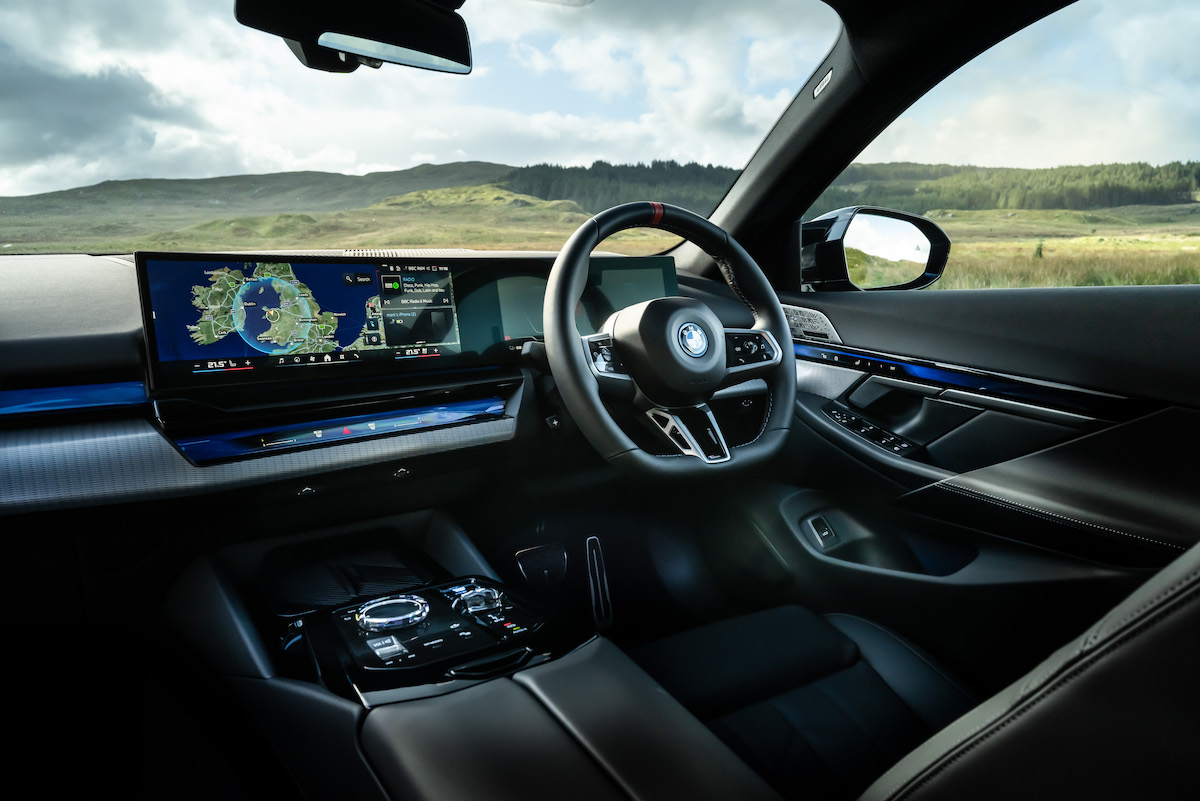
The i5 gets some technology that has trickled down from the flagship i7 and 7 Series limousines, including BMW’s Interaction Bar. It may sound like a venue for speed dating, but it’s actually a horizontal trim strip that runs the full width of the dashboard and part of the way into the door trims. It provides ambient lighting that reflects the activity of the car or the driving mode you’ve selected, and it also houses a number of touch-sensitive controls to operate various functions, many of which are peripheral settings of the ventilation system. It’s an interesting feature – if rather gimmicky – but for us, it’s no substitute for having proper physical buttons and switches.
Alas, you get very few of those elsewhere because – as is the fashion these days – most functions are controlled through the infotainment screen. This is a 14.9-inch screen that sits alongside a 12.3-inch driver’s display in a single frameless curved unit. It looks pretty swish and runs BMW’s latest Operating System 8.5 software.
Like most systems, it has touchscreen functionality, but mercifully it can also be navigated by turning and pressing the rotary controller on the centre console, which is much less distracting. The shortcut buttons alongside the dial help as well, plus there are shortcuts to the most regularly used functions running across the bottom of the screen – so user-friendliness could be a lot worse. Even so, the system takes plenty of getting used to, simply because it’s so complex.
This same iDrive infotainment comes as standard on all i5 models, and it includes DAB radio, Bluetooth hands-free phone operation, a native navigation system, and Apple CarPlay and Android Auto connectivity.
Sport Edition is the entry-level model. Highlights include 19-inch alloy wheels, LED headlights and rear lights, dual-zone climate control, sports front seats, wireless smartphone charging, cruise control and parking assist. Stepping up to the mid-range M Sport adds the likes of two-colour 19-inch alloy wheels, part-Alcantara seats, M Sport suspension, an M Sport leather steering wheel and high-gloss Shadowline exterior trim. The M Sport Pro adds even more cosmetic upgrades, plus 20-inch alloy wheels, a Harman/Kardon audio system, an M Sport spoiler and seat belts, and a glowing front grille (yes, really).
The flagship M60 xDrive isn’t a trim level as such, more a standalone performance version with the power, pace and upgrades that befit a car with a six-figure price tag.
BMW i5 running costs
Big cars aren’t cheap. Electric vehicles aren’t cheap. BMWs aren’t cheap. So it’ll come as no surprise whatsoever that a big electric BMW most certainly isn’t cheap. The base-level BMW i5 eDrive40 Sport Edition variant checks in at around £68,000, while choosing the M Sport Pro trim adds another £10,000 to the price (which seems like a lot for some bigger wheels and a few styling goodies). Plump for the M60 and you’ll be paying close to £100,000, and you won’t have to add too many optional extras to take the price over that threshold and well beyond.
A car this powerful and this expensive is going to be sitting towards the top of the 50-group insurance scale, so it’s no surprise to find the M60 right at the top. At least you won’t have to pay to put petrol in the i5, though, and filling it with electricity should prove much cheaper than running a combustion-engined 5 Series if you have the ability to charge at home. If you haven’t already, you can read about the i5’s range and charging times in the ‘Three Things to Know’ section of this review.
By far the biggest savings can be enjoyed by company car drivers, who will pay Benefit-in-Kind company car tax on just three percent of the i5’s value. Compared to a combustion-engined car (even a relatively cheap one), this will save you a not-so-small fortune in monthly bills.
BMW i5 reliability
Predicting the reliability of a new car is pretty much impossible, but looking at BMW’s historical performance can provide some clues. Take a look at the 2025 What Car? Reliability Survey, and the previous version of the 5 Series did pretty well in the Executive Car class. Petrol and diesel models were considered separately, with the petrol 5 Series coming fifth in the 24-model category, while diesel versions finished 11th. In the manufacturer standings, BMW came sixth out of the 30 carmakers considered in the study, which was way ahead of premium German rivals Mercedes-Benz and Audi.
Like all BMWs, the i5 is protected by a three-year, unlimited-mileage warranty. The drive battery is under warranty for eight years or 100,000 miles, whichever comes first.
- All versions of the i5 are powered by the same lithium-ion battery pack, which has a capacity of 81.2kWh. In the eDrive40 variant, this delivers an official, WLTP-tested driving range of up to 382 miles, whereas on the M60, that figure stands at 330 miles. These figures are for the i5 saloon. In the i5 Touring, they drop to 351 and 321 miles respectively.
- The i5 has a maximum DC charging speed of 205kW, which is very impressive. Find a powerful enough public rapid charger, and you can take on a 10-80 percent charge in 30 minutes, or get yourself a 97-mile top-up in just 10 minutes under ideal conditions.
- Drive your i5 in Efficient mode, and you also have the option to enable a ‘Max Range’ function. This limits your power and top speed (to 60mph), as well as paring back the operation of various non-essential functions, such as the air-conditioning. BMW says that this can increase your car’s range by as much as 25 percent.
- If you want the fast one: All i5s are fast, to be fair, but the M60 is by far and away the fastest. A mammoth maximum power output of 593bhp makes it capable of covering 0-62mph in just 3.8 seconds. Believe us when we say that this kind of acceleration is quite an experience.
- If you want the affordable one: No BMW i5 is particularly affordable, but the most attainable one of the lot is the eDrive40 Sport Edition, which comes with plenty of performance and luxury kit.
- If you want a sportier look: For around £10,000 you can bypass the mid-range M Sport and upgrade from standard Sport Edition trim to M Sport Pro, which gets you bigger wheels, a few styling goodies and a light-up kidney grille. However, we’d spend the cash on adding adaptive suspension to the M Sport car instead.
- If you’re a company car driver: Monthly company car tax bills will be ridiculously low on all i5s no matter which one you pick. So if your company will let you, you might as well go the whole hog and have the M60.