BYD Sealion 7 Review (2025-present)
Byd Sealion 7 cars for sale
3.0
Expert review
Pros
Loads of passenger space
Extremely fast
Solid build quality (mostly)
Cons
Unsettled suspension
Disappointing energy efficiency
Fiddly infotainment system
The CarGurus verdict
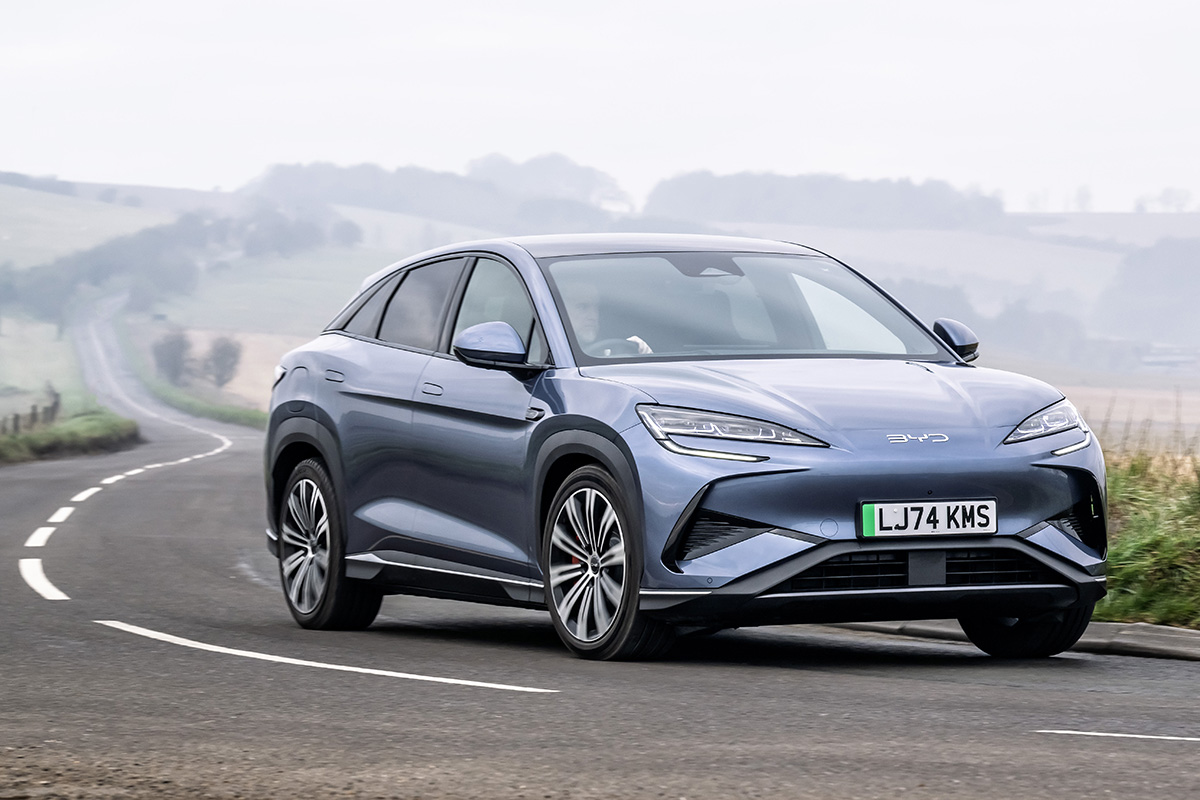
It feels like there’s a good car in here that’s struggling to get out, and being held back by an over-reliance on the infotainment screen (instead of physical buttons), a rather unsophisticated suspension setup, and poor energy efficiency.
It’s a shame, because the Sealion 7 is roomy, smart, and feels incredibly solidly built. It’s also lavishly equipped, and it looks the part, both inside and out. As a result, the single-motor Comfort model might be worth a look – but the heavier, less efficient four-wheel-drive versions are difficult to recommend.
What is the BYD Sealion 7
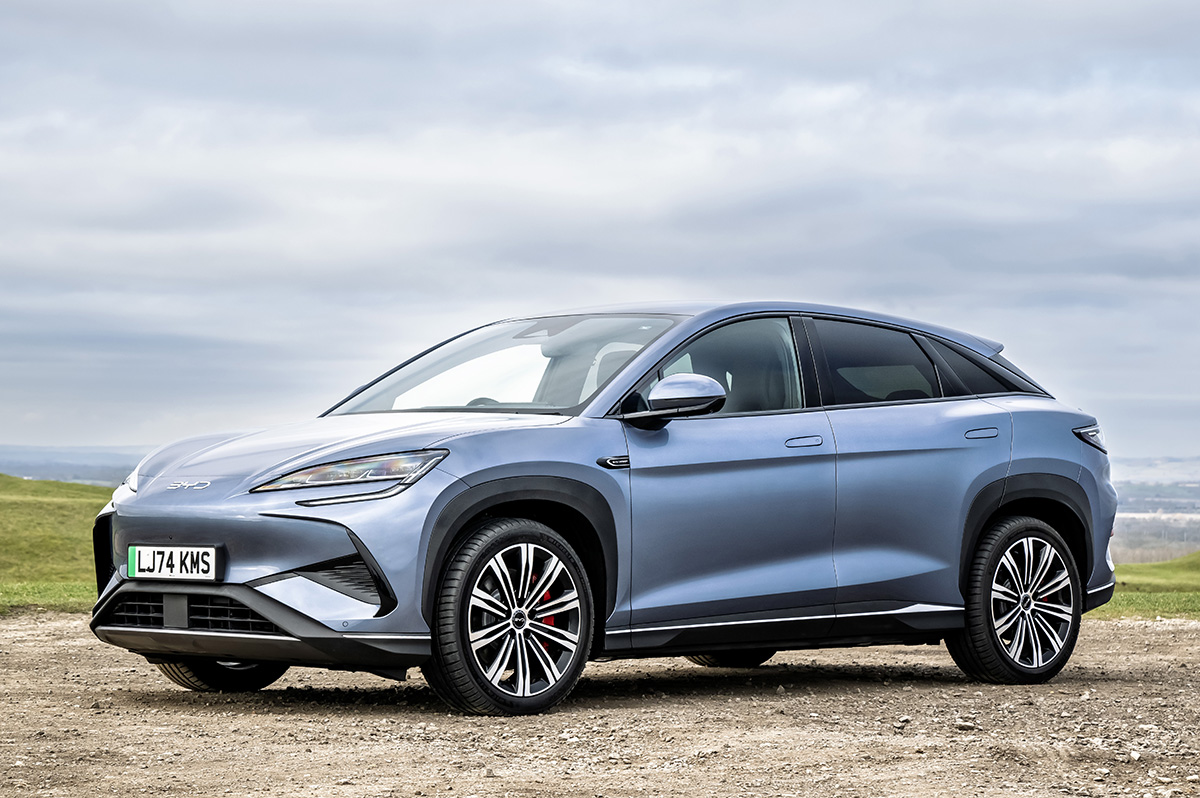
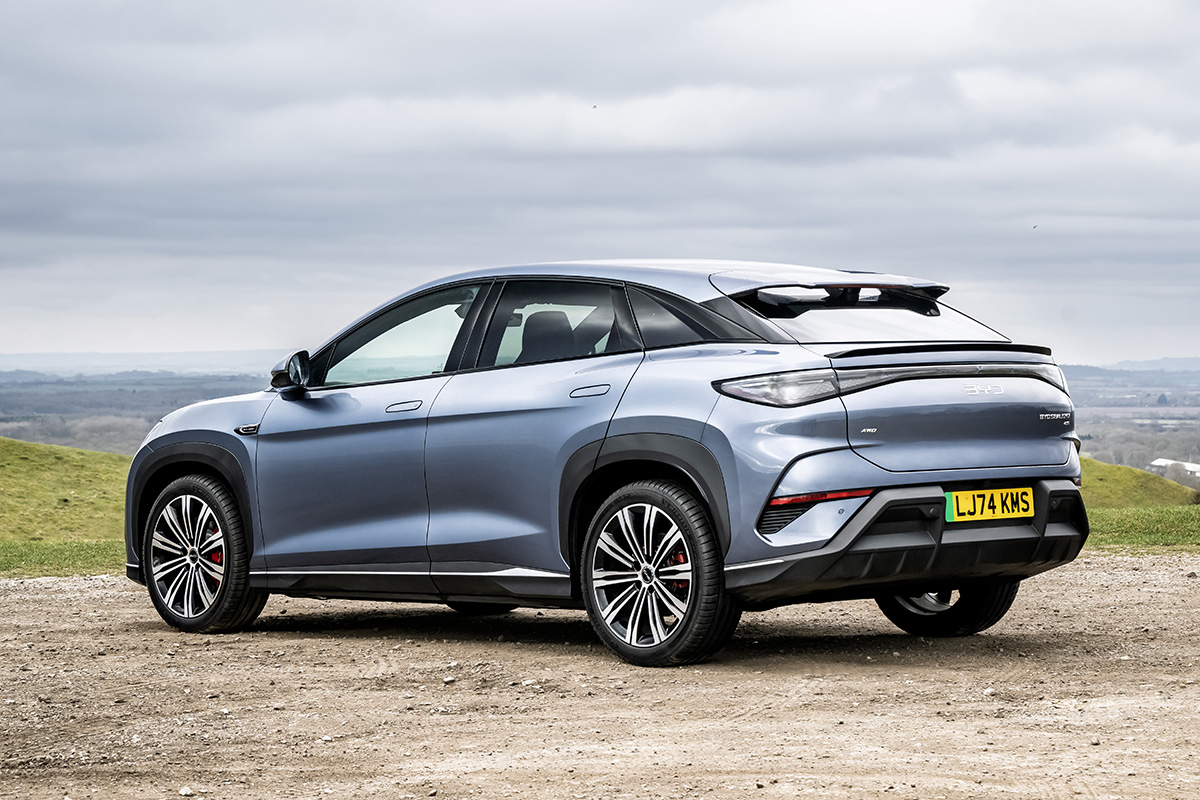
If the BYD Sealion 7 is a little tricky to pigeonhole for you, think of it this way: it’s pitched squarely against the Tesla Model Y; in other words, it’s like a Kia EV6, Ford Capri or a Skoda Enyaq Coupe, but a little bit bigger.
That means it gets a swooping roofline atop an SUV body with an electric powertrain. Think of it, then, as being an SUV version of BYD Seal saloon – or a pure electric coupe version of the plug-in hybrid Seal U – and a larger, sleeker sibling to the firm’s Atto 3 and Dolphin.
The idea is to offer a big, family-friendly electric SUV with attractive styling that’s redolent of a premium brand, but at a price that’s aligned with more mainstream models. To that end, the Sealion 7 will appeal to buyers looking for a new car that delivers space and style at a sensible price.
How practical is it?
There’s not much to dislike about the Sealion 7 from within. You get a vast amount of space for drive and passenger alike, and there’s plenty of seat adjustment up front to allow you to find a good driving position.
There’s a high centre console that offers two niches for mobile phones, one of which features wireless charging and a small vent to keep your phone cool.
Behind this is a pair of cupholders and an arm rest that opens to reveal more storage space, and if that’s not enough, below the console there’s an enormous cubby where you can dump larger items. The door bins are spacious, too, with room for a good-sized bottle in each.
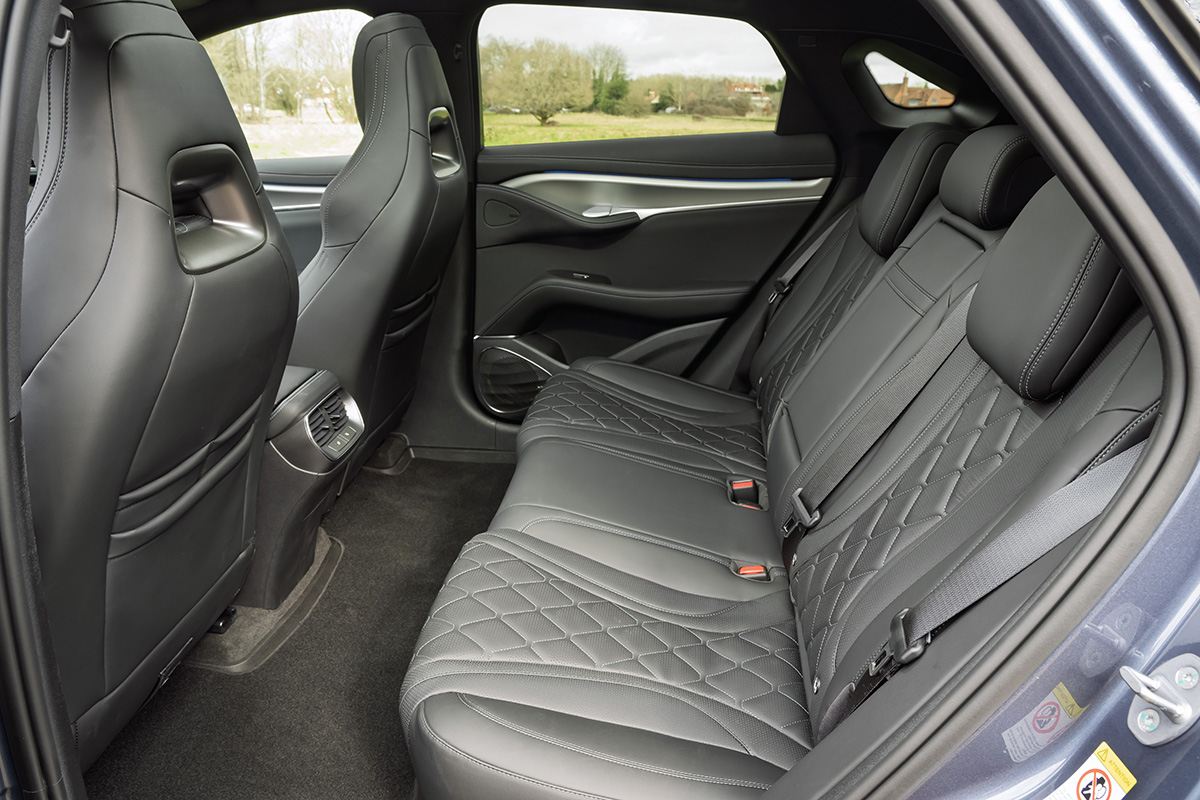
Further back, rear-seat passengers have not been forgotten, as you’d expect in a family SUV. Once again, there’s a huge amount of space, with more leg room than you’ll know what to do with. Happily, that curving roofline doesn’t eat into head room, either, and the huge doors and high-mounted rear seats make it easy to buckle children in, or for those who are less mobile to gain entry.
Once inside, rear-seat passengers benefit from the additional practicality of three separate door pockets – two phone-sized, and one larger one – on the back of each front seat. There are also two USB sockets for charging devices on the move.
What about boot space? Well, at 520 litres the boot itself is a bit down on the Enyaq Coupe’s, but it’s similar to or better than most of the Sealion 7’s other rivals’. What’s more, you get a ‘frunk’ – an additional cubby under the bonnet – giving you an extra 58 litres’ worth. Taken together, this means you actually get slightly more room all told than you do in the Enyaq Coupe.

What’s it like to drive?
There are three different versions of the Sealion 7 available, each with its own powertrain and battery configuration.
The range kicks off with the rear-wheel-drive (RWD) Comfort, which gets the smaller (82.5kWh usable) of the two batteries, and just one motor producing 308bhp, which allows a 0-62mph acceleration time of 6.7 seconds. You also get an official range of 300 miles (expect anywhere between 210 and 240 miles in the real world), and a maximum charging speed of 150kW, which should get you from 10 to 80 per cent charge in 32 minutes.
Upgrade to the Design AWD, and you get the same battery (and charging speed), but it’s now allied to an additional electric motor driving the front wheels, making the Design four-wheel drive. That additional motor results in a whopping power output of 523bhp – far more than most of the Sealion 7’s rivals can muster – and a 0-62mph time of just 4.5 seconds. The top speed of every Sealion 7 is 133mph.
With the weight of the extra motor, however, the official range of the Design version drops to a fairly uninspiring 283 miles – which means on a cold winter’s morning, you might see your real-world range dip below 200 miles.
The top-of-the-range Excellence AWD improves things somewhat by teaming the same dual-motor powertrain as the Design model with a bigger battery, of 91.3kWh usable capacity.
This results in 312 miles of range (anywhere between 220 and 250 in the real world). The Excellence also gets faster charging speeds, so can top up from 10 to 80 per cent in just 24 minutes – providing you can find a charger that’s quick enough.
As you might imagine given those performance figures, the overriding impression you get of the Sealion 7 on the road is of a very quick car. Even in the Comfort version there’s more than enough power to get you out of trouble, while the Design and Excellence models are absurdly rapid.
But, to half-inch a large tyre manufacturer’s slogan, power is nothing without control. And unfortunately, that’s something the Sealion 7 lacks.
The problem is its suspension, which has clearly been set up for comfort rather than handling. That’s no bad thing, but it hasn’t been done with a great deal of nuance – instead, the Sealion 7 just feels soft and sloppy. And it isn’t even that comfortable at low speeds, where the damping can’t keep up with the sharper imperfections of urban potholes and drain covers.
As a result, these send dull shudders through the car – and, notably, up through the steering column, which suggests the Sealion 7 isn’t all that stiff.
On motorways the Sealion 7 is better, simply by dint of the fact that the smooth road surface removes some of the clumping. But on undulating stretches, the way it wafts and wallows reminds you that it just isn’t particularly well controlled.
As you might expect, then, it isn’t much cop if you try to have a bit of fun on a back road, either. Granted, there’s plenty of grip and traction, but the Sealion 7 leans over if you try to corner too quickly, and gives you barely any feedback through the steering, which erodes your confidence further still.
As a result, you spend most of your time waiting to straighten the wheel before you can bring all that power to bear, then braking hard to scrub off all that speed before the next bend.
Technology, equipment & infotainment
Every version of the Sealion 7 comes absolutely dripping with toys. Even on the entry-level Comfort, you get a vast panoramic roof, a heated steering wheel, heated and ventilated front seats, dual-zone climate control, ambient lighting, a 360-degree top–down parking display, adaptive cruise control, a heat pump, keyless entry and starting, and vehicle-to-load charging.
In fact, all you get if you upgrade to the Design is a set of bigger alloy wheels. And a further step up to the Excellence gives you leather seats and a head-up display, but not much else in terms of on-board tech.
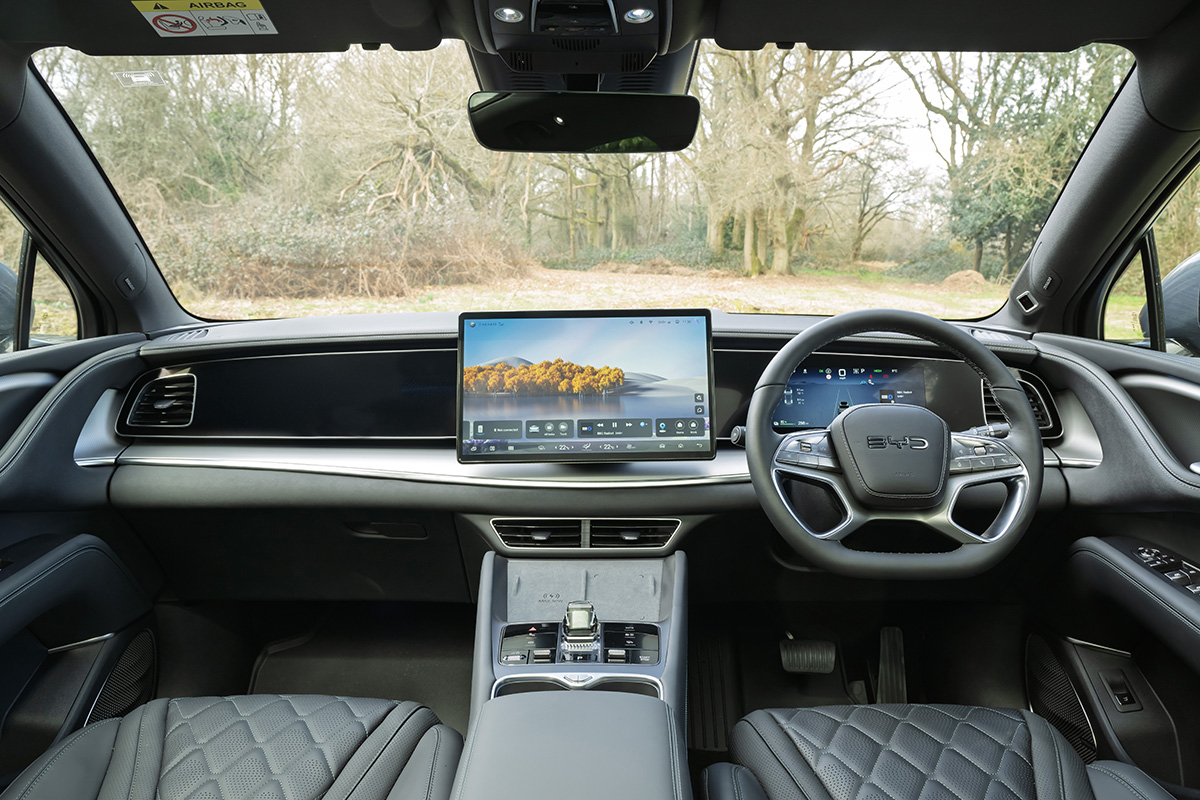
Unfortunately, BYD’s super-minimal interior design philosophy means all of these functions must be controlled through the massive, 15.6-inch touchscreen – and that’s a lot for it to have to do.
As a result, simply finding the function you want in the first place can mean a trip through several layers of menus and sub-menus. And because BYD doesn’t give you an always-on climate control bar like some manufacturers do, adjusting the temperature from an Apple CarPlay or Android Auto screen requires a swipe, then at least three button presses, then another swipe – taking your eyes away from the road for far too long.
The Sealion 7 even seems to understand this, because while you’re engaged in trying to adjust whatever you’re trying to adjust, the draconian driver monitoring system will chide you for spending too much time looking away from the road with bongs and on-screen messages.
You can, of course, disable this, along with the several other driver ‘aids’ that are far too invasive or simply don’t work very well. But again, to do so requires you to find them deep in the settings menu, and deactivate them one by one – a frustrating process that you have to repeat each time you start the car, as all of these functions default to ‘on’.
On the plus side, the screen’s responses are at least pin-sharp – and its party trick of rotating from landscape to portrait mode is useful for… um… playing with in a traffic jam, we guess?
BYD Sealion 7 running costs
On the face of it, the Sealion 7 doesn’t actually look any cheaper than its rivals. But when you factor in that you get a larger car for the same money – and that it comes with a huge amount more toys too – then you start to realise just what tremendous value it is.
The downside is that it won’t be all that cost-effective to run. Official average energy efficiency figures even on the entry-level Comfort are fairly underwhelming at just 3.1 miles per kilowatt hour (mpkWh) – and they get worse the further up the range you get, with the Excellence returning a poor figure of 2.8.
In the real world, those figures are likely to be even less impressive, and we wouldn’t be surprised to see a return of around 2.5mpkWh – perhaps worse – in everyday usage.
On the plus side, biennial servicing will keep maintenance costs to a minimum. Don’t forget to check where your local BYD service centre is, though – they aren’t as widespread as most manufacturers’ yet, and that could mean extra costs involved in getting your BYD to and from its annual service.
Like every electric car, VED will come in at £10 for the first year, but don’t forget that every Sealion 7 will incur the premium car surcharge, which will mean tax costs from years two to six will rise to £620 a year, before falling back to £195.

BYD Sealion 7 reliability
As yet, there’s very little information on BYD’s reliability – it’s such a new brand to the UK that we simply don’t have any data yet, and it’ll be a while before its cars age to a degree that we can gather any meaningful reliability statistics.
The good news is that BYD gives you a lengthy warranty of six years or 93,750 miles, whichever crops up sooner, which suggests that it has confidence in the longevity of its vehicles. That’s more than you’ll get with most of the Sealion 7’s rivals – the only exception being the Kia EV6, which runs to seven years or 100,000 miles.
- A strong showing in Euro NCAP crash tests suggests the Sealion 7 will be a pretty safe bet in a crash – especially for your kids. Adult occupant and child occupant protection scores of 87 and 93 per cent respectively are impressive, and at least as good as the competition.
- The Sealion 7 is unusual in having a different kind of battery to most EVs. BYD’s proprietary Blade battery uses lithium iron phosphate (LFP) technology, which means it’s far less likely to catch fire if penetrated than a traditional lithium-ion battery.
- BYD is still a relatively new name on the UK market, but the company is in fact part of a huge Chinese conglomerate producing batteries, solar panels, electronics and commercial vehicles – as well as electric cars.
- If you want the best all rounder: go for the Comfort. It’s more than fast enough for most people, has the second-best electric range in the line-up, and as it’s the lightest option, it stands the best chance of controlling its ride quality. It’s also just as well equipped – or as near as makes no difference – as the more expensive models.
- If you want all-wheel drive: then you’ll have to upgrade to the Design. You also get much more power into the bargain – but beware that the lack of any additional battery capacity means the extra weight eats into the range.
- If you want to splash the cash: it has to be the Excellence. You don’t get a whole heap more equipment than the Comfort or Design models, but you do get more power than the former, and more range than the latter, thanks to the bigger battery. But given the range isn’t that much greater than that which you get with the Comfort, ask yourself if you really need it.

