Hyundai Ioniq 6 Review (2023-present)
Hyundai IONIQ 6 cars for sale
4.0
Expert review
Pros
Individual looks
Pleasant to drive
Stuffed with equipment and technology
Cons
Ride is decidedly firm
Some disappointing pieces of interior trim
Wing mirror cameras are a bit pointless
The CarGurus verdict
The Hyundai Ioniq 6 is a really appealing car that blends hi-tech features and futuristic feel with appealingly retro styling details, useful interior roominess and great efficiency. It does have very strong competition, and it’s a real shame that it doesn’t have better ride comfort, and that it still feels a bit cheap inside in some areas, especially in Premium trim. Even so, the Hyundai Ioniq 6 is a really desirable and generally excellent electric executive, and not just in terms of its value for money.

What is the Hyundai Ioniq 6?
The Hyundai Ioniq 6 is a battery electric vehicle (BEV) that goes up against other four-door electric executive cars such as the Tesla Model 3 and BMW i4.
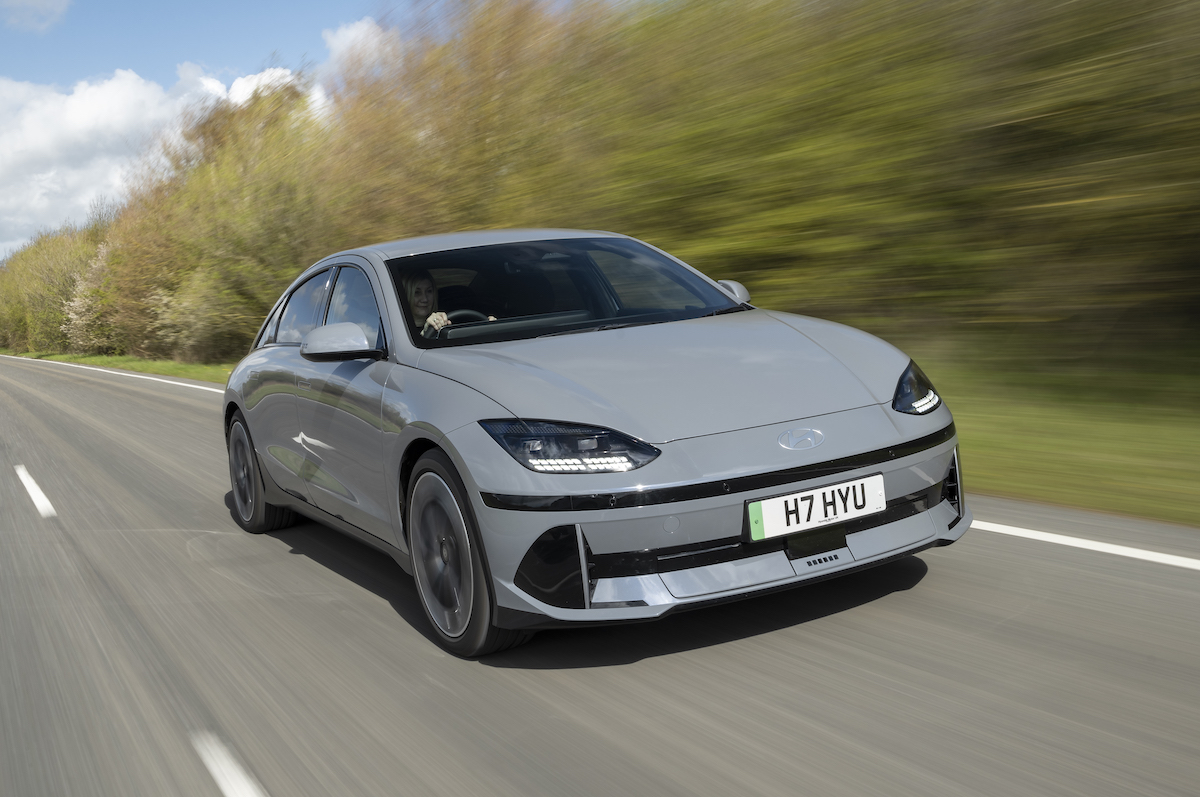
It’s offered with rear-wheel drive from a single, 225bhp electric motor powertrain, which delivers an official WLTP range of up to 338 miles. A dual-motor, all-wheel drive model gets 321bhp and takes the 0-62mph time from 7.4sec down to 5.1sec, but also sees its WLTP range drop to 322 miles. Based on the same ‘E-GMP’ platform as the Kia EV6 and Hyundai Ioniq 5, the Ioniq 6 nonetheless has a completely different (and, in our opinion, rather brilliant) look to those other EVs that the Korean brands have launched in the last few years. Inspired by 1930s airplanes, among other things, the Ioniq 6 has been conceived with aerodynamics as a priority, hence the sleek, bullet-shaped profile and distinctive spoiler, all of which helps to achieve impressive aerodynamics of 0.21cD (for some context, the very aerodynamic Mercedes EQE manages 0.20). It’s also why Hyundai has dubbed the Ioniq 6 a ‘streamliner’.
That also contributes significantly to the Ioniq 6’s efficiency, which is up there with the best EVs for miles per kWh of battery capacity, and helps the Hyundai to a better official range than the entry-level Tesla Model 3 (which manages 305 miles). Mind you, the Tesla Model 3 Long Range and the Volkswagen ID.7 will go a bit further, with WLTP ranges of around 380 miles. The Ioniq 6 is one of the roomiest cars in the class. A long, 2.95m wheelbase and overall body length of 4.85m means that there’s plenty of passenger space, and some of the best tech in the class, too. Vehicle-to-load charging is standard, meaning that you can plug another EV or any electronic device into the three-pin charging point in the rear seats and charge up using energy from the car’s high voltage battery. It also charges more quickly than most other EVs, thanks to the 800V charging system.

How practical is it?
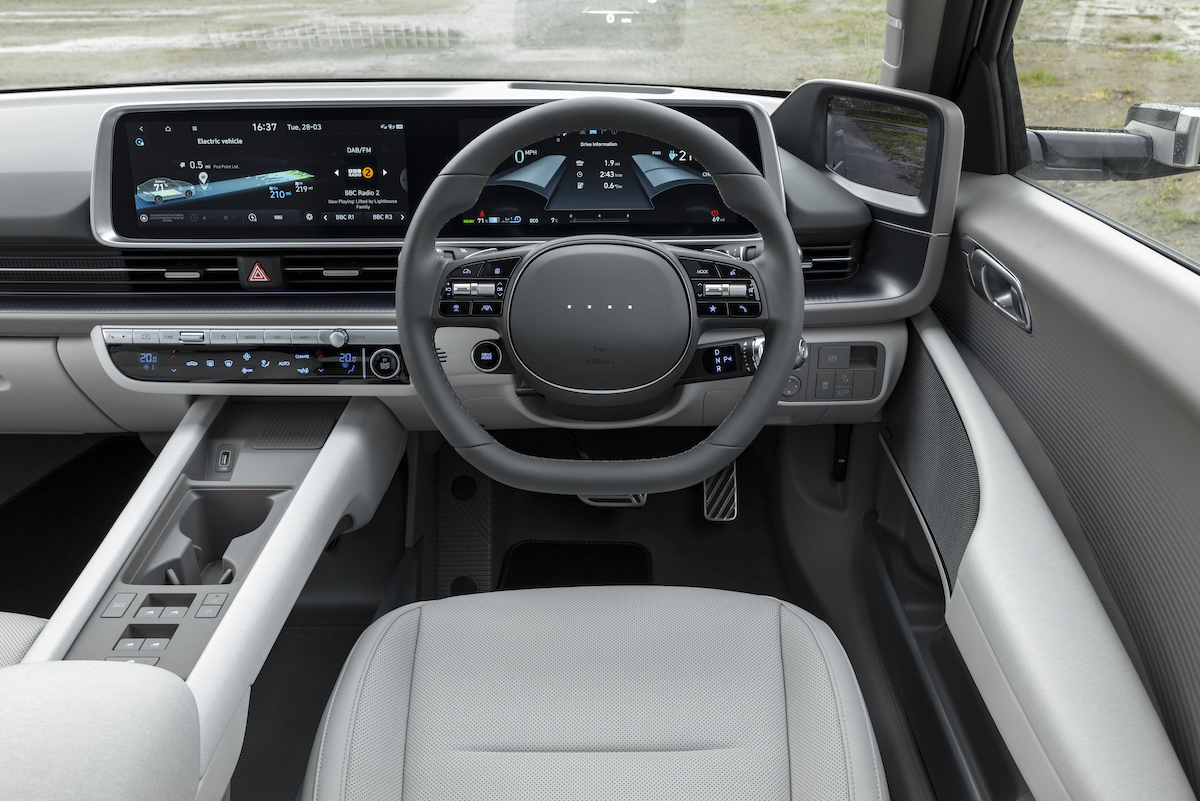
Slide into the driver’s seat of the Ioniq 6 and you’re met with dual screens that are perched high up on the dashboard, inset into the ‘wing’ of the dash that curves around to a prominent corner jutting out at the base of the windscreen, mimicking the airplane cockpit feel and giving the ‘cocoon’ feeling that Hyundai is aiming for. Minimalist, horizontal vents and refreshingly simple climate-control buttons look very modern, and a high centre tunnel further emphasises the sense that you’re cocooned in the cabin.
This high-set centre console houses a couple of cupholders but it feels like they need a cover to finish off the slick appearance inside the Ioniq 6. Mind you, you’ll be needing those cupholders, as the door bins are narrow and won’t even take a normal 500ml bottle.
A sizeable glove box and a large, open storage shelf beneath the floating central console goes some way to making up for this, but it’s tricky to stop your stuff from sliding around down there.
The overall appearance up front in the Ioniq 6 is really clean and intriguing, while still offering a great driving position that’ll suit even very tall drivers. Ultimate trim also adds ‘relaxation’ seats that recline for the ideal ‘nap-while-you-charge’ experience, and it also gets leather upholstery that’s much nicer than the cheap-feeling textile finish in the Premium cars.
Otherwise, perceived quality is fine even in the entry-level Hyundai Ioniq 6 Premium, and a touch better than you get in the Tesla Model 3, but the plastics and some of the finer finishes are a way off what the BMW i4 and VW ID.7 offer.
Rear passenger space is no problem at all, with a vast amount of legroom that’ll rival full-size executive limos, but headroom might be a touch tight for anyone who’s much over 6ft.
Boot space is fine, with the deep boot able to take a lightweight buggy or a set of golf clubs, but hatchback alternatives like the Kia EV6 and BMW i4 will be more practical. There’s underfloor storage in the boot of the Ioniq 6, which is useful for storing cables, or the rear-wheel drive model can take a useful 45 litres in the ‘frunk’ storage compartment in the nose of the car. The dual-motor Ioniq 6 also has a frunk, but it’s much shallower with only 12 litres of storage.
What’s it like to drive?
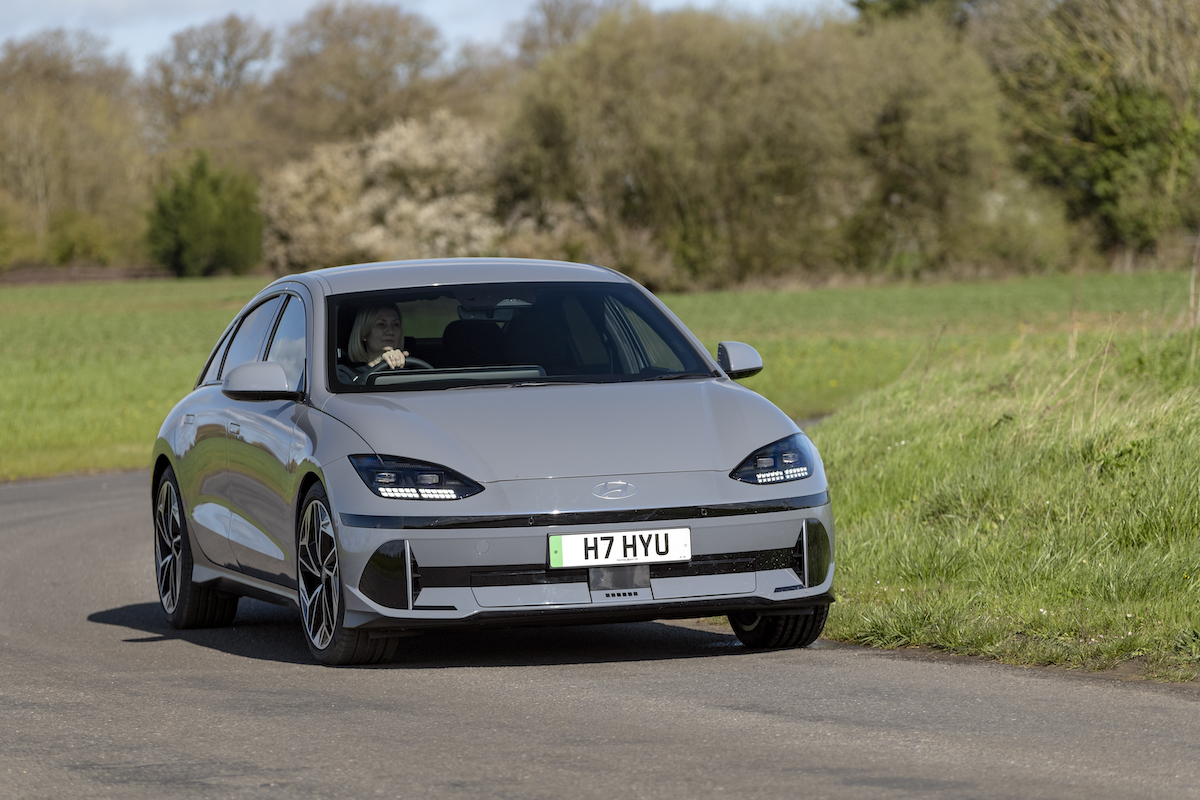
The Hyundai Ioniq 6 is a really pleasant car to drive; extremely refined, and more than fast enough even in the less potent, rear-wheel drive variant. Power arrives in a seamless flow, and you can sharpen up the throttle response and make the steering feel weightier by selecting Sport mode. We had a brief go in the dual-motor, AWD model, which feels muscular and very neutral in the way it drives but, unless you want the additional peace of mind that four-wheel drive brings in colder months, the single-motor Ioniq 6 is actually a bit more fun on typical UK roads.
It turns into corners keenly and feels balanced, with the body neatly tied down, making this a more satisfying drive than the equivalent Tesla Model 3, even if the more playful BMW i4 remains the pick of these compact electric executives if you’re after the most entertaining driver’s car.
It's just a shame that the ride comfort is firm enough to intrude on the otherwise very serene experience in the Ioniq 6. Our test car rode on 20-inch alloy wheels (which are standard on every model) and Pirelli P Zero tyres, and the result was a rather fidgety ride over scruffy, patched up surfaces. It deals really well with bigger undulations and bumps, but high frequency intrusions and coarse surfaces make themselves known more than is ideal.
Even so, it’s not likely to be a deal breaker for most, especially as the Ioniq 6 is such a consummate sophisticate in every other aspect of the way it drives.
Technology, equipment & infotainment
Hyundai has established itself as something of a leader in tech when it comes to electric cars, not least thanks to the 800V electrical system that allows faster rapid charging than the 400V systems fitted to most rivals. It’s essentially an industrial-strength electrical system, which means that the Ioniq 6 can charge at up to 220kW, which makes it good for a 10-80% rapid charge in around 18 minutes if you find a powerful enough DC rapid charger. Plug into a standard 7kW home charger and you’ll have a full charge in around 12 hours.
Not only that, but the Ioniq 6 also gets vehicle-to-load charging across the whole line-up. That’s a fancy way to explain that you can charge your things using the car’s high voltage battery using either the standard domestic three-pin plug located beneath the rear seats, or with an optional attachment that you fit to the external charge port. Great for charging devices when you’re camping, or even for trickle charging another EV. And don’t worry, you can set a limit for how much battery power will be discharged, in order to save the power you need for the journey home.
There’s also a standard heat pump, which helps to heat the cabin more efficiently so that it improves your winter driving range; even better since a heat pump is an expensive option on some of the Hyundai’s rivals.
A 12.3-inch touchscreen infotainment system brings Apple CarPlay and Android Auto, satnav with charger search function, and over the air updates. It’s easy to use, and the graphics are good if not quite as smart as those on the (granted, much more expensive) BMW i4. There’s also wireless charging, changeable ambient lighting, a couple of USB charge points, heated seats, adaptive cruise control with semi-autonomous drive mode, reversing camera and keyless entry, even if you go for entry-level Premium trim.
Stepping up to Ultimate adds leather upholstery, ventilated seats, sunroof, a Bose sound system, LED steering wheel lights, a remote smart parking system and a head-up display. You can also add Digital Side Mirrors to the Hyundai Ioniq 6 Ultimate; this is the company’s name for side cameras that replace normal mirrors with a camera feed beamed to a screen mounted at the sides of the dash. They cost £995, and you’re much better off saving your money, as the screen graphics aren’t particularly good so it’s not always easy to see what it’s showing, nor is it very well integrated into the dash. The standard mirror is far better in every way, other than the minimal aerodynamic improvements that the side cameras offer.
Naturally, there’s also a phone app to allow you to remotely check and control your charging and cabin temperature.

Hyundai Ioniq 6 running costs
The Ioniq 6 isn’t as cheap as the standard Tesla Model 3, and doesn’t have the benefit of access to Tesla Superchargers, but it does go a bit further to a charge and gets better equipment; by any standards it is very well priced in the class.
Not only that, but we found it efficient even in mostly quite sprightly country road driving, returning 3.8m/kWh in our single-motor test car, which is good for a real-world range of 281 miles in mild, dry, 18-degree conditions. We’d expect that to drop to some 220 miles on a long winter motorway drive (always the worst-case scenario for an electric car), while warmer summer weather will easily see mixed driving range creep up to over 300 miles and towards the claimed figure. Assuming you’re seeing an average, all-year-round efficiency of 3.5m/kWh from the Ioniq 6, that means you’d be paying 12p per mile for electricity if you’re charging up at home for 45p/kWh; a full battery from empty would cost £34.83 on the same tariff. If you can charge routinely overnight on a cheap off-peak tariff, that cost drop to around 4p per mile, or £5.80 per full battery.
For context, a petrol car doing 40mpg will cost around 15p per mile, while a diesel doing 55mpg will cost 14p per mile.
Regardless of what you’re paying for your electricity, the Hyundai Ioniq 6 is one of the more efficient electric cars you can buy, and so also promises to be one of the cheapest to charge.

Hyundai Ioniq 6 reliability
The Hyundai Ioniq 6 is too new for there to be any owner- or warranty feedback on reliability, but Hyundai has a great reputation as a brand. It came fifth overall in the What Car? 2022 Reliability Survey, and it backs up that reputation with a five-year, unlimited-mileage warranty on all of its new cars. The battery is warrantied for eight years and 100,000 miles, and data from the existing fleet of electric cars on our roads suggests that it will retain around 85% or more of its capacity after ten years and 100,000 miles. Keeping it charged between 20-80% in routine short journey use, and not rapid charging unless you need to, will help to keep battery degradation to a minimum.
- Go for Ultimate trim - the higher of the two trims - and you get four small, square lights in the centre of the steering wheel that replace the badge that you’d normally expect. These, it’s said, are morse code for the ‘H’ of the Hyundai badge, but they also change colour to show charging status, to show when you’re in reverse, when you’re using the voice control and more, making them nifty additional communication, as well as another detail that further makes this car feel rather spaceship-like.
- Every Hyundai Ioniq 6 gets a CCS and Type 2 charging port in the rear wing of the car, where you’d expect the fuel filler cap on a petrol or diesel car. You don’t need a cable for rapid charging: those always have cables tethered to the station itself, which you plug into the CCS port. The Type 2 charging cable is provided as standard for charging at slower, AC chargers including home chargers. You’ll have to pay extra for a three-pin charging cable if you want to slow charge your Ioniq 6 from a normal domestic socket.
- The Hyundai Ioniq 6 received a five-star Euro NCAP crash safety rating, with an impressive 90% for safety assist systems, including a lane keep assist system that’s one of the better for remaining unobtrusive on country roads. Even so, we’re glad that you can turn it off with a single press of a button on the steering wheel.
- If you want the best value: Go for the Ioniq 6 Premium with rear-wheel drive, which is the cheapest Ioniq 6 that you can get, but still feels like a class act.
- If you want the best company car: Benefit in Kind company car tax is extremely cheap for electric cars currently, but it will start to creep up a bit in 2025, so we’d suggest you stick with the Premium trim and single motor combo.
- If you want the best high mileage commuter: Again, go for the single motor Hyundai Ioniq 6, but step up to Ultimate as then you get the head-up display, better sound system and also front seats that fully recline if you want a lie down while you charge.
- If you want the sportiest: It’s got to be the dual motor, all-wheel drive car with its boosted performance and sports car-like acceleration. It’s not a delicate and playful car to drive, but it is assertive and easy to enjoy on a good road.


