Hyundai Kona 2026 review | A funky-looking yet practical small SUV
Hyundai Kona cars for sale
3.0
Expert review
Pros
Roomy, practical cabin
Great infotainment system
Generous standard equipment
Cons
Merely so-so to drive
Cabin could feel posher
Should be more comfortable

The CarGurus verdict
There’s a lot to like about the latest second-generation Hyundai Kona SUV. Whether the futuristic looks are included or not will be a matter of personal taste, but buyers will almost certainly be wowed by the car’s generous passenger space, large luggage compartment, solid build quality, generous equipment, cracking infotainment system and compelling ownership package.
It's certainly not perfect. It’s dynamically very average, with so-so handling, an unsettled ride and the odd iffy powertrain option. The interior could feel posher, too, although in fairness, that’s a criticism you could level at many other cars in the class. It’s a very decent all-rounder, though, so if space, practicality, equipment and value are more important to you than dynamic polish, it’s certainly worth considering. A special mention here goes to the Kona Electric, too, which is good enough to earn a four-star overall rating.

What is the Hyundai Kona?
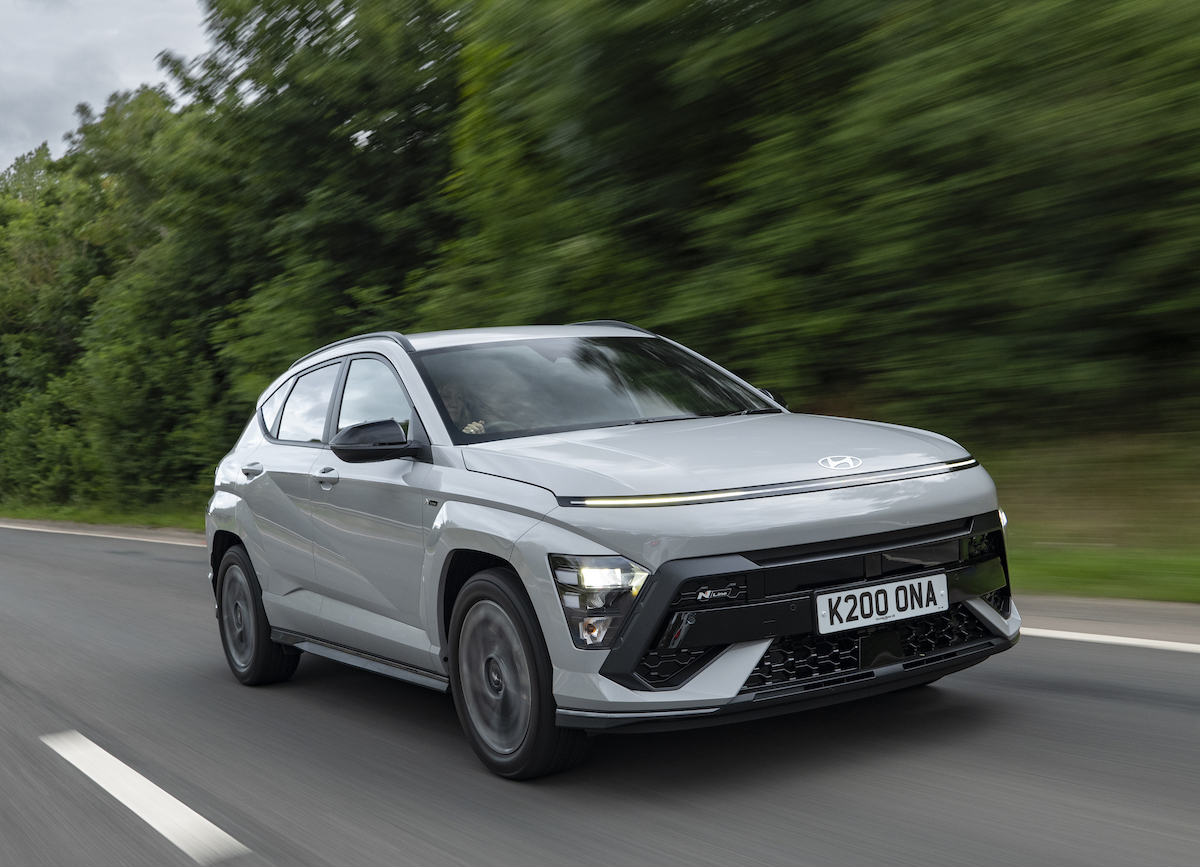
The latest Kona is the second incarnation of Hyundai’s popular mini-SUV, and it’s fair to say that it’s evolved quite a bit compared with the first one. That car’s slightly oddball looks have been traded for futuristic angular styling, in line with the Korean brand’s other recent offerings such as the Tucson, Ioniq 5 and Ioniq 6. The Kona has also grown quite a bit in an attempt to improve on the old car’s limited practicality.
A range of powertrains is offered to cater for almost every taste. Like with the previous car, you can have your Kona with a conventional petrol engine, a petrol-electric hybrid powertrain, or as a fully electric car. Unlike with the last Kona, however, a plug-in hybrid powertrain isn’t offered this time around. This review focuses on the combustion-engined Konas: we’ll review the electric version separately because it’s quite a different prospect, and a notably more impressive offering in many ways.
In terms of rivals, there’s definitely no shortage, with the new Hyundai Kona sitting in one of the most popular and overcrowded sections of the car market. They include choices such as the Ford Puma, Skoda Kamiq, Seat Arona, Nissan Juke, Volkswagen T-Cross, Vauxhall Mokka, Renault Captur and Toyota Yaris Cross. However, the Kona’s elevation in size means it now sits at the bigger, roomier end of the compact SUV market, against cars such as the Kia Niro (with which it shares a platform), Peugeot 2008, Volkswagen T-Roc and Honda HR-V.

How practical is it?
The first-generation Kona was a bit short on boot space and rear-seat passenger space, and customers weren’t shy about telling Hyundai so. Happily, the brand listened, and in an effort to address those issues, the Kona has grown by 14 centimetres in overall length, and 6cm in its wheelbase (the space between the front and rear axles). Thankfully, this supersizing effort has been successful. Lifting up the hatchback tailgate reveals a very roomy cargo space of 466 litres, regardless of which of the powertrains you choose, and the space is a useful square shape as well.
There’s a moveable boot floor that lets you either maximise capacity in its lower position, or level off the small boot lip in its higher position. Fold down the rear seats, and this higher position also levels off the step up to the rear seatbacks when they are folded, although they do lie at a slight angle. Still, at least the seats fold down in a 40/20/40 split (on all but the entry-level Advance cars), which is more versatile that the 60/40 arrangement you get in many competitors. The back seats don’t slide backwards and forwards like they do in some rivals, but there’s lots of headroom and legroom on offer, which is more important in something that’s likely to be used as an everyday family car.
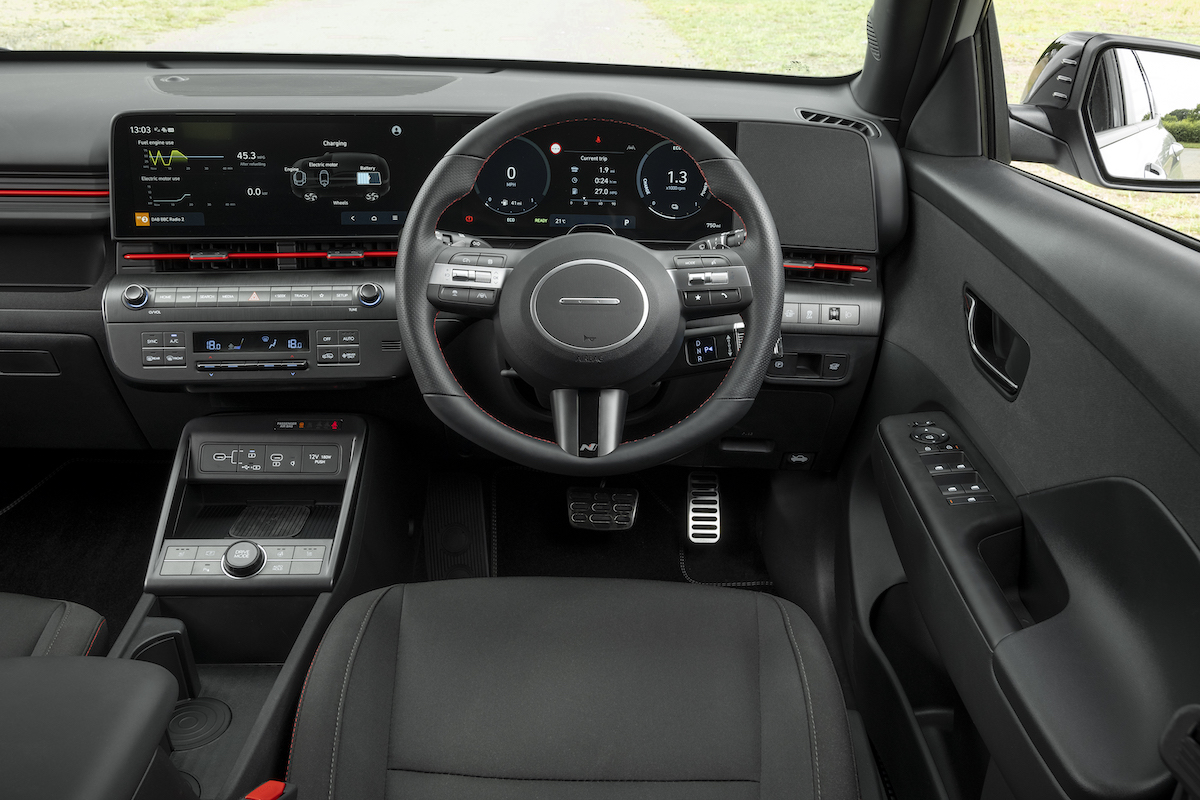
If you’re promoted to the front seats, you’ll find a fairly hi-tech environment, with twin screens mounted side-by-side to take care of your driver information and infotainment. The central infotainment touchscreen works really well, with logically laid out menus, sharp graphics and quick responses, and there are several handy shortcut buttons, too. The digital drivers display also looks good, but it’s not as configurable as many such systems we’ve come across.
There are physical buttons and switches to control the air conditioning, which we always prefer to ventilation controls being buried within touchscreen menus, and most of the other switchgear is easy to find and use, too. The exception is the small cluster on the right-hand side of the steering wheel, which includes the switch for the electronic parking brake, which you often forget is there as a result. Your forward visibility is pretty clear, but the small rear window, flanked by chunky pillars, means your rearward view isn’t quite so clear.
In terms of quality, everything feels solid and sturdy, with a substantial and well assembled feel. It doesn’t feel enormously posh, though, with rather a lot of hard, uncushioned surfaces to be found, many of them in key areas, sch as the top of the dashboard.

What’s it like to drive?
As we said earlier, this review focuses on the combustion-engined versions of the Kona, so let’s start there. The range opens with a turbocharged 1.0-litre three-cylinder petrol engine with 118bhp, which can be mated to either a six-speed manual gearbox or a seven-speed DCT dual-clutch automatic, and we tried it with the former. It’s not ultimately all that fast, unsurprisingly, but it feels a lot perkier than you might expect, with willing pull right from the bottom of the rev range and an eagerness to build revs. It’ll be plenty punchy enough for most drivers, especially if they do most of their driving in urban environments, but it doesn’t feel out of its depth at motorway speeds, either. It’s not perfect: the throttle response is a bit lazy, so when you press the pedal when you’re already on the move, there’s a small delay before the acceleration begins, and when you come off the pedal, there’s a small delay before the revs start to drop. Regardless, we think this will probably be the best engine option for a lot of customers.
The next engine in the range is the 1.6 turbo petrol, the most powerful unit on offer with 195bhp, and again this can be had with either a six-speed manual gearbox or a seven-speed dual-clutch automatic. We tried it with the latter, and in truth, it made for a pretty dysfunctional partnership. There’s very little polish about how the transmission goes about its work: press the accelerator pedal, and it seems to either give you no power at all, or all the power all at once, with no rhyme or reason as to which you get. The engine itself isn’t great, either: it sounds thrashy and rough when the gearbox is working it to its limits (which is quite often), and when you do mean to get your foot down, it ultimately doesn’t feel anywhere as near as fast as the power output suggests.
The last powertrain to talk about is the hybrid version. This uses a 1.6-litre petrol engine and an electric motor to deliver a combined output of 139bhp. It’s a self-charging hybrid, so you don’t plug it in and it won’t go all that far on just electric power, but it will move along without the petrol engine running for short bursts at low speeds, and under gentle acceleration, saving fuel in the process. And when the petrol engine does cut back in, it does so smoothly and unobtrusively. Again, performance isn’t exactly dazzling, but the hybrid drivetrain is perky enough to make life easy and refined enough to make it civilised. The brakes are pretty dire, though, with a wooden feel that means you’re constantly second-guessing how hard you need to press the pedal whenever you roll up to a junction.
While there’s lots of variation in how the various powertrain versions in the line-up perform, it’s a much more clear-cut story on ride and handling. You wouldn’t expect a small family SUV to be the last word in sharpness, and indeed the Kona isn’t. You can feel the top-heavy body rolling around as you change direction, and the steering is both light and vague. But while the Kona is not a hugely satisfying car to drive, it does at least feel stable and secure. What you might expect a small family SUV to be, however, is comfortable, and that’s where the Kona might surprise you. It struggles to deal with various different types of surface imperfections, so it feels fidgety and unsettled for a bit too much of the time. It stops short of being uncomfortable, but many rivals do a lot better on this score, so if that’s a priority for you, you’ll probably be better served by one of those.
The thing that’ll likely drive you more mad than anything else about driving the Kona, however, is the cacophony of bongs and pings that you’re bombarded with, courtesy of the various active safety systems on board. It really is relentless, and there are so many that, half the time, it’s not even clear what you’re being warned about. You can turn them off (we don’t usually endorse turning off safety systems, but in this case, it really is too much), but they are reinstated automatically every time you restart the car..
Technology, equipment & infotainment
The Kona is fairly well equipped across the board. Even entry-level Advance versions get alloy wheels, dual-zone climate control, automatic lights and wipers, cruise control (adaptive cruise with stop and go on automatic models), front and rear parking sensors, a reversing camera, keyless entry and go and the full twin-screen infotainment system with DAB, Bluetooth, native navigation, Apple CarPlay and Android Auto.
Next up is sporty N Line trim that adds a bodykit, heated front and rear seats, a heated steering wheel, privacy glass, a powered tailgate, wireless phone charging pad and ambient interior lighting. Then comes N Line S trim, which adds ventilated front seats, alcantara and leather upholstery, three-zone climate control, powered front seats, 360-degree cameras and a BOSE premium stereo upgrade. Ultimate trim is the range-topper, but all that really adds is full leather upholstery and a sunroof.
Hyundai Kona running costs
If efficiency and lower fuel bills are a priority for you, then it’s the Kona hybrid that does best on that front. The precise WLTP fuel economy figure differs according to which trim level you specify, but all of them sit above the 60mpg mark. Just bear in mind the fact that the hybrid will cost you more to buy in the first place; a lot more than in the case of the 1.0-litre, but not all that much more in the case of the 1.6 turbo.
Meanwhile, the 1.0-litre engine has a figure of around 48mpg, or a couple of mpg less if you combine it with the automatic gearbox. The 1.6 turbo should return about 44mpg regardless of which transmission you pick.
In terms of insurance, the 1.0-litre and the hybrid sit in groups 22 to 23, meaning fair-to-middling premiums, while the 1.6 turbos sit between 30 and 33, so insurance costs will be considerably higher.
If you’re a company car driver and you choose one of the pure petrol versions, you’ll pay Benefit-in-Kind company car tax on between 31% and 34% of the value of your car. That’ll be a fairly expensive way of running a company car. For the hybrid, that drops to 26% due to its lower emissions, meaning tax bills will be a lot more palatable. However, if your lifestyle allows for it, you’d be mad not to choose the Kona Electric, because you’ll pay tax on just 2% of that car’s value, saving you an absolute fortune.

Hyundai Kona reliability
It’s a fair bet that a Kona will be a reliable proposition. The Kona Hybrid finished third out of the 38 small SUVs to feature in the 2025 What Car? Reliability Study with a reliability score of 98.7 per cent – an exceptionally good result that suggests it'll be extremely dependable.
The petrol version of the Kona didn’t feature, as there weren’t enough responses from owners of this particular variant. However, the previous-generation Kona petrol came in just behind the latest hybrid version, in 5th, with a score of 98.1 per cent – which bodes well.
To give buyers even more peace-of-mind, Hyundai applies a very impressive warranty to all its new cars, with five-year, unlimited-mileage cover. That’s one of the best packages in the business, and arguably the outright best if you’re a particularly high-mileage driver.
- Although all Konas do well on luxury equipment, do bear in mind that the more basic versions do miss out on quite a bit of safety kit. All versions get autonomous emergency braking, hill start assist, intelligent speed limit assist, driver attention warning, lane keep assist, lane follow assist, and a leading vehicle departure alert as standard. However, you have to upgrade to at least N Line S trim if you want blind spot assistance, rear cross traffic alert, safe exit warning and parking collision avoidance assist. The Kona hasn’t yet been subjected to Euro NCAP crash tests.
- If you specify N Line S or Ultimate trims, and you add the optional Lux Pack (it’s expensive, mind), then you get something called Hyundai Digital Key 2 Touch. This basically allows you to lock, unlock and start the car using your phone, meaning you can leave the keys at home. It also means the ‘key’ can be shared with friends and family remotely when they need access to the car.
- Most cars come with a choice of one or two colours that don’t cost you extra, but if you want one of the other ones available, you have to add it as a cost option, and the Kona is no different. But while those colours are usually solid whites or other muted colours, the Kona’s standard colour is the eye-catching Mirage Green, and it’s actually one of the nicest colours in the whole palate to our eye. If you’re prepared to pay extra, there’s a total of 11 others to choose from, although their availability depends on which version of the car you choose.
- If you want the cheapest one: The entry-level 1.0-litre engine is a very decent choice thanks to its mix of perky performance, reasonable economy and affordable purchase price. We’d also say that entry-level Advance trim will have enough kit for most customers, unless you’re desperate for a powered tailgate and wireless phone charging. Sticking with the standard manual gearbox rather than adding the auto will save you money, too.
- If you want the most economical one: The Kona hybrid is the star of the show on that score, with official fuel economy of at least 60mpg across all trim versions, and it’s a lot more affordable to buy than the electric Kona.
- If you want the fast one: If you happen to like the idea of a fast Kona, then it’s got to be the 195bhp 1.6 turbo (until the rumoured Hyundai Kona N turns up in the fullness of time). Just don’t expect it to be as fast as you think it’s going to be. And, we’d stick with the standard manual gearbox in the hope that it would work rather better with the engine than the automatic ‘box in the car we drove.
- If you’re a company car driver: Pick the Hyundai Kona Electric, because it’ll cost you a fraction of what the others will in Benefit-in-Kind company car tax. Rates are so low, in fact, that you might as well have the range-topping N Line S or Ultimate models, because it’ll make barely any difference to your monthly bills.


