Kia Niro 2026 review | Overshadowed by its siblings
Kia Niro cars for sale
4.0
Expert review
Pros
Very low running costs
Roomy for passengers
Lots of equipment as standard
Cons
PHEV loses some boot space
Not exciting to drive
Styling won't be to all tastes
The CarGurus verdict
The Kia Niro is a really good all-round family car, with a choice of hybrid powertrains. It’s a shame that the 1.6 petrol engine is pretty underwhelming, both in its performance and the racket it makes when you accelerate hard. In most situations, though, it’s unobtrusive enough.
It’s fairly unexceptional to drive, but the Kia’s smart and roomy interior really impresses. It’s usefully more spacious than most family hatchbacks or compact SUV alternatives. As a whole, this is a really complete and highly recommendable family car, whether you go for the hybrid or plug-in hybrid.

What is the Kia Niro?
The Kia Niro is a chunky, family-sized crossover SUV that measures 4.4 metres in length, making it similar in size to rivals such as the Toyota C-HR and Hyundai Kona. It’s also a little bigger than the Ford Puma, but smaller than family SUVs such as the Kia Sportage. All of these are perfectly relevant alternatives to a Kia Niro, however. In fact, given its broad price range of approximately £30,000 to £40,000, the Kia Niro has rivals ranging from traditional hatchbacks to SUVs, estates and even fastbacks such as the Kia EV4. Pick whichever body shape and powertrain you want in a family car, and there’s something to suit you in this price range.
The Kia Niro is a really compelling prospect, despite the kaleidoscope of alternatives. For a start, it’s offered as a ‘full’ hybrid (known as the HEV, or hybrid electric vehicle) or a plug-in hybrid (PHEV), which very few rivals can match. Both of the hybrid Kia Niro models get the same 1.6-litre, four-cylinder petrol engine and six-speed dual-clutch automatic gearbox. The full hybrid Kia Niro HEV has a 1.32kWh lithium-ion battery, which provides occasional pure-electric running at lower speeds and when you’re coasting off the throttle. The plug-in hybrid has an 11.1kWh lithium-ion battery that gives it up to 38 miles of pure electric range according to the official WLTP efficiency test. There is also a pure-electric Niro EV, which we deal with in a separate review.
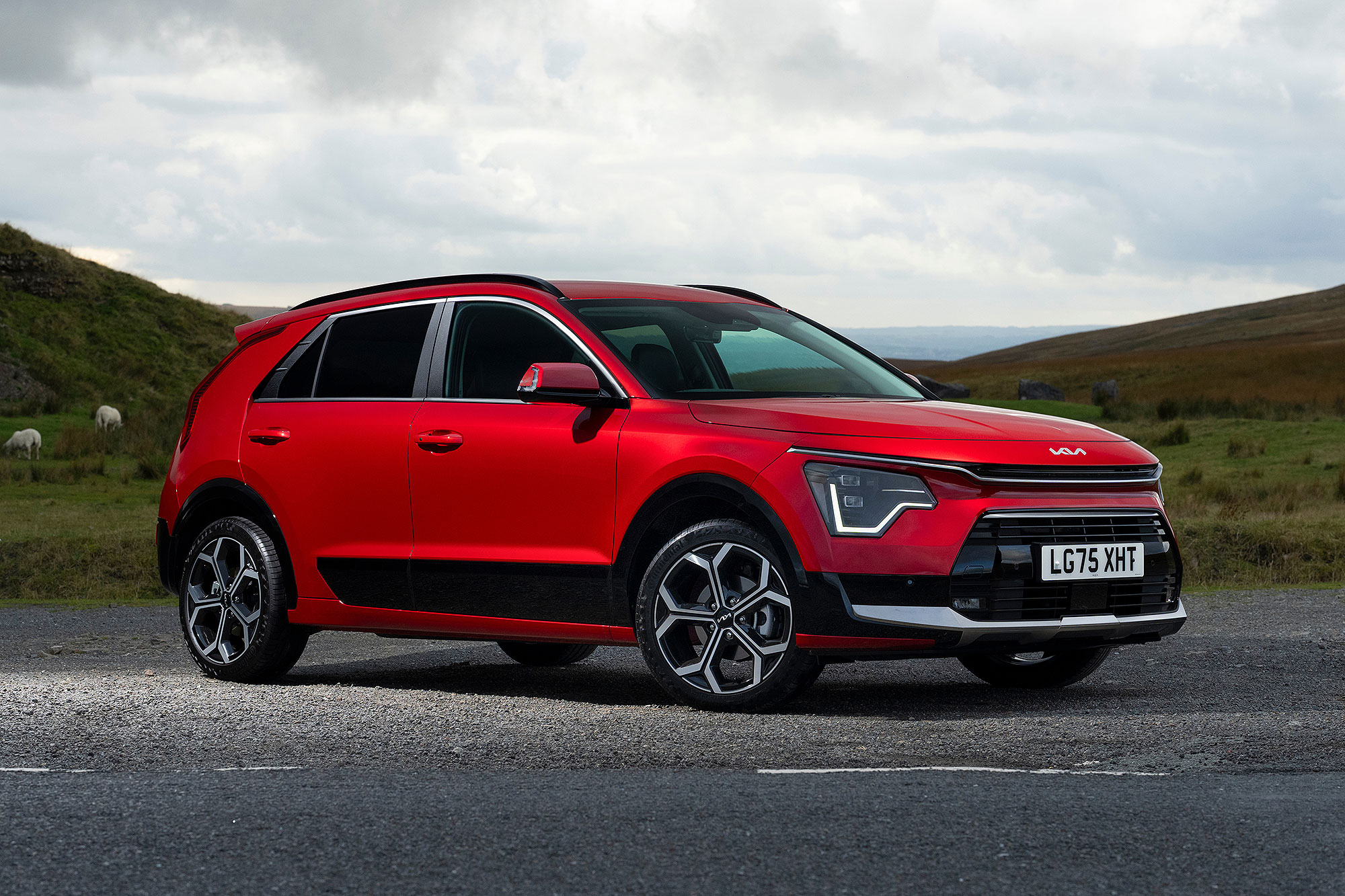
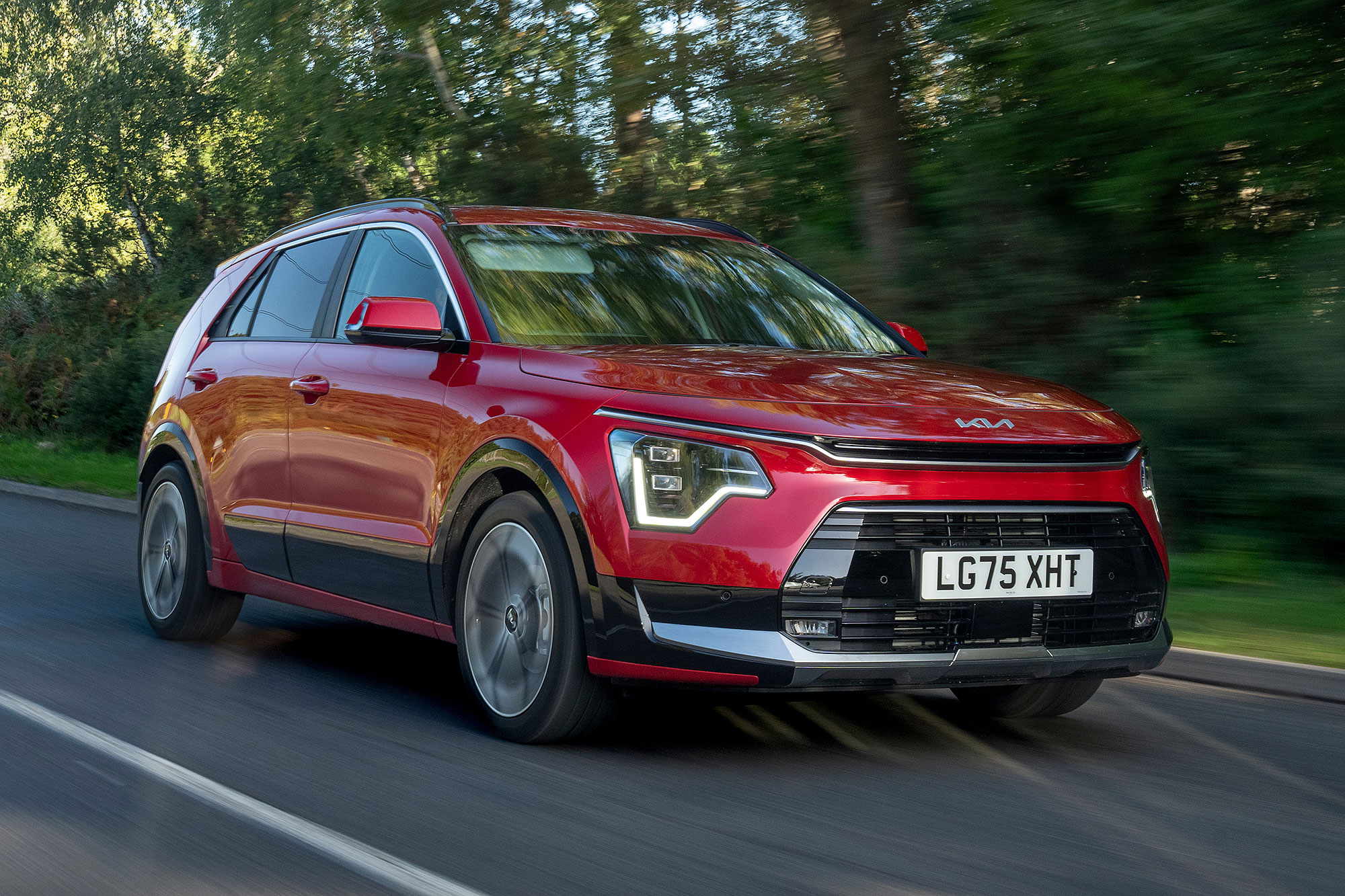
This latest Kia Niro is underpinned by the firm’s ‘K3’ platform, which is also used by the Hyundai Kona. Its styling is a big departure from the drab first-generation Niro. Angular LED lights, a very chin-heavy grille, a boxy body and slim, high-set rear lights all make the Kia Niro look rather eye-catching, even if it’s also a rather fussy design. Kia no longer offers a contrast-colour rear three-quarter panel (in either grey or black) on new Niro models, but you may still see it on used examples. It was only available on previous top-spec ‘4’ versions.

How practical is it?
The Kia Niro hybrids are practical enough to make great family cars. The Niro HEV has a really good-sized boot, with 451 litres of space available: usefully more than the 381 litres you get in the VW Golf, or the 358 litres in a Toyota C-HR Hybrid.
The Kia Niro PHEV does lose a fair chunk of its boot space – primarily the underfloor storage – due to the location of its larger plug-in-hybrid battery, which reduces the capacity to 348 litres. This is still not bad, and bigger than the 310 litres in the VW Golf plug-in hybrid. You may still struggle to get a double buggy into the Niro PHEV, so be sure to spend some time with a demo car if that’s a concern. The Niro HEV will be a bit better, and both cars have wide boot apertures as well as rear seats that fold flat in a 60/40 split. All Kia Niros get roof rails as standard.
Rear passenger space is really good, with usefully more legroom than you find in most rivals, although there are no sliding rear seats. Access is good, too, with a slightly higher seat base and taller roofline than most hatchbacks. This makes it easier to reach in for faffing with child seats, and indeed easier to slide in for those with limited mobility.
Up front, there are good-sized doorbins and a central storage area under the armrest, plus a cubby for your phone beneath the air-con controls. The high-set driving position is very good on Evolve and Aspire trims, which get lumbar adjustment and electric seat movement as standard. The Pure-spec car, with manual seat adjustment, is fine unless you need that adjustable lumbar support. Evolve and Aspire have standard heated seats and a heated steering wheel, too.
The dashboard looks similar to that of the Kia EV6, and the materials feel durable and tactile, with an array of modern-looking contrasting finishes. It’s all reasonably easy to use, with a touch-sensitive panel of air-con controls that you can switch to infotainment shortcuts at the press of a button. It’s a bit fiddly on the move, but better than having the air-con controls buried in the touchscreen. The large rotary gear selector is convenient as well.
What's it like to drive?
Both the Niro HEV and Niro PHEV are perfectly fit for purpose: confident, composed and generally comfortable. Their steering is light and easy to predict, which makes the Kia feel nicely responsive around town, while it stays planted and unflustered at high speeds for calm motorway progress.
Both are actually most enjoyable to drive when running in their pure electric modes, but that only happens in occasional bursts in the Kia Niro HEV, due to the tiny battery. It does spend a useful amount of time with the engine off, such as when you lift off the accelerator or are driving at low speeds, but you do notice the vibration and noise of the petrol engine when it kicks in. With that happening quite a lot, and with the six-speed automatic gearbox having fairly slow shifts, the powertrain can feel rather busy at times. It’s also noisy yet not terribly fast if you accelerate hard, as a 0-62mph time of 10.4sec suggests.
The Kia Niro PHEV managed a useful real-world electric range of well over 30 miles on our varied test route of mostly town and country roads, which we drove in summer conditions. In EV mode, the Niro PHEV is smooth, yet it still feels responsive enough for nippy getaways into fast traffic. As with the HEV, if you rev the engine hard then it gets very boomy-sounding without much acceleration in return, but everything settles down to an ignorable background thrum in unhurried driving. The 0-62mph time for the Niro PHEV is 9.6 seconds.
Ride comfort is acceptable, even on the 18-inch wheels that both of our test cars rode on, but sharp potholes can be a bit jarring on the bigger wheel choices, especially at low speeds. The 16-inch wheels of Pure models provide a smoother low-speed ride. The rest of the time, both hybrids are calm and collected, although do note that the pure electric Kia Niro EV is the best model to drive, and by some margin.

Technology, equipment & infotainment
The Kia Niro is available in three different trims: Pure, Evolve and Aspire. Whatever model you choose, you’ll get standard equipment such as dual-zone climate control, LED lights, adaptive cruise control, rear USB-C charging sockets, a reversing camera and rear parking sensors.
All Kia Niros also get a large-format 10.25-inch touchscreen, with Android Auto, Apple CarPlay and Bluetooth connectivity, a DAB radio and a charger search function for PHEV owners. It’s a good system that’s easy to use thanks to sharp graphics, quick screen responses and logical menu layouts. Pure and Evolve have a 4.2-inch digital driver display, which expands to a full 10.25-inch setup on Aspire. A head-up display is also standard on Aspire.
However, entry-level Pure lacks automatic wipers and air vents for rear passengers, as well as the ability to control the level of regenerative braking via paddles on the back of the steering wheel. Pure models are marked out visually by their 16-inch alloys, lack of gloss black wheelarch finish and basic halogen headlights. Choose Evolve or Aspire, and you’ll get a more contemporary and premium look.
Evolve trim also gets heated- and electrically adjustable seats with lumbar support, part-leatherette upholstery, keyless entry, paddle shifters for the gearbox or brake regeneration, wireless phone charging, front parking sensors, air vents for those in the back, blind spot warning, a semi-autonomous drive mode, and more.
Meanwhile, go for the top-spec Kia Niro Aspire, and you get full leatherette upholstery, a sunroof, an eight-speaker Harman Kardon sound system, semi-autonomous parking, ventilated front seats and heated outer rear seats. A novel feature is a full passenger relaxation seat, which reclines, aircraft-style, at the push of a button. Perfect for snoozing while the PHEV battery recharges.
Every Kia Niro gets adaptive cruise control with a stop-and-go function, autonomous emergency braking that can sense a bicycle, pedestrian or car, two pairs of Isofix points and seven airbags including a driver’s knee airbag.

Kia Niro running costs
The Kia Niro HEV costs from around £31,000 to around £36,000 (correct at the time of writing). The Niro PHEV runs from around £35,000 up to around £40,000. That’s competitive with many of its rivals, including the Toyota C-HR and Volkswagen T-Roc and Golf, along with its sister car, the Hyundai Kona. We’d like to see lower-interest finance deals and monthly payments, but generally, the Kia is reasonably priced for such a well-equipped and spacious car: provided you avoid the pricey Aspire trim level.
As for fuel efficiency, the Kia Niro HEV achieves an official figure of around 61mpg and CO2 emissions of around 105g/km. You’ll see 45-50mpg without trying too hard, and upwards of 50mpg in situations where you can run on electric power frequently.
The Niro PHEV manages a combined fuel economy of 344mpg. However you should always treat plug-in hybrid economy figures as, well, mostly nonsense, as much of the test is run in EV mode. Better to figure out if you can charge easily, and cover most of your journeys on electric running, which will cost around half of what you’ll pay to run the petrol engine. Once the battery charge has depleted, you still get some hybrid running capability, but don’t expect more than 40mpg in mixed driving conditions.
Service intervals are every 12 months or 10,000 miles, which is a bit shorter than some alternatives, but Kia routinely offers fixed-price servicing deals.

Kia Niro reliability
Kia has an excellent reputation for reliability, meaning that a Kia Niro should deliver dependable, stress-free motoring. As a brand, Kia came a decent eighth out of 30 brands tested in the 2025 What Car? Reliability Survey. That's lower than in most previous years, but still entirely presentable.
On top of that, there’s a fully transferrable seven-year, 100,000-mile warranty, which covers the car and its batteries, delivering peace of mind for both new-car buyers and those purchasing a Kia Niro on the secondhand market.
- The Kia Niro PHEV plugs in via a Type 2 charging socket on the front wing, and will take less than three hours to charge from a standard 7kW home charger. That said, its peak 3.3kW charging speed is less than that offered by some alternatives, such as the Volkswagen Golf eHybrid. There’s no rapid charging function on the Kia Niro PHEV, so three hours is the fastest charge you will get, regardless of how powerful the charger may be.
- A standard domestic socket will deliver a full charge into the Kia Niro PHEV in around five hours, but you’ll have to pay extra for the relevant cable. Of course, you don’t have to plug in the Niro HEV, as the tiny battery is ‘self-charging’.
- Both the Niro HEV and PHEV have regenerative braking, as does every electric and hybrid car. This is a system where the car feels like it’s braking gently when you lift off the throttle, but it’s actually spinning the electric motor in reverse in order to harvest additional energy and top up the battery. Both the hybrid and the PHEV have smooth, predictable brake regen' responses, and in the PHEV you also get four different levels of brake regen' that you can toggle through on the wheel-mounted paddles, but only if you go for Evolve or Aspire trims. Cleverly, these become gear-change paddles when the car is put into its Sport mode.
- If you’re a company car buyer: Honestly, the pure electric Kia Niro EV (or newer Kia EV3) is the best bet for any company car driver given how much less Benefit-in-Kind tax it attracts. If that’s not going to suit your lifestyle, though, the Kia Niro PHEV is the one for you. It still gets really useful pure electric running for cheaper costs, plus the much lower CO2 figure means company car taxes are very low. The hybrid is also cheaper than an equivalent non-electrified car, but in this company it looks pricey on BIK tax payments.
- If you’re after the best value: The Kia Niro HEV Evolve is a good balance of affordability, equipment and purchase cost. If you really want the cheapest purchase price, then the Pure version is, of course, cheaper still. You get a lot more equipment and better re-sale values with the Evolve, though, which is why it’s our pick of the range.
- If you want the best motorway commuter: The Kia Niro HEV promises to be efficient on the motorway, so if you do mostly long journeys then it may be your best bet You could even consider the Aspire trim as it gets a head-up display, which is always useful on a long journey.


