Hyundai i30 Review (2018-present)
Hyundai i30 cars for sale
4.0
Expert review
Pros
Roomy estate is the pick of three bodystyles
Hugely exciting i30N hot hatch
Generous standard equipment
Cons
Most versions are unexciting to drive
The Fastback sacrifices rear headroom for style
Interior could be better finished

The CarGurus verdict
With the exception of the bombastic i30N – which we've reviewed separately – the Hyundai i30 is not an exciting or terribly desirable car. But it is a handsome hatchback that is also one of the best available for striking a balance of purchase and running costs, and that now has one of the best touchscreen infotainment systems of any family car.
We’d like a classier interior finish, and a plug-in option in the engine range, and maybe a bit of the i30N’s sparkle to the handling. But, despite this being a fairly dull car, it also does everything that you’d ask of a family hatchback, with less cash required for more peace of mind than most alternatives. Very sensible, but there's absolutely nothing wrong with that.
What is the Hyundai i30?
Forget any lingering brand stigma that may still cling to Hyundai. This Korean brand hasn’t been the underdog for a very long time. These days, it’s often top dog. And the hatchback class is one of those where the Hyundai does extremely well.
At launch in 2017, the i30 was offered with turbocharged petrol engines in 1.0-, 1.4- or 2.0-litre capacities, and a 1.6-litre was the sole diesel option. A mid-life facelift at the end of 2020 has brought a new lineup including 1.0- and 1.5-litre turbocharged petrol engines, and a 1.6-litre diesel engine, all of which have mild hybrid systems.
The trim levels were also shaken up with the facelift, but the good news is that even the base S trim that was offered from 2017 to 2020 came with most of the kit you want, including alloy wheels, Bluetooth and autonomous emergency braking. The i30 is available in three body styles, hatchback, estate and Fastback, with the latter being a four-door car with a sleeker roofline and a saloon-style boot. Of course, the hatchback is the happy medium, the estate the practical option and the Fastback the one to go for if you like a more stylish finish.

How practical is it?
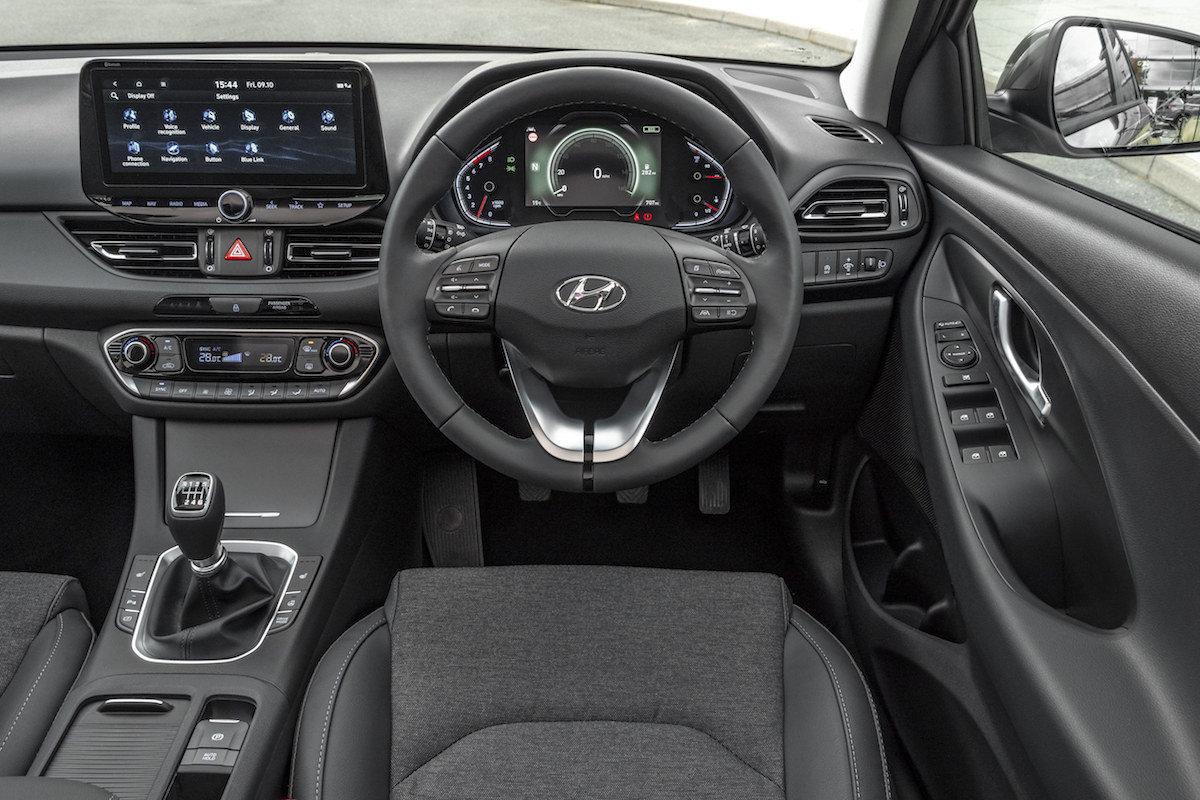
Hyundai has worked hard to shake off its budget image and as result the i30 is well finished inside. A VW Golf has a better looking dashboard, but the Hyundai’s interior feels solidly put together and is finished in tactile materials and well-damped switches. It’s also an easy place to get comfortable, with plenty of seat and steering wheel adjustment for the driver, decent visibility and a straightforward dashboard layout that’s instantly understandable.
All versions of the i30 have plenty of room in the back for a couple of adults (three at a squeeze) to sit comfortably, even if alternatives like the Skoda Octavia serve up more space. The Fastback sacrifices a bit of rear headroom to its coupe-like roof, so this is one to avoid if you need to duck into the back seats regularly to belt kits into the back.
That said, all versions have been designed to cope with hard-working family life, with numerous cubbies and storage spaces to house all the usual odds and ends. The door pockets are deep and can accommodate 1.5-litre bottles, while there’s also a large glovebox, a lidded cuby between the front seats that doubles as an armrest and handy tray (complete with USB charging) ahead of the gear lever.
On paper, the i30 Fastback’s 450-litre boot is larger than most, plus in practice it’s more than deep enough for a chunky buggy. Yet the narrow opening and highish lip makes it a little awkward when loading larger items, meaning it's not quite as practical as you’d hope.
The hatchback and estate versions are far more versatile, the former’s 395-litre capacity being one the biggest in the class. It doesn’t have sliding seats or any nifty tricks like those you might find in small SUV alternatives like the Renault Captur and Skoda Kamiq, but it’s spacious enough for hard daily use.
Yet for our money, the Hyundai i30 Tourer is our pick of the body shapes. It’s compact enough to feel wieldy and nippy about town, yet it looks handsome and the 602-litre boot is huge, bigger than that of the Ford Focus, Toyota Corolla and Vauxhall Astra estates. Fold the split-fold rear seats down and the available space increases to a very healthy 1,650 litres.

What’s it Like to drive?
The i30 isn’t the most exciting or engaging family hatchback to drive, but it’s a composed and capable choice that’s as good as most. The steering is quite slow, but it’s accurate and lets you make good use of the plentiful grip, and the comliant suspension makes you very comfortable, even around town, although the trade off is quite a bit of body lean in corners. Certainly, a Ford Focus, Mazda 3 or Volkswagen Golf are more fun on a good road, but the Hyundai is calm and surefooted.
If you’re considering a used or nearly-new Hyundai i30, there isn’t a bad engine amongst them. It really depends on your lifestyle, so consider the 1.6-litre CRDi diesel if you want the best economy, or want easy-going performance even with a car full of people and stuff. However, the petrols are quieter and more free-revving, and are also efficient, so don’t discount them, especially if you do mostly shorter trips around town.
The 2020 facelift ditched the diesels and slimmed down the petrol line-up to a 118bhp 1.0-litre three-cylinder and a 157bhp 1.5-litre four-cylinder. The latter is a more muscular performer with plenty of mid-range acceleration for easy overtaking, but the former unit is arguably better suited to the i30, revving smoothly and feeling more responsive than its small size would suggest.
Standard on all engines is a six-speed manual gearbox, which features a novel electrically operated clutch that means there’s no physical connection between the pedal and the transmission. It works so seamlessly that you’d never guess it wasn’t a standard, hydraulically operated set-up. Also available is a seven-speed DCT twin-clutch automatic. This operates slickly enough, but the gearchanges aren’t as quick and responsive as VW’s DSG gearbox.
For keen drivers, there’s also the outstanding Hyundai i30N to consider if you’re after a full-on hot hatch. This raucous performance hatch is a rival to the VW Golf GTi, Honda Civic Type R, and while it’s firm ride and shouty exhaust might not be to everyone’s tastes, for those who want a properly involving hot hatch that’s easy to live with yet feels naughty and rebellious at all times, this is the one for you, and you can read our full review here.
Technology, equipment & infotainment
All versions of the i30 are fairly well-equipped, featuring almost all the kit you’re likely to need. Even the entry-level S gets air-conditioning, Bluetooth connectivity and electric windows, while the SE adds little luxuries such as a leather steering wheel and cruise control, while the flagship Premium features upgrades such as keyless entry, heated seats and climate control.
The basic S version is the only one that doesn’t get a touchscreen, making do with a standard radio and CD player set-up. The SE gets a 5.0-inch affair, while SE Nav or up get an 8.0-inch screen that also features Apple CarPlay and Android Auto as well as factory-fitted nav, Bluetooth and digital radio.
From 2020, the updated i30 featured a refreshed line-up that comprises SE Connect, N-Line and Premium models. Equipment levels were improved across the board, with all getting a leather steering wheel, cruise control, reversing camera and parking sensors. The N-Line packs a sporty bodykit and interior trim, while the Premium adds part-leather seat trim, a heated steering wheel and wireless smartphone charging.
Also new is the larger 10.25-inch touchscreen nav system that’s already been fitted to the Ioniq and Kona. It gets the smartphone app connectivity you want, plus nav with 3D view and live traffic updates, and more importantly is one of the best systems in the class for user friendliness. It’s standard on the N-Line and Premium, while the SE Connect gets a smaller 8.0-inch display.
Pre-facelift Hyundai i30s had decent safety equipment, including lane-keep assist, autonomous emergency braking and six airbags. The 2020 update has seen an improvement, so if you go for top-spec Premium trim you also get adaptive cruise control with a semi-autonomous mode that means the car will stop, start and keep to its lane in sluggish traffic, although you must always have your hands on the wheel and be in control of the car. Blind spot assist and even rear cross traffic alert (which tells you if there’s a car coming when you’re reversing out of a space) are also standard on Premium trim. The i30 received the maximum five star Euro NCAP crash safety rating when it was tested in 2017.

Hyundai i30 running costs
The Hyundai i30 will be one of the cheaper family hatchbacks to run (provided you aren’t considering the brilliant i30N, which is for those who are far more fussed about fun than funds). It’s usefully cheaper to buy new than the VW Golf or Toyota Corolla, and is priced more on a par with the Skoda Octavia, Kia Ceed and Vauxhall Astra. Finance deals are good, although perhaps not as keen as you might expect, so be sure to get quotes for a variety of cars you’re considering – including those with a higher list price – if you’re paying on monthly finance, since it might surprise you how close the monthly payments are for seemingly more expensive cars.
Fuel economy is good, if nothing exceptional. Expect some 45 to 50mpg from the pre-facelift 1.0 T-GDi depending on where the car is being driven, while the 1.4 will likely return more like 40mpg and the 1.6 diesel will exceed 50mpg easily. Official figures for the new 2020 engines are very decent, with WLTP tests returning 61.4mpg for the 1.0 T-GDi whether in manual or DCT automatic form, while the 1.5 T-GDi returns 44.8mpg, or 46.3 with the auto’. The 1.6 CRDi returns an official 58.9mpg.
The Hyundai’s insurance groups are lower than many rivals, too, and that five-year, unlimited-mileage warranty is one of the best in the industry and brings extra peace of mind and the promise of very little in the way of repair or maintenance costs. Servicing is often available on a fixed rate, and with special offers available, so tends to be comparably cheap.
The only area where the Hyundai looks comparably expensive is in depreciation, since it does lose a bigger chunk of its value over the first few years than alternatives like the VW Golf. Not great if you're considering a brand new i30, but if you're buying used, it'll work in your favour.
Hyundai i30 reliability
Hyundai has a very good reputation for reliability. It came sixth out of 31 brands included in the 2020 What Car? used car reliability survey, which factors in cars up to five years old. The i30 itself was rated 17th out of 24 family cars included in the same What Car? survey, since it was reported to have suffered more faults per car than the Ford Focus, Seat Leon and VW Golf, even if it fared better than the Honda Civic and Peugeot 308.
Given the five-year warranty (which also includes roadside assistance as standard), parts that are generally affordable, and data that suggests the i30 will be just as reliable as most rivals, it’s likely to be one of the cheapest family hatches to own.
- Don’t go confusing the mild hybrid system in the facelifted 2020 Hyundai i30 with ‘full hybrid’ or plug-in hybrid cars. A mild hybrid system is simply a small electric motor that enhances the performance and efficiency of a petrol or diesel engine, but that never powers the car on its own. It’s powered by energy that’s created by the car’s natural forward movement when you coast, or by the friction created when you brake. So, you never get pure electric running as you do in a full hybrid like the Toyota Corolla, and you can’t plug it in. You just drive it and fuel it like a ‘normal’ car. You probably won’t even notice that there’s an electric motor involved, but you should hopefully notice the economy benefits.
- If you do want electric running, the Hyundai i30 is lacking any options. Its sister car, the Kia Cee’d, now has a plug-in hybrid variant so we wouldn’t be surprised if a PHEV variant of the i30 were to follow, but there’s no official confirmation. Currently, if you want a plug-in hybrid hatchback, we’d suggest you look at the Skoda Octavia iV or VW Golf GTE. That said, Hyundai does offer its Ioniq hatchback with PHEV power (there’s also an all-electric and ‘self-charging’ hybrid model), although it’s a little more cramped than the i30.
- All versions of the i30 come with Drive Mode settings that allow drivers to switch between Eco, Normal and Sport. The latter sharpens the throttle response and adds weight to the steering in an effort to deliver a more involving driving experience, while the former dulls the accelerator to encourage more efficient progress. In truth, the differences between the settings are minor and it’s best just to leave the car in Normal.
- If you’re considering an i30 as a school run and general runabout car, the 1.0-litre (whether pre- or post-2020 facelift) is the best option, either in hatchback or estate guise depending on your load-carrying needs. It’s quiet, smooth revving and happy enough on a long motorway trip. There’s also now a dual-clutch automatic gearbox available with this engine. SE Nav is the best value as a used car, or SE Connect for the facelifted car is generously equipped and has great standard infotainment.
- Company car buyers should also look to the 1.0-litre petrol, since it is the cheapest model and also falls into a lower Benefit in Kind (BiK) tax bracket, making it usefully cheaper than the other models for company car tax. Entry-level SE Connect has all the equipment you need including a 10.25-inch colour touchscreen with nav.
- For those who do high mileage and/or regularly carry a lot of people and stuff, go for the bigger engines whether you’re buying new or used. The 1.4-litre turbocharged engine in pre-facelift cars is punchy enough, but you may be better with the diesel if you’re looking for frugal economy and torquey response. With the updated 2020 model, the 1.5 T-GDi gets a hearty 187lb ft of torque and will do 0-62mph in 8.8sec, so (while we haven’t driven it yet) we’d expect it to do a fine job even if you’re often driving a fully laden car. Of course, the estate is the best bet where space is a priority.
- If you want sportier looks without sporty running costs, the i30 N Line 1.5 T-GDi is for you, and consider the Fastback if you don’t particularly need the more useful boot in the hatchback. N Line gets tweaked suspension settings and sportier looks, and it also arrived in 2018 so you can get a used one if that suits your budget better. As a second-hand option, the manual 1.4 petrol is spot on. It was offered with a dual-clutch automatic transmission, but it’s a bit lazy and isn’t as fun to drive.
- For novice or learner drivers, a used 1.0 T GDi SE Nav is a really great choice. They’re cheap by the standards of comparably equipped hatches, the 118bhp engine falls into a low group 8 for insurance, and it’s got great levels of safety equipment and crash protection.

