Jaguar F-Pace Review (2016-present)
Jaguar F-PACE cars for sale
4.0
Expert review
Pros
Great to drive
Good standard equipment
Roomy and practical
Cons
High running costs with V8 models
Poor interior quality on pre-facelift cars
Firm ride, especially on larger wheels
The CarGurus verdict
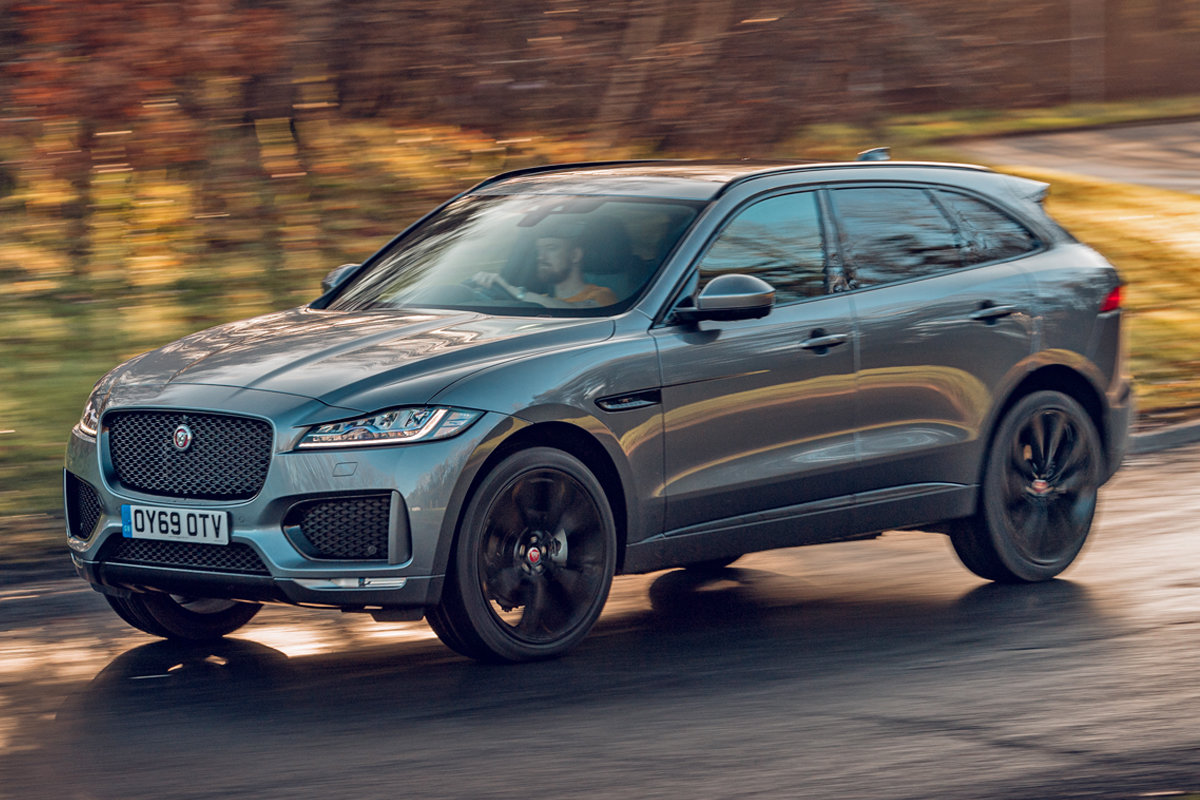
The Jaguar F-Pace is a car that’s always been very enjoyable to drive compared with most of its rivals, with sharp handling, detailed steering and punchy engines. It can’t quite match a Porsche Macan for thrills, but it has the measure of just about everything else in the midsize prestige SUV class. It’s also a very roomy and practical car in most of its forms, and it comes very well equipped as standard.
It's also worth bearing in mind, though, that the F-Pace is a car that’s changed a lot over the years, most notably with a facelift in 2021, which traded the earlier versions’ rather dowdy interior and clunky infotainment system for much posher, much better quality replacements. That’s why we’d say that the later example you can afford, the better the car you’ll get. It’s not perfect: the firm ride means plenty of rivals are more comfortable and some of the engines are rather thirsty. However, if you’re after a family SUV that you buy with your heart as well as your head, the F-Pace has a lot going for it.

What is the Jaguar F-Pace?
What Jaguar took its first steps into a new market in 2015, when it unveiled its first SUV, the F-Pace. The brand described it as a “performance crossover” and, when deliveries kicked off in 2016, it went head-to-head with established rivals such as the Audi Q5, the BMW X3, the Land Rover Discovery Sport and the Mercedes-Benz GLC.
It was no half-hearted entry into the competitive SUV field, either. The F-Pace debuted with smart styling, sharp handling, advanced technology, and an engine line-up that ranged from mild to wild.
Renowned for its sports cars, such as the F-Type, Jaguar focused on ensuring that the F-Pace SUV delivered the responsive and agile handling associated with the brand, which would give it an edge over more mundane rivals. It also tried to do so without compromising comfort or practicality, so that the F-Pace would remain viable to buyers who wanted a sensible-but-appealing family SUV.

How practical is it?
Even by the impressive standards of other midsize premium SUVs, the F-Pace is a very roomy and practical family car. Open up the powered tailgate – that’s a standard feature on all versions, by the way – and you’ll find a loadbay that has a good square shape. The precise amount of space you get depends on which version you go for, but you’ll find that most versions have upwards of 600 litres, which is really competitive for the class.
Go for the P400e, however, and you’ll find that - like with most plug-in hybrids - you lose quite a bit of that capacity, because the hefty battery pack needs to be squeezed in beneath the boot floor. The figure you’re left with drops to 485 litres, but to be fair, that’s still more than the 450 litres you get in the plug-in version of the BMW X3. However, the space available is eaten into further by the fact there’s no underfloor storage for stashing your charging cables, so you’ll have them rattling around in the main load area. The elevated boot floor also leaves you with an odd slope upwards from the lip to the level main part, and when you fold the 40-20-40 split-folding rear seats down, it also leaves you with an awkward step down to the backs of the rear seats. In other versions of the F-Pace, however, the rear seats drop to leave you with a more or less flat and level load area.
Talking of the rear seats, they have lots of legroom and headroom. The optional panoramic roof does eat into the latter, but you’ll still need to be well over six foot before you find your head brushing the ceiling. The middle seat is nice and wide for when you need to carry a third person in the back, although limited shoulder room means things will still be a bit of a squeeze.
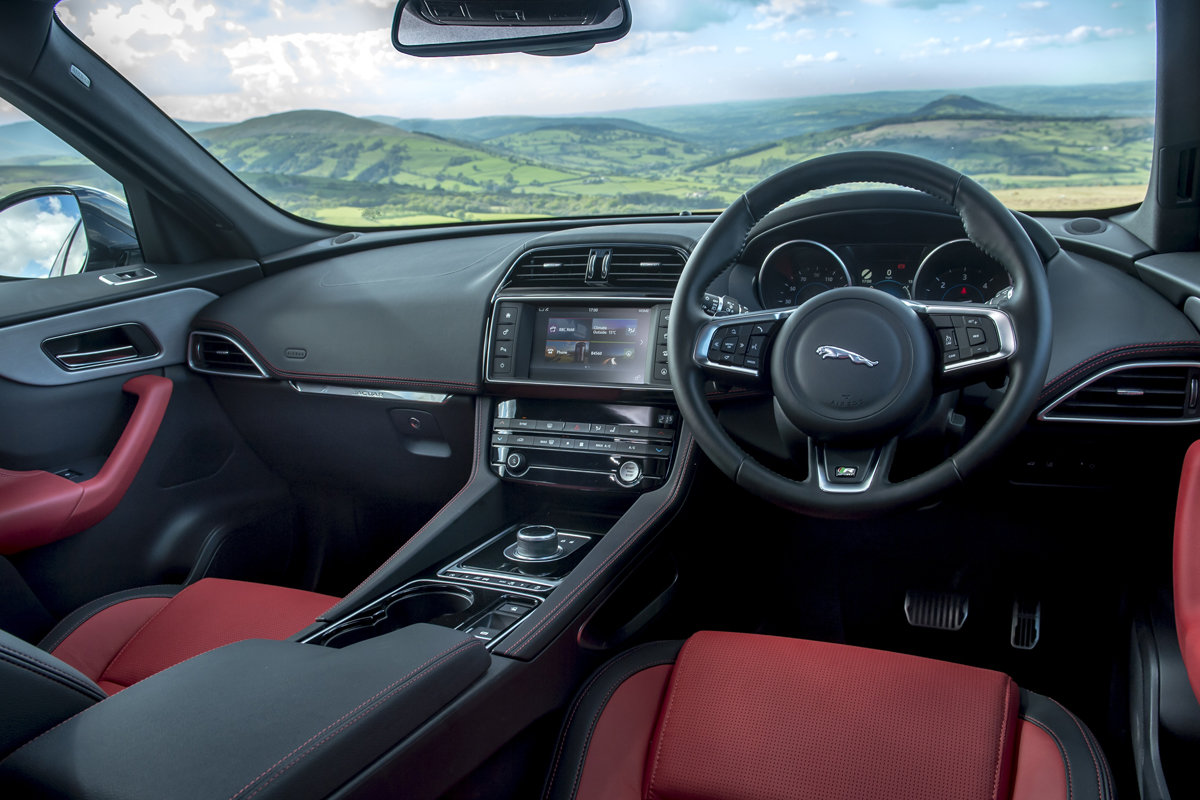
We mentioned earlier that the F-Pace has undergone various improvements over the years, and nowhere is that more evident than inside the car. Early examples trailed the established German competition on both quality and ergonomics, and in most cases, by quite a distance. However, following an extensive facelift in 2021, the F-Pace is now up there with the very best in the class in both areas.
On the quality front, the materials are now plusher and the various switches work in a faultlessly slick way, so it all feel very classy indeed. Those clever switches also help improve ergonomics, as does the latest Pivi Pro touchscreen infotainment system. More on that in the Technology and Equipment section.

What’s it like to drive?
The F-Pace had an interesting range of engines from launch, including conventional four-cylinder diesel engines and a 380hp supercharged 3.0-litre petrol V6. Rear-wheel drive and all-wheel-drive (AWD) configurations were available, with the latter often reserved for the more powerful variants.
A bit later, Jaguar introduced the F-Pace SVR. The supercharged V8 powerhouse is a grin-inducing choice, and remains a worthwhile alternative to similarly upmarket offerings such as the Porsche Macan, the Porsche Cayenne, the Alfa Romeo Stelvio Quadrifoglio and the Range Rover Sport.
The numerous changes to the F-Pace throughout the car’s life have included changes to the engine range, and it bears little resemblance to the line-up at launch. These days, buyers of a brand new F-Pace choose from one of two diesel engines - either the 2.0-litre 201bhp unit in the D200 or the 3.0-litre 296bhp unit in the D300 – or a couple of petrols – the 2.0-litre 247bhp engine in the P250 or the 3.0-litre 395bhp engine in the P400 Sport - to power their car. The SVR P550 has a stonking 5.0-litre V8 petrol with 542bhp (later upped to 567bhp), while at the slightly less bonkers end of the scale, you have the P400e plug-in hybrid, which combines an electric motor with a 2.0-litre turbocharged four-cylinder petrol engine to deliver 398bhp and an all-electric range of up to 40-odd miles. All these later engines come with all-wheel drive and an automatic gearbox.
Whatever vintage of F-Pace you’re considering, there isn’t a bad choice to be made on your engine, and it’s simply a case of how fast you want your sporty SUV, although do bear in mind that most of the engines aren’t particularly economical, and some of them will be positively ruinous to run.
And whichever version you choose, you’ll get a sporty SUV that’s genuinely fun and engaging to hustle along a good road. The Jaguar’s steering is accurate and weighty, there’s bags of grip and the suppression of body lean is also really impressive, while the throttle and brakes on most versions work responsively and fluidly. It all adds up to a driving experience that’s a rather more agile and playful that you might expect from a car of this size. The P400e is perhaps a touch less wieldy than other F-Paces due to the extra weight of its batteries and the slightly duller responses of its throttle and brakes, but it’s still an enormously enjoyable car to fling about.
The sporty handling does come at a cost, however. The ride can be rather firm, particularly on cars specified with larger wheels. Most versions stop short of being uncomfortable, but this edginess certainly won’t be to everyone’s taste, so more than ever, we encourage you to try before you buy. Also make sure you can live with the refinement levels because you’ll hear more wind-, road- and engine noise that you will in some rivals.
Technology, equipment & infotainment
At launch, the range consisted of Prestige, R-Sport, Portfolio, S and First Edition models. Equipment levels were really good from the outset, with even the Prestige getting front and rear parking sensors, cruise control, heated seats, hill descent control, and Bluetooth connectivity. The flagship First Edition came with high-end features including LED headlamps, a Virtual Instrument Cluster (a screen in place of traditional analogue dials), and 22-inch alloy wheels.
Trim levels and specifications were some of the many things to change unrecognisably over the lifespan of the car – several trim grades came and went over time – and nowadays, buyer choose between R-Dynamic S, R-Dynamic SE, R-Dynamic HSE, P400 Sport and SVR trims. Rest assured, each one of them is stocked to the nines with luxury goodies and driver assistance features.
One important feature that’s standard on all post-facelift F-Paces is that Pivi Pro touchscreen system we touched upon earlier, which replaced the rather unintuitive and dated-looking infotainment system in older F-Paces. The graphics are sharp, the screen transitions are slick and the operating system is well laid out and easy to use. We still prefer systems with a rotary dial controller, but as touchscreens go, this is about as good as it gets.
However, that facelift did introduce one other ergonomic annoyance in the form of the gear selector. Early examples had a rotary dial-style selector that rose out of the centre console theatrically when you fired up the engine, and all you had to do was twist and go. That was later replaced by a more conventional lever selector, which some will find utterly infuriating.
There’s a kind of trigger thing on the back of it that you need to press to engage either drive or reverse. If you forget – which you often do – the lever still moves to where it needs to go, but the drive isn’t engaged. So, you’re either sat there wondering why you’re not going anywhere, or even worse, you’re not going in the direction you expected. This can be particularly hair-raising during tight parking manoeuvres.
Jaguar F-Pace running costs
Running costs will vary significantly from model to model, due to the wide engine line-up and different drivetrain options.
If you’re really looking to minimise costs, then an early base-level rear-wheel-drive diesel variant will prove the most cost-effective in terms of purchase price and fuel economy. The automatic D200 returns a combined fuel economy of around 45mpg on the WLTP test procedure, while the all-wheel-drive model isn’t miles behind, clocking in at around 42mpg. While those figures aren’t too bad, many rivals do rather better.
Four-cylinder diesel versions of the F-Pace have a 60-litre fuel tank which, coupled with a real-world economy around or north of 40mpg, means a useful range of around 500 miles. Six-cylinder diesel and petrol variants get a bigger tank, but are also less efficient, so will usually deliver a similar range per tank.
Unless, that is, you opt for the SVR variant; the claimed average is just above the 20mpg mark, and if you drive it like it’s supposed to be driven, you’ll get nowhere near that. Even if you did, it would drain its 83-litre tank in 400 miles.
A range of service plans are offered, which include complimentary AdBlue top-ups for diesel models and a 24-month warranty on the genuine Jaguar parts used. Payment costs can also be spread, making things more manageable, and the service plan can also be transferred onto other cars. Alternatively, if you sell your Jaguar, the remaining money can be refunded to you.
There’s one other thing to bear in mind, especially if you’re looking at used F-Paces, and that's the cost of replacement tyres. The 22-inch wheel option, for example, is shod with a 265/40 R22 tyre. One good brand-name tyre can set you back some £230, so replacing a set of all four – with fitting and balancing – can easily cost upwards of £1,000.

Jaguar F-Pace reliability
Every new F-Pace comes with a three-year, unlimited-mileage warranty, which is on a par with that offered by companies such as BMW. It also betters the likes of Audi, the warranty of which lasts for three years but only 60,000 miles.
As is the case with others, you also get 12 months’ roadside assistance. Hopefully, you won’t need it, but Jaguar’s reputation for reliability is pretty poor and, although it is improving, owners have reported numerous small issues. The vast majority of gripes appear to relate to electronic and media faults, but the major mechanical components appear robust and are used extensively elsewhere.
There have also only been a handful of recalls on the F-Pace. Five recalls were issued for the first-year Jaguar F-Pace, but that number dropped in subsequent years.
Should you be concerned about the ongoing reliability of your F-Pace, you can opt for an extended warranty. It offers 12 months’ extensive cover, as well as MOT cover and seven days’ car hire. The number of claims and mileage is unlimited, too, so major gripes should be few. A less costly Select warranty extension is also available, which covers fewer components and has lower claim limits.
If you’re thinking about buying a used F-Pace, have a look at Jaguar’s approved used scheme. Every car offered goes through a 165-point inspect and comes with 12 months’ warranty and 12 months’ roadside assistance. It’s also tested before sale and, if required, reconditioned using genuine Jaguar parts.
- The Jaguar F-Pace has the full five-star safety rating from Euro NCAP, but that’s not the full story. It was tested way back in 2017, and because the testing standards get harder and harder each year, there’s no way a 2017 F-Pace would get five stars now. However, incremental changes over the car’s lifetime have brought more and more safety equipment and driver aids, so in real terms, later cars will be safer overall than early ones.
- It's not just the car itself that has changed over the years; the whole nomenclature surrounding it has, too. As we said earlier, when the car was launched, the trim levels included Prestige, R-Sport, Portfolio, S and First Edition. Now, however, the trim levels work in a completely different way. Unless you buy the standalone P400 Sport or SVR models, your car will come in R-Dynamic trim, but you then add on a specification pack on top of that, making your car either an R-Dynamic S, and R-Dynamic SE or an R-Dynamic HSE. Confused? Us too.
- The engine nomenclature has also changed entirely. With early cars, the engines had name like 20d, 25d, 25t and 30t. The numbers equated to the approximate power level of the car, while ‘d’ stood for diesel and ‘t’ stood for turbocharged petrol. Nowadays things have been swapped around: a D200 is a diesel engine with approximately 200 horsepower, while a P250 is a petrol with 250 around horsepower. The difference between a P400 and a P400e is that the latter is a plug-in hybrid. Sheesh.
- If you’re a company car driver: the P400e plug-in hybrid is definitely the car for you, as its low CO2 emissions will mean that you pay a fraction of the company car tax that you would on a regular petrol or diesel F-Pace. WLTP figures also suggest that you’ll get 176mpg, but that’s a figure that’s taken from a laboratory test that’s unrealistically flattering to PHEVs, so it’s merely a pipe dream in the real world.
- If you want the fastest F-Pace: The SVR’s 542bhp supercharged 5.0-litre V8 makes it the fastest version, and it’s actually got faster over the years, Originally, the 0-62mph time was given at 4.3 seconds, but incremental improvements have seen that drop to 3.8 seconds today. Either way, probably fast enough. It’ll cost you an absolute fortune to buy and run, though, with new prices starting at around £85,000 and a WLTP fuel economy figure (an optimistic one at that) of 23mpg.
- If you want the best all-rounder: You definitely want a post-facelift example, so a 2021 car or later, due to its vastly improved interior and infotainment. It might not be fashionable these days, but the diesels really suit the F-Pace, and there’s not a lot wrong with the entry-level D200, which is brawny, works nicely with the automatic gearbox, and will likely give you the best real-world fuel economy.


