Kia EV3 review (2024-present)
Kia EV3 cars for sale
4.0
Expert review
Pros
Extrovert styling
Loads of space for a car of its size
Long range
Cons
Unsettled ride
Too many touch-sensitive controls inside
Some cheap-feeling interior plastics

The CarGurus verdict
The Kia EV3 isn’t quite the home run its larger sibling, the EV9, was. But this is still a solid, desirable and distinctive electric SUV with a lot of practicality. It might not be quite as versatile as some of its rivals, but it packs in a lot of space and equipment, and while some of the interior plastics might not quite match up to your expectations for such an expensive car, the EV3 is still a delightful place to be.
Importantly, it’s also backed up by an excellent reliability record and a long warranty. And while it’s let down by a ride quality that’s just a bit too jiggly, the EV3 is still a pleasant enough car to drive.
If you like the idea of the EV3’s extrovert styling, but would like something a little more comfortable with an interior that’s both more versatile and more usable, try the Hyundai Kona Electric. Or if you’d rather pay less for your EV, you could always look at the MG ZS EV.
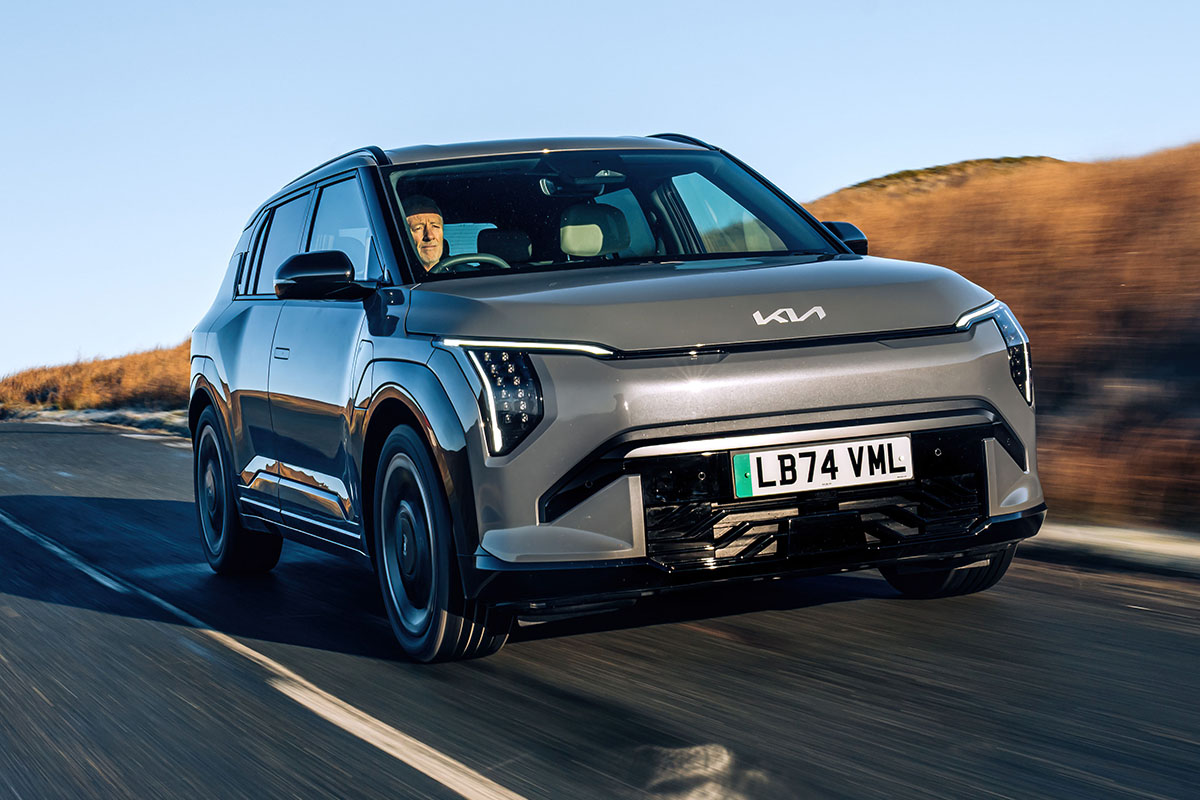
What is the Kia EV3?
The words ‘electric family SUV’ in conjunction with one another are highly unlikely to take you up to the heady peaks of automotive exhilaration. And this is something Kia understands. Which is why it’s styled its latest electric crossover to look like something that’s just driven off the set of Judge Dredd.
It’s called the EV3, and it’d fit in pretty well on the streets of Mega-City One, with its blocky side profile, slender headlamps and concept car-esque detailing making it even more extrovert than its stablemate, the Kia Niro EV. The result is a car that’s instantly recognisable, with a look all of its own that sets it apart from rivals like the closely-related Hyundai Kona Electric. Other rivals include the Smart #1, Volvo EX30, Skoda Elroq, VW ID.3, Cupra Born, Renault Megane E-Tech, and Citroën e-C4.
The line-up is pretty simple: there’s only one motor on offer, with a healthy 201bhp. This is then allied to a 58kWh battery on the cheapest Air model, with the option of a larger 81kWh unit; pricier GT-Line and GT-Line S versions get the 81kWh battery as standard. All EV3s are front-wheel drive.

How practical is it?
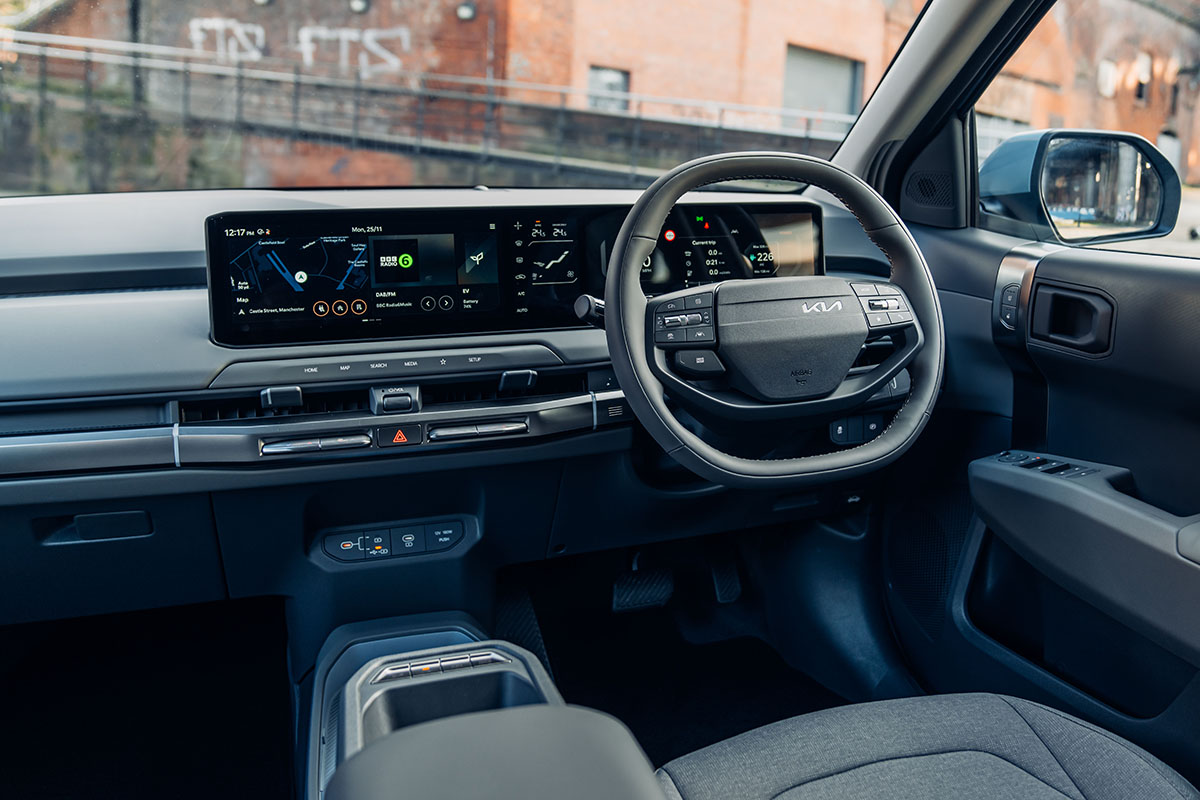
Climb aboard the EV3 and you’re met with anything but a dystopian futurescape. Inside, it’s light, airy and welcoming. The dashboard is finished in light colours, and there’s a good variety of different materials, which helps add visual interest.
The only downside is that some of those materials don’t feel particularly classy; large swathes of the door panels, for example, are finished in a dimpled plastic that looks and feels somewhat downmarket. At night, you’ll also notice that the ambient lighting strips reflect in the side windows, obstructing your view of the door mirrors
The layout of the front seat area affords plenty of storage, mind you. From the huge tray on the floor in between the seats to the flip-out cupholders to the armrest cubby, there are all sorts of areas to store odds and ends. And the way you can slide the lower section of the arm rest forward in GT-Line models, to reveal a flat surface on which you can write should you need to take notes, is a neat touch.
In the back seats, the story is equally impressive. There’s a vast amount of leg and head room on offer, and you get two USB charging sockets, so rear-seat passengers can keep their devices topped up on the move. The big doors leave wide, squared-off apertures, too, making it a doddle to buckle younger children into their car seats.
It is a bit of a shame, however, that the rear seats aren’t more clever – they don’t split in three, like they dow in the Hyundai Kona Electric, and nor do they slide back and forth as per the Smart #1.
You do at least get a variable height floor behind the hatchback boot, which is something – and it’s a decent size, too, with 460 litres of boot space on offer. That’s allied to an additional 25 litres of storage in a separate compartment under the bonnet, where you can stash the charging cable out of the way if you want to.

What’s it like to drive?
Go for the 58kWh battery in the Air model, and you get an official range of 270 miles, which should work out at around 200 miles of driving range in the real world, depending on the weather and your driving style. If you need more than that, you can upgrade to the 81kWh battery that comes as standard in the GT-Line and GT-Line S models. That should get you a very useful 375-mile official range, which should work out to around 280 miles in the real world, again depending on the conditions. That’s more than you’ll get from most electric vehicles in this class.
Both versions feature a single permanent magnet electric motor that develops 201bhp. That’s enough to make acceleration in the EV3 feel brisk; 0-62mph takes 7.7 seconds in the 81kWh mode, or just 7.5 in the lighter 58kWh.
Out on the road, that brisk acceleration is matched to good body control; it’d be wrong to say the Kia EV3 doesn’t lean over in bends, but the effect isn’t too marked. Combined with solid levels of grip, that means you can hustle it along a twisty road and have a moderately good time doing so. Regenerative braking levels can be tweaked using the paddles behind the steering wheel, too.
True, it’d be better if there was more feedback from the steering, so ultimately a Smart #1 is probably a touch more enjoyable, but the EV3 doesn’t feel quite as mushy as the Hyundai Kona.
The trouble is, there’s a trade-off for that extra body control, which is the way the EV3 rides bumps. Its suspension manages to be the worst of both worlds at times, jiggling along over smaller, sharper ruts while also allowing just a bit too much waft over longer undulations at faster speeds, which can make you feel a little queasy.
Technology, equipment & infotainment
On every EV3 – even the entry-level Air model – you get heated front seats, front and rear parking sensors, cruise control, a heated steering wheel, climate control, LED lights, blind-spot collision warning, and wireless Apple CarPlay and Android Auto. Upgrade to the EV3 GT-Line, and you add a wireless mobile phone charger, artificial leather upholstery, electric seat adjustment for the driver, and 19-inch alloy wheels.
The top-of-the-range GT-Line S then adds a 360-degree parking camera, a Harman Kardon sound system, a head-up display, a sunroof, a powered tailgatem ventilated seats in the front, and heated outer rear seats.
Disappointingly, you can only get a heat pump as an optional extra on the highest of these trim levels – which feels somewhat churlish, given the difference they make to range depletion in colder temperatures.
The EV3 gets a widescreen, landscape-oriented 12.3-inch touchscreen that’s smaller than a Tesla’s; by and large, this works well, with quick responses and simple to understand graphics, though some of the options can be buried quite deep in the menu system.
Next to this is a touch-sensitive climate control panel, which is less effective, mainly because it’s hidden from view by the steering wheel. As a result, you have to peer round it to be able to see it – which is annoyingly necessary because, being touch-sensitive, you can’t feel your way to the buttons and have to look at what you’re pressing.
The shortcut keys for the touchscreen are also touch-sensitive, which means they too can be a little distracting to use, although they are more clearly in your line of sight. You do get a few piano key style physical switches to raise and lower the temperature, at least.
The driver display with its virtual dials is clear and easy to read, and takes on different appearances depending on which driving mode you’ve selected.

Kia EV3 running costs
Starting at around £33,000, the EV3 is quite a lot of money for a relatively compact electric car; an MG ZS EV, for example, will set you back almost £10,000 less. That said, very few EVs of this size can provide the combination of space, range and performance on offer here, and you also get a seven-year/100,000-mile warranty thrown in, so you might argue that it’s worth the money.
No matter which EV3 you choose, you get an official WLTP electrical efficiency figure of 4.2 mi/kWh, which is pretty respectable for a car of this size. Expect to see that dip to around 3.5 in the real world, depending on the sort of driving you’re doing.
As is par for the course with most electric cars, the EV3 only needs to be serviced every two years or 20,000 miles; expect to pay around £160 for a first-year service at a Kia main dealer, which isn’t cheap for an electric car service, though neither is it as expensive as some rivals.

Kia EV3 reliability
Kia has a reputation for solid reliability, with frequent appearances in the top 10 manufacturers in the What Car? Reliability Survey; the EV3’s combustion-engined stablemate, the Sportage, is even one of Britain’s best-selling cars. The EV3 is too new for us to have any specific model data on it, but Kia’s electric cars are widely considered to be some of the best in the business, and seem to be pretty dependable.
Like all Kias, the EV3 is backed up by one of the best warranty offers in the business; you’re protected up to seven years or 100,000 miles, with unlimited mileage cover in the first three years. Do bear in mind that the number of failures that are covered drops off slightly in the final four years of the warranty’s duration.
- The EV3 backs up its impressive range figure and battery sizes with some rapid charging speeds. It’ll charge at up to 150kW, if it’s connected to a charger that can match that figure, which means a 10-80 per cent charge in the smaller battery model will take 29 minutes, or 31 minutes in the big-battery model.
- The EV3 is one of the widest small SUVs out there. At 1.85 metres, it’s almost as wide as a BMW i5, which is a much larger car. Just something to keep in mind if you regularly drive in tight urban streets or through width restrictions.
- The EV3 is capable of vehicle-to-load (V2L), which means it’s able to power or charger smaller electrical appliances – for example, an e-bike – from its battery. However, be aware that V2L is only available on the top-of-the-range GT-Line S version – and you have to pay extra for it.
- If you’re on a budget: go for the Air trim with the standard range battery. It’s the cheapest there is, and while the extra range of the top model is nice to have, it isn’t essential – this entry-level car will still get you a fair old distance on a charge.
- If money’s no object: the GT-Line S is obviously the one to have. You get the bigger battery as standard, and the step up from the GT-Line is quite considerable in terms of the amount of equipment you get; some of that kit that’s on the list is really nice to have. Don’t forget to spec the heat pump, though.
- If you value comfort: choose the Air, but upgrade to the long-range battery. You’ll get the peace of mind of the longer range, but you also get the smaller 17-inch wheels, whose chunkier tyres will mean the EV3 isn’t as unsettled over sharper bumps
- If you want the best all-rounder: your best bet is the GT-Line version, which comes with plenty of equipment, smarter looks, and the larger battery, all for a reasonable price.


