Range Rover Electric 2026 review | The best Range Rover ever

CarGurus expert score
Pros and cons
What we like
Electric drive elevates Range Rover yet further
Immensely capable both on road and off it
Superb comfort and refinement
What to consider
Expensive
Range not a match for the class best
Overburdened touchscreen
The CarGurus verdict
The Range Rover Electric is a magnificently appealing machine that takes the brand’s luxury draw to a new level. Ultra-refined, ultra-comfortable, ultra-luxurious, it is a very special car to drive, one that does everything a regular V8 Range Rover can do and plenty more besides.
The range may not impress those who are chasing numbers, but the real-world performance is more reassuring, certainly ensuring this is an EV you can rely on to deliver what it says. It charges sufficiently quickly at a rapid charger to minimise downtime too. Perhaps the biggest deterrent may be the Range Rover Electric’s luxury-grade pricing, for this is an elite machine that comes with a similarly heady price tag. But if you have the means, it’s hard to deny the Range Rover Electric isn’t worth it.
out of 5 expert review
What is the Range Rover Electric?
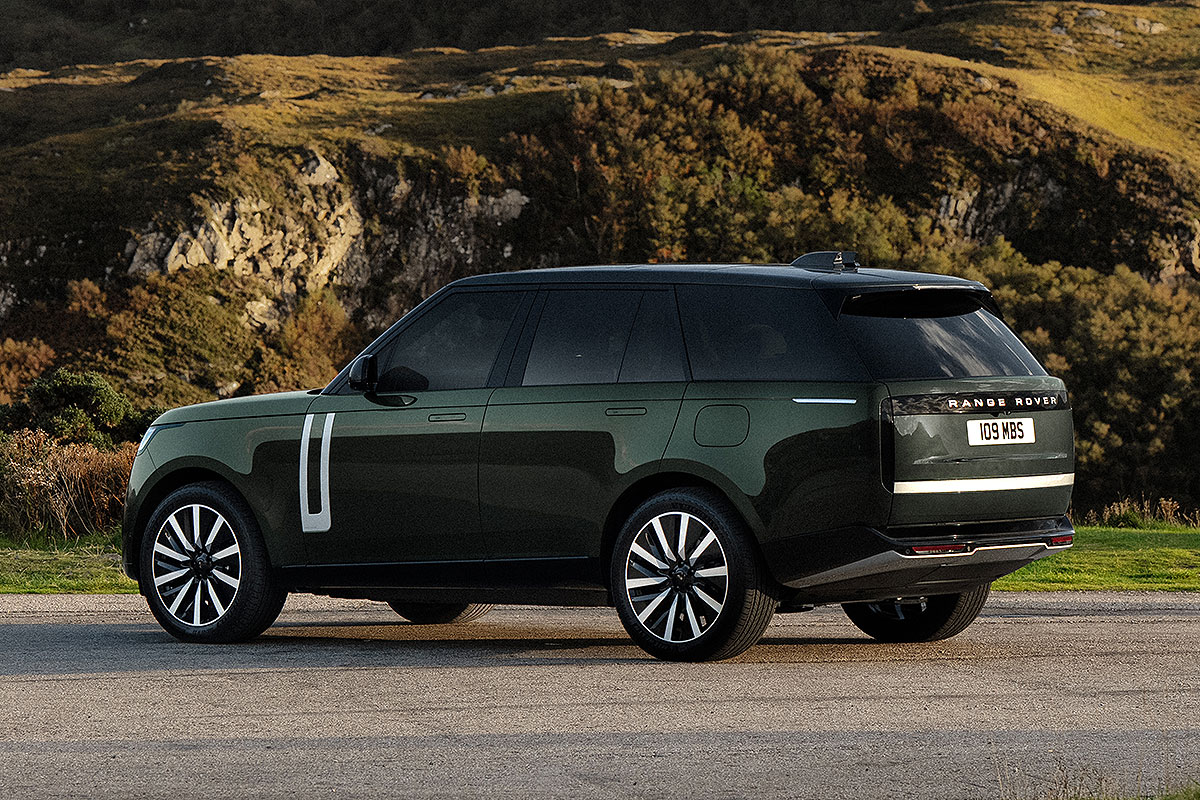
The Range Rover Electric is, as its name suggests, the all-electric version of the famous luxury 4x4. Rather than being an all-new car, like the Porsche Cayenne Electric, it simply swaps the regular petrol and diesel powertrains for a full EV setup. Minor design details apart, it’s visually identical to a regular Range Rover.
All this is intentional, says the firm. Some people are ready to go electric now, while it doesn’t yet work for others. The aim here is to give people the choice – indeed, the Range Rover’s core architecture was designed to allow a full range of powertrains, from rorty V8 petrol, to plug-in hybrid, right through to this latest electric version.
There will be two versions of Range Rover Electric, called EV450 and EV550. The number relates to the total power of their front and rear electric motors; they’re otherwise identical, with both using a 118.5kWh battery. The Range Rover Electric has a range of up to 372 miles, and JLR is keen to highlight the ‘real-world’ range of up to 333 miles. Both standard and long-wheelbase versions are offered, with launch versions focused on the lavish Autobiography, SV and First Edition trims. More affordable (a relative term, admittedly) SE and HSE will follow later.
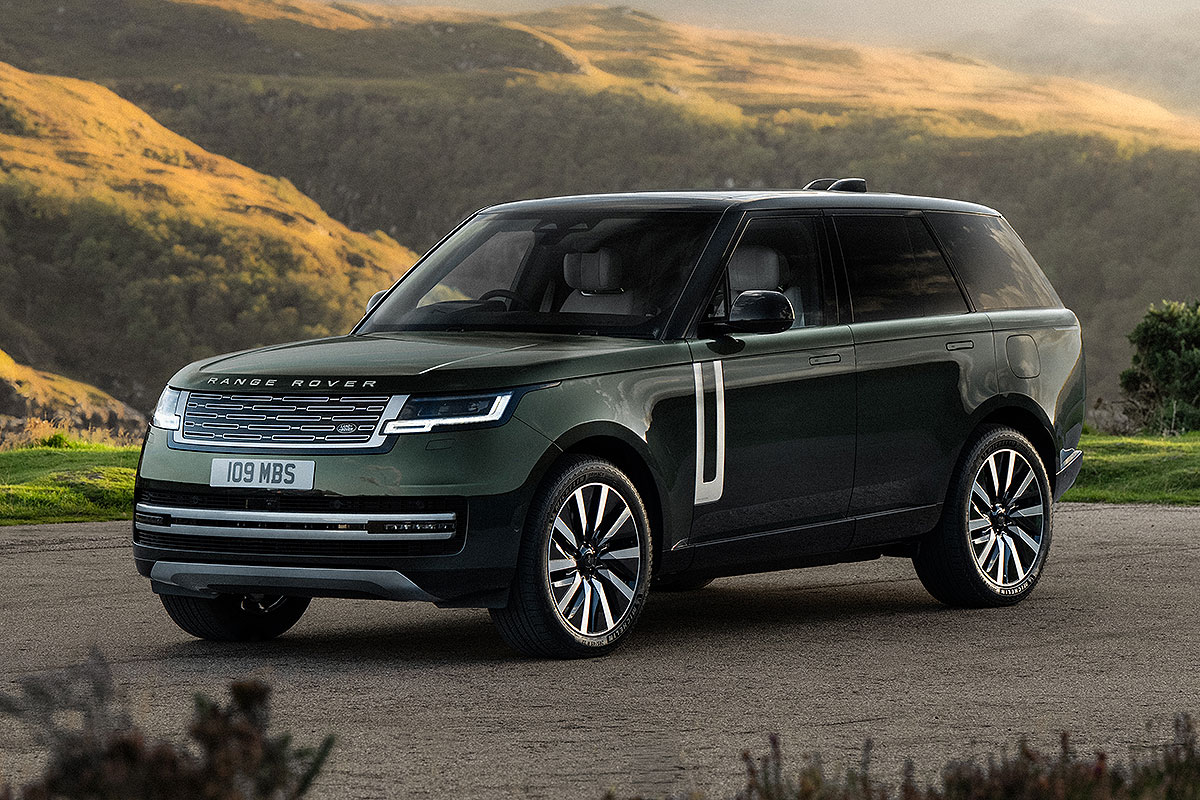
So what are the styling changes that mark out a Range Rover Electric? The list is short. The key one is a different front grille, now closed-off to boost the car’s aero efficiency (it now has a Cd drag factor of 0.29, which isn’t bad for a Range Rover). There are also ‘EV’ logos in the centre of the wheels… and, save for the (optional) green stripe on the registration plate, that’s it. You don’t even get ‘electric’ badging on the bootlid.
It looks the same inside too, with identical controls: the gearlever’s ‘S’ setting now selects single pedal mode, rather than sport mode. There are EV-specific readouts, but the main displays look the same, and there’s nothing that marks the Range Rover Electric out as different. If you are comfortable driving a regular Range Rover, you’ll be right at home here.
There currently aren’t many fully-electric rivals for the Range Rover Electric. The impressive Porsche Cayenne Electric is the obvious one, as are the disappointing Mercedes-Benz EQS SUV and upcoming Bentley Torcal. The Mercedes-Benz G-Class is a bit extreme, the new BMW iX5 isn’t quite as elite as the Range Rover, and the Rolls-Royce Spectre is a coupe, not an SUV. Let’s not even mention the Ferrari Luce.
Practicality
How practical is it?
The Range Rover Electric offers the same imperious driving position as the regular model. This is an SUV you really do have to step up into, probably grabbing the steering wheel as you do so. At least there’s no sill to step over, and the standard air suspension does offer an access mode, lowering it a bit closer to the ground. Once there, relish the fantastic visibility and regal view across the huge bonnet.
Plump, luxurious seats adjust in plenty of directions, but if you want to adjust things such as lumbar support and massage functions, you need to do so through the touchscreen. The polished switches on the doors only adjust fore and aft reach, plus the angle of the backrest. You also have to use the touchscreen to turn on the heated or cooled seats. At least there are physical controls for electrically adjusting the steering wheel and door mirrors.
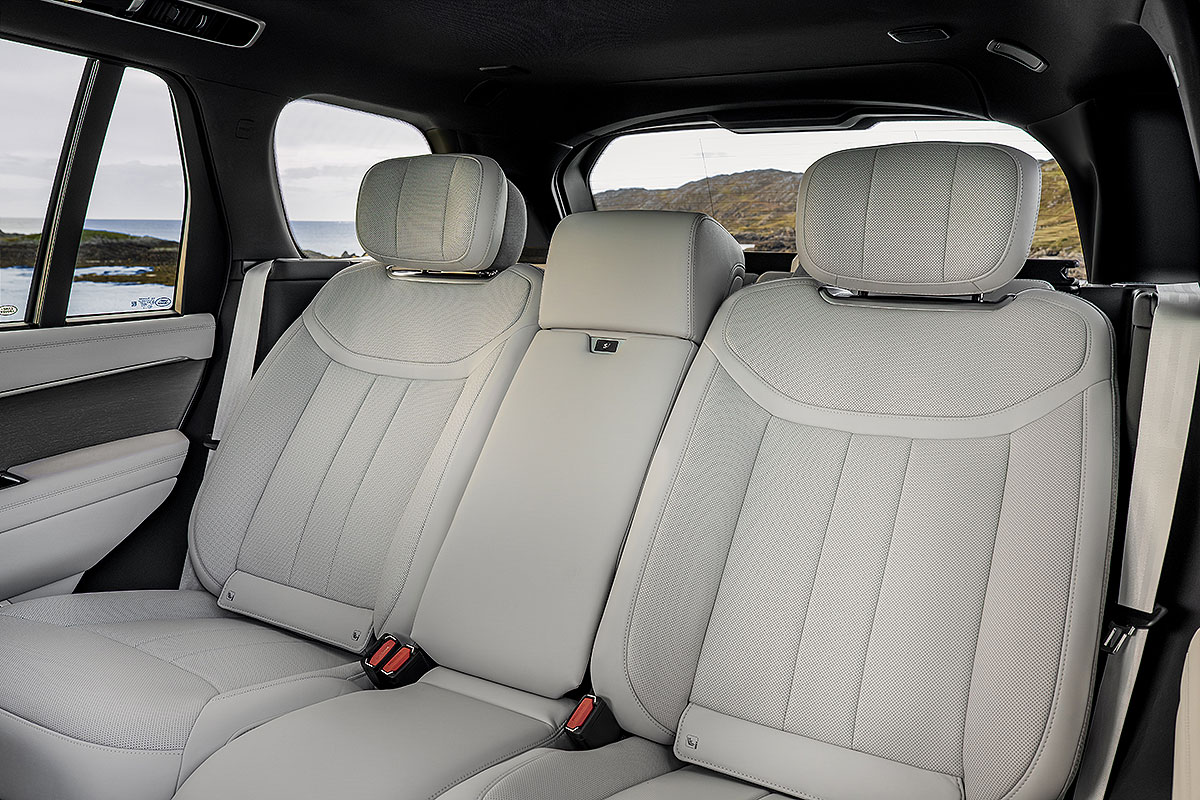
The Range Rover wraps around you a little more than you’d expect from such a large car, but this helps make it easy to drive. The rear seats offer plentiful space, and if you want even more rear legroom, pick the long-wheelbase version. Three seats are standard in the rear, with long-wheelbase SV versions having two captain’s chairs that offer as much indulgent adjustment as those in front. You can’t, however, get a seven-seat Range Rover Electric, as the space is taken up by some underfloor electric componentry.
The classic Range Rover split tailgate is present and correct. The upper section hinges upwards, with the lower section folding downwards to provide a handy seat (you can set the stereo to only play through the rear speakers, bringing immersive audio to your tailgate picnic). It’s all done electrically, of course. The Range Rover Electric has a huge 733-litre load capacity; that’s a little bit smaller than some ICE versions, due to that electrical hardware, but still massive. Fold the rear seats and it expands to 1,753 litres.
The Range Rover Electric does not have a frunk. JLR boasts this is a selling point rather than a negative – proof of its “clever packaging”. It also points to surveys that show few EV owners currently utilise their front boots, certainly not in large luxury vehicles such as the Range Rover Electric. They'd rather use the conventional boot – access to which can be made easier by lowering the rear air suspension at the press of a button.
The Range Rover Electric has a beautiful interior. Everything you touch feels soft and of luxury-grade quality. This is enhanced in First Edition models, which have a new Light Cloud Ultrafabrics PU and Kvadrat interior; plush, sustainable and gorgeous. If your wallet is deep enough, it’s endlessly customisable. The Range Rover Electric also has an in-car fragrance system to scent the ultra-clen and fully-purified cabin air.
However, as mentioned, it’s decidedly minimalist in terms of controls. A few years back, the designers chose to get rid of the physical climate control panel, meaning everything is now adjusted through the touchscreen. This is fiddlier than it should be, and adjusting the seat temperature is even more so. If you’re doing it on the move, the merest stray swipe will have the climate control accidentally fully blasting on max cooling; in this regard, it’s not very ‘luxury’. Such buyers prefer tactile clicks of a cool metal control, not the artificial haptic vibration of a packed touchscreen.
Driving
What's it like to drive?
The Range Rover Electric will woo you from the moment you select drive and pull away. Already enveloped in silence as you let the soft-close doors whirr shut, there’s no additional vibration, whirr, noise or other disturbances as you begin your journey. The biggest disturbance will be the crunch of your gravel driveway beneath the tyres.
This is an incredibly refined car. JLR’s figures put it a full 7dB quieter than a petrol V8 which, given how noise is logarithmic, makes the Range Rover Electric a staggering 80% quieter than a petrol version. The peace continues as speeds rise too, with little tyre noise, air suspension that operates quietly over even the most challenging roads, and wind noise that’s impressively subdued at motorway speeds and beyond.
Then there’s the sheer comfort. An air-suspended Range Rover has long been a smooth, serene drive, and the Range Rover Electris is no exception. It is remarkably cushioned and smooth over bumps, taking the harsh edge off even the nastiest-looking surfaces. You can thunder along challenging roads in serene isolation, the suspension doing all the hard work to keep you comfortable. Tireless tweaks to the car's suspension ensure the Range Rover Electric is flatter, more settled and composed than ever, even when you’re stomping hard on the accelerator or charging along undulating B-roads.
The pay-off is handling that’s softer than a more sporting SUV such as the Porsche Cayenne Electric. The Range Rover Electric’s slower steering perhaps highlights the fact this is a machine built for wafting, but while it doesn’t exactly wallow into corners, it doesn’t have the control of its sportier sister car, the Range Rover Sport Electric, either. Instead of hustling it and feel it wallow, best sit back, make use of the steering’s impressive precision and drive it intelligently with your fingertips.
The EV550 model produces 542bhp, and serves up 0-62mph acceleration in 4.5 seconds. JLR says this makes it a match for the V8 models – and with plenty of instantly-available pulling power, the perception is that it’s even quicker, and certainly more fuss-free. The lack of engine roar, or automatic gearchanges, makes it feel effortlessly seamless – and, fair warning, can often conceal just how quickly you’re travelling. Best to make good use of that standard speed limit warning bleeper…
Traction is superb. The Range Rover Electric can adjust power output of the electric motors in an eyeblink, which means it can manage slip up to 100 times faster than a petrol model. On the road, this gives it the feeling of absolute traction and supreme confidence; off-road, it makes light work of surfaces you can barely even walk across. Oh, and it can still wade through water up to 900mm deep, which was demonstrated by driving through a Loch.
The Range Rover Electric’s one-pedal drive mode is, for those who like it, nice and seamless. It even has a soft-stop ‘chauffeur’ trick, whereby it comes to a near-imperceptible halt rather than grabbing on the brakes. Off-road electronic drive modes are similarly sophisticated, making it an effortless go-anywhere, all-weather machine.
The Range Rover Electric is a large machine, but precise steering and its excellent visibility help make it manageable. An arsenal of cameras come to your aid too, both regular parking cameras and Land Rover’s clever off-road cameras that help you precisely place the wheels even when you can’t actually see where you’re going. If you’re driving with people in the back, the ‘ClearSight’ interior mirror allows you to switch to a camera display too, although I struggled to get along with it.
It’s worth mentioning battery performance, because JLR’s real-world claims seem to stack up. I didn’t see the official 372-mile range displayed on a fully-charged example in an autumnal Scotland during the car’s launch – but I did see several examples of the engineers’ claimed 330-mile real-world range. Indeed, after a day’s high-speed driving and intensive slow-speed off-roading, the battery was still showing 160 miles with 50% charge. Most owners, adds the firm, will have off-street parking to charge their Range Rover Electric overnight – and the firm has even worked with upmarket EV charger firm Andersen to launch a bespoke Range Rover Electric charging unit.
Tech and equipment
Technology, equipment & infotainment
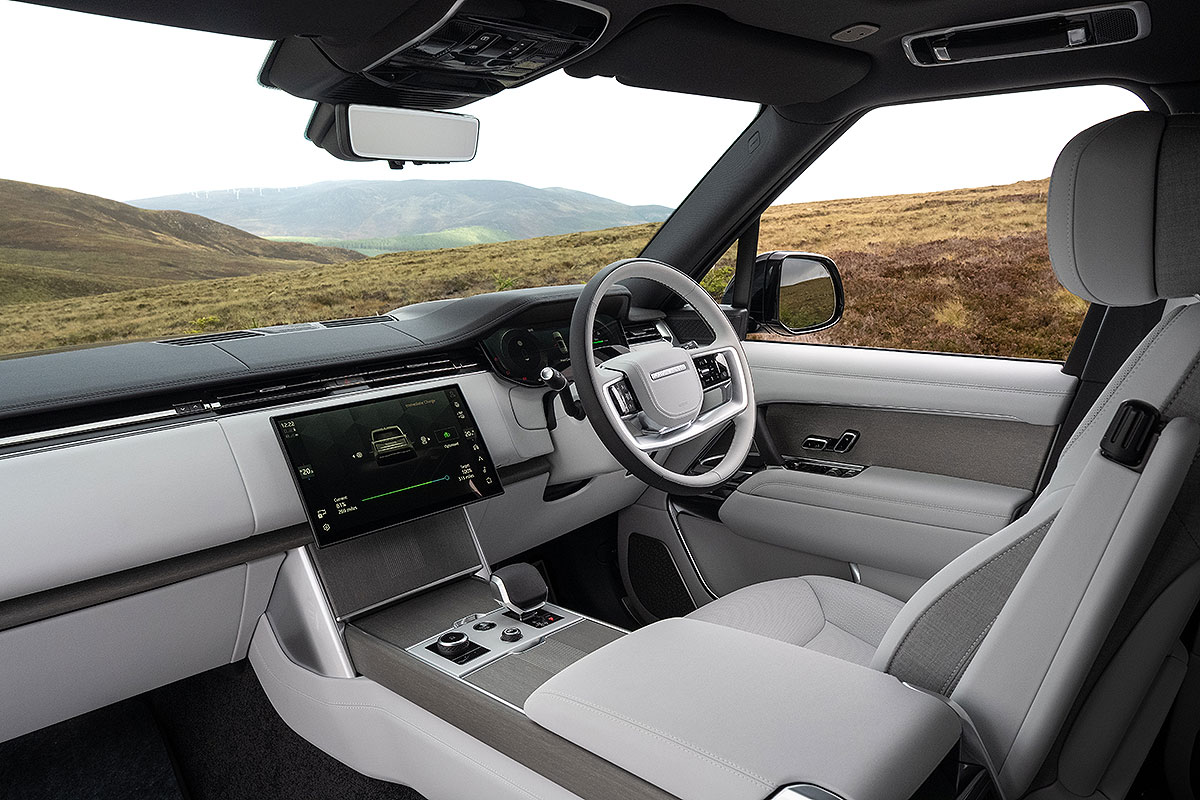
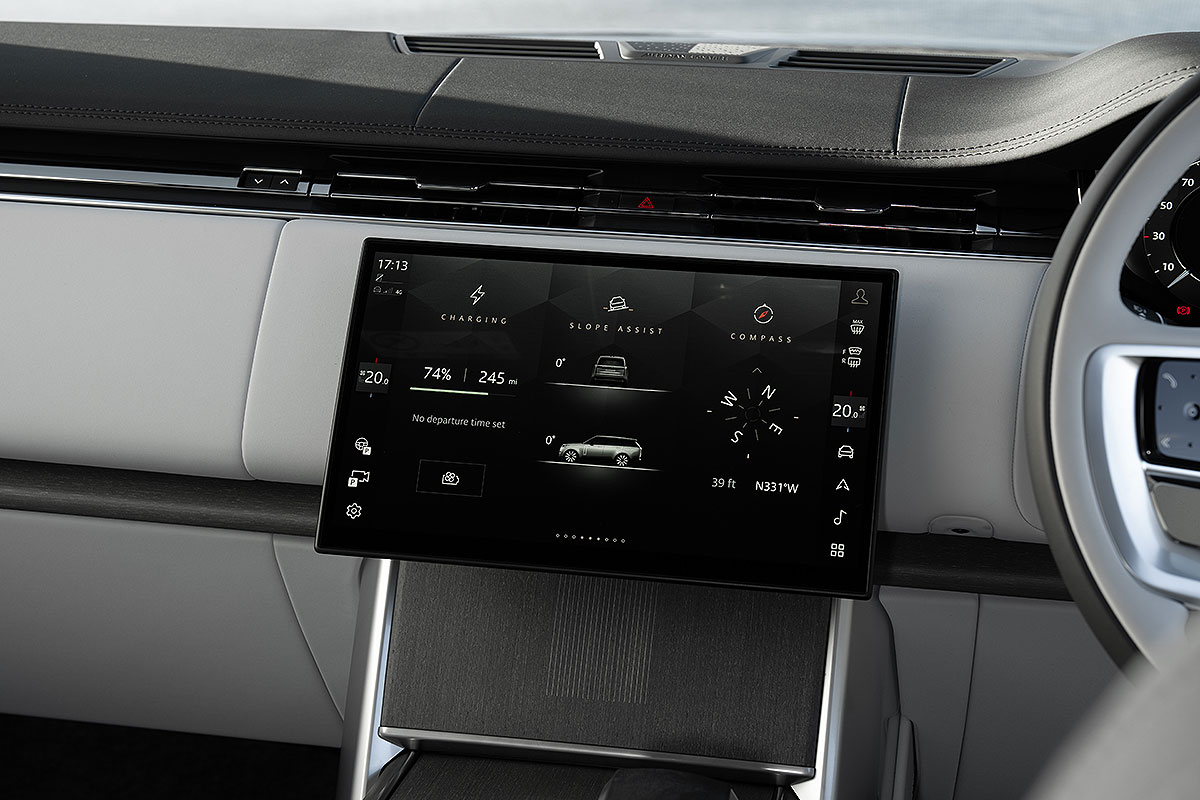
The Range Rover Electric uses the same Pivi Pro infotainment tech as other models. This excellent system uses a 13.1-inch curved touchscreen in the centre of the dash, with a supplementary colour driver’s display. It has excellent graphics and looks beautiful, and is apparently backed up by AI-driven conversational voice assistance, aided by Alexa.
Removing the physical heater controls has made it a little over-burdened, though. The engineers claim 80% of tasks can be performed with just two taps of the screen, but having to fiddle with sliding controls in the sidebars for climate and stereo volume is a step too far, and spoils the system’s clarity.
Wireless Apple CarPlay and Android Auto are standard, meaning phones can be tucked away out of sight on the wireless charging device, without the need for cables. It’s a shame the wireless charging speed is a mere 15W though.
Being the Range Rover Electric, there is a dedicated app page on the infotainment system to manage charging and other EV essentials. There’s a Range Rover charging app too; the account allows seamless payment with chargers the world over, often at reduced rates if you take out a subscription. Meanwhile, the satnav factors in charging stops on long trips, and even lets you be routed only via ultra-rapid chargers, minimising the time stopped.
EV charging tech is advanced, too. An 800-volt architecture allows the giant 118.5kWh battery to charge from 10-80% in just 22 minutes – that’s at speeds of up to 325kW. It has clever split-charging tech, so can switch into 400-volt mode and make use of older rapid chargers too. The double-stack battery has been tested from -40C to +90C, and packs in plenty of patented tech to promise a long life of high performance.
You’d expect an electric Range Rover to be very well-equipped, and this one doesn’t disappoint. It’s largely the level of luxury you want as you move up through the model range, rather than adding on any essential must-haves. And at the top of the range, things get very indulgent indeed, with those long-wheelbase SV models wowing with their hot stone massage individual rear seats positioned astride an electric fold-out table, electric fold-away cupholders and even a refrigerator complete with two sturdy SV-engraved glasses.
Running costs
Range Rover Electric running costs
The Range Rover Electric is expensive to insure, of course. It’s a large, luxury SUV, with a Group 50E rating. But then, you wouldn’t expect anything else, would you? Naturally, given its heady list price, monthly finance payments are going to be steep, despite expected retained values upwards of 60%.
But the fact it is electric means that another major running expense, fuel costs, will be dramatically reduced. Instead of paying upwards of £175 to fill a tank of diesel, the right home tariff brings the potential to fully charge that massive battery for around £7. And that will see you start the day with well over 300 miles’ range, helping you avoid the need to use expensive public EV chargers.
There are even more savings if you’re a company car driver. Because it’s a zero-emissions EV, Benefit-in-Kind is fixed at just 4% for the 2026-27 tax year. OK, that’s still based on a very high list price, but it remains a huge saving over a comparable diesel, never mind a mild hybrid petrol.
There’s the potential for cheaper servicing costs, too. With no engine oil to change, or spark plugs to renew, there might be running costs savings here too, although, given how this remains a luxury SUV, this may be relative.
Range Rover Electric reliability
Land Rover models overall don’t have the best reputation for reliability. Indeed, in the latest What Car? Reliability Survey, the brand was placed plumb last, 30th out of 30. It has a reliability rating of just 84.9%.
However, the detail reveals a different picture. It is unreliable Range Rover Evoque and Land Rover Discovery Sport models that pull down the overall rating. This latest generation of Range Rover is actually pretty reliable, scoring third place in the luxury SUV category with a reliability rating of 93.8%. And the model that topped the category? Why, the Range Rover’s sister car, the Range Rover Sport.
As the Range Rover Electric is theoretically a more straightforward car, with less mechanical componentry to go wrong, there’s the potential for it to be even more reliable still. After all, JLR has proven it on an exhaustive four-year test schedule, covering over 900,000 miles, and 250,000 hours of physical and virtual testing. The aim is for this to be the most reliable Range Rover ever.


What owners say
Three things to know
- There’s no frunk. Instead, space is used for JLR’s clever ThermAssist tech. This is like a heat pump on steroids. It is an intelligent thermal management system that reduces cabin heating energy consumption by 40%, and can add up to 25 miles of extra driving range by optimising thermal and battery efficiency. The firm is rather proud of the much-patented tech.
- The Range Rover Electric uses expensive dual-rate springs to stop the rear end pitching down under acceleration. As this is an effect that can be magnified by the instant toque of an EV, the engineers chose instead to minimise it, to create a more refined and even-keel driving experience.
- You can get a Range Rover Electric in either standard or long wheelbase guise, but you can’t get one with seven seats. That’s due to the space taken up by the battery and the various other electric drive gubbins.
Which one to buy
- If you want the most affordable: The Range Rover Electric SE is the one with the lowest list price, albeit still around £120,000. Not that JLR expects to sell that many, we were told; most reservations at the car's launch are for Autobiography and First Edition versions.
- If you want the rarest: The Range Rover First Edition will only be available for the first model year. If you have one eye on future collectability, this one is worth a look – you also get the added benefit of unique extra goodies.
- If you want the longest range: They’re all much of a muchness, with both EV450 and EV550 delivering around 330 miles in the real world. This means you can choose to your heart’s content, safe in the knowledge one particular version won’t be delivering significantly more miles per charge than another.
- If you want the ultimate indulgence: The Range Rover Electric LWB SV Black is a lavish limo whose two armchair-like rear seats offer hot stone massages at the press of a button. Yours for a cool £225k.

